The Supreme Court of India recently shared a transformative vision. This vision impacts the nation’s real estate sector significantly. In a landmark observation, the court advocated for digitizing land records using blockchain technology.
Specifically, the court wants to end the “traumatic” experience of property disputes. Currently, property litigation clogs our judicial system. Therefore, moving toward an immutable digital ledger could revolutionize how we handle titles.
The Supreme Court’s Vision for Digital Land Governance
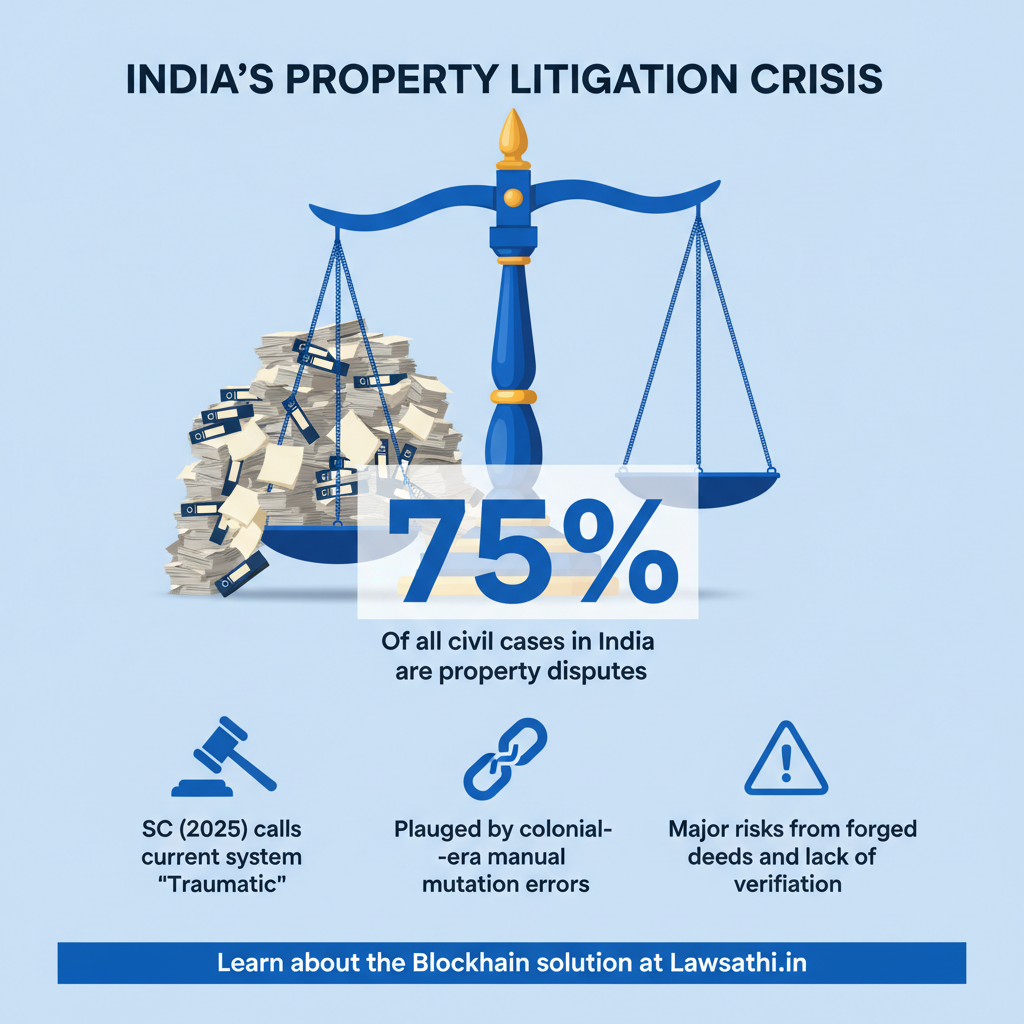
For decades, Indian courts have struggled with “colonial-ea” property laws. In the recent case of Samiullah v. State of Bihar (2025), the bench highlighted a major crisis. Specifically, Justices P.S. Narasimha and Joymalya Bagchi noted a startling statistic. They observed that property disputes account for nearly 60% to 75% of all civil cases.
Moving Toward Modern Technology
Consequently, the Court suggested that the government must adopt modern technology. They proposed a system where every transaction is recorded on a blockchain. This would create a “tamper-proof” history of ownership. As a result, the judiciary could finally clear the massive backlog of land-related lawsuits.
Understanding Blockchain: Why the Supreme Court Prefers ‘Tamper-Proof’ Tech
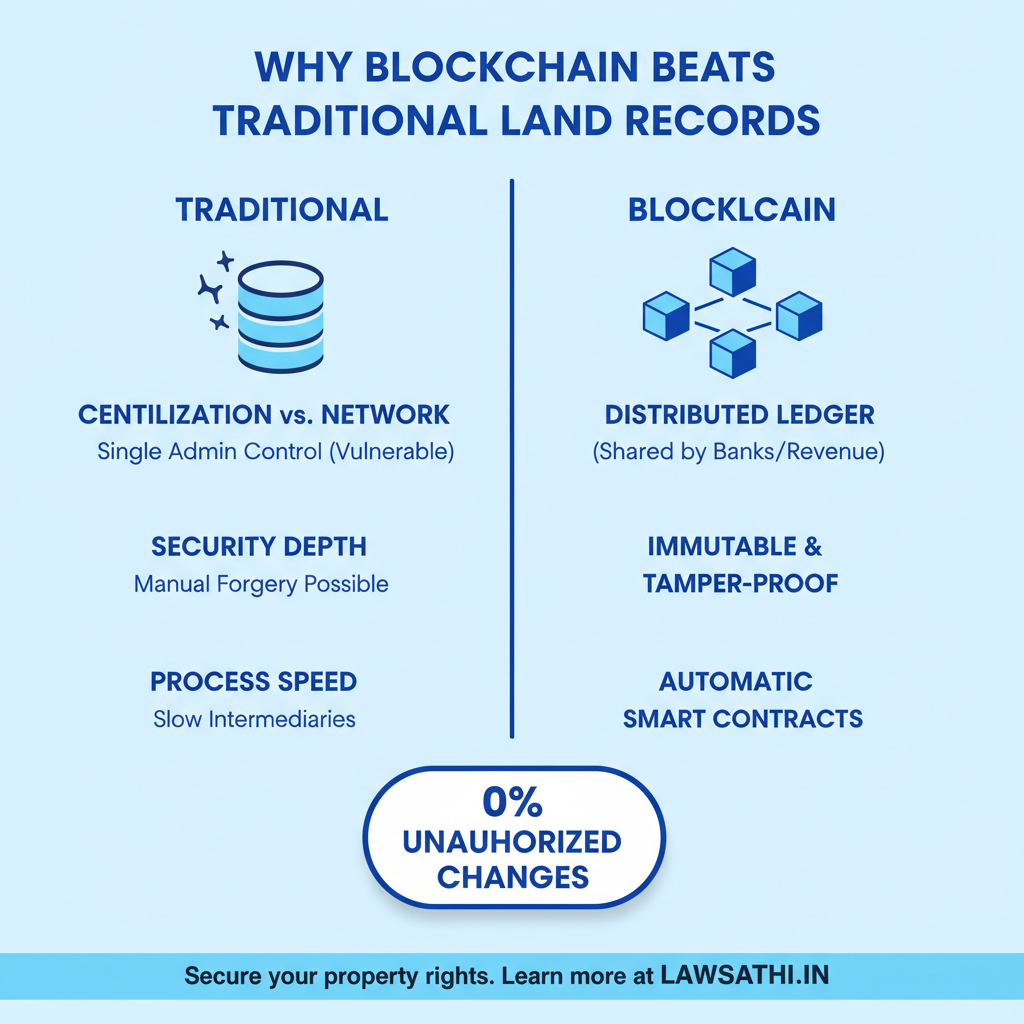
Most people confuse standard digitization with blockchain. However, there is a fundamental difference between a PDF in a database and a distributed ledger. In a standard database, an administrator can change or delete entries.
In contrast, blockchain records are immutable. If someone tries to alter a record, the entire network rejects the change. Therefore, this technology offers a higher level of security than traditional digital files.
How Blockchain Differs from Current Databases
Traditional systems are centralized at the Tehsil or State level. This makes them vulnerable to manual “mutation” errors. Moreover, corrupt officials can sometimes forge backdated entries in physical registers.
Blockchain uses Distributed Ledger Technology (DLT). This means the Revenue Department, Registration Department, and Banks all hold a copy of the same data.
The Power of Smart Contracts
Furthermore, this technology introduces the concept of “Smart Contracts.” For example, a property transfer could trigger automatically once the buyer pays the stamp duty. This removes the need for multiple intermediaries.
Most importantly, it ensures that a seller cannot sell the same plot to two different buyers. Consequently, the entire process becomes much more transparent for everyone involved.
Evaluating the Current Landscape of Indian Land Records
Digital transformation is already underway. Most of this work happens through the Digital India Land Records Modernization Programme (DILRMP). According to the Ministry of Rural Development, 95% of Records of Rights (RoR) are now computerized. Additionally, over 29 States have implemented the “Bhu-Aadhar” or Unique Land Parcel Identification Number (ULPIN).
Addressing Common Types of Land Fraud
In fact, despite these updates, fraud remains common. The Supreme Court cited instances where sales are registered without verifying the Jamabandi (possession records). Consequently, forged sale deeds still find their way into the system.
Digitizing land records using blockchain would solve this. Specifically, it links every deed to a unique, verified hash value. This prevents criminals from placing fake documents into the chain of title.
Key Benefits for Legal Practitioners and Law Firms
For lawyers, the move to blockchain simplifies the entire due diligence process. Currently, verifying a 30-year title history requires manual inspection of physical registers. This process is slow and often unreliable.
However, a blockchain-based system allows for instant, verifiable title searches. This saves time and reduces the risk of professional liability for firms. As a result, lawyers can focus on higher-level legal strategy.
Blockchain Records as Admissible Evidence
The legal weight of digital records has increased significantly. Under the Bhartiya Sakshya Adhiniyam, 2023, electronic records are now “Primary Evidence.” Specifically, Sections 57 and 61 treat digital data on par with original paper documents.
Proving Document Authenticity
Furthermore, Section 63 of the BSA requires a certificate to prove digital records haven’t been altered. Blockchain naturally provides these “Hash Values” (SHA256). Therefore, lawyers can prove the “chain of custody” with scientific certainty.
This will drastically reduce the cross-examination time. Specifically, it eliminates arguments regarding the authenticity of documents in court. Consequently, legal proceedings may become much faster.
Challenges in Implementation: From Policy to Ground Reality
Transitioning to this technology is not without hurdles. First, rural Tehsils often lack the high-speed internet required for real-time blockchain sync. Second, the government must bridge the gap between “legal title” and “physical possession.”
Digital records show who owns the land on paper. However, they don’t always show who actually sits on it. Therefore, on-ground verification remains a critical necessity.
Data Privacy and the DPDP Act
Additionally, the Digital Personal Data Protection (DPDP) Act, 2023 adds another layer of complexity. The government acts as a “data fiduciary” for land records. They must ensure transparency while protecting the owner’s privacy.
Moreover, balancing these needs requires a robust legal framework. Engineers and legal experts must work together. Specifically, they must ensure the system is both open and secure at the same time.
The Future of Indian Property Law: Conclusive Titling
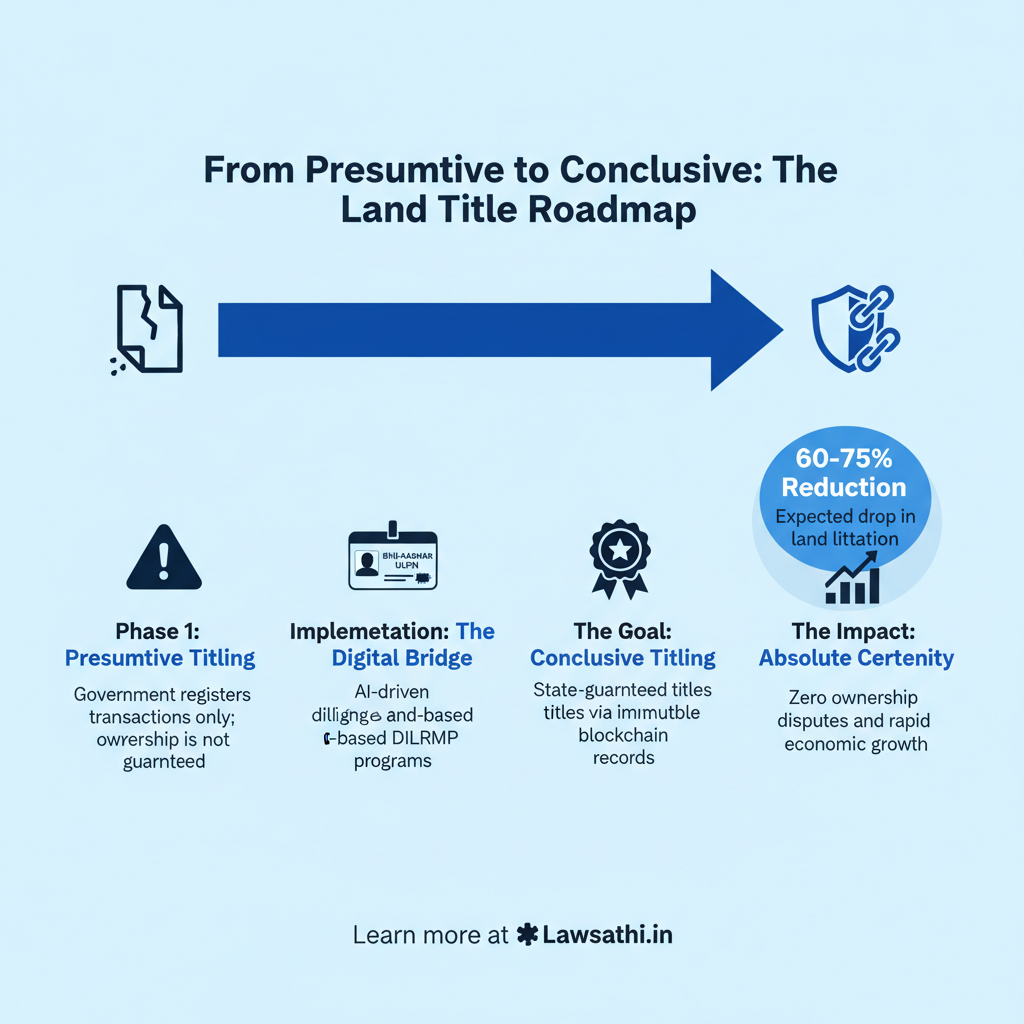
The ultimate goal of digitizing land records using blockchain is moving to “Conclusive Titling.” Currently, India follows “Presumptive Titling.” This means the government only registers the transaction, not the actual ownership.
As a result, if the seller’s title is flawed, the buyer suffers the loss. This creates significant financial risk for Indian citizens.
Protecting Property Buyers
In a Conclusive Titling regime, the state guarantees the title. If the blockchain shows you are the owner, your right is absolute. Moreover, we are seeing the rise of AI-driven due diligence tools.
These tools scan blockchain histories to flag encumbrances in seconds. Furthermore, legal practitioners must upskill to understand these distributed ledgers and AI integrations. Specifically, staying updated is the only way to remain competitive.
Summary: Embracing a Transparent Legal Ecosystem
The Supreme Court’s push for blockchain is a visionary step. It promises to transform Indian property law. Instead of a source of conflict, it can become an engine of economic growth.
By removing the possibility of tampering, we can protect buyers. Similarly, we can reduce the burden on our judges. For example, Haryana’s faceless registration system has already shown how technology improves efficiency.
Conclusion and Next Steps
In conclusion, the synergy between law and emerging technology is inevitable. While challenges exist, the benefits of a secure, transparent, and digital system are far greater. Indian law firms must prepare for this shift. This will help them remain relevant in a tech-driven judiciary.
Stay ahead of the legal curve. As the Indian judiciary embraces blockchain and digitization, ensure your practice is powered by the best-in-class legal AI. Discover how LawSathi can streamline your case management today.