Introduction: Supreme Court’s Significant Week
The Supreme Court weekly round-up February 2026 brings critical developments across criminal law, arbitration, and land acquisition. Between February 9-15, 2026, the apex court delivered several consequential rulings. These judgments will shape legal practice in India significantly.
The week’s headline-making order came in the Unnao custodial death case. Specifically, the Court refused bail to accused police officers. Additionally, significant clarifications on arbitration law under Section 11 marked this judicially active week. Furthermore, landmark rulings on the Limitation Act in land acquisition matters emerged.
For practicing lawyers, this Supreme Court weekly round-up February 2026 offers essential precedent updates. Each ruling carries practical implications for criminal defense. Moreover, commercial litigation and property law practitioners will find valuable guidance.
Unnao Custodial Death Case: Supreme Court Refuses Bail to Accused Police Officers
Case Background and Proceedings
The Supreme Court’s stern stance on custodial violence echoed through its refusal to grant bail in the Unnao custodial death case. The matter involves the death of a Dalit youth in police custody in Unnao, Uttar Pradesh. This incident occurred during 2024.
The accused police personnel sought bail citing their long incarceration. Furthermore, they claimed lack of direct evidence. However, the Court rejected these submissions emphatically.
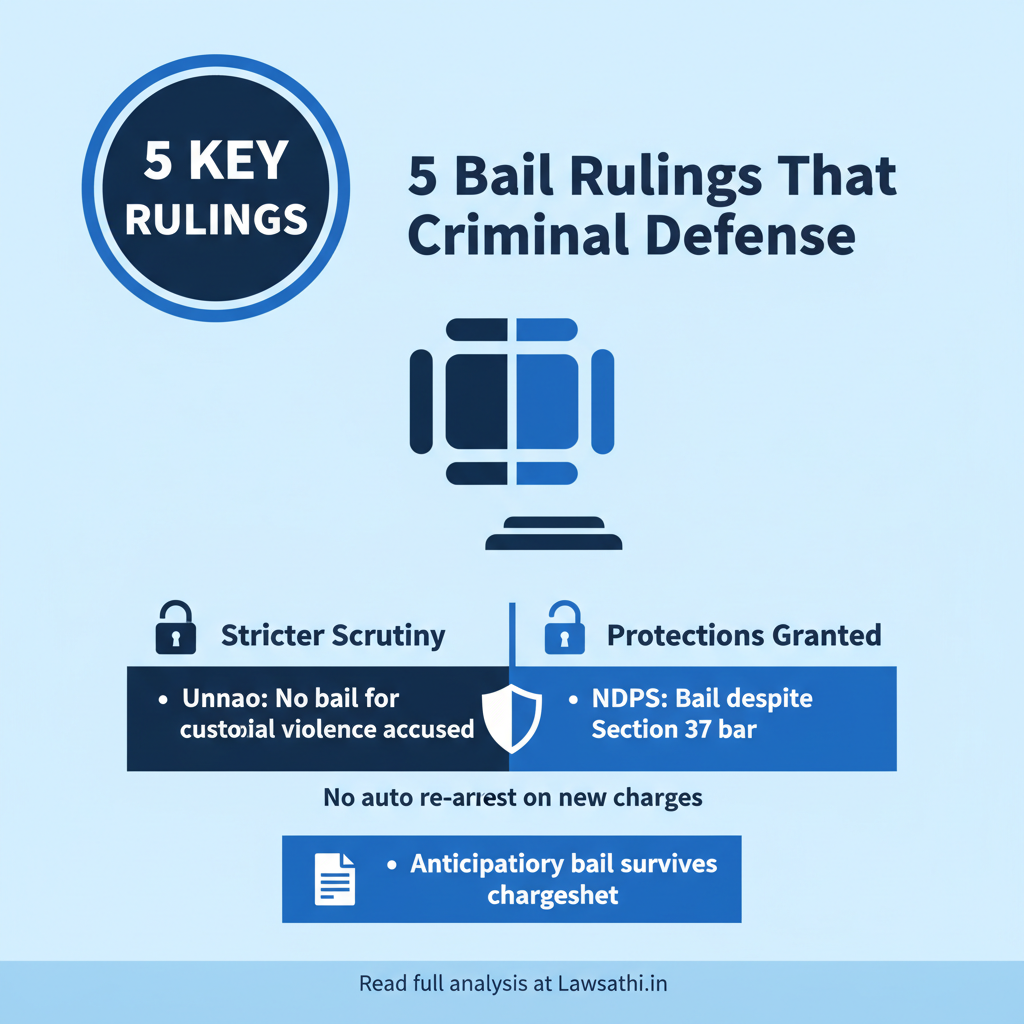
It noted that custodial death cases require a different threshold for bail consideration. The Court emphasized a crucial principle. Those entrusted with law enforcement must face stricter scrutiny. This applies when they are accused of violating the very rights they swear to protect.
Court’s Reasoning on Bail Denial
Under Section 439 CrPC, the Court examined whether the accused deserved the discretion of bail. The bench observed that granting bail in custodial death cases would send a troubling message. Consequently, it would undermine public confidence in the criminal justice system.
The Court referenced the landmark DK Basu guidelines on custodial violence protections. Furthermore, it cited the Lalita Kumari case regarding mandatory registration of FIRs. These precedents established the heightened accountability expected from police personnel.
Implications for Police Accountability
This ruling reinforces an important principle. Law enforcement officers cannot claim ordinary bail considerations. Therefore, the Court’s observations will guide lower courts across India in similar cases.
Criminal practitioners defending police officers must now prepare for heightened judicial scrutiny. This applies specifically to custodial violence matters.
Bail Jurisprudence: Key Clarifications on Re-Arrest Powers
Landmark Ruling in Sumit v. State of UP
In a significant criminal law development, the Supreme Court addressed a crucial question. Can accused persons be automatically re-arrested when new offences are added post-bail? The case of Sumit v. State of UP settled this matter.
The bench of Justices JB Pardiwala and KV Viswanathan delivered the judgment on February 12, 2026. They held that investigating agencies cannot unilaterally arrest an accused. This applies merely because additional cognizable offences appear in the charge sheet.
Protection for Accused on Bail
The Court established clear procedural safeguards. First, the accused can surrender and apply for fresh bail. This applies to the newly added offences. Alternatively, the investigating agency must approach the court that granted bail.
The agency can seek orders under Sections 437(5) or 439(2) CrPC for bail cancellation. Only then can the accused be taken into custody. As a result, this prevents arbitrary re-arrest without judicial oversight.
Practical Guidance for Criminal Practitioners
Lawyers must advise clients that bail grants them limited protection. However, this protection is not absolute. Therefore, if new serious offences emerge, proactive legal strategy becomes essential.
The Court cited Sushila Aggarwal v. State (NCT of Delhi). This established that anticipatory bail continues without fixed expiry. Filing of charge sheet alone doesn’t terminate protection unless courts record special reasons.
Arbitration Law: Section 11 Appointment Powers Clarified
The Ankhim Holdings v. Zaveri Constructions Ruling
Commercial litigation practitioners received important clarity through Ankhim Holdings v. Zaveri Constructions. The Supreme Court delivered this judgment on February 10-11, 2026.
The dispute involved a partnership firm, M/s Anmol Alliance. This firm was formed for an SRA project in Andheri (West). After disputes arose, arbitration proceedings commenced. However, the sole arbitrator terminated proceedings in October 2023 citing fee payment issues.
The Bombay High Court appointed a substitute arbitrator. Crucially, it also declared earlier proceedings a nullity. Consequently, this portion of the order faced Supreme Court scrutiny.
High Courts Cannot Nullify Proceedings
The Supreme Court held that High Courts exceeded their limited jurisdiction under Section 15(2). The statute envisages minimal judicial intervention in arbitration matters. Therefore, courts cannot assume powers not conferred by the Arbitration and Conciliation Act, 1996.
Section 15(2) must be read alongside Section 15(3) regarding continuity of proceedings. Moreover, Section 15(4) explicitly protects prior orders of arbitral tribunals. The High Court effectively set aside orders under Sections 16 and 17. However, it failed to follow the appellate mechanism under Section 37.
Impact on Arbitration Practice
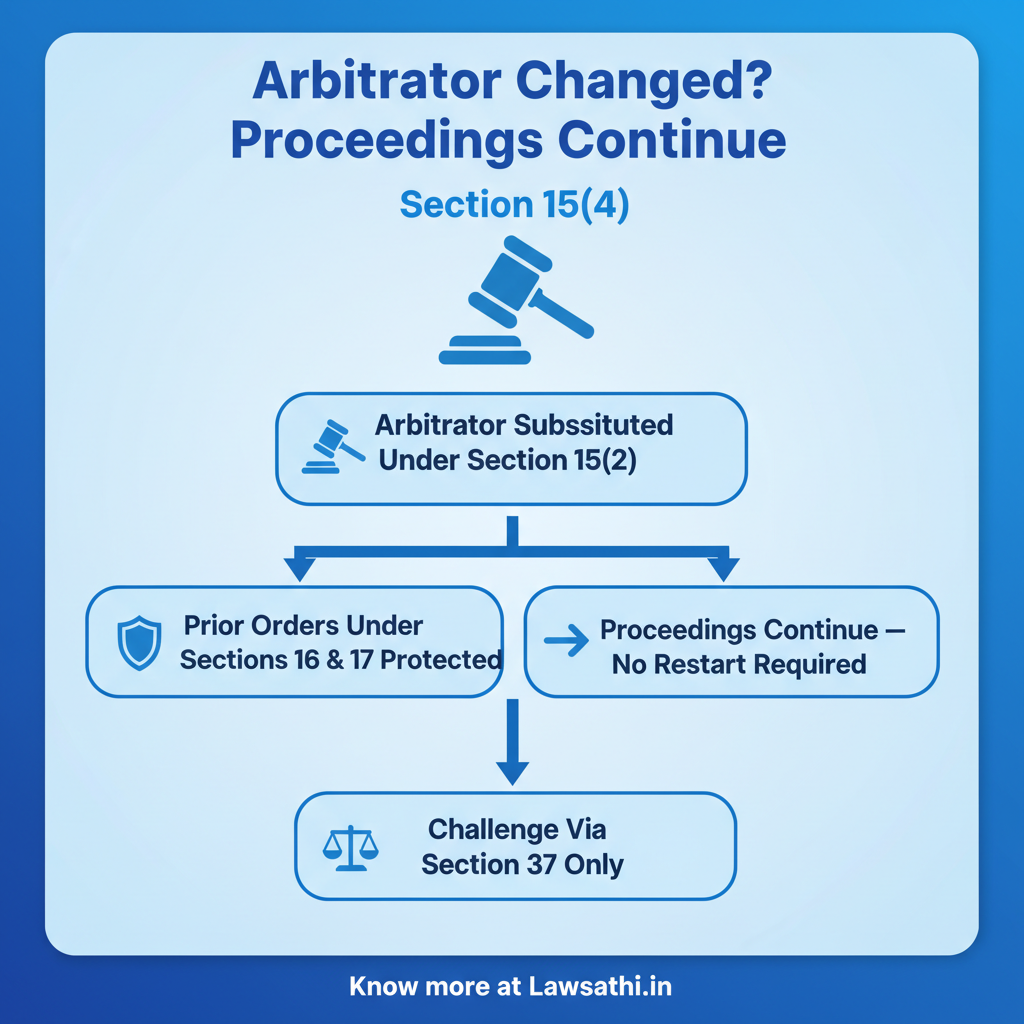
This ruling preserves the continuity principle central to arbitration efficiency. Prior orders and interim measures remain valid despite arbitrator substitution. As a result, parties need not restart arbitration from scratch.
For commercial lawyers, this provides crucial precedent when challenging High Court orders. The judgment reinforces legislative intent for minimal judicial interference in arbitral proceedings.
NDPS Act: Bail Despite Section 37 Restrictions
Grant of Bail in Wajid Ali Case
The Supreme Court granted bail in Wajid Ali @Tinku v. State of Rajasthan despite stringent Section 37 requirements. The bench of Justice Pankaj Mithal and Justice SVN Bhatti delivered this order on February 9, 2026.
The accused remained in custody for over two years and ten months. Furthermore, the Court noted an unexplained delay of 21 days. This delay occurred in sending samples to the Forensic Science Laboratory. Most material witnesses had already been examined.
Overcoming Section 37 Rigours
Section 37 of the NDPS Act imposes strict conditions for bail in drug-related cases. However, the Court recognized that procedural delays can justify bail even under restrictive provisions. Therefore, long incarceration and trial delays constitute valid grounds.
The judgment aligns with earlier precedent. Specifically, the Court held that Section 37 cannot be interpreted literally to render bail impossible. Constitutional protection under Article 21 remains paramount.
Bail Conditions Cannot Include Monetary Deposits
In another significant ruling, the Supreme Court reiterated an important principle. Bail cannot be conditioned on monetary deposits. The case of Prantik Kumar v. State of Jharkhand addressed conditional bail orders passed by the Jharkhand High Court.
The Court set aside conditions requiring deposit of money for bail grant. Consequently, this provides important precedent for criminal defense lawyers challenging onerous bail conditions.
Land Acquisition: Limitation Act Applicability Clarified
Major Ruling on RFCTLARR Act Interpretation
The Supreme Court delivered a landmark judgment in Deputy Commissioner v. M/s S.V. Global Mill Limited on February 9, 2026. Justice M.M. Sundresh and Justice Satish Chandra Sharma authored this reportable judgment (2026 INSC 138).
The case addressed the interplay between two statutes. Specifically, the old Land Acquisition Act, 1894 and the new RFCTLARR Act, 2013. It examined limitation periods for appeals under Section 74 of the 2013 Act.
Key Conclusions from the Judgment

The Court held that Section 5 of the Limitation Act, 1963 applies to appeals under Section 74. Therefore, High Courts must adopt a pragmatic approach rather than pedantic procedure in delay condonation applications.
All applications for condonation of delay stand allowed under this ruling. First appeals before High Courts will be treated under Section 74 of the 2013 Act. In contrast, Section 54 of the 1894 Act will not apply.
Practical Significance for Property Law Practitioners
This judgment provides major relief for landowners whose appeals were rejected on limitation grounds. Lawyers handling land acquisition matters must cite this precedent. This applies when challenging limitation-based rejections.
The ruling clarifies that Section 24(1)(a) of the 2013 Act applies where awards passed after the commencement of the new legislation. For passing awards, provisions of the 2013 Act alone apply. However, rehabilitation and resettlement aspects remain exceptions.
Anticipatory Bail: No Automatic Termination on Chargesheet
Clarifying Sushila Aggarwal Precedent
The Supreme Court reaffirmed that anticipatory bail protection ordinarily continues without fixed time limits. The recent ruling clarified a key point. Filing of chargesheet does not automatically terminate anticipatory bail.
Courts cannot restrict anticipatory bail till filing of chargesheet as a routine measure. Therefore, special reasons must be recorded for imposing such limitations. This provides important guidance for courts exercising jurisdiction under Section 438 CrPC.
Impact on Pre-Arrest Bail Practice
Criminal defense practitioners can rely on this clarification. It helps when opposing conditions that limit anticipatory bail duration. The protection continues unless courts specifically cancel it following due process.
Notable Orders and Admissions During the Week
PIL Admissions and Government Notices
The Supreme Court admitted several significant PILs during the week. On February 10, 2026, the Court quashed SC/ST Act charges against Vyapam whistleblower Dr. Anand Rai. Additionally, notice was issued to the Centre and Tamil Nadu Government. This concerned a plea seeking CBI probe into an alleged Ponzi scam.
The Court also expressed reservations about a Constitution Bench judgment. Specifically, regarding compensation for loss of love and affection. These observations may trigger future review proceedings.
Digital Arrest Concerns and Regulatory Response
The Ministry of Home Affairs proposed SOPs to address digital arrest frauds. Furthermore, the Reserve Bank of India agreed to consider staff accountability frameworks. These developments followed Supreme Court’s earlier concerns about rising digital fraud cases.
Tamil Nadu Illegal Sand Mining Matter
On February 11, 2026, the Supreme Court sought details from Tamil Nadu Government regarding FIRs in illegal sand mining cases. Chief Justice Surya Kant and Justice Joymalya Bagchi heard the matter. The case involved alleged illegal mining worth Rs. 4,730 crore.
The CJI’s observation underscored concerns about state agencies investigating their own officials. He asked: “How can cat look after the milk?”
Key Takeaways for Legal Practitioners
Criminal Law Practice Updates
This Supreme Court weekly round-up February 2026 offers several actionable insights. First, bail conditions cannot include monetary deposits. Therefore, cite the Prantik Kumar ruling. Second, anticipatory bail has no automatic expiry upon chargesheet filing.
For NDPS cases, document FSL delays and custody periods for bail arguments. Section 37 rigours can be overcome with long incarceration and delayed appeals. Additionally, re-arrest for newly added offences requires court orders. Agencies cannot act unilaterally.
Commercial and Arbitration Practice
The Ankhim Holdings judgment affirms the continuity principle in arbitration. Prior orders remain protected under Section 15(4) despite arbitrator substitution. Therefore, use Section 37 for challenging orders, not substitution proceedings.
Land Acquisition Matters
The Limitation Act applies to appeals under Section 74 of the 2013 Act. Consequently, condonation applications should be liberally considered. Courts must adopt pragmatic approaches over technical objections.
Recommended Citations for Future Filings
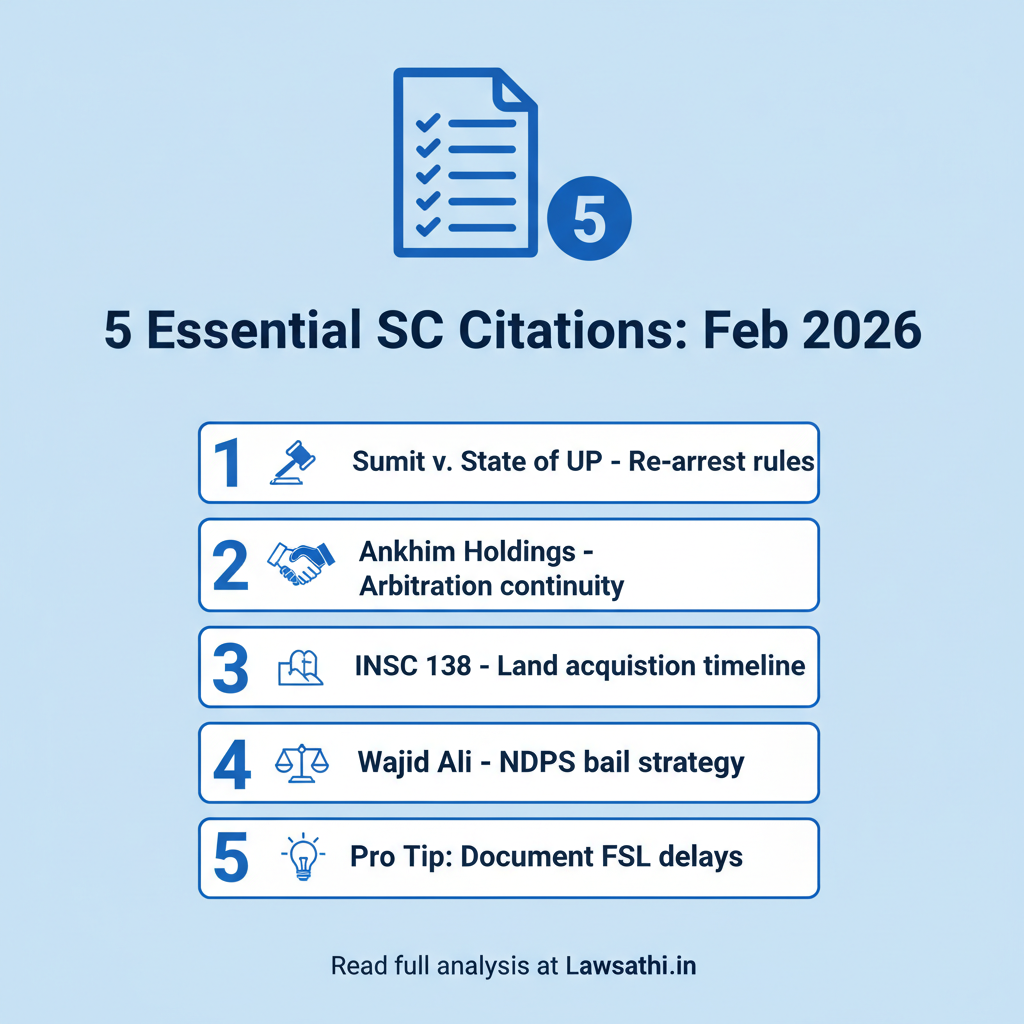
Practitioners should preserve these key citations from this Supreme Court weekly round-up February 2026:
– Sumit v. State of UP, 2026 LiveLaw (SC) 147 (re-arrest requirements) – Ankhim Holdings v. Zaveri Constructions (arbitration continuity) – 2026 INSC 138 (land acquisition limitation) – Wajid Ali @Tinku v. State of Rajasthan (NDPS bail)
Conclusion
The Supreme Court weekly round-up February 2026 demonstrates the Court’s active engagement with fundamental legal questions. From custodial death cases to arbitration reform, these judgments will shape Indian jurisprudence significantly.
For practicing lawyers, staying updated with these developments is essential. This ensures effective client representation. Moreover, the precedents established this week provide valuable tools for criminal defense, commercial litigation, and property disputes.
—
Stay ahead with real-time Supreme Court updates. LawSathi’s AI-powered legal research tool tracks judgments daily and delivers personalized alerts based on your practice areas. Start your 14-day free trial at lawsathi.com and never miss a critical ruling.