
The landscape of competitive exams in India has faced a significant legal shift recently. Specifically, a major Supreme Court reserved category relaxation ruling has clarified how candidates can migrate between categories. This decision impacts thousands of aspirants appearing for the Indian Forest Service (IFS) and Civil Services examinations.
The Core Question of Category Migration
The primary legal issue involves candidates who use age or attempt relaxations during the preliminary stage. Can they later claim a seat in the Unreserved (General) category based on their final marks?
This question has triggered intense legal debates across various High Courts for years. However, the Supreme Court has now provided a definitive answer to this complex constitutional puzzle.
Significance for Legal Practitioners
This ruling is vital for lawyers handling service matters and administrative law. Most importantly, it interprets the boundaries of Article 16(4) regarding affirmative action.
Consequently, it sets a clear precedent for how recruitment rules should be applied in multi-stage competitive examinations. Lawyers must now pay close attention to the specific language used in exam notifications.
Factual Matrix of the Indian Forest Service (IFS) Case
The case originated from a dispute involving the Union Public Service Commission (UPSC) and several candidates. These individuals applied for the IFS exam under reserved categories like OBC, SC, or ST.
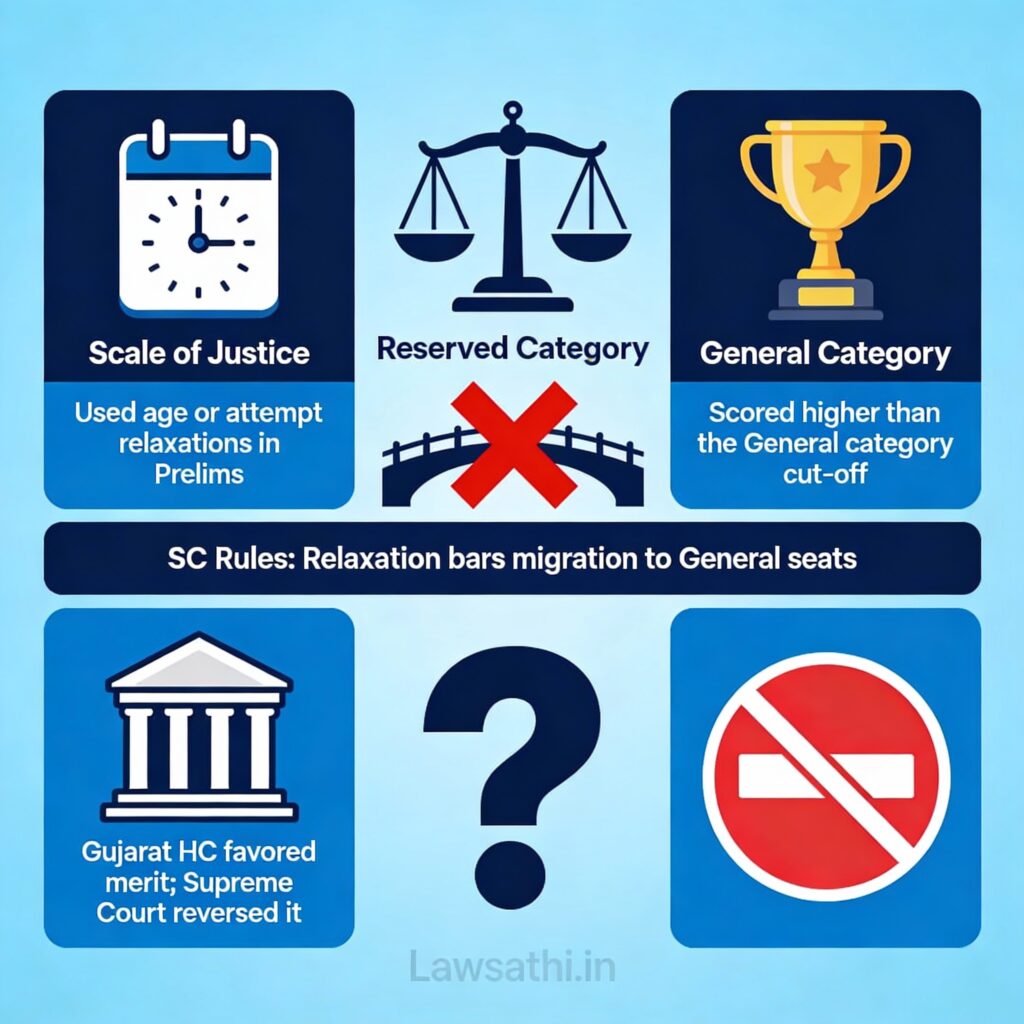
During the Preliminary stage, they availed themselves of concessions. Specifically, they used age relaxations or exceeded the number of attempts allowed for General candidates.
From High Court to the Supreme Court
The candidates performed exceptionally well in the Main examination and interview phases. In fact, their final scores were higher than the last candidate selected in the Unreserved category.
Therefore, they argued they should be moved to the General merit list. They believed their high merit entitled them to “General” status despite their initial relaxations.
The Initial Judicial Conflict
The Gujarat High Court initially favored the candidates. It ruled that merit should be the primary criterion for final selection.
However, the UPSC challenged this view in the Apex Court. According to the LiveLaw report on reservation migration, the Commission argued that relaxations at any stage create a permanent category binding.
Understanding the ‘Concessional Standard’ Doctrine
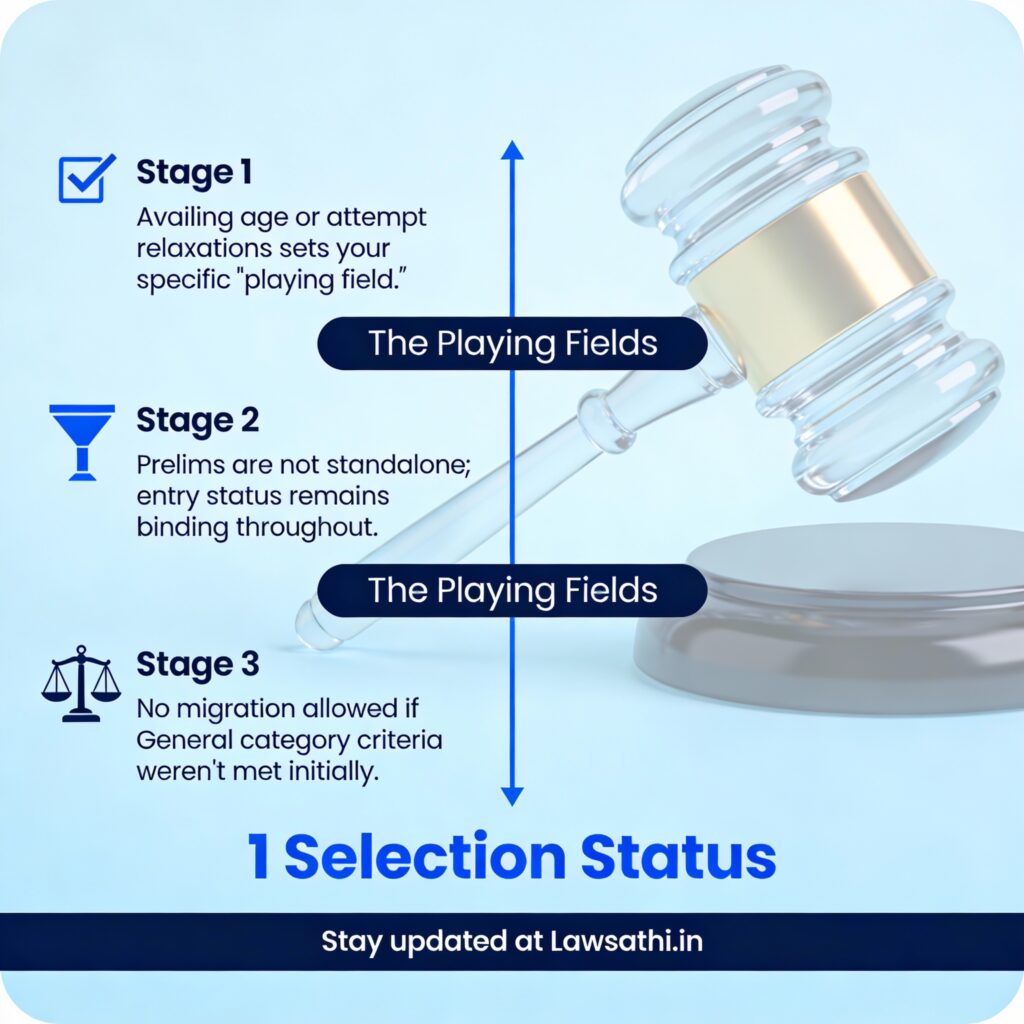
The Supreme Court emphasized the “Concessional Standard” doctrine in its judgment. This doctrine suggests that once a candidate uses a benefit, they operate on a different playing field.
For example, a candidate might only be eligible to sit for the exam because of age relaxation. In this case, they cannot later claim to be a “General” candidate.
The Level Playing Field Argument
The Court viewed the Preliminary exam as an integral screening mechanism. Even though Prelims marks do not count for the final merit list, the exam still determines eligibility.
Therefore, the Supreme Court reserved category relaxation ruling maintains that using a concession at the start changes the candidate’s status throughout the process. This ensures that all candidates in a specific category meet the same standards.
Rules 12 and 13 of the IFS Exam
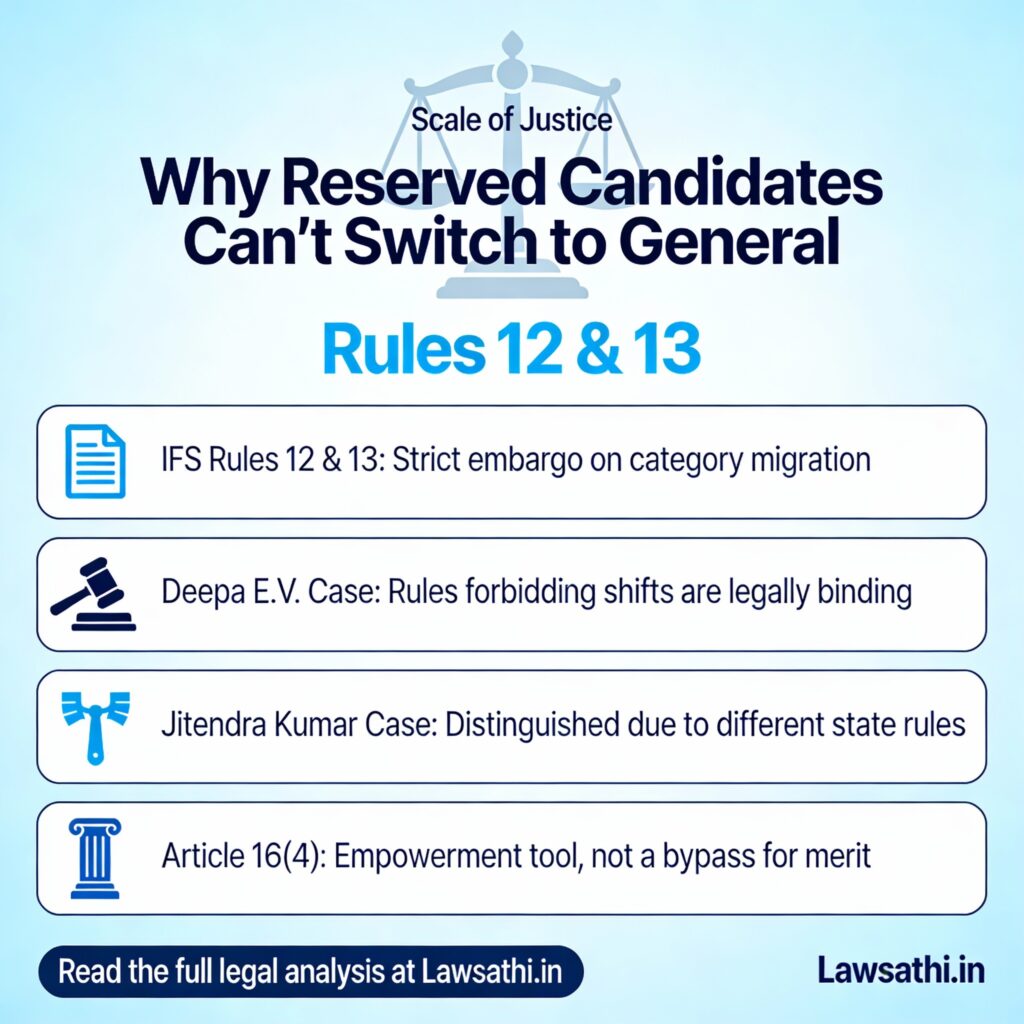
The judgment specifically referenced Rule 12 and Rule 13 of the IFS Examination Rules. These rules outline the eligibility criteria for different categories.
Furthermore, the Court noted that these rules impose a specific embargo. Recruitment rules often dictate that a “reserved” applicant remains “reserved” if they utilize any standard not available to General applicants.
The Court’s Rationale: Why Relaxation Prevents Category Migration
The Court’s rationale rests on the principle of fairness. It argued that a candidate who benefits from a relaxed standard cannot later claim to be on par with Unreserved candidates.
This is because the Unreserved candidates had to meet stricter criteria just to enter the examination hall. As a result, allowing migration would create an uneven playing field.
Article 16(4) and Equality of Opportunity
The Court interpreted Article 16(4) as a tool for empowerment. However, it is not a tool to bypass merit structures once a concession is taken.
As noted in the SCC Online commentary, the state has the power to define the terms of reservation. Consequently, if the recruitment rules forbid migration, the courts cannot override those rules.
Prelims as an Integral Selection Stage
Furthermore, the Court clarified that the Preliminary exam is not a standalone event. Instead, it is the first filter of the selection process.
In other words, the entire examination is one unified procedure. If a candidate is “below the bar” for the General category at the start, they remain in their specific reserved category until the end.
Precedents Cited: From Deepa E.V. to Jitendra Kumar Singh
To reach this conclusion, the Court looked at past Supreme Court reserved category relaxation ruling examples. Specifically, it looked at the conflict between the Deepa E.V. and Jitendra Kumar Singh cases.
These two cases offered seemingly different perspectives on candidate migration. The Court had to harmonize these views to provide a clear path forward for future exams.
The Alignment with Deepa E.V.
The Court chose to follow the precedent set in Deepa E.V. v. Union of India.
In that case, the court held that once a candidate uses a relaxation, they cannot migrate to the General category. This applies especially when the recruitment rules explicitly forbid such a shift.
Distinguishing Jitendra Kumar Singh
On the other hand, the Jitendra Kumar Singh case allowed migration. However, the Court distinguished this by pointing out that the specific state rules in that case were different.
Therefore, the current ruling reinforces that the text of the recruitment rules is supreme. If the rules say “no migration,” then the candidate is bound by their initial category choice.
Implications for Legal Practitioners and Future Litigation
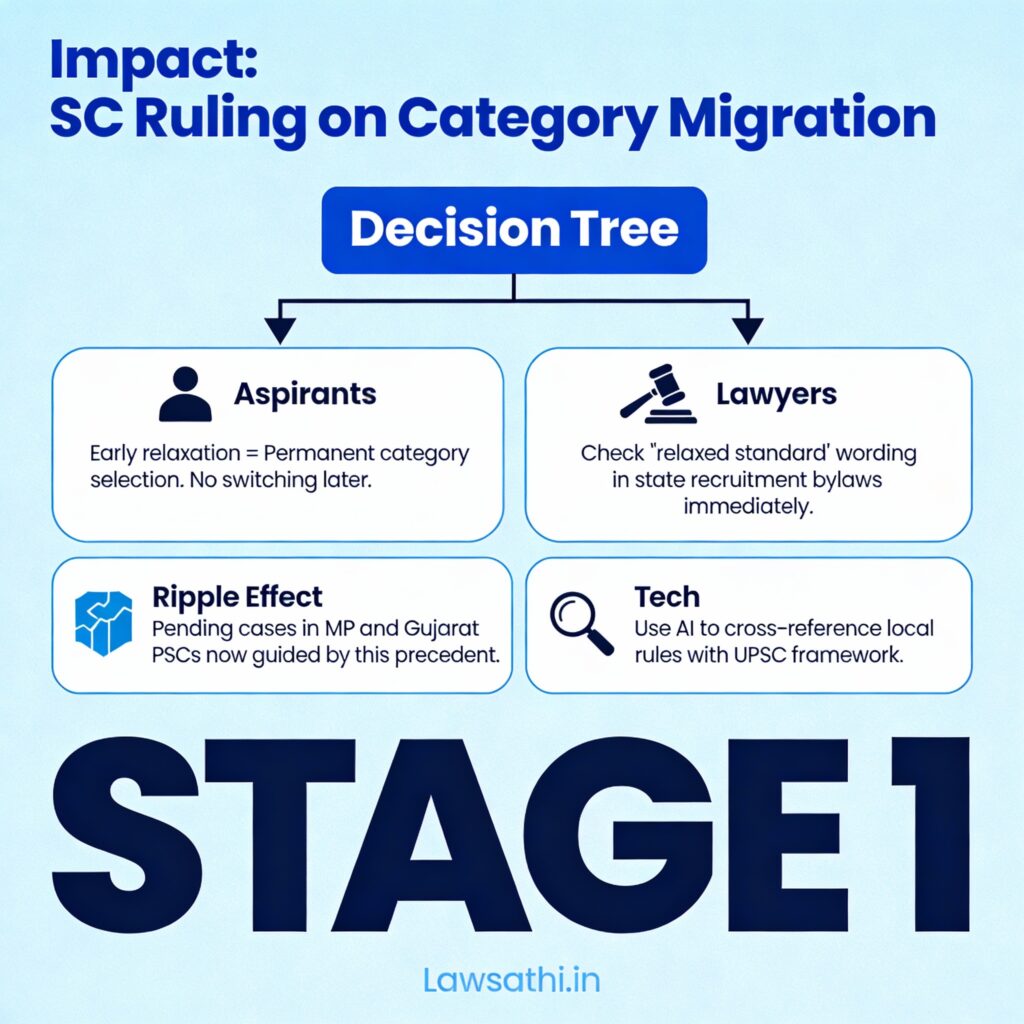
This judgment will have a ripple effect on State Public Service Commissions (PSCs). Lawyers representing various government bodies should now review their local recruitment bylaws.
Most importantly, they must ensure the wording regarding “relaxed standards” is unambiguous. Clear language will prevent future legal challenges and lengthy court battles.
Impact on Pending PSC Cases
Many state-level cases are currently stayed pending this UPSC decision. For instance, disputes in Madhya Pradesh and Gujarat regarding meritorious reserved candidates will likely follow this precedent.
Consequently, lawyers must advise their clients that using age relaxation is now a permanent category selection. This applies to many jurisdictions across the country.
How Technology Eases Research
Tracing these state-specific variations can be a daunting task for any litigator. However, modern tools make this easier.
Specifically, LawSathi’s AI can help lawyers quickly identify if a state’s recruitment rules match the UPSC framework. This allows for faster drafting of petitions and more accurate legal advice.
Conclusion: The Future of Meritocracy and Reservation
In summary, the Supreme Court reserved category relaxation ruling brings much-needed clarity. It establishes that the “Reserved” and “General” categories are distinct once a candidate accepts a relaxation prize.
This prevents the “best of both worlds” scenario. Candidates cannot enter through a lower bar but later take a seat from the higher bar category.
The decision balances the need for affirmative action with the integrity of the competitive process. As we move through 2026, this ruling will serve as the benchmark for all civil service disputes in India.
For candidates, the message is clear. You must choose your category and your concessions wisely at the very beginning of the journey.
Stay updated on the latest Supreme Court rulings with LawSathi’s AI-powered legal updates. Manage your research and case citations effortlessly. Book a demo today.