The Indian legal landscape witnessed a seismic shift on January 5, 2026. On this day, the Supreme Court delivered a high-stakes verdict regarding the Delhi Riots conspiracy case. Specifically, the court denied bail to Umar Khalid and Sharjeel Imam. Consequently, this ruling has sparked intense debate among legal professionals nationwide.
Impact on Defensive Legal Strategies
Many lawyers now question the future of the “Bail not Jail” doctrine under special statutes. For instance, the court characterized certain protest methods as terrorist activities. Because of this, the judgment creates new challenges for defense counsel. Therefore, understanding these UAPA bail conditions Supreme Court rulings is essential for every criminal lawyer in India.
The Shift from Liberty to Security
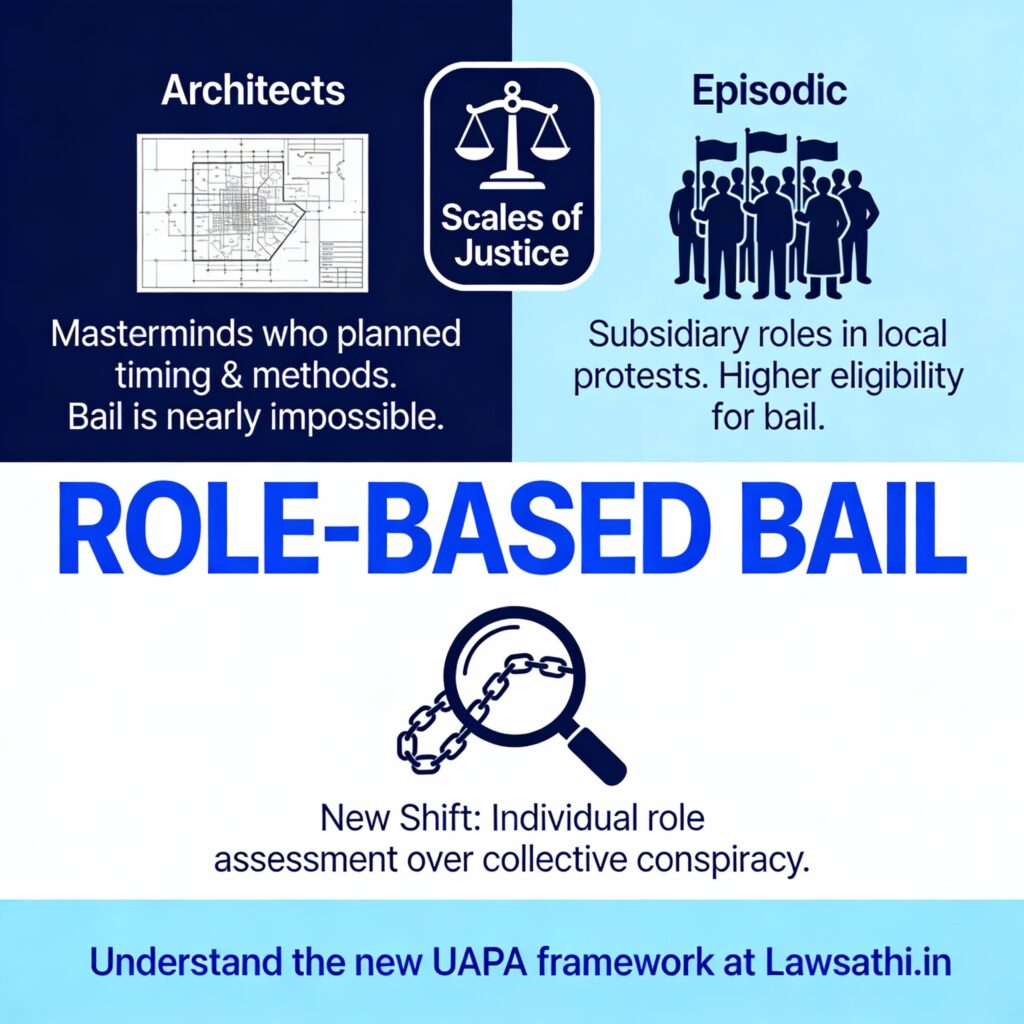
Historically, Indian courts balanced individual liberty with state security. However, the recent ruling in Gulfisha Fatima v. State Govt. of NCT of Delhi signals a change. Specifically, the bench of Justice Aravind Kumar and Justice NV Anjaria singled out Khalid and Imam as “masterminds.”
While five co-accused received bail, the court denied relief to the primary appellants. This move suggests a return to a more prosecution-centric approach. As a result, the legal community is re-evaluating how to argue bail in high-profile cases.
The Core of the Controversy: Analyzing the Restrictive Conditions
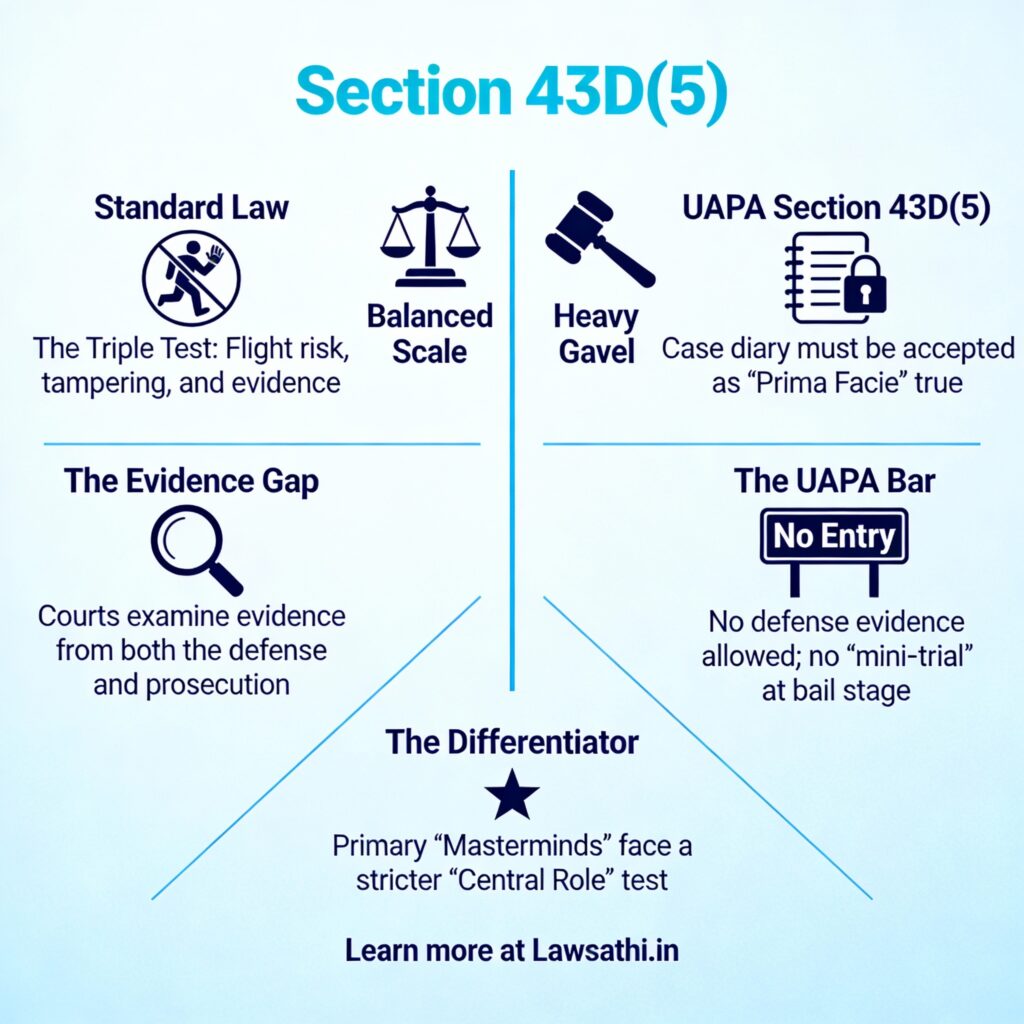
The primary hurdle in these cases is Section 43D(5) of the UAPA. In normal criminal law, the “Triple Test” usually determines bail outcomes. For example, judges look at flight risk, witness tampering, and evidence destruction. However, the UAPA sets a much higher bar for the accused person.
Understanding the Prima Facie Standard
Under Section 43D(5), the court must review the prosecution’s case diary. It must decide if the accusations are “prima facie true.” In the Umar Khalid bail ruling, the court found the allegations satisfied this threshold.
Specifically, the bench focused on the “central and formative” roles of the accused. Therefore, the court did not look at defense evidence at this stage. This interpretation makes it incredibly difficult for the accused to secure release during the trial.
Protests as Terrorist Acts
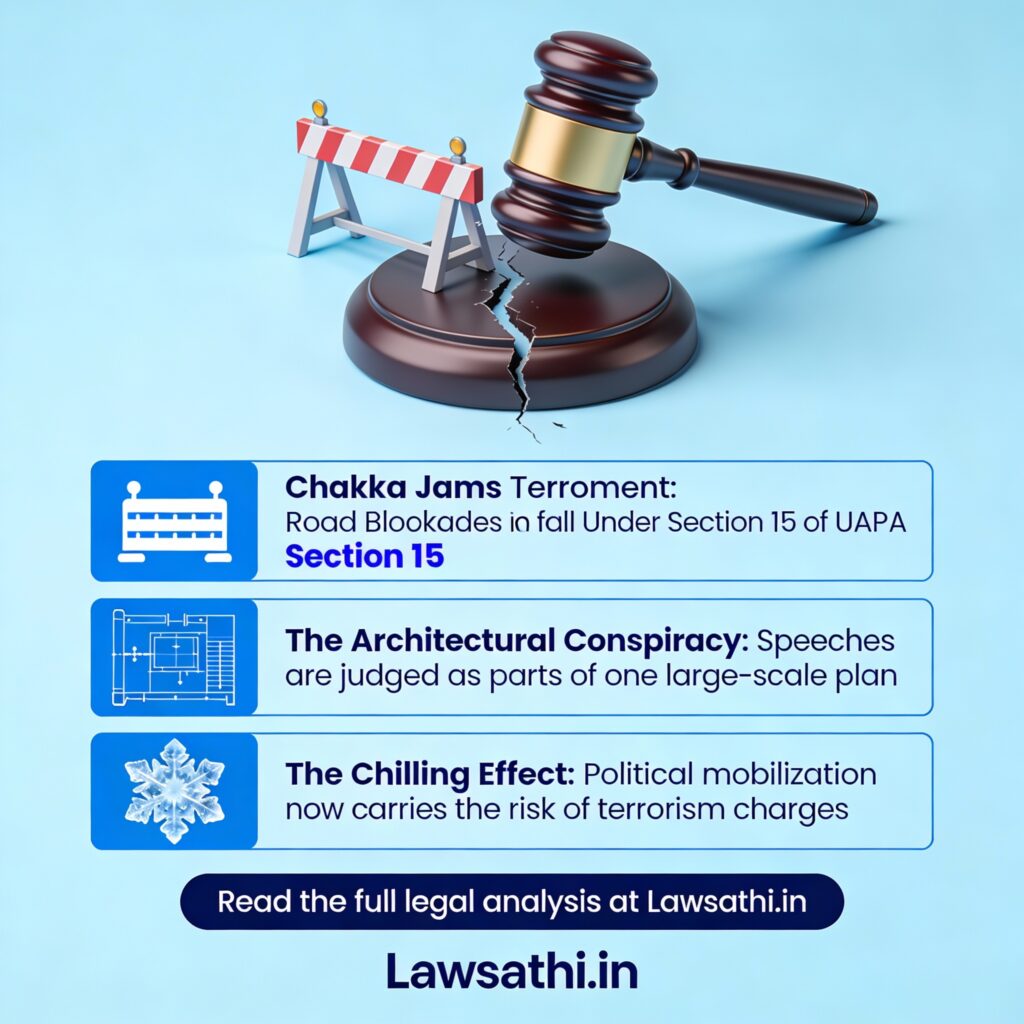
A significant part of the controversy involves the definition of “terrorist acts.” For example, the court viewed chakka jams (road blockades) through a national security lens. It ruled that these disruptive acts could fall under Section 15 of the UAPA.
Furthermore, the court dismissed the argument that speeches were non-violent. It stated that judges cannot examine speeches in isolation. Instead, they must consider the entire “architectural” conspiracy. As a result, this creates a daunting precedent for future political mobilization cases.
Comparative Analysis: Watali vs. Recent Interpretations
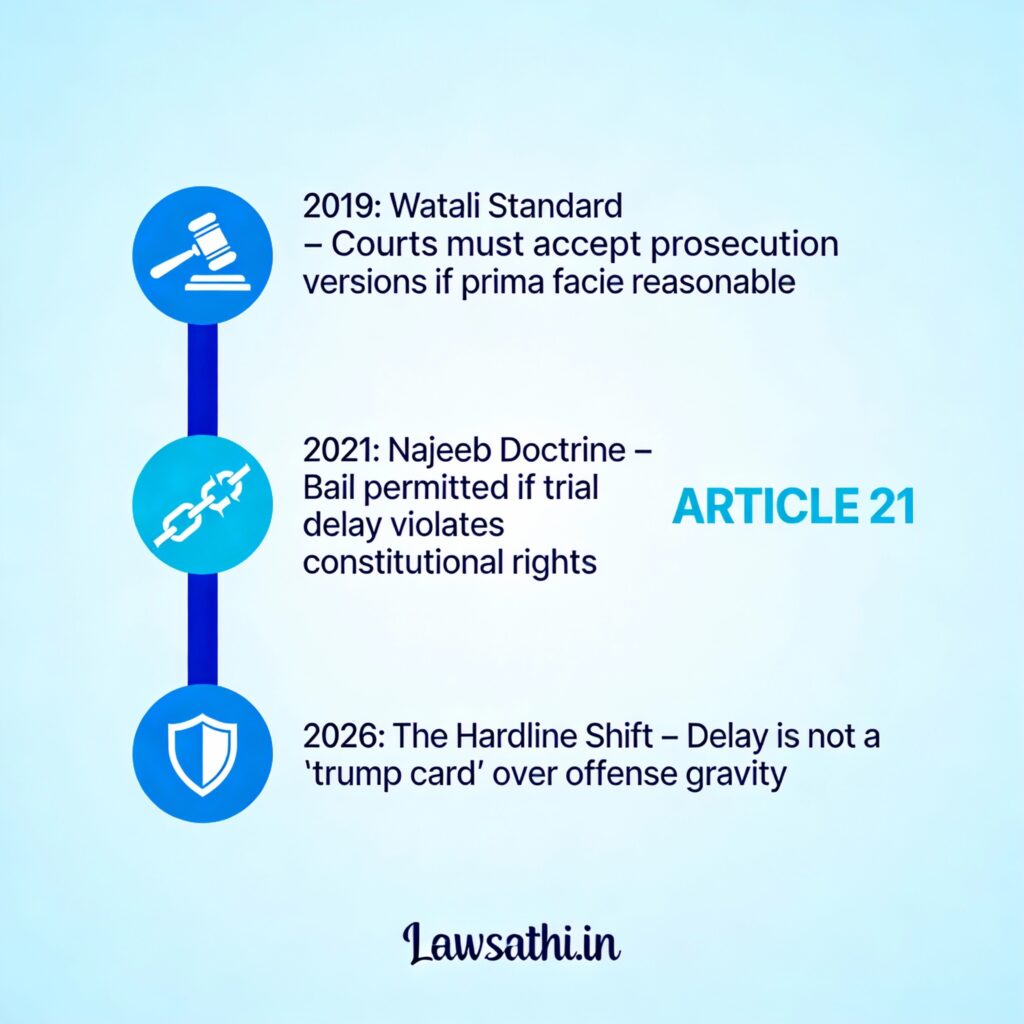
The legacy of NIA v. Zahoor Ahmad Shah Watali (2019) continues to dominate UAPA jurisprudence. This judgment established that courts cannot conduct a mini-trial at the bail stage. Essentially, the court must believe the prosecution’s version if it appears reasonable on the surface.
The Erosion of the Najeeb Doctrine
In 2021, the Union of India v. K.A. Najeeb case offered a glimmer of hope. It held that constitutional courts could grant bail if the trial was delayed excessively. Furthermore, because a long trial violates Article 21, the statutory bar could be bypassed.
However, the 2026 ruling explicitly stated that delay in trial is not a trump card. The court prioritized the gravity of the offense over the duration of incarceration. Even after five years in custody, the court found the security concerns paramount.
Dissecting the Broad Probabilities
The current UAPA bail conditions Supreme Court standard relies on “broad probabilities.” Consequently, defense lawyers cannot introduce their own documents to disprove the police narrative.
Instead, the defense strategy is often limited to pointing out gaps in the charge sheet. This reinforcement of the Watali standard limits judicial discretion during the pre-trial phase significantly.
Implications for Indian Lawyers and Future Bail Applications
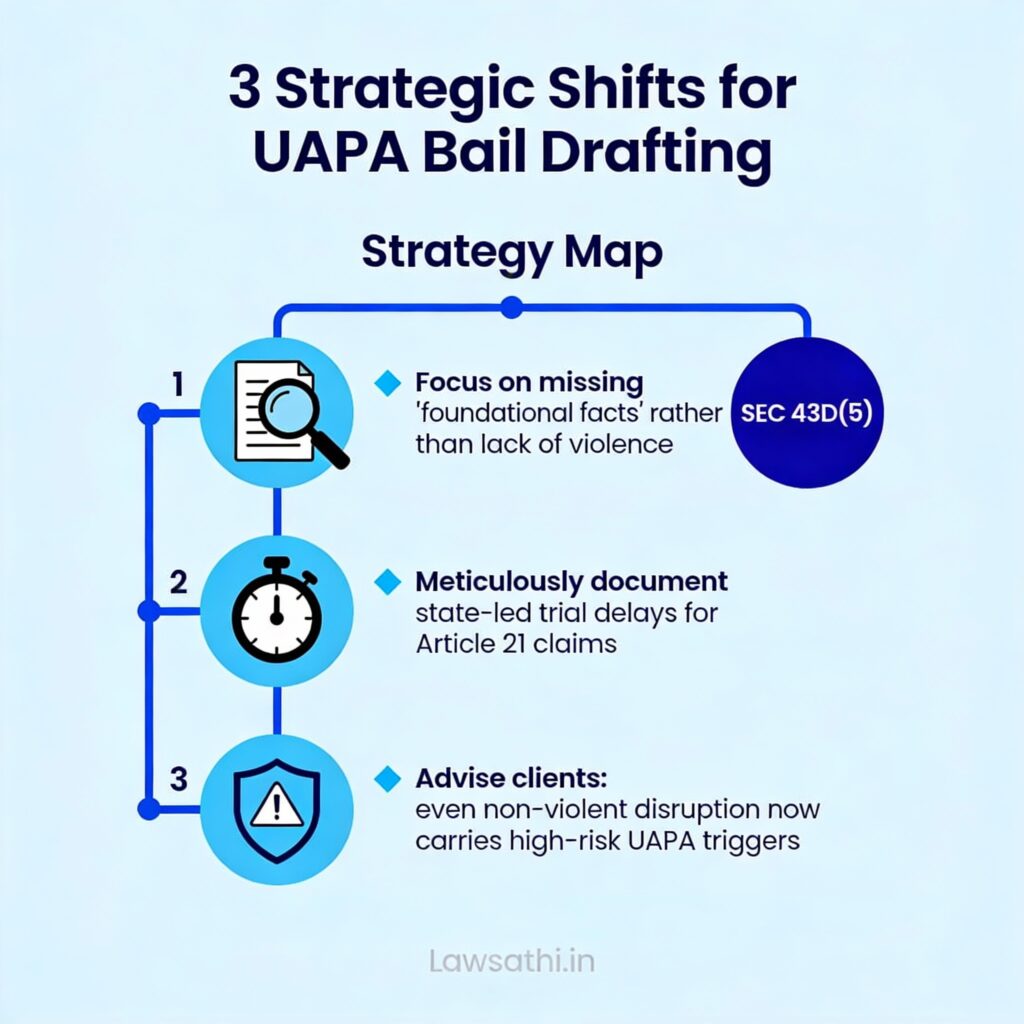
The Sharjeel Imam UAPA case creates a unique set of challenges for trial court practitioners. First, the categorization of protests as “terrorism” changes the risk profile of political clients. Therefore, lawyers must now warn clients that even planning a road blockade could lead to UAPA charges.
Practical Drafting Challenges
Defense counsel must shift their drafting strategies immediately. Simply arguing about the lack of violence may no longer suffice. Instead, lawyers should focus on the lack of “foundational facts” in the prosecution’s story.
Moreover, practitioners should still raise Article 21 concerns regarding the right to a speedy trial. Although the 2026 ruling makes this harder, it remains a vital constitutional argument. Specifically, documentation of state-led delays becomes the most important part of the bail application.
The Chilling Effect on Civil Liberties
There is a growing fear of a “chilling effect” on dissent. For example, if organizing a protest is legally equated to a conspiracy for terror, fewer citizens may speak out. For lawyers, this means an increase in complex litigation involving fundamental rights.
Additionally, trial courts may feel pressured to follow this strict interpretation. As a result, many pending applications in the Delhi Riots cases may face rejection. Therefore, lawyers must prepare for long-term litigation in the High Courts and Supreme Court.
The Global Perspective and Constitutional Validity
International human rights standards often clash with India’s anti-terror laws. For instance, the UN Human Rights Council has frequently flagged the UAPA. They argue that Section 43D(5) violates the presumption of innocence. In contrast, the Indian government consistently defends these measures. They argue these laws are necessary for national security.
Article 21 and Punitive Incarceration
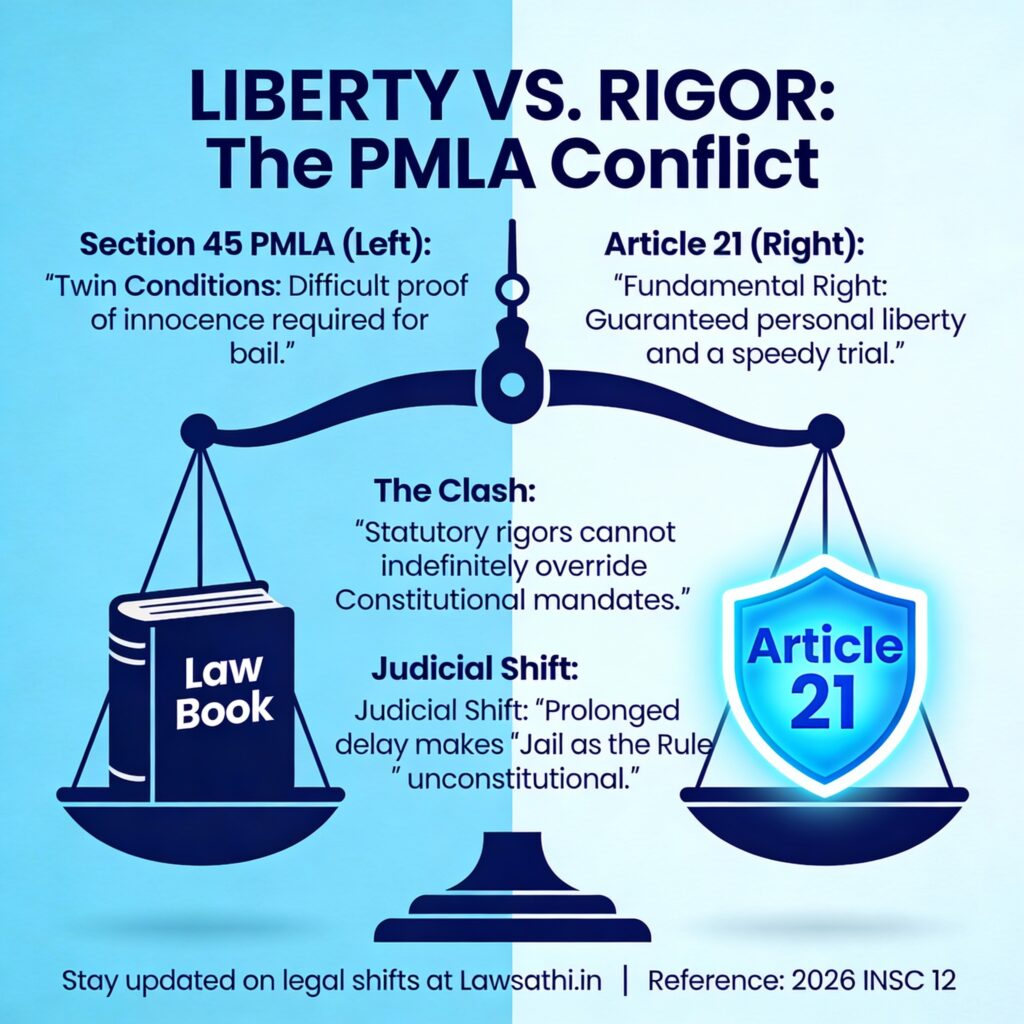
Legal scholars argue that prolonged incarceration without trial is inherently punitive. If a trial takes ten years, the “bail” stage becomes the actual punishment. For instance, the Delhi High Court recently clarified that pre-charge detention requires rigorous scrutiny.
However, the Supreme Court appears to prioritize collective safety over individual liberty. This tension between Article 21 and the UAPA remains a highly debated topic. Consequently, it dominates modern Indian criminal jurisprudence.
Balancing Security and Freedom
The Supreme Court remarked that “neither liberty nor security admits of absolutism.” This philosophy justifies the current restrictive UAPA bail conditions Supreme Court has endorsed. For example, the court believes that the state must have the power to prevent “architectural” conspiracies. While this protects the public, it places a heavy burden on those who are innocent.
Conclusion: The Road Ahead for Judicial Discretion
The 2026 ruling in the Umar Khalid and Sharjeel Imam cases signals a tough era for UAPA defendants. The court has reinforced the strict Watali standard. Furthermore, it has limited the impact of the Najeeb delay argument. Additionally, the inclusion of protest tactics under the definition of terrorism broadens the scope of the Act.
Indian lawyers must now navigate a landscape where the “prima facie” test is more rigid. Therefore, strategic litigation will likely focus on forcing the state to begin trials faster. Without a trial, the accused remains trapped in a legal vacuum. In this space, bail is almost impossible to achieve.
Ultimately, the evolution of this jurisprudence will determine the future of civil liberties in India. Stay ahead of critical legal shifts. Specifically, use LawSathi’s AI-powered research tools to analyze recent Supreme Court precedents and streamline your litigation strategy. Start your free trial today.