The legal landscape in India has changed significantly with the arrival of the Bharatiya Nagarik Suraksha Sanhita (BNSS). For defense lawyers, mastering Section 528 BNSS quashing FIR procedures is now a professional necessity. This provision replaces the familiar Section 482 of the CrPC. While the essence of justice remains, practitioners must adapt to the new statutory framework immediately.
Introduction: The Transition from Section 482 CrPC to Section 528 BNSS
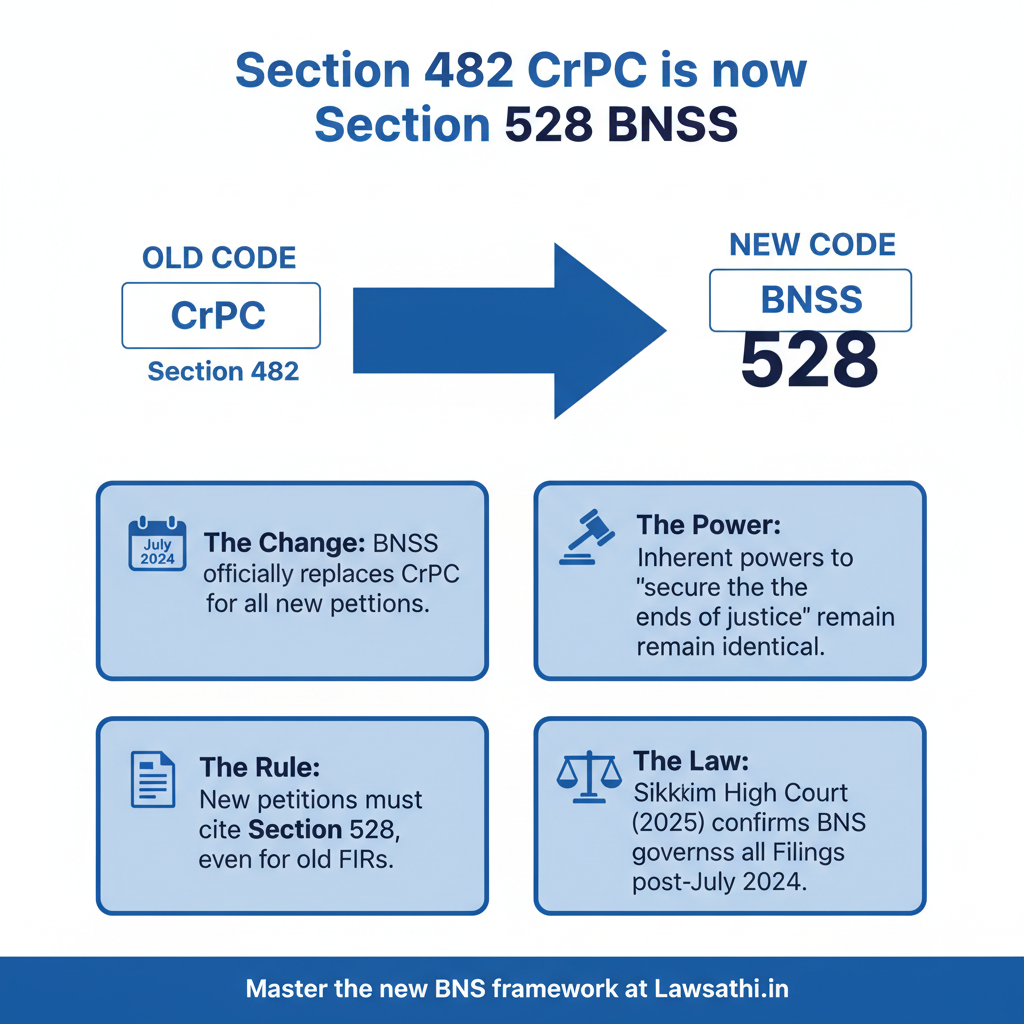
The Bharatiya Nagarik Suraksha Sanhita (BNSS) became fully operational on July 1, 2024. Therefore, Section 528 of the BNSS has officially succeeded Section 482 of the CrPC. It retains the inherent powers of the High Court. Specifically, these powers prevent the abuse of any legal process.
Preservation of Inherent Powers
The language in Section 528 remains identical to its predecessor. For example, it protects the High Court’s power to “secure the ends of justice.” However, defense lawyers must now update their pleadings. You should ensure every document reflects the new numbering. Even if an FIR was lodged under the old IPC, new petitions must cite the BNSS.
Mandatory Adaptation for Practitioners
Courts have already provided clarity on this transition. In fact, the Sikkim High Court recently addressed this change. In Deepam Pradhan v. Krishna Kumari Bhandari (2025), the court issued a significant ruling. It stated that petitions filed after July 2024 must follow Section 528. Most importantly, this applies even for older criminal cases.
Legal Grounds for Quashing an FIR under BNSS
Identifying strong grounds is the first step toward a successful Section 528 BNSS quashing FIR petition. Generally, the High Court does not interfere with investigations. However, it will act if the legal process is being weaponized against a citizen.
The Prima Facie Test
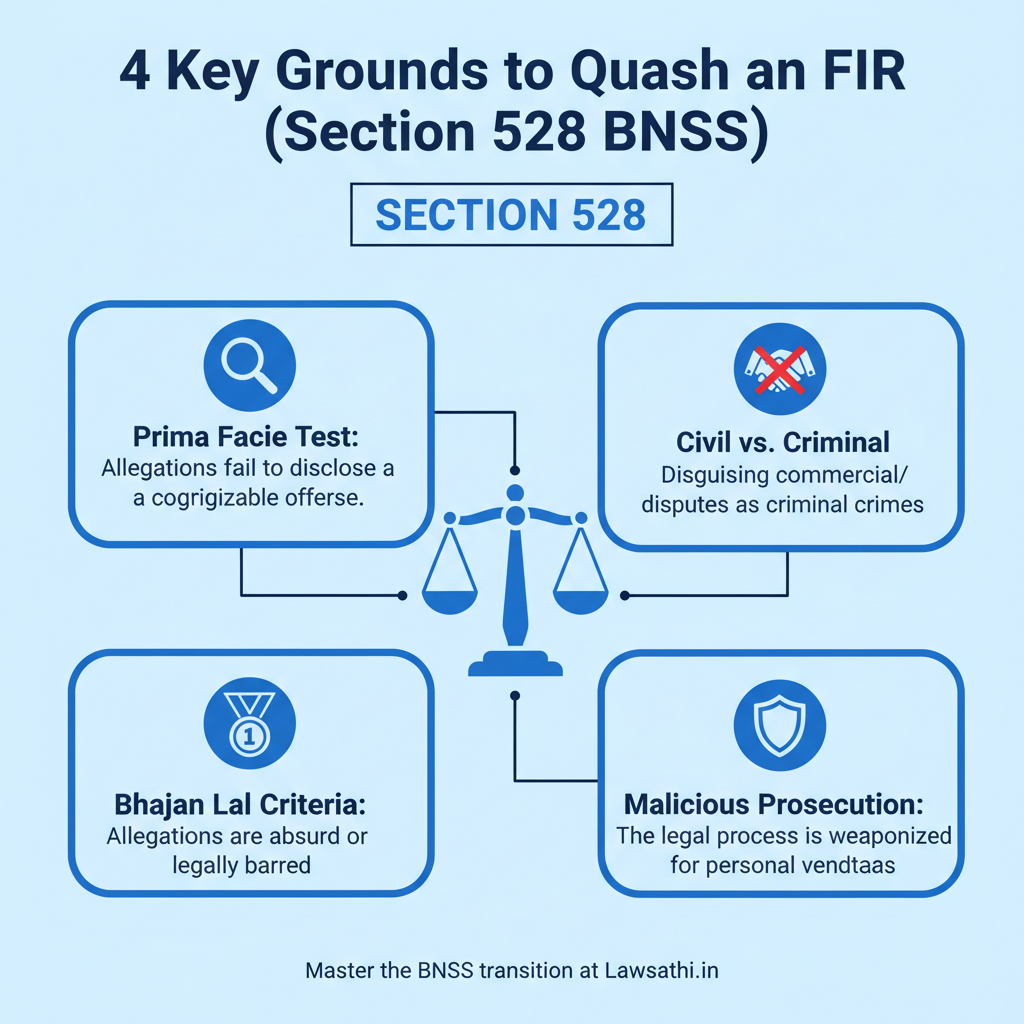
First, the court applies the “Prima Facie” test. In other words, the court examines if the FIR actually discloses a cognizable offense. If the allegations fail to show a crime, the FIR should be quashed. Moreover, the court looks for a lack of essential ingredients required by the Bharatiya Nyaya Sanhita (BNS).
Applying the Bhajan Lal Criteria
The landmark State of Haryana v. Bhajan Lal ruling still serves as the gold standard. High Courts continue to use these criteria under the BNSS era. For example, the court can intervene if allegations are absurd. Additionally, this applies if there is an express legal bar to the proceedings.
Civil Disputes and Malicious Prosecution
Secondly, many criminal cases are actually civil disputes in disguise. High Courts frequently quash FIRs arising from purely commercial or matrimonial disagreements. Furthermore, quashing is justified in cases of malicious prosecution. If a victim initiates a case for a personal vendetta, it constitutes an abuse of process.
Step-by-Step Procedural Guide for Filing under Section 528
Drafting a petition under Section 528 requires precision and technical accuracy. You must ensure that your application meets all procedural requirements. Consequently, this prevents technical dismissals at the admission stage.
Drafting the Petition
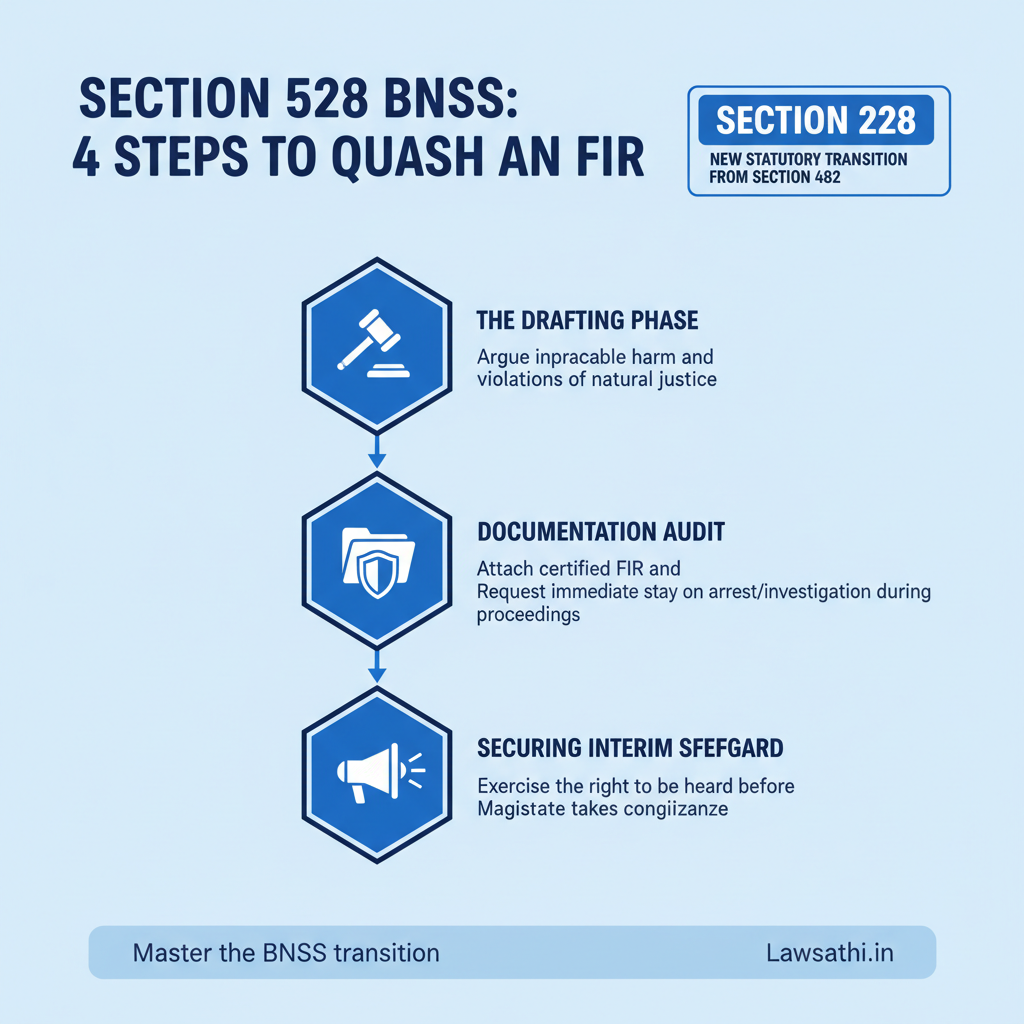
A strong petition must highlight the specific failure of the prosecution. For example, you should emphasize why the continued investigation causes irreparable harm. Additionally, include a clear prayer for the quashing of the entire proceeding. Use clear language to explain how the FIR violates the principles of natural justice.
Jurisdiction and Documentation
Specifically, you must file the petition in the High Court where the FIR was registered. Furthermore, attach all necessary supporting documents. This includes certified copies of the FIR. You should also include statements recorded under Section 180 of the BNSS. Previously, these were known as Section 161 statements under the CrPC.
Seeking Interim Relief
Most importantly, always pray for interim relief. This usually involves a stay on the arrest or investigation. In fact, this protects your client while the High Court deliberates. In Imran Pratapgarhi v. State of Gujarat (2025), the Supreme Court provided guidance. It noted that even nascent investigations can be stayed if they are perverse.
Key Differences and Nuances: BNSS vs. CrPC for Practitioners
While the core power remains, the procedural context has shifted. Practitioners must map old CrPC sections to their new BNSS counterparts carefully. As a result, you will avoid errors in citation that lead to delays.
Mapping Statutory Counterparts
For instance, the power of a Magistrate to order an investigation has moved. It is no longer Section 156(3) of the CrPC. Instead, you must refer to the updated provisions within the BNSS. Similarly, the final police report is now filed under Section 193 of the BNSS.
The Right to be Heard
Additionally, Section 223 of the BNSS introduces a new safeguard. This section provides a “Right to be heard” before a Magistrate takes cognizance. Specifically, failing to provide this hearing can be a strong ground for a petition. This is a significant procedural change that defense lawyers must leverage.
Timeline and Successive Petitions
Currently, courts are becoming stricter regarding timelines. For example, the Karnataka High Court recently warned against successive quashing petitions. Unless circumstances change significantly, a second petition is rarely entertained. Therefore, you must present your best arguments in the first filing.
Expert Tips for Defense Lawyers: Strengthening the Petition
To succeed, your petition must stand out at the admission stage. Most petitions fail because they ask the court to weigh evidence. However, the High Court is not a trial court.
Avoid the Mini-Trial Pitfall
A common mistake is asking the High Court to act as a trial court. In Muskan v. Ishaan Khan (2025), the Supreme Court reiterated this rule. Specifically, courts cannot conduct a “mini-trial.” Therefore, you should not ask them to inquire into the credibility of allegations. Focus instead on the legal impossibility of the case.
Utilizing Digital Evidence
The Bharatiya Sakshya Adhiniyam (BSA) now offers better pathways for electronic records. Therefore, you should use digital evidence like GPS logs or CCTV footage to support your petition. These records can prove an alibi or a lack of criminal intent. Under the BNSS, electronic records hold significant weight as primary evidence.
Testing the Material
The Supreme Court has recently laid down a four-step test for quashing. First, check if the material relied upon is undisputed. Second, determine if the allegations actually constitute an offense. If the material would inevitably lead to an acquittal, the court should quash the FIR.
Conclusion: Navigating the New Criminal Jurisprudence
The transition to Section 528 BNSS quashing FIR marks a new chapter in Indian law. While the inherent power remains a shield, its application requires modern expertise. Defense lawyers must balance the legacy of the CrPC with the technical updates of the BNSS.
In fact, staying updated with emerging High Court circulars is crucial. As the judiciary interprets the BNSS, new nuances will surely emerge. By focusing on procedural lapses, lawyers can successfully protect their clients’ rights.
Streamline your transition to BNSS with LawSathi. Use our AI-powered legal research tools to draft flawless Section 528 petitions. Book a demo today!