
Introduction: The Convenience vs. Compliance Dilemma
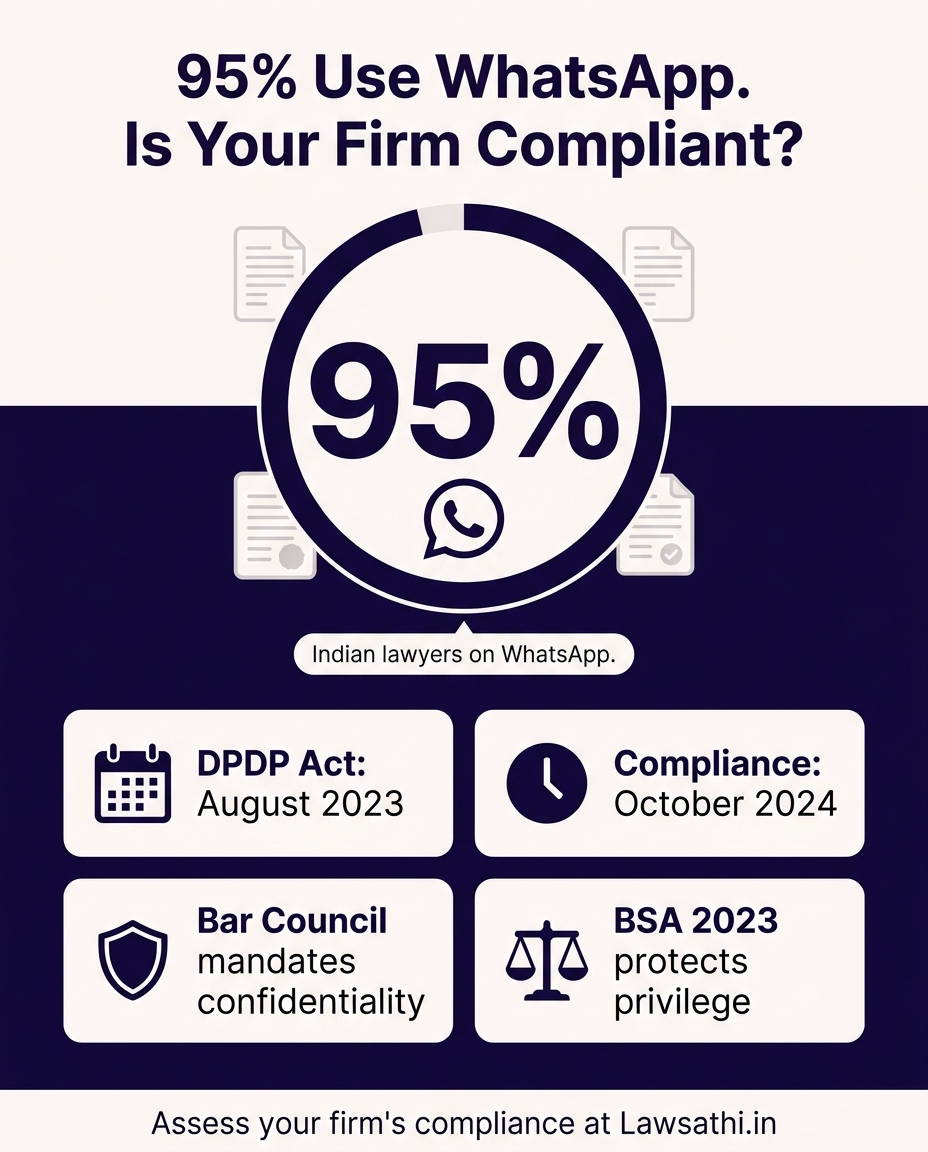
Walk into any district court or High Court in India. You will see lawyers glued to their WhatsApp screens. From sharing case documents to coordinating with clients, the app has become indispensable. In fact, WhatsApp is installed on approximately 95% of Indian Android devices source. Therefore, it serves as the default communication tool for most legal professionals.
However, the regulatory landscape has fundamentally shifted. The Digital Personal Data Protection Act, 2023 received Presidential assent on August 11, 2023 source. Although enforcement was initially delayed, the Ministry of Electronics and Information Technology indicated in October 2024 that companies should begin compliance. Additionally, draft rules were published in November 2024.
The Core Conflict for Legal Practitioners
This creates a critical dilemma for Indian law firms. The convenience of WhatsApp versus the statutory data protection obligations under the DPDP Act demands serious attention. The question of WhatsApp vs secure client portal for law firms India is no longer academic. Rather, it is a pressing compliance necessity.
The Bar Council of India Rules under Part VI, Chapter II specifically mandate client confidentiality source. Furthermore, attorney-client privilege receives protection under Sections 132-134 of the Bharatiya Sakshya Adhiniyam, 2023 source. Consequently, lawyers must evaluate whether their current communication methods align with both professional ethics and the new data protection framework.
Understanding the DPDP Act: Obligations for Legal Data Fiduciaries
Law Firms as Data Fiduciaries
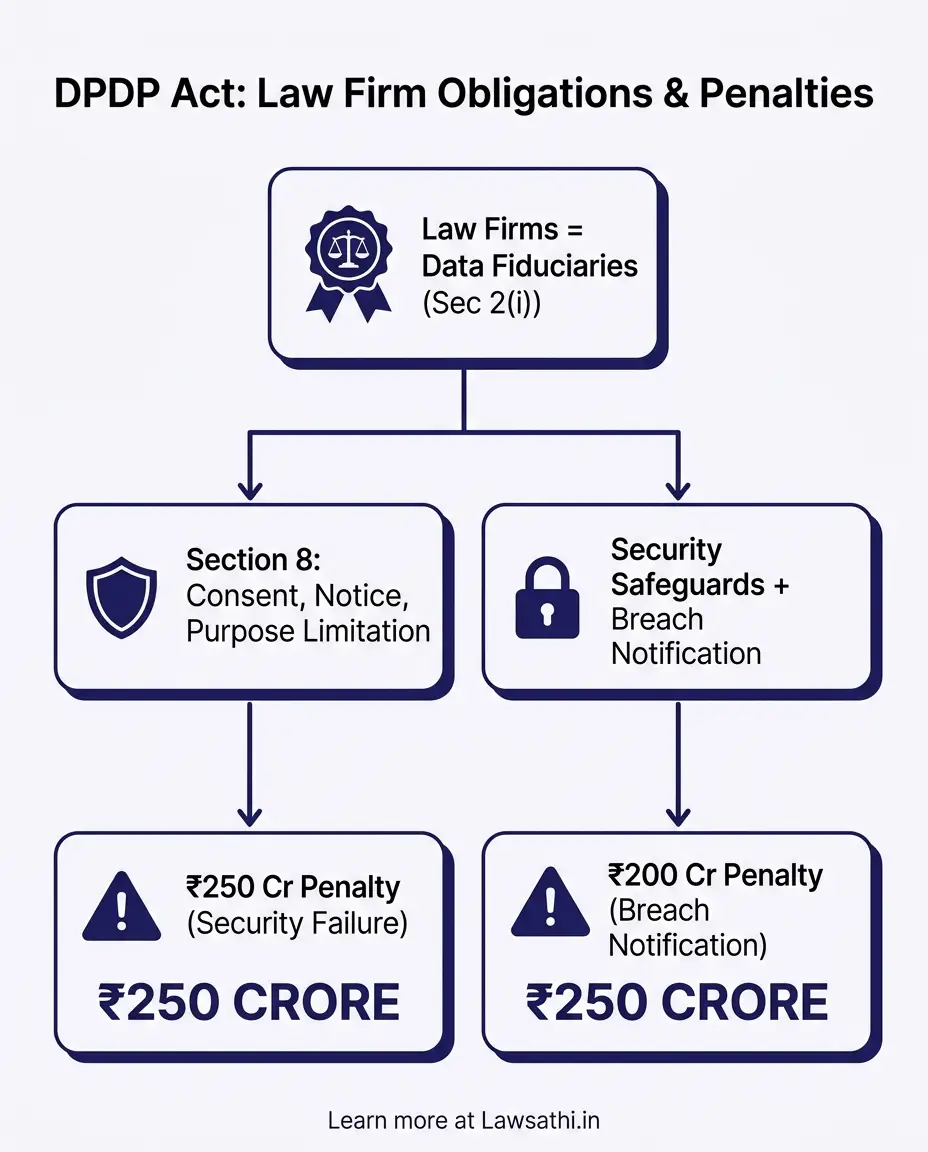
Under Section 2(i) of the DPDP Act, a “Data Fiduciary” means any person who alone or in conjunction with other persons determines the purpose and means of processing personal data source. Law firms clearly fall within this definition. Specifically, they determine what client data to collect, how to process it, and for what purposes.
According to legal analysis, firms handling private clientele in civil, family, and criminal litigation process significant volumes of individual personal data source. Therefore, most law firms qualify as Data Fiduciaries. Some larger firms may even qualify as “Significant Data Fiduciaries” due to the volume of data they process.
Key Compliance Obligations Under Section 8
Section 8 of the DPDP Act imposes several critical obligations on Data Fiduciaries source. First, firms must provide clear notice to clients about data collection and processing. Second, they must obtain and record consent through “clear affirmative action.”
Purpose limitation requires that data be processed only for specified purposes. Data minimization mandates collecting only what is necessary. Storage limitation under Section 8(7) requires erasing data when the purpose is served or consent is withdrawn source.
Furthermore, Section 8(5) requires implementing “reasonable security safeguards” to protect personal data from breaches. Section 8(6) mandates notifying the Data Protection Board and affected clients if a breach occurs.
Severe Penalties for Non-Compliance
The penalty structure under the DPDP Act is substantial. Failure to implement reasonable security safeguards can attract a maximum penalty of ₹250 crore source. Similarly, failure to notify a breach carries a penalty of up to ₹200 crore.
These are not merely theoretical risks. The NCLAT explicitly noted in January 2025 that the DPDP Act “is likely to be enforced” source. Moreover, the Act may cover all issues pertaining to data protection. Consequently, law firms must treat compliance as an urgent priority rather than a distant concern.
WhatsApp: The Compliance Red Flags
Encryption Misconceptions
Many lawyers believe WhatsApp’s end-to-end encryption provides adequate security. However, this is a dangerous misconception. Encryption only protects message content during transit. It does not protect stored data on devices.
Consider a common scenario. A lawyer loses their phone at a court complex. All WhatsApp messages—case strategies, client confessions, settlement discussions—remain accessible on the device. Anyone who unlocks the phone can read everything. As a result, the encryption offers no protection once data reaches the device.
Furthermore, forwarded messages create uncontrolled copies across multiple devices. A sensitive document shared with one client could be forwarded to dozens of others. The originating lawyer has no control over these copies.
Audit Trail Deficiencies
The DPDP Act requires firms to demonstrate that they obtained consent and provided notice. However, WhatsApp provides no mechanism for recording formal consent. There is no audit trail showing who accessed what data and when.
When a client alleges their data was misused, how can a lawyer prove compliance? WhatsApp offers no defensible documentation. Deleted messages may still exist on other parties’ devices or in backups. This creates significant evidentiary challenges.
Data Localization and Jurisdictional Risks
India’s approach to data localization has been strict in the financial sector. The RBI’s 2018 circular mandated that payment system data must be stored only in India source. While WhatsApp has faced pressure to localize data, metadata may still involve cross-border flows source. This metadata includes who messaged whom, when, and from which device.
For privileged attorney-client communications, this creates serious concerns. The NCLAT in December 2025 held that “users must retain the right to decide what data is collected” source. Additionally, users should control for which purposes and for how long data is stored. WhatsApp’s data policies may not align with this requirement.
Blurred Professional Boundaries
Most Indian lawyers use personal WhatsApp accounts for professional communication. This creates obvious problems for “purpose limitation.” The same account handles family groups, college friends, and confidential client matters.
A lawyer might accidentally share a case document to a family group instead of a client. Screenshots can be taken and shared without any audit trail. These risks fundamentally conflict with DPDP obligations and professional ethics.
Secure Client Portals: Built for Legal Compliance
Centralized Data Control
Secure client portals offer a fundamentally different architecture. All communications and documents exist in a controlled, centralized environment. The law firm—not the platform—controls the data.
When a client withdraws consent or a matter concludes, the firm can execute erasure requests comprehensively. This satisfies the storage limitation requirement under Section 8(7) of the DPDP Act.
For example, platforms like Jupitice Digital Law Office provide centralized dashboards for case management source. These include complete governance and audit trails. The firm maintains ownership and control throughout.
Automated Consent Management
Client portals can capture consent through digital acknowledgment mechanisms. They record timestamps, IP addresses, and clear affirmative actions. This creates documentary evidence of compliance.
The DPDP Rules require that “notice must be clear, standalone, understandable… using simple plain language” source. Consent withdrawal must be “as comparable to the process of giving consent.” Modern portals are specifically designed to meet these requirements.
Comprehensive Audit Trails
Every action within a secure portal creates an audit record. Who accessed what document, when, from which location—all logged automatically. This creates defensible documentation for regulatory inquiries.
Platforms like Manupatra Legal Tech Suite offer performance tracking, case movement monitoring, and risk identification features source. If the Data Protection Board ever investigates, the firm can produce complete records demonstrating compliance.
Enterprise-Grade Security Standards
Leading Indian law firms are already adopting security certifications. Shardul Amarchand Mangaldas attained ISO/IEC 27001:2022 certification in June 2025 source. This global benchmark addresses evolving risks like cyberattacks, data breaches, and cloud vulnerabilities.
Secure portals typically offer multi-factor authentication, encryption at rest and in transit, and role-based access control. These features directly support the “reasonable security safeguards” requirement under Section 8(5).
Head-to-Head Comparison: Feature vs. Compliance Factor
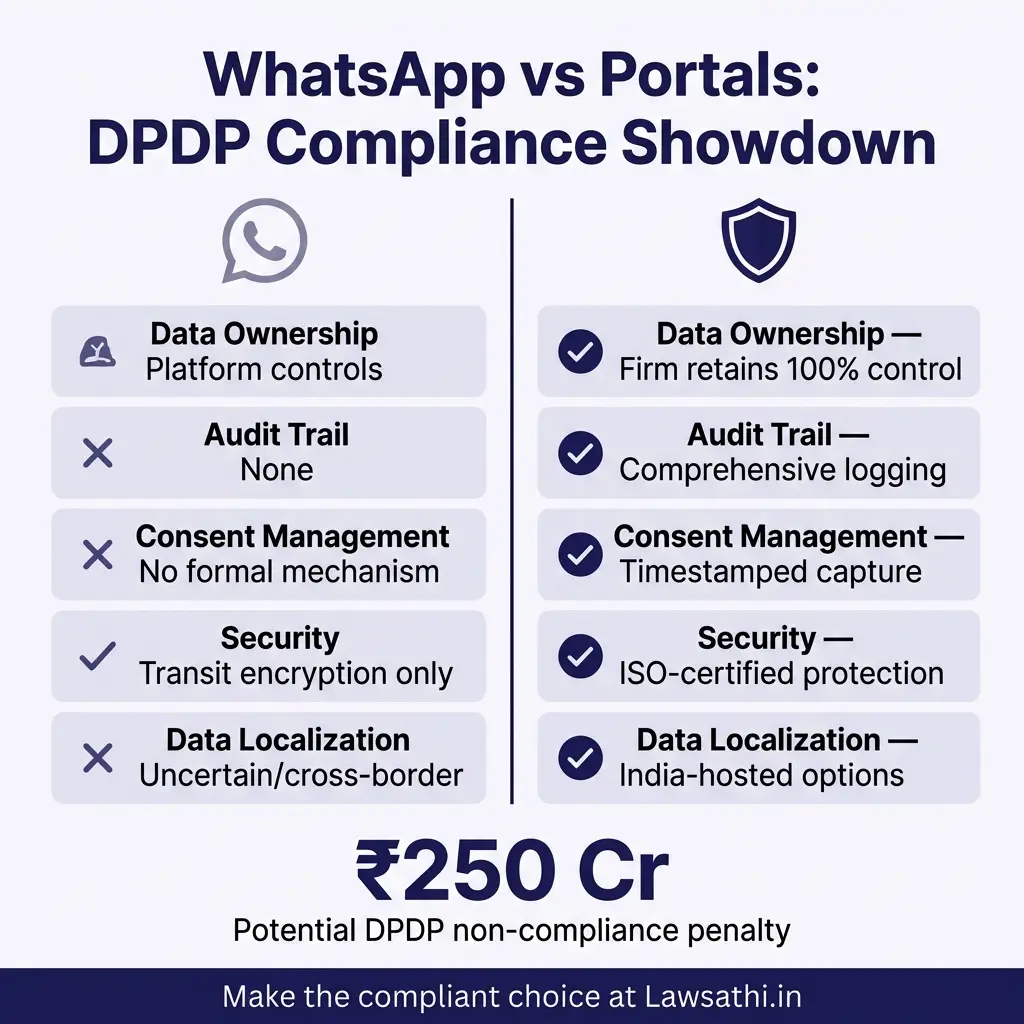
| Factor | WhatsApp | Secure Client Portal | |——–|———-|———————| | Data Ownership | Platform controls; subject to Meta policies | Firm retains complete control | | Security Standards | Transit encryption only; device security varies | Enterprise-grade; ISO certifications possible | | Consent Management | No formal mechanism; no audit trail | Built-in capture with timestamps | | Audit Trail | None—cannot prove access history | Comprehensive logging for compliance | | Data Localization | Uncertain; metadata may flow cross-border | India-hosted options available | | Purpose Limitation | Personal/professional boundaries blurred | Strict separation with access controls | | Breach Response | Cannot determine scope or notify affected parties | Identify affected data; support notification | | Cost | Free | Investment required | | Professional Perception | Informal | Enhances firm credibility |
The Cost-Benefit Analysis
Consider the mathematics. The maximum penalty for security safeguard failures under the DPDP Act is ₹250 crore. In comparison, UK law firms were fined €113,000 in 2022 for data breaches source. Furthermore, they faced €70,000 in fines in 2025 for lacking basic safeguards like multi-factor authentication.
Portal investments typically range from monthly per-user subscriptions to enterprise licenses. Against a potential ₹250 crore penalty, the cost of compliance infrastructure appears prudent. More importantly, robust data protection enhances client trust and competitive positioning.
Transitioning Your Firm: Practical Steps for Lawyers
Step 1: Conduct a Data Audit
Begin by mapping all current communication and data flows. Identify every touchpoint where your firm collects client data. This includes website contact forms, client intake documents, biometric systems, and yes—WhatsApp communications.
According to expert analysis, firms must “first identify all touchpoints where data is collected” source. Document what data you collect, why you collect it, how long you retain it, and who can access it.
Step 2: Position Portals as Client Protection
Client adoption requires careful communication. Do not frame the portal as an inconvenience. Instead, position it as a value-add for client safety.
Consider this script: “To protect your confidential information and comply with India’s new data protection law, we now use a secure client portal. This ensures your documents are encrypted, access-controlled, and you have transparency on who views your information.”
Emphasize that this protects the client’s interests. Most clients will appreciate the professionalism and security.
Step 3: Adopt a Hybrid Communication Strategy
You need not abandon WhatsApp entirely. Instead, restrict it to non-sensitive communications only. Use it for appointment reminders, availability confirmations, and administrative coordination.
However, never share via WhatsApp: – Legal opinions or case strategies – Sensitive client documents – Settlement discussions – Any privileged communication
Train all staff on these boundaries. Create clear protocols for what goes through which channel.
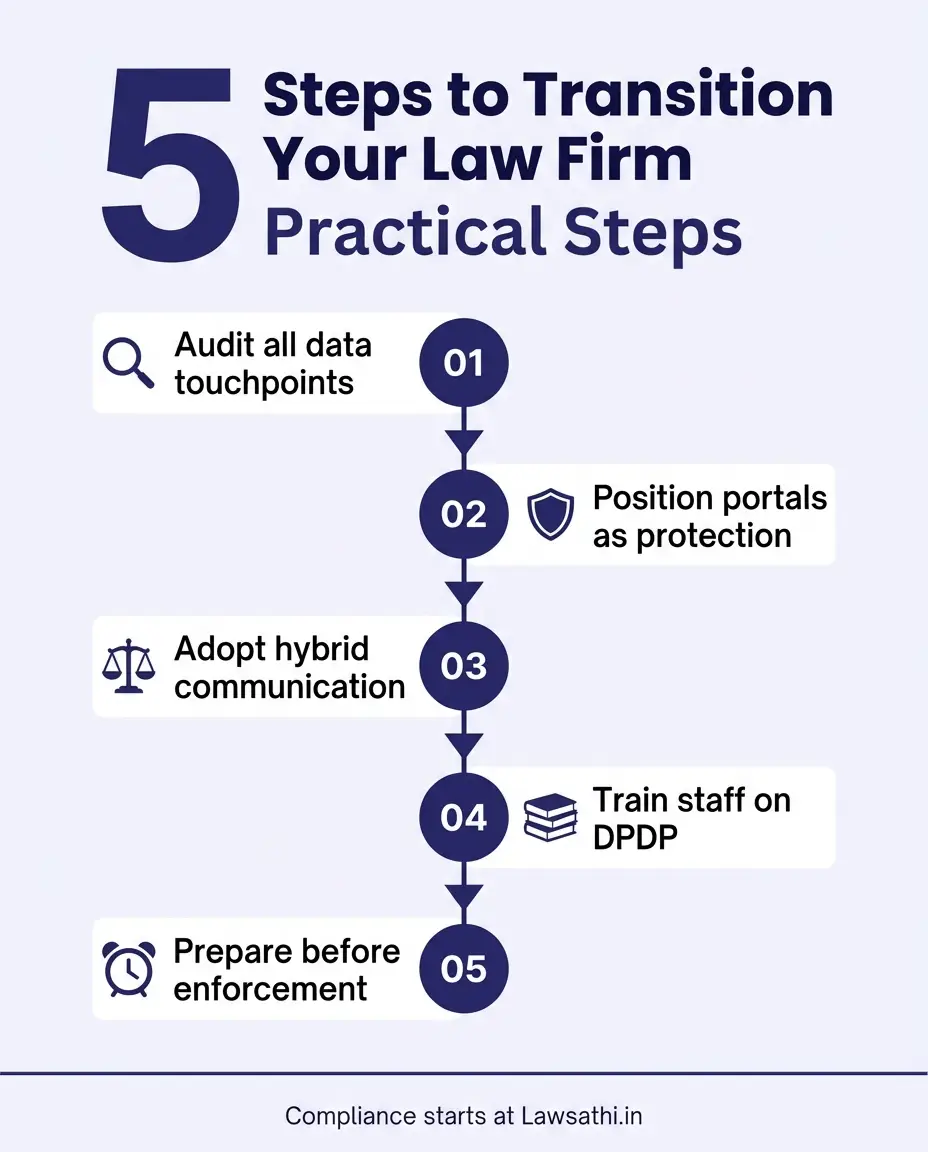
Step 4: Train Staff Comprehensively
The DPDP Act “demands a cultural and operational shift involving all stakeholders, from partners to administrative staff” source. Therefore, conduct training sessions covering: – DPDP Act fundamentals and obligations – Recognizing personal data in legal practice – Portal usage and protocols – Breach identification and reporting procedures – Consent requirements and documentation
Schedule regular refresher sessions as rules are finalized and enforcement begins.
Step 5: Prepare for the Enforcement Era
Use the current transition period wisely. Law firms that “conduct regular data audits and data processing impact assessments” will be at “much better standing in terms of DPDPA compliance” source. Begin implementing portals now rather than scrambling after enforcement notices are issued.
Conclusion: Future-Proofing Your Practice
The legal profession in India faces unprecedented regulatory exposure. Traditionally, self-regulation through Bar Council rules governed professional conduct. However, the DPDP Act applies horizontally to any entity processing personal data, regardless of industry source. Consequently, law firms will not be immune.
From Best Practice to Legal Requirement
Data protection is no longer optional. The NCLAT explicitly acknowledged that the DPDP Act “is likely to be enforced” source. The Ministry has already indicated companies should begin compliance. Therefore, waiting for formal enforcement notices before acting is imprudent.
The debate around WhatsApp vs secure client portal for law firms India has a clear answer. Secure portals are necessary infrastructure, not a luxury. The cost of compliance tools pales against potential ₹250 crore penalties and professional liability implications.
Embrace the Digital Transformation
Major Indian law firms are already moving in this direction. From Shardul Amarchand Mangaldas’s ISO certification to platforms like WITTS offering PAN-India litigation management source, the industry is transforming.
Gartner predicts legal, risk, and compliance functions will double technology spend by 2027. Firms that act now will gain competitive advantages. Those that delay face regulatory, reputational, and professional risks that no lawyer should ignore.
The choice is clear. Prioritize compliance, protect your clients, and secure your practice’s future.
Ready to upgrade your firm’s data security and ensure DPDP compliance? Experience LawSathi’s encrypted client portal with a 14-day free trial today.