
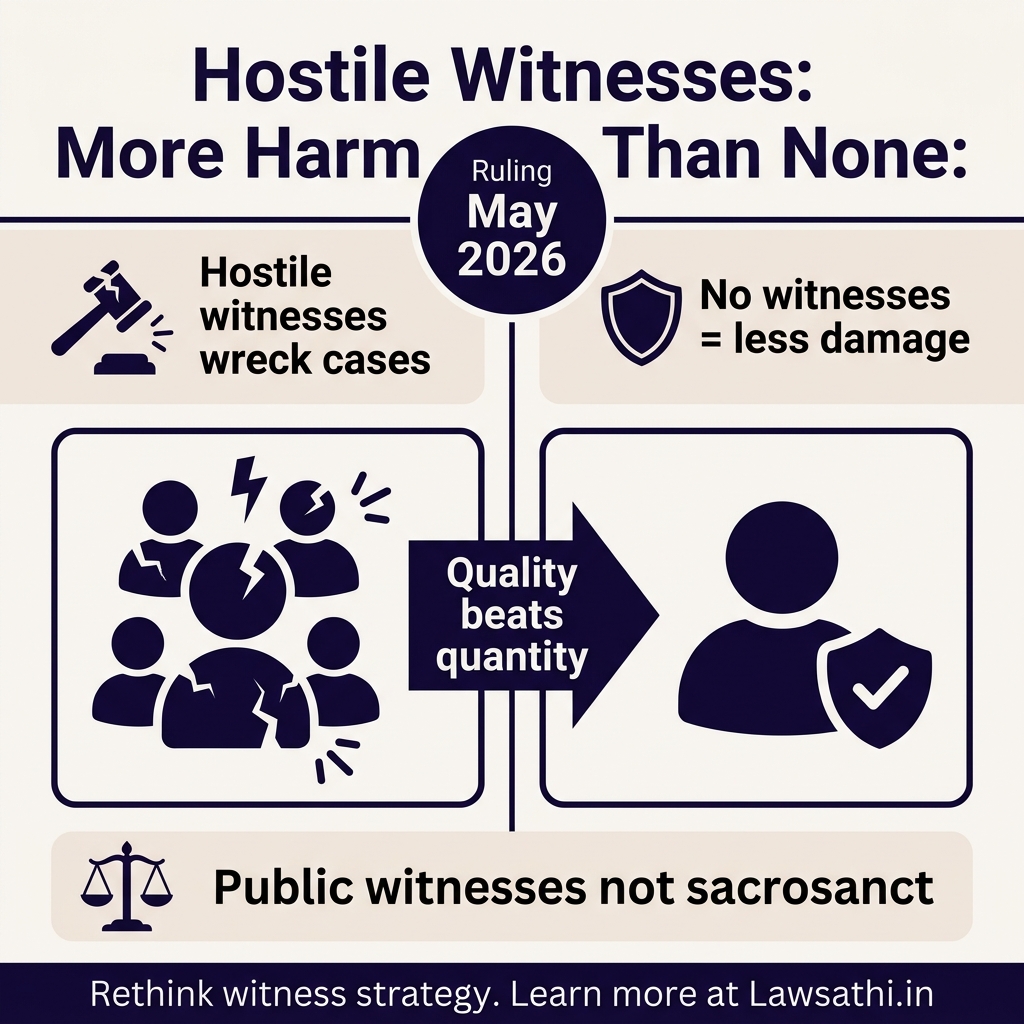
The Delhi High Court recently made a striking observation that challenges conventional wisdom in criminal litigation. In a significant ruling on May 22, 2026, Justice Vimal Kumar Yadav noted a crucial fact. Specifically, having public witnesses who turn hostile may cause more damage than their complete absence. This Delhi High Court hostile witness observation has profound implications for prosecutors and defense counsel. The Court questioned the “sacrosanct” status given to independent public witnesses in criminal trials. Its reasoning suggests that legal practitioners must fundamentally rethink their approach to citing witnesses in charge sheets.
Introduction: The Reliability of Public Witnesses
Indian criminal practice has long favored citing numerous public witnesses in charge sheets. Prosecutors often believe that more witnesses strengthen their case and lend credibility to the investigation. However, this assumption faces serious challenge from recent judicial pronouncements.
The Court’s Fundamental Question
The Delhi High Court posed a critical question in Rajinder Kumar v. State. Justice Yadav asked why the absence of independent public witnesses is invariably argued as grounds to disbelieve the prosecution’s case. The Court’s answer was unambiguous. In fact, there is nothing inherently sacrosanct about such witnesses.
A Pattern of Witness Hostility
The legal system has witnessed numerous instances where supposedly trustworthy public witnesses ruined cases beyond repair. When these witnesses turn hostile, they don’t merely fail to support the prosecution. Instead, they actively damage the entire case narrative.
The Core Thesis
Therefore, the Court emphasized that the focus should shift from quantity to quality. The emphasis must be on having truthful witnesses. Moreover, practitioners should avoid merely accumulating public witnesses who may later resile from their statements.
Understanding ‘Hostile Witness’ Under Indian Law
Before examining the Delhi High Court’s observations, practitioners must understand what constitutes a hostile witness. The term carries specific legal meaning under Indian jurisprudence.
Definition and Legal Framework
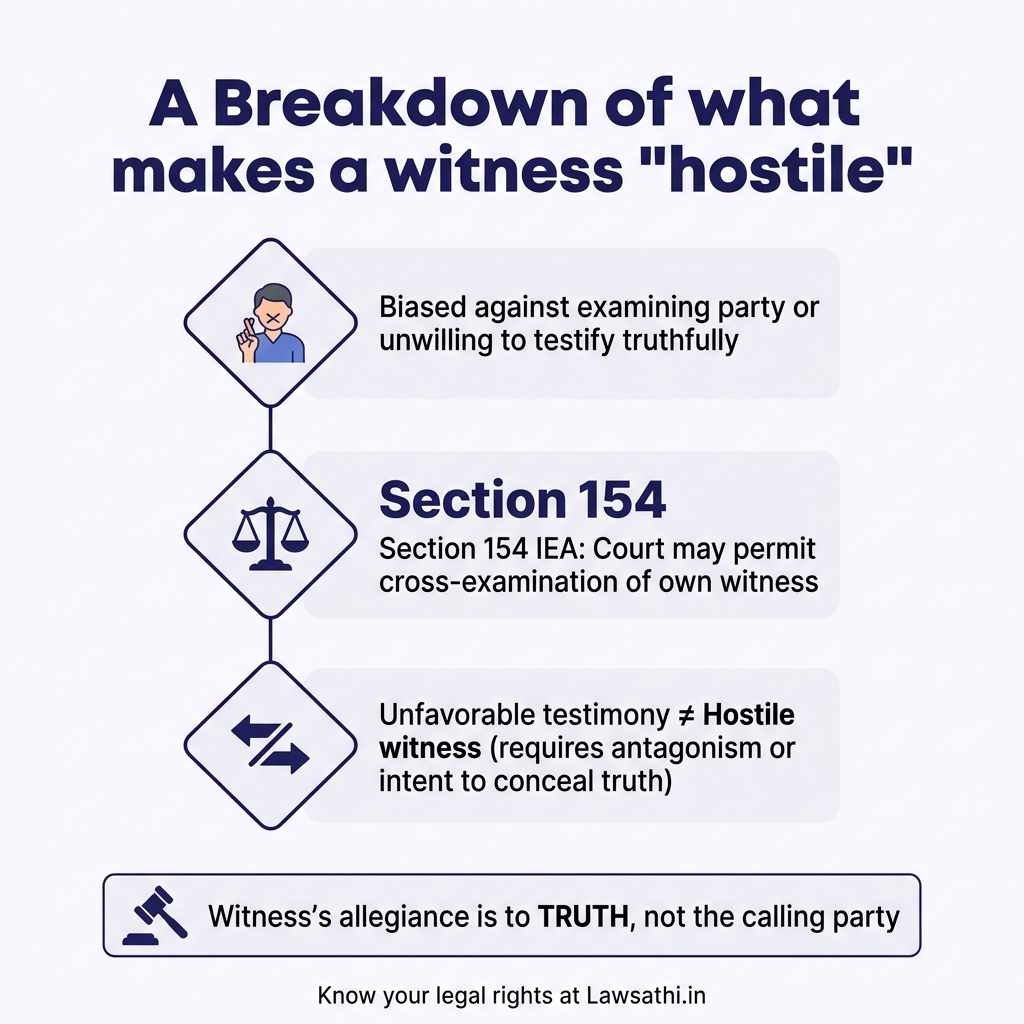
Black’s Law Dictionary defines a hostile witness as one who is biased against the examining party. Alternatively, such a witness may be unwilling to testify truthfully. In Indian law, the concept finds statutory backing in Section 154 of the Indian Evidence Act, 1872.
Section 154: The Statutory Provision
Section 154 grants courts discretionary power to permit the party calling a witness to cross-examine their own witness. The provision states that courts may allow questions “which might be put in cross-examination by the adverse party.”
However, this discretion is not unlimited. The Supreme Court in State of Bihar v. Laloo Prasad Yadav clarified important principles. Permission under Section 154 should ideally be sought when a witness resiles from their expected position during chief examination.
When Does Hostility Arise?
Importantly, mere unfavorable testimony does not make a witness hostile. Hostility requires antagonism or an intention to conceal the truth. Courts infer hostility from the answers given and the witness’s overall demeanor.
Furthermore, a witness’s primary allegiance is to truth, not to the party calling them. This principle underlies the entire framework of declaring witnesses hostile. The prosecution must demonstrate that the witness is “not desirous of telling the truth.” Specifically, this unwillingness must occur at the instance of the party calling him.
The Delhi High Court’s Critical Observation
The Delhi High Court hostile witness ruling emerged from a 23-year-old appeal in a robbery and Arms Act case. The judgment offers valuable insights into witness strategy.
Case Background and Facts
In Rajinder Kumar v. State, the appellant challenged his conviction for robbery and violations of the Arms Act. The case originated from a 2001 incident at a public bus stand. The defense argued that no independent public witness was joined during the arrest. This absence, they contended, weakened the prosecution’s case.
The Court’s Analysis
Justice Yadav dissected the role of public witnesses with remarkable candor. The Court observed that independent public witnesses ordinarily lend credibility to investigations. However, their absence is not fatal. What proves truly damaging is when such witnesses turn hostile after being cited.
Direct Quote from the Judgment
The Court stated: “The legal history, as is contemporary legal system, has seen numerous examples where the so called independent trustworthy, reliable ‘Public Witness’ ruined the deposition and case beyond repair.”
This observation directly challenges the routine practice of citing numerous public witnesses. Consequently, the Court questioned the “fancy” of calling public witnesses who are unwilling to support the prosecution.
The Distinction in Witness Types
Additionally, the Court distinguished between public witnesses and official witnesses like police personnel. In this case, the robbery charges resulted in acquittal due to doubtful identification procedures. However, the Arms Act conviction was upheld based on reliable police testimony.
Supplementary Supreme Court View
The Supreme Court’s recent ruling in Talari Naresh v. State of Telangana reinforces this principle. The apex court noted that hostile witness testimony can support acquittal, not just conviction.
Why Hostile Witnesses Harm the Prosecution’s Case
Understanding why hostile witnesses prove damaging requires examining several mechanisms. The harm extends beyond mere lack of support for the prosecution narrative.
The ‘Numbers Game’ Fallacy
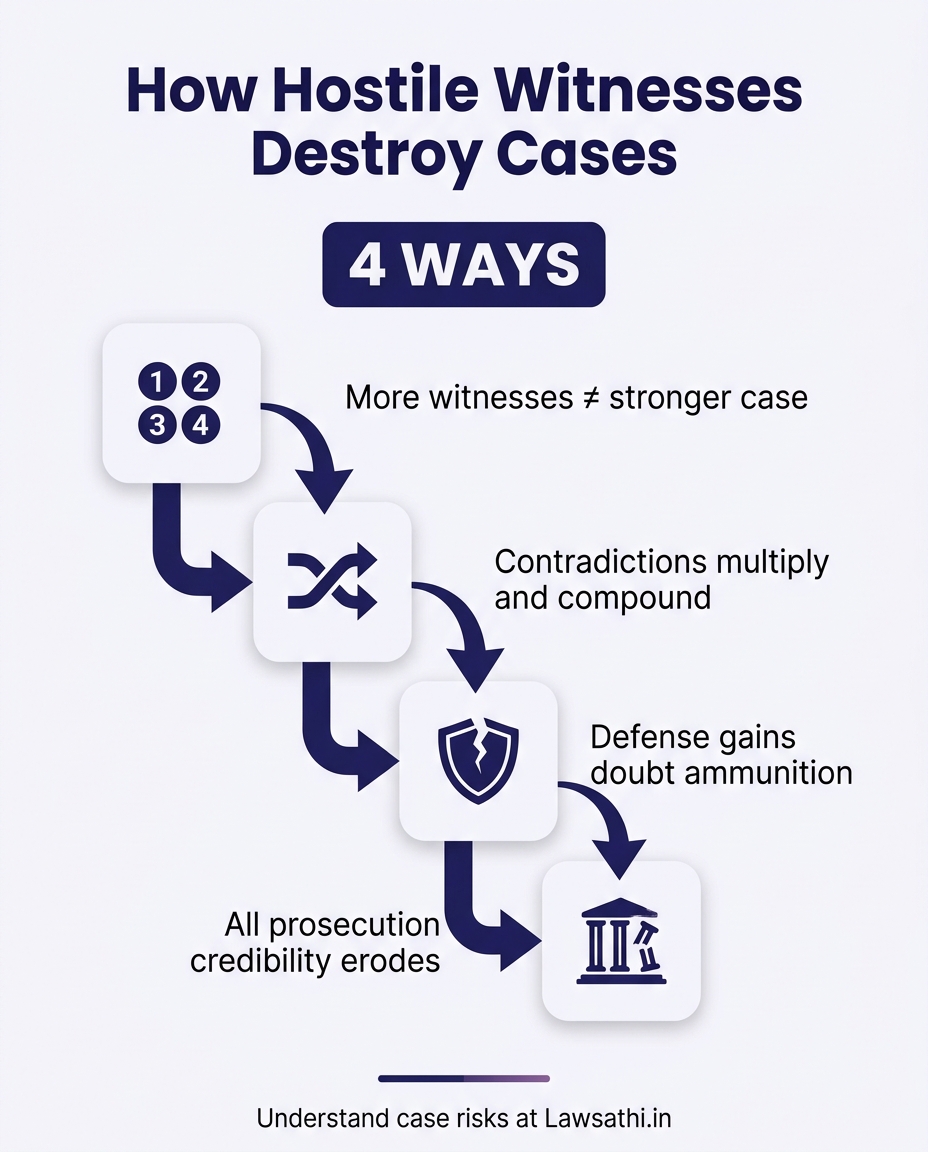
Many prosecutors operate under the mistaken belief that more witnesses equal stronger evidence. However, this approach fundamentally misunderstands how courts evaluate testimony.
For example, multiple hostile witnesses destroy a prosecution narrative more effectively than a single hostile witness. Each contradiction compounds the damage to the case’s credibility.
Creating Foundational Doubt
In the Talari Naresh case, prosecution witnesses 1, 3, 4, and 5 all turned hostile. They contradicted each other on the fundamental question of where the offense occurred. As a result, this destroyed the prosecution’s entire case foundation.
Providing Defense Ammunition
Hostile witnesses essentially gift the defense powerful arguments for reasonable doubt. Defense counsel can exploit contradictions to demonstrate that the prosecution’s entire case lacks reliability. Consequently, the burden of proof becomes harder to satisfy.
Impact on Judicial Assessment
The Delhi High Court has previously held that hostile witness evidence is not entirely inadmissible. Courts may rely on the dependable portion of such testimony. However, this requires careful scrutiny and independent corroboration.
The Erosion of Credibility
Most importantly, when the prosecution cites witnesses who subsequently contradict their own statements, the entire case suffers. Judges may question why other prosecution witnesses should be believed. Specifically, when some have clearly been dishonest, doubt spreads to the entire testimony.
Legal Recourse: Perjury and Section 340 CrPC
A natural question arises: can the state prosecute witnesses for lying under oath? The answer reveals significant practical challenges.
Section 340 CrPC Framework
Section 340 of the Code of Criminal Procedure governs proceedings for offenses affecting the administration of justice. Courts may order inquiries when offences under Section 195(1)(b) CrPC appear to have been committed.
Two Essential Preconditions
The Supreme Court has established two requirements for initiating such proceedings. First, materials must establish a prima facie case. Second, it must be “expedient in the interests of justice” to hold an inquiry.
The High Burden for Perjury Claims
Not every contradictory statement justifies Section 340 proceedings. The Supreme Court in Aarish Asgar Qureshi emphasized this limitation. Therefore, the statement must be “deliberately or intentionally” false to warrant prosecution.
A Notable Judicial Perspective
The Kerala High Court in Thomman v. IInd Addl. Sessions Judge offered a striking perspective. The Court quoted Beaumont, CJ: “To prosecute a man who has resiled from a false statement made under Section 164 is to encourage him in the belief that it pays to tell a lie and stick to it.”
Practical Reality
Consequently, prosecution for perjury remains rare in Indian courts. Courts exercise caution before initiating such proceedings. In most cases, the burden of proving intentional falsehood is simply too high.
Strategic Takeaways for Criminal Law Practitioners
The Delhi High Court hostile witness ruling offers crucial lessons for both prosecutors and defense counsel. Strategic adjustments can significantly improve case outcomes.
Pre-Trial Due Diligence
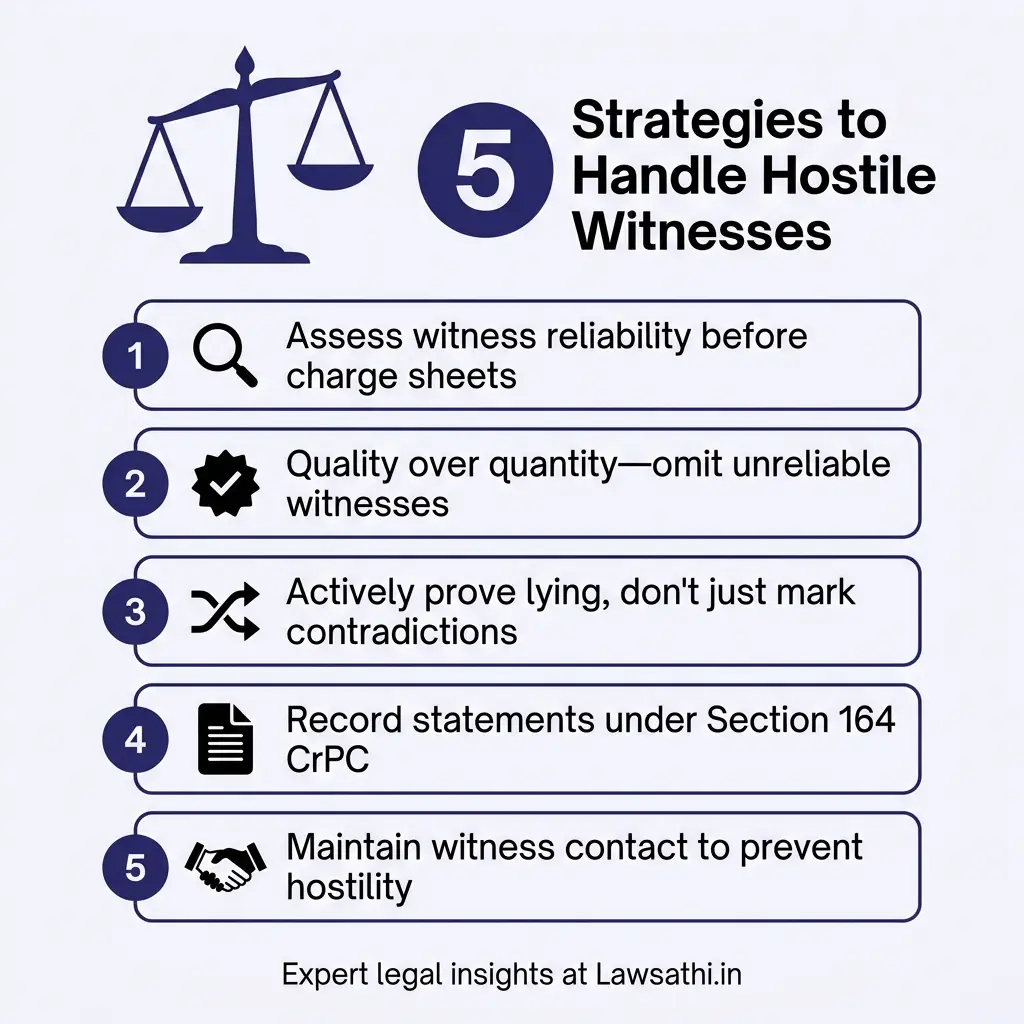
First, prosecutors must assess witness reliability before citing them in charge sheets. This requires interviewing witnesses multiple times and documenting all interactions. However, this assessment must go beyond mere statements.
Strategic Witness Selection
Second, quality must trump quantity in witness selection. The Delhi High Court explicitly suggested that omitting unreliable witnesses is better than including them. Therefore, prosecutors should resist the temptation to cite every potential witness.
Effective Cross-Examination
Third, when witnesses do turn hostile, effective cross-examination becomes crucial. The Supreme Court has held that merely marking contradictions is insufficient. Instead, prosecutors must actively demonstrate that the witness is lying.
The Role of Trial Judges
Additionally, trial judges must take a participatory role rather than acting as “mere tape recorders.” The Supreme Court emphasized that public prosecutors should conduct thorough cross-examination of hostile witnesses.
Documentation Best Practices
Furthermore, meticulous documentation of witness statements becomes essential. Recording statements under Section 164 CrPC before a magistrate provides crucial safeguards for important witnesses. This creates a contemporaneous record that can counter subsequent contradictions.
Support Mechanisms
Finally, maintaining regular contact with witnesses before trial helps prevent hostility. Witnesses often turn hostile due to intimidation, inducement, or simple neglect. Proper support mechanisms, especially for vulnerable witnesses, can mitigate these risks.
Conclusion: Quality Over Quantity in Evidence
The Delhi High Court’s recent observation marks an important shift in criminal trial practice. The ruling recognizes that independent public witnesses are not inherently “sacrosanct.”
The Central Message
Justice Yadav’s words bear repetition: “So having them and not having, has no impact rather, having them and they turning hostile would do more harm than good.” This principle should guide every prosecutor’s witness strategy.
A Paradigm Shift
The ruling signals a fundamental shift from volume-based evidence to credible testimony. Courts increasingly recognize that witness quality matters far more than quantity. Therefore, prosecutors who cite numerous potentially unreliable witnesses do their cases no favors.
Practical Implementation
For criminal law practitioners, the message is clear. Pre-trial assessment of witness reliability is not optional but essential. Strategic decisions about which witnesses to cite can determine case outcomes.
The Duty of Prosecutors
Public prosecutors bear the responsibility of ensuring reliable, truthful testimony forms the foundation of prosecution cases. This requires courage to exclude witnesses who may prove unreliable. Even if their absence invites defense criticism, the long-term benefits outweigh the risks.
Streamline your case preparation and evidence management with LawSathi’s AI-powered tools. Organize witness statements, track case law, and build stronger arguments for your criminal practice. Start your free trial today.