Introduction: The Rise of India's First International Financial Services Centre
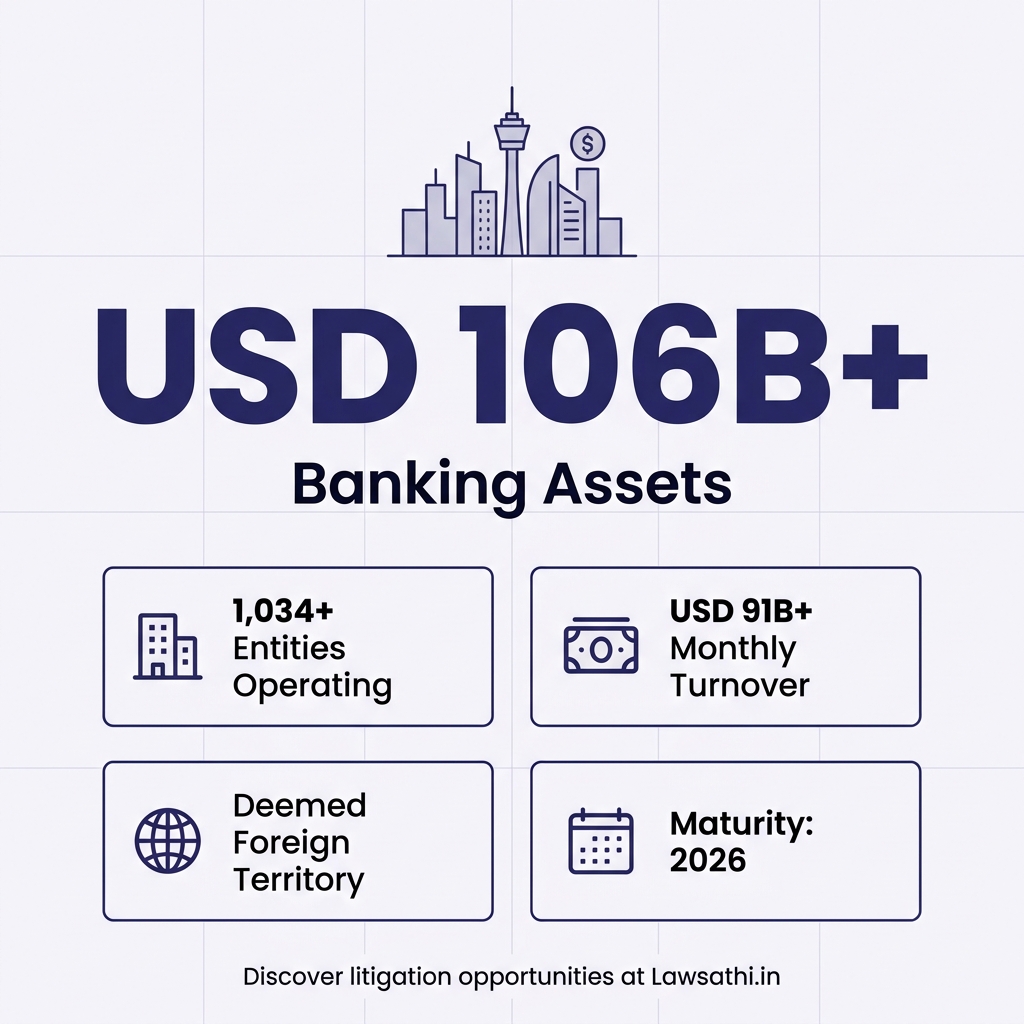
Litigation opportunities in GIFT City have surged dramatically as India's first International Financial Services Centre (IFSC) reaches maturity in 2026. What began as an ambitious project in Gujarat has transformed into a bustling financial hub. Today, it hosts over 1,034 registered entities. Furthermore, it manages banking assets exceeding USD 106 billion. For Indian legal professionals, this represents a paradigm shift in practice potential.
GIFT City operates under a unique legal framework unlike any other jurisdiction in India. Specifically, it is treated as a "deemed foreign territory" located physically on Indian soil. Consequently, transactions here occur in foreign currencies, not Indian Rupees. This distinction creates a fascinating intersection of domestic and international law. Moreover, it opens new avenues for cross-border litigation India has not seen before.
Therefore, understanding this ecosystem is crucial for lawyers seeking to expand their practice. The jurisdictional separation from domestic courts creates specialized demand. As a result, early movers in this space stand to gain significant first-mover advantages.
The Legal Framework: Understanding the IFSCA Authority
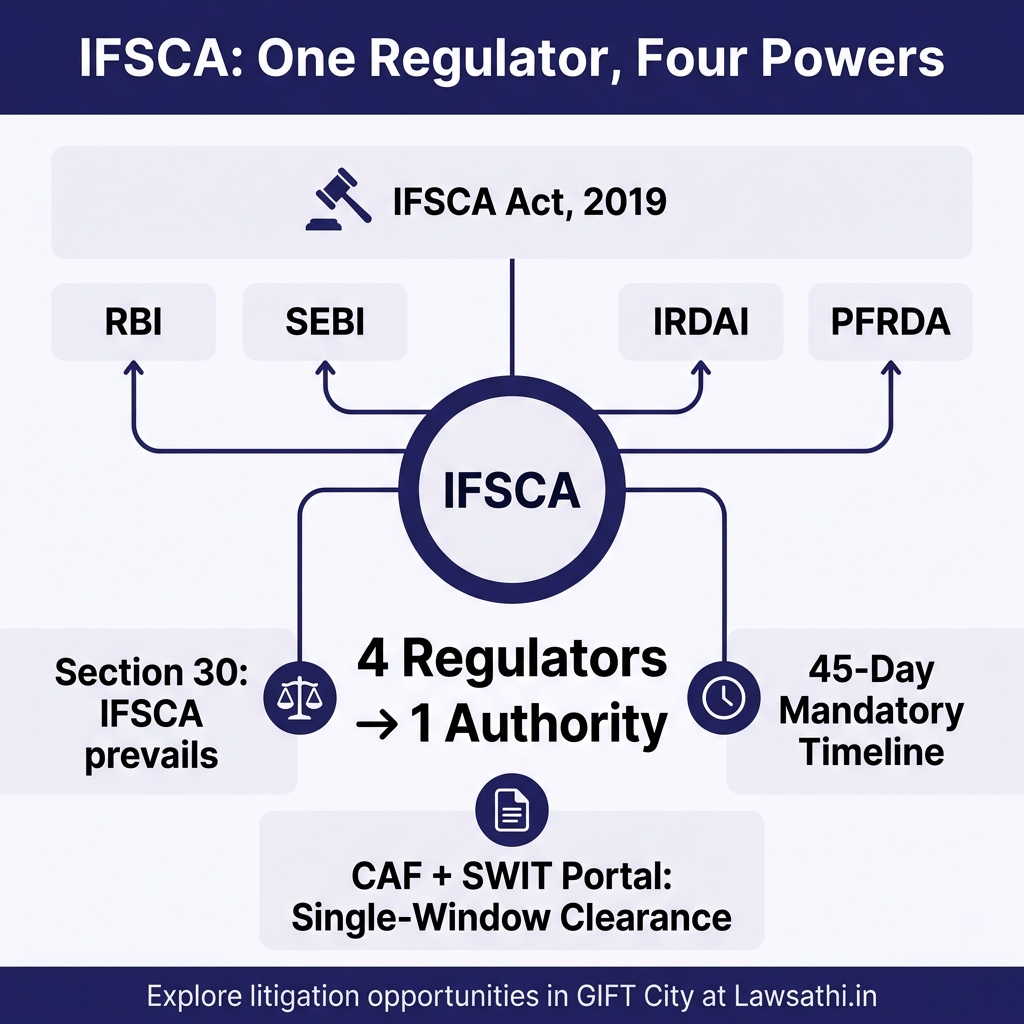
The cornerstone of legal practice in GIFT City is the International Financial Services Centres Authority (IFSCA). Established under the IFSCA Act, 2019, this unified regulator changed the game. Before IFSCA, financial institutions had to navigate multiple regulatory bodies. Now, a single entity wields the combined powers of four major regulators.
Unified Regulatory Powers and Their Impact
Specifically, the IFSCA exercises the powers of the RBI, SEBI, IRDAI, and PFRDA. This consolidation streamlines regulatory approvals and dispute resolution processes. For litigators, this means dealing with one authority instead of four separate ones. However, it also requires a broad understanding of various financial sector laws.
In addition, the Act explicitly excludes IFSC from the jurisdiction of domestic financial regulators. Therefore, lawyers must master the specific IFSCA regulations rather than standard domestic provisions. Moreover, the IFSCA has an overriding effect under Section 30 of its Act. Its provisions prevail over anything inconsistent in other laws.
This legal supremacy ensures a consistent regulatory environment for international businesses. Consequently, litigation opportunities in GIFT City often involve interpreting these new, specialized regulations. Lawyers must navigate this hierarchy carefully when advising clients or arguing cases.
The Single-Window Clearance Mechanism
The Authority has implemented a Common Application Form (CAF) for most entities. This single-window mechanism simplifies entry for financial institutions. For legal professionals, this transparency reduces procedural hurdles. However, it also means that disputes may arise from these very application processes.
In addition, the SWIT Portal facilitates swift decision-making. The regulator must decide within 45 days of submission. This efficiency attracts global businesses but also demands faster legal responses. Therefore, lawyers practicing here must adapt to this accelerated timeline compared to traditional Indian courts.
Inside the International Financial Services Courts
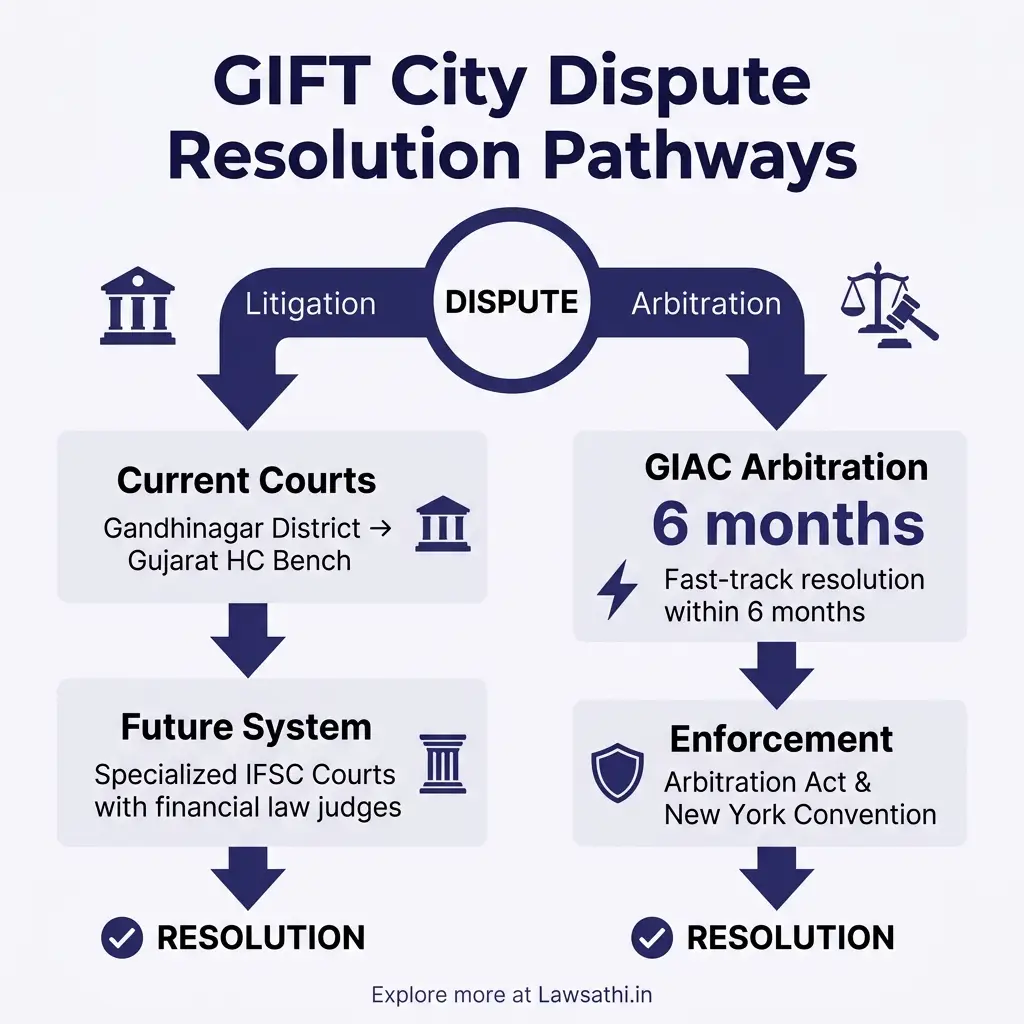
Understanding the court structure is vital for tapping into litigation opportunities in GIFT City. Currently, the Indian legal system applies within the IFSC. However, the jurisdictional flow differs from standard domestic disputes. Initially, matters fall under the jurisdiction of the Gandhinagar District Courts.
The Role of Gujarat High Court
For appeals and higher-level disputes, the Gujarat High Court serves as the primary forum. It has a designated bench hearing matters related to IFSC disputes. Furthermore, commercial disputes are handled under the Commercial Courts Act, 2015 framework. This court plays a pivotal role in shaping the jurisprudence for this new financial hub.
Therefore, lawyers based in Gujarat or those willing to travel have a distinct advantage. They can build expertise in the specific procedures of this designated bench. Moreover, the High Court's interpretations of IFSCA regulations set precedents. These precedents will guide future litigation strategies across the IFSC.
The Future: A Standalone IFSC Court System
While the current system functions adequately, a dedicated judiciary is on the horizon. The proposed International Financial Services Centre Courts Bill aims to create a specialized court structure. As of 2026, discussions continue regarding this standalone system. Once established, it will function similarly to specialized commercial courts globally.
This development will significantly enhance litigation opportunities in GIFT City. Specifically, it promises faster resolution times and judges with specific financial law expertise. Consequently, Indian lawyers should prepare now for this evolution. Building a practice in this evolving landscape requires foresight and adaptation.
Key Practice Areas for Litigators in GIFT City
The diversity of financial activities in GIFT City creates multiple litigation practice areas. Lawyers can specialize in niche sectors that were previously inaccessible in India. Furthermore, the scale of operations—USD 91+ billion in monthly exchange turnover—guarantees disputes.
Banking and Financial Services Disputes
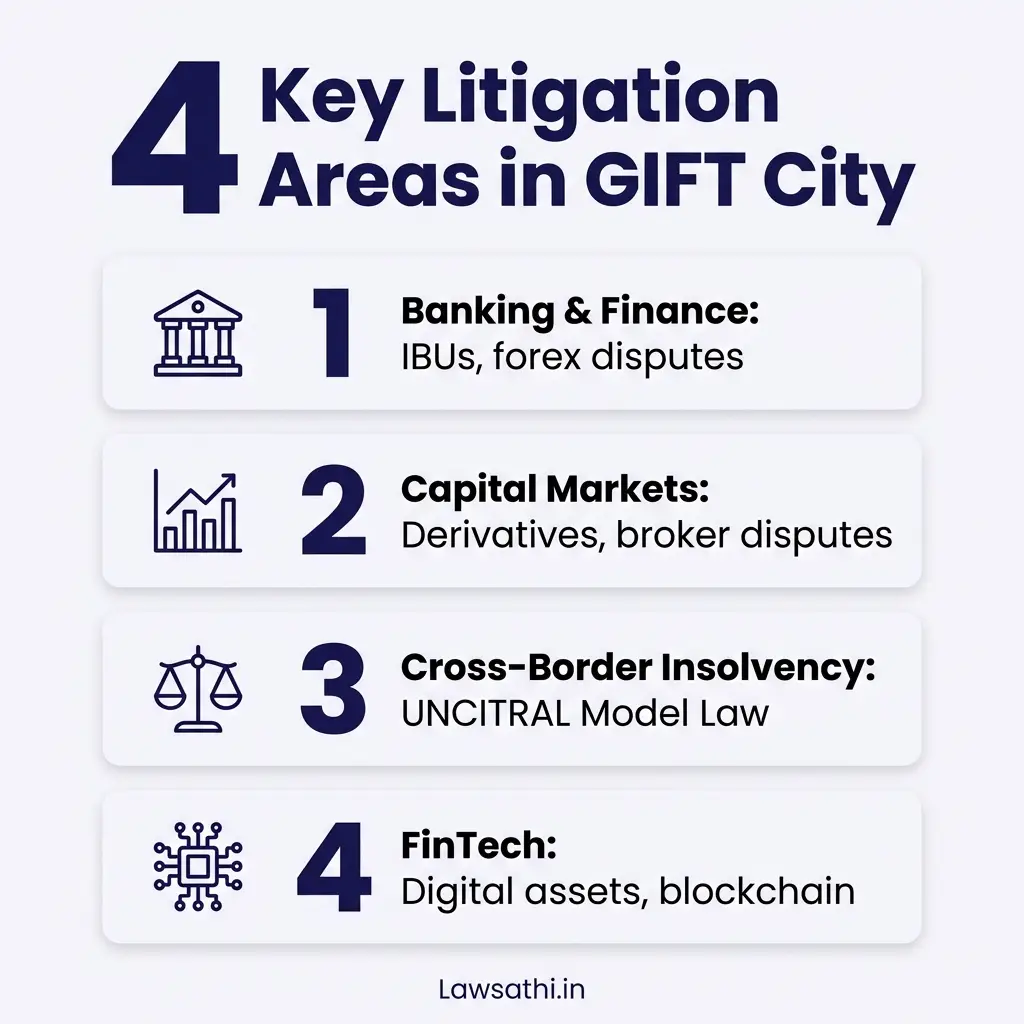
IFSC Banking Units (IBUs) form the backbone of this financial centre. Both Indian and foreign banks operate here, offering offshore banking services. Disputes often involve external commercial borrowings and trade finance documentation. Additionally, complex forex transactions and derivative products generate litigation.
For example, cross-border lending agreements may involve multiple jurisdictions. Litigators must navigate these intricate contractual matrices. Furthermore, the treatment of IFSC units as "persons resident outside India" adds complexity. As a result, this status affects how banking disputes are adjudicated under FEMA regulations.
Capital Markets and Securities Litigation
Two major international exchanges operate within GIFT City. Consequently, capital markets litigation is a high-growth area. Disputes may arise from index derivatives, single stock derivatives, and commodity futures. Moreover, the International Bullion Exchange also presents unique legal challenges.
Lawyers must understand the Capital Market Intermediaries Regulations, 2021. Broker disputes, depository issues, and listing violations fall under this scope. In contrast to standard SEBI litigation, the global nature of these exchanges means applying international securities law principles.
Cross-Border Insolvency and Bankruptcy
This is perhaps the most critical area for new-age litigators. India is moving towards adopting the UNCITRAL Model Law on Cross-Border Insolvency. The Insolvency Law Committee recommended this alignment years ago. Now, GIFT City is the testing ground for these complex proceedings.
A landmark case in 2025, Compuage Infocom Limited, proved this potential. For the first time, a Singapore High Court recognized an Indian insolvency proceeding. This mutual recognition opens doors for international bankruptcy lawyers. In addition, the IBBI Cross-Border Insolvency Report outlines the framework. Consequently, lawyers proficient in cross-border insolvency will find immense opportunities here.
FinTech, Cryptocurrency, and Digital Asset Disputes
GIFT City is also a FinTech hub. The IFSCA has a dedicated framework for FinTech entities. As a result, disputes involving digital lending, robo-advisory, and crowdfunding are rising. Moreover, the IFSCA FinTech Incentive Scheme, 2022 has attracted numerous startups.
Consequently, legal issues around digital assets and blockchain are emerging. Lawyers must understand the regulatory sandbox mechanism. They must also grasp the nuances of limited use authorizations. Therefore, this sector offers a frontier for tech-savvy legal practitioners.
Arbitration vs. Litigation: The Preferred Route in GIFT City
While litigation has its place, arbitration is often the preferred route in GIFT City. The government explicitly prioritized alternative dispute resolution here. In fact, the Union Budget 2022-23 announced an International Arbitration Centre (IAC).
The GIFT City International Arbitration Centre (GIAC)
The GIFT City International Arbitration Centre aims to rival Singapore and London. It offers cost-effective and speedy dispute resolution. The objective is to place GIFT IFSC on par with global hubs. Therefore, lawyers must be well-versed in international arbitration rules.
The IIAC (Conduct of Arbitration) Regulations, 2023 govern proceedings here. Fast-track arbitration can conclude within six months. This speed is a massive advantage for commercial entities. Furthermore, day-to-day hearing provisions expedite the process significantly.
Enforcement of Awards and Judgments
Enforcement is a critical factor in choosing between arbitration and litigation. Awards from GIAC can be enforced under the Arbitration and Conciliation Act, 1996. Since GIFT City is a "deemed foreign territory," enforcement of foreign awards may also become smoother. As a result, the New York Convention framework applies, facilitating global enforceability.
However, litigators should not ignore the Gujarat High Court's supervisory role. The Court handles appeals and interim reliefs. Therefore, a hybrid approach understanding both systems is best. Lawyers can offer comprehensive advice only if they master both avenues.
Practical Guide: How Indian Lawyers Can Tap Into GIFT City
Entering this market requires strategic planning and specific credentials. Litigation opportunities in GIFT City are accessible but competitive. Therefore, Indian lawyers must follow a structured approach to establish themselves.
Registration and Eligibility Requirements
Currently, advocates enrolled with the Bar Council of India can practice in Indian courts. This includes the courts having jurisdiction over GIFT City. However, for advisory roles with IFSC units, the process differs. Specifically, law firms can set up branches or incorporate entities in the IFSC.
They must register under the Ancillary/Support Services category. The process involves submitting the Common Application Form via the SWIT Portal. Engaging with the IFSCA Development Team is a recommended first step. Furthermore, the Authority typically decides on applications within 45 days.
Essential Skills for IFSC Practice
Success in GIFT City requires more than just Indian law knowledge. First, lawyers must understand international commercial law principles. Knowledge of UNCITRAL instruments is non-negotiable. Furthermore, comparative financial regulation—understanding US, UK, and Singapore frameworks—is highly valuable.
In addition, proficiency in cross-border transaction structures is essential. Lawyers should familiarize themselves with the Master Circular for Investment Advisers. Moreover, continuous learning through IFSCA workshops and IIM-Ahmedabad programs is advisable. The competition is global, so skills must be world-class.
Building a Client Base in the Financial Hub
Networking is critical in a new financial centre. Target clients include IFSC Banking Units, fund management entities, and FinTech startups. For example, attending IFSCA events like the InFinity Forum is crucial. These events provide direct access to decision-makers.
Furthermore, collaborating with international law firms can be a strategic entry point. Many foreign firms are setting up practices in GIFT City. Indian litigators can offer local support and court representation. Consequently, this symbiotic relationship can help build a robust client pipeline.
Challenges and Considerations for Legal Professionals
While the opportunities are vast, the challenges are equally real. Therefore, lawyers must be aware of the hurdles before diving in.
Competition from International Law Firms
Foreign law firms are permitted to operate in GIFT IFSC. They provide advisory services on international law and their home jurisdiction's law. Consequently, Indian lawyers face competition from established global players. However, differentiation through local expertise and cost-effectiveness is key.
Operational Costs and Infrastructure
GIFT City demands premium infrastructure. The commercial real estate costs are significant. The IFSCA Tower is a state-of-the-art facility, but operating there is expensive. Therefore, law firms must factor in these high overheads when planning their expansion.
Moreover, the expectation is for 24/7 operations to match global markets. IFSC exchanges offer 22-hour trading. As a result, law firms may need to staff multiple shifts. This increases salary costs and operational complexity.
Conclusion: The Future of Legal Practice in India's Financial Gateway
Litigation opportunities in GIFT City represent the future of Indian legal practice. The market potential is immense, with India's international financial services market projected to grow exponentially. Furthermore, banking assets have already crossed USD 106 billion.
For early adopters, the strategic advantage is clear. Building relationships now with incoming financial institutions ensures long-term clients. Moreover, gaining expertise in emerging areas like aircraft leasing and sustainable finance positions lawyers as specialists. As a result, the intersection of technology, finance, and law in GIFT City offers a unique career trajectory.
Therefore, Indian lawyers must upskill and adapt. The transition from domestic practice to international financial litigation is challenging but rewarding. In conclusion, GIFT City is not just a location. Rather, it is a glimpse into the globalized future of Indian law.
Ready to modernize your practice for high-stakes international litigation? Streamline your case management and client billing with LawSathi – the preferred software for future-ready Indian law firms. Start your free trial today.