The Supreme Court's recent judgments on BNSS Section 528 have provided much-needed clarity on the inherent powers of High Courts to quash FIRs. For criminal practitioners across India, these rulings offer critical guidance on when and how to invoke these extraordinary powers. The transition from the Code of Criminal Procedure, 1973 to the Bharatiya Nagarik Suraksha Sanhita, 2023 brought uncertainty. Specifically, lawyers questioned the scope of inherent jurisdiction. However, the apex court has now reaffirmed that the substantive powers remain unchanged.
Understanding these developments is essential for lawyers handling quashing petitions, anticipatory bail matters, and criminal appeals. This post examines the Supreme Court's key observations. Furthermore, it covers established grounds for quashing FIRs and practical strategies for criminal practice management under the new regime.
Introduction: A Landmark Clarification on Inherent Powers
The Supreme Court delivered a significant ruling in March 2025. It clarified the scope of inherent powers under BNSS Section 528. In Imran Pratapgarhi v. State of Gujarat Criminal Appeal No. 1545 of 2025, the Court held that High Courts can quash FIRs. Notably, this applies even at the nascent stage of investigation. Consequently, this ruling overturned the conventional wisdom that courts must wait for investigation to complete before exercising inherent powers.
Why This Judgment Matters for Criminal Practitioners
For decades, criminal lawyers have relied on Section 482 of the CrPC. Specifically, they used it to protect clients from frivolous prosecutions. However, the enactment of BNSS from July 1, 2024 created uncertainty. Many questioned whether these powers survived the transition. Therefore, the Supreme Court's clarification removes all doubt on this critical issue.
According to LiveLaw's analysis, the Court emphasized a key point. Inherent powers exist to prevent abuse of legal process. These powers are not conferred by statute. Instead, they are inherited by High Courts as the highest courts in their respective states.
The Transition from CrPC to BNSS
Importantly, the Bharatiya Nagarik Suraksha Sanhita, 2023 replaced the CrPC completely from July 1, 2024. Now, BNSS Section 528 serves as the successor to Section 482 CrPC. However, practitioners must understand both provisions. This is because transitional cases create jurisdictional complexity.
Furthermore, the Supreme Court has made it clear. The fundamental nature of inherent powers remains untouched. What has changed is the procedural framework. Specifically, it is the framework within which these powers operate. Consequently, criminal lawyers must now navigate both old and new regimes. This depends on when their cases originated.
Understanding BNSS Section 528: The New Avatar of Section 482 CrPC
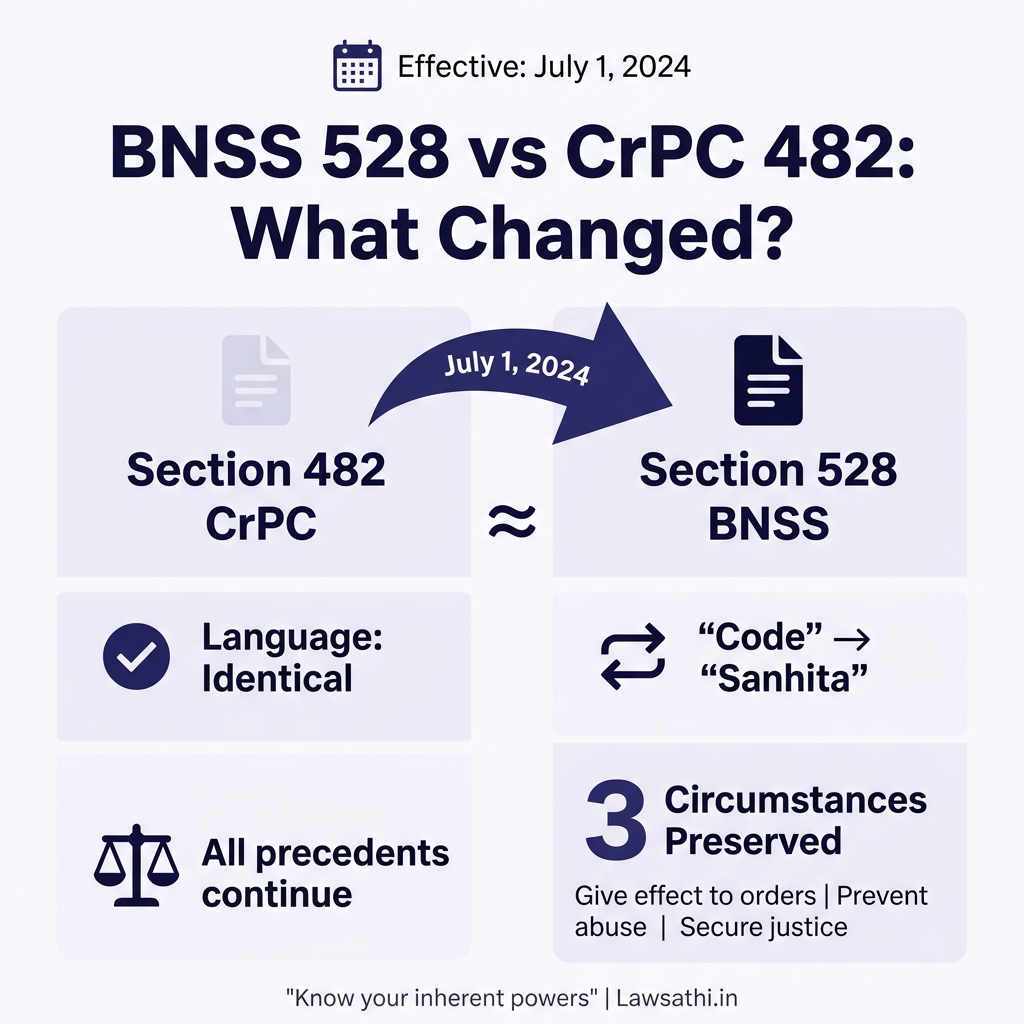
Fortunately, BNSS Section 528 preserves the inherent powers of High Courts. It uses identical language to its predecessor. The official text of the provision states:
"Nothing in this Sanhita shall be deemed to limit or affect the inherent powers of the High Court to make such orders as may be necessary to give effect to any order under this Sanhita, or to prevent abuse of the process of any Court or otherwise to secure the ends of justice."
Three Circumstances for Exercise of Power
The provision identifies three distinct circumstances where inherent powers can be invoked. First, it applies to give effect to any order under the Sanhita. Second, it allows intervention to prevent abuse of the process of any Court. Third, it acts to otherwise secure the ends of justice. Notably, these three categories remain identical to those under Section 482 CrPC.
Legislative Intent Behind the Provision
Moreover, the legislative history reveals a clear intent to preserve judicial discretion. Section 561-A of the 1898 CrPC first recognized inherent powers. Subsequently, Section 482 in the 1973 Code followed. For instance, India Code's official repository confirms this. Parliament intended continuity rather than change.
The word "saving" in the provision's title is significant. It indicates that these powers existed before the statute. Furthermore, they continue despite it. Therefore, High Courts do not derive these powers from the BNSS. Instead, they merely retain powers inherent to their constitutional position.
The Supreme Court's Key Observations on Section 528
The Supreme Court's 2025 rulings offer detailed guidance. Specifically, they explain how BNSS Section 528 should operate in practice. These observations build upon decades of precedent. In addition, they adapt principles to the new statutory framework.
No Absolute Bar at Investigation Stage
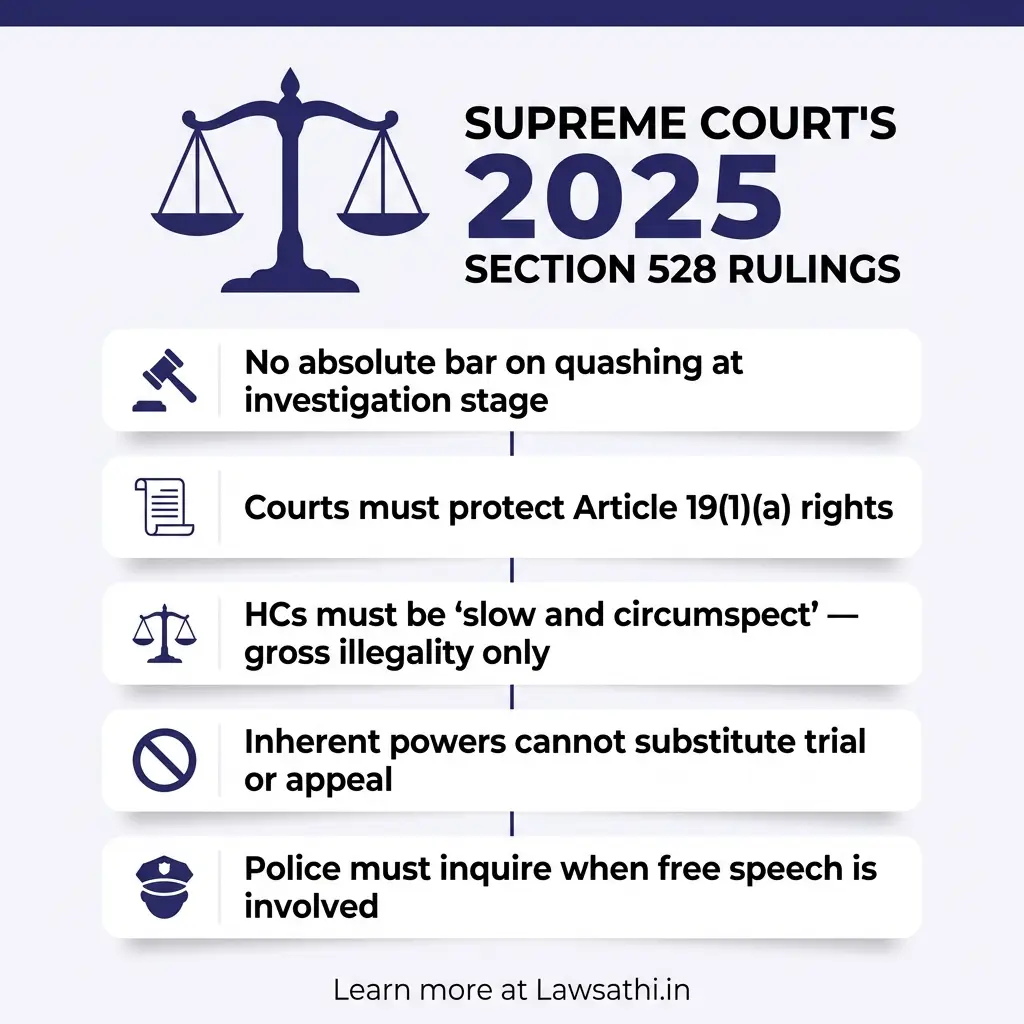
In Imran Pratapgarhi, the Court rejected an argument. Specifically, they rejected the claim that quashing petitions must await investigation completion. According to LiveLaw's coverage, the Court held a clear view. Each case depends on its facts and circumstances.
To illustrate, the judgment stated: "When the High Court, in the given case, finds that no offence was made out on the face of it, to prevent abuse of the process of law, it can always interfere even though the investigation is at the nascent stage." Consequently, this clarification empowers practitioners. They can seek early intervention in appropriate cases.
Protection of Fundamental Rights Under Article 19(1)(a)
The Imran Pratapgarhi case involved specific allegations. It concerned promoting enmity through recitation of a poem. However, the Court emphasized a vital principle. Police officers must honour fundamental rights while exercising statutory powers. As noted in SCC Times' analysis, the Court held that courts are duty-bound. They must protect freedom of speech and expression.
Therefore, this observation has significant implications. It affects practitioners defending clients in cases involving fundamental rights. For example, the Supreme Court indicated a procedural safeguard. Higher police officers should conduct preliminary inquiries when allegations touch upon Article 19(1)(a) freedoms. This procedural safeguard strengthens the case for quashing frivolous FIRs. Specifically, it applies to FIRs that target legitimate speech.
Standard for Exercise of Inherent Powers
In Shaurabh Kumar Tripathi v. Vidhi Rawal 2025 INSC 734, the Court laid down a cautious approach. High Courts must be "very slow and circumspect" when exercising inherent powers. However, interference is warranted only in specific cases. These involve "gross illegality or gross abuse of process of law."
The Court clarified a key limitation. Inherent powers cannot be used as a substitute for trial or appeal. Generally, High Courts should adopt a "hands-off approach" during ongoing proceedings. However, intervention becomes imperative in certain scenarios. This applies when there is apparent abuse of process or necessity to secure justice.
Grounds for Quashing FIRs Under Section 528: Established Categories
The Supreme Court has consistently recognized specific categories. These are where BNSS Section 528 can be invoked. For instance, these categories derive from a landmark judgment. This is State of Haryana v. Ch. Bhajan Lal 1990 INSC 363. Understanding these categories helps practitioners assess the merits of quashing petitions.
Category 1: Absence of Prima Facie Offence
First, the most common ground arises when the FIR discloses no offence. This applies even if the FIR is accepted in toto. If essential ingredients of the alleged offence are missing, the High Court can quash proceedings. According to SCC Online's analysis, this category applies broadly. It applies regardless of the investigation stage.
For example, an FIR may allege cheating. However, if it contains no allegation of inducement or deception, quashing is appropriate. Therefore, the Court can examine the complaint document. It does so without delving into evidentiary matters.
Category 2: Abuse of Process of Law
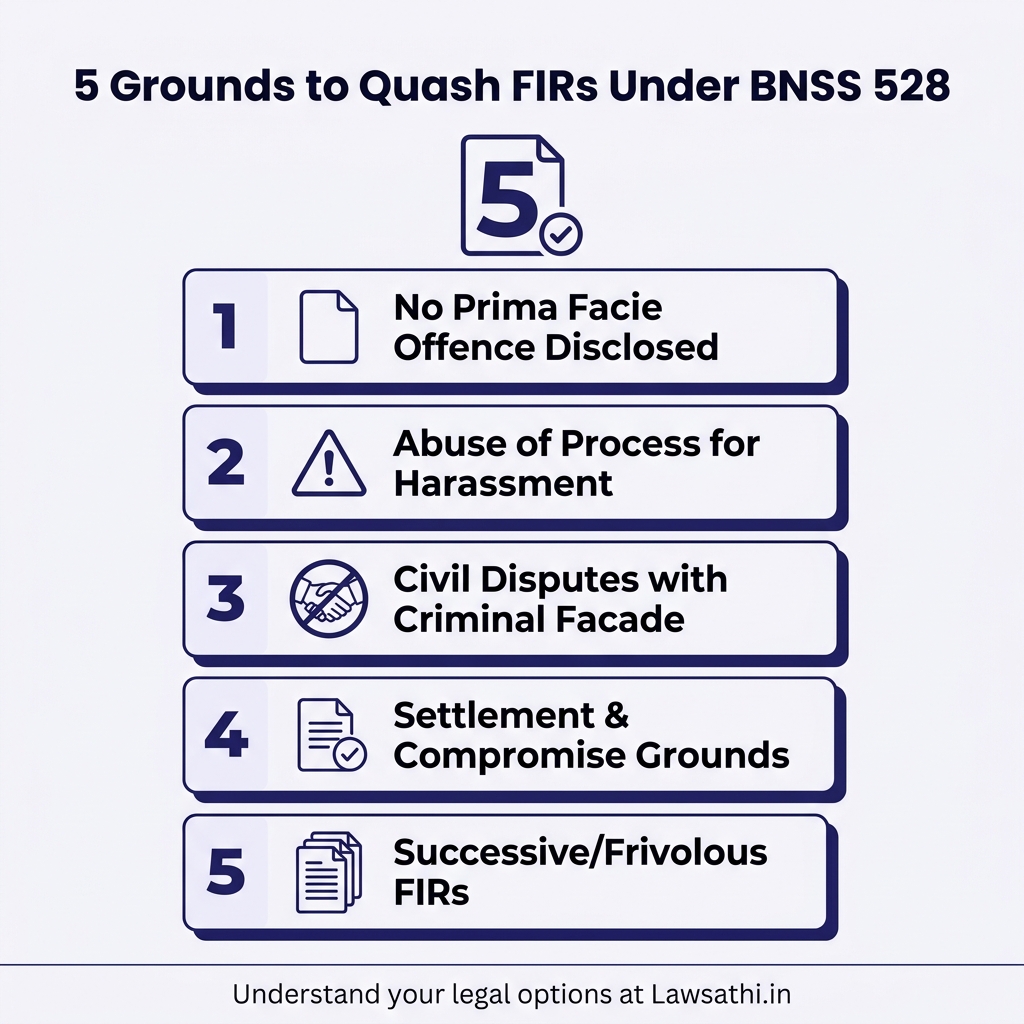
Moreover, criminal proceedings cannot become weapons for settling personal scores. SCC Times notes that courts must intervene. This applies when prosecutions are initiated with ulterior motives.
This category covers cases where criminal law is used improperly. Specifically, it is used as a counterblast to other proceedings. In addition, it includes situations where complainants weaponize the legal process. They may do so for extortion or harassment. Therefore, practitioners should gather evidence of mala fide intent. This helps support such petitions.
Category 3: Civil Disputes with Criminal Facade
Unfortunately, many FIRs arise from purely civil disputes. Parties often seek to criminalize them for leverage. The Supreme Court has repeatedly held a key principle. Criminal courts are not collection agencies. For example, in G. Sagar Suri v. State of U.P., the Court quashed proceedings. These essentially involved commercial disputes.
Therefore, practitioners should emphasize the civil nature of transactions. This is crucial when seeking quashing on this ground. Documentation showing contractual relationships strengthens the case significantly. Similarly, pending civil suits or commercial arbitration help.
Category 4: Settlement and Compromise
Furthermore, compoundable offences can be quashed when parties reach settlement. However, for non-compoundable offences, the Court exercises discretion. This is based on several factors. SCC Times reports that courts consider various elements. These include the nature of the offence, impact on society, and rehabilitation prospects.
Category 5: Successive and Frivolous FIRs
Additionally, a second FIR on identical allegations constitutes abuse of process. Consequently, the High Court can quash such redundant prosecutions. It does so under inherent powers. Similarly, FIRs filed solely to harass the accused warrant intervention. This applies when there is no genuine grievance.
Practical Implications for Criminal Practitioners
The Supreme Court's clarification on BNSS Section 528 requires action. Specifically, practitioners must adapt their strategies. Understanding procedural nuances can make the difference. It determines success or failure in quashing petitions.
Strategic Assessment Before Filing
First, before approaching the High Court, practitioners must carefully evaluate their case. They should determine which legal provision applies. This depends on the FIR date. Second, they must assess whether adequate grounds exist for quashing. Third, they should consider whether alternative remedies should be exhausted first.
Timing Considerations for Quashing Petitions
Furthermore, the stage of proceedings significantly impacts the approach. SCC Times explains an important distinction. Before cognizance, both Article 226 and Section 528 remain available. However, after cognizance, only Section 528 BNSS applies. Consequently, this distinction affects the constitutional remedies available to petitioners.
For matters at the investigation stage, the Imran Pratapgarhi judgment helps. It removes the previous hesitation. However, practitioners must demonstrate a key point. They must show no offence is made out from the FIR's face. Mere allegations without prima facie ingredients support early intervention.
Evidence and Documentation Requirements
Moreover, successful quashing petitions require robust documentary support. Essential documents include the FIR copy and charge-sheet. Additionally, the cognizance order and settlement agreements are important. Furthermore, practitioners should submit material that undermines the complaint's factual foundation.
For cases involving mala fide prosecution, evidence is crucial. Specifically, evidence of prior disputes between parties helps. For instance, communications and settlement attempts demonstrate the complainant's motives. Similarly, parallel proceedings help. Therefore, courts respond favorably to comprehensive documentation. It reveals the prosecution's true nature.
BNSS Section 528 vs Section 482 CrPC: What Has Changed?
Practitioners often ask a common question. Does BNSS Section 528 differ substantively from its predecessor? The short answer is no. However, transitional provisions create practical complexity. This requires careful navigation.
Substantive Comparison of Both Provisions
| Aspect | Section 482 CrPC | Section 528 BNSS | |--------|------------------|------------------| | Language | "Nothing in this Code..." | "Nothing in this Sanhita..." | | Substance | Identical | Identical | | Effective Date | Until June 30, 2024 | From July 1, 2024 |
The only textual difference is the reference terms. It uses "Code" versus "Sanhita." However, the three circumstances for exercise of power remain identical. Therefore, all precedents under Section 482 CrPC continue to apply. They fit BNSS Section 528 proceedings.
Transitional Complexity Under Section 531
Unfortunately, Section 531 of BNSS contains repeal and savings provisions. These have generated conflicting interpretations. SCC Times' analysis highlights the disagreement. This exists among High Courts.
For example, the Rajasthan High Court held a specific view. It said FIRs registered before July 1, 2024 remain governed by CrPC entirely. In contrast, the Punjab & Haryana High Court took another view. It held that each procedural step follows the law in force at that time. Similarly, the Allahabad High Court distinguished between investigation and cognizance stages.
Practical Recommendation for Practitioners
Given the conflicting interpretations, practitioners should cite both provisions. They should do this in quashing petitions. Petitions involving FIRs from both periods should reference both. Section 482 CrPC and BNSS Section 528 should be cited alternatively. This approach ensures protection regardless of which interpretation prevails.
Furthermore, practitioners must monitor Supreme Court resolution of this conflict. The divergent High Court views will likely reach the apex court. They seek authoritative determination. Until then, protective citation remains the safest strategy.
Common Mistakes to Avoid When Filing Under Section 528
Unfortunately, even experienced practitioners make errors when filing quashing petitions. However, understanding these pitfalls improves success rates and client outcomes.
Procedural Errors That Weaken Petitions
First, the most common error involves citing the wrong provision. Post-July 1, 2024 matters require BNSS Section 528 reference. However, some practitioners continue citing Section 482 CrPC. They often do this out of habit. While courts may overlook this error, it reflects poorly. It shows a lack of professional diligence.
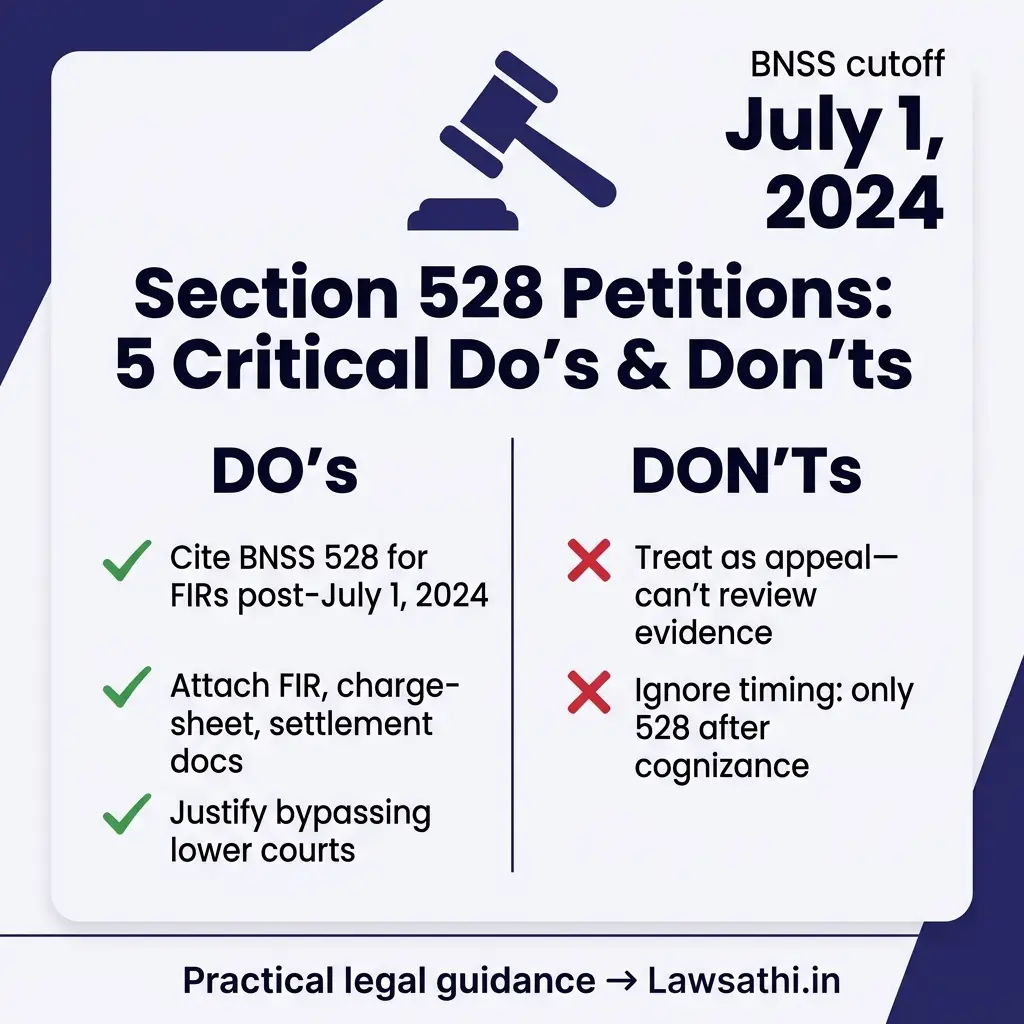
Another significant mistake involves failing to place key documents on record. For instance, the cognizance order is essential for post-cognizance petitions. Similarly, the charge-sheet must accompany petitions filed after filing of charges. Consequently, incomplete documentation gives courts reason to defer consideration.
Misunderstanding the Scope of Inherent Powers
Furthermore, many practitioners treat inherent powers as appellate jurisdiction. This fundamental misunderstanding leads to inappropriate petitions. LiveLaw reports that the Supreme Court has laid down a four-step test. High Courts must follow this.
Inherent powers cannot be used to examine evidence. Similarly, they cannot assess witness credibility. That remains the exclusive domain of trial courts. Instead, practitioners must demonstrate abuse of process. Alternatively, they must show complete absence of offence from the record itself.
Overlooking Alternative Remedies
Moreover, courts discourage bypassing available remedies without adequate justification. If revision or appeal provides relief, inherent powers should not be invoked. According to SCC Times, practitioners must explain a key point. They must show why direct High Court approach is necessary.
Acceptable reasons include urgency or exceptional circumstances. Additionally, multiplicity of proceedings counts. However, mere convenience does not justify bypassing statutory remedies. Therefore, practitioners should always address this aspect in their petitions.
Conclusion: Adapting Your Practice to the New Framework
The Supreme Court's clarification on BNSS Section 528 provides essential guidance. Criminal practitioners should take note. The fundamental principles remain unchanged from the CrPC era. However, practitioners must adapt to the new statutory framework.
Key Takeaways from the Supreme Court Clarification
First, inherent powers exist to prevent abuse and secure justice. They are not a substitute for trial. Second, quashing is permissible even at the investigation stage. This applies when no offence is made out. Third, the transition from CrPC to BNSS has not altered substantive powers. Fourth, practitioners must cite appropriate provisions. This should be based on case timelines.
Importance of Staying Updated on BNSS Jurisprudence
Moreover, the new criminal statutes continue to generate judicial interpretation. India Code provides the authoritative text. However, practitioners need more than statutory language. Regular monitoring of Supreme Court and High Court judgments ensures current knowledge. This helps with developing jurisprudence.
Criminal practice requires constant learning and adaptation. The transition from colonial-era criminal procedure to the BNSS framework demands attention. Practitioners must note subtle changes. Consequently, practitioners who master these nuances gain competitive advantage in advocacy.
Technology as an Enabler for Modern Criminal Practice
Furthermore, managing criminal cases across multiple courts requires efficient systems. Tracking case status and managing deadlines can overwhelm traditional methods. Similarly, maintaining document repositories is difficult. Fortunately, technology solutions offer practical assistance for modern practitioners.
AI-powered tools can help practitioners track judgments efficiently. Additionally, they help manage case documents and monitor court schedules. Such systems reduce administrative burden while improving client service quality.
Stay ahead of evolving criminal law jurisprudence with LawSathi's AI-powered case tracking and legal research tools. Sign up for a free trial to streamline your practice and never miss a critical court update.