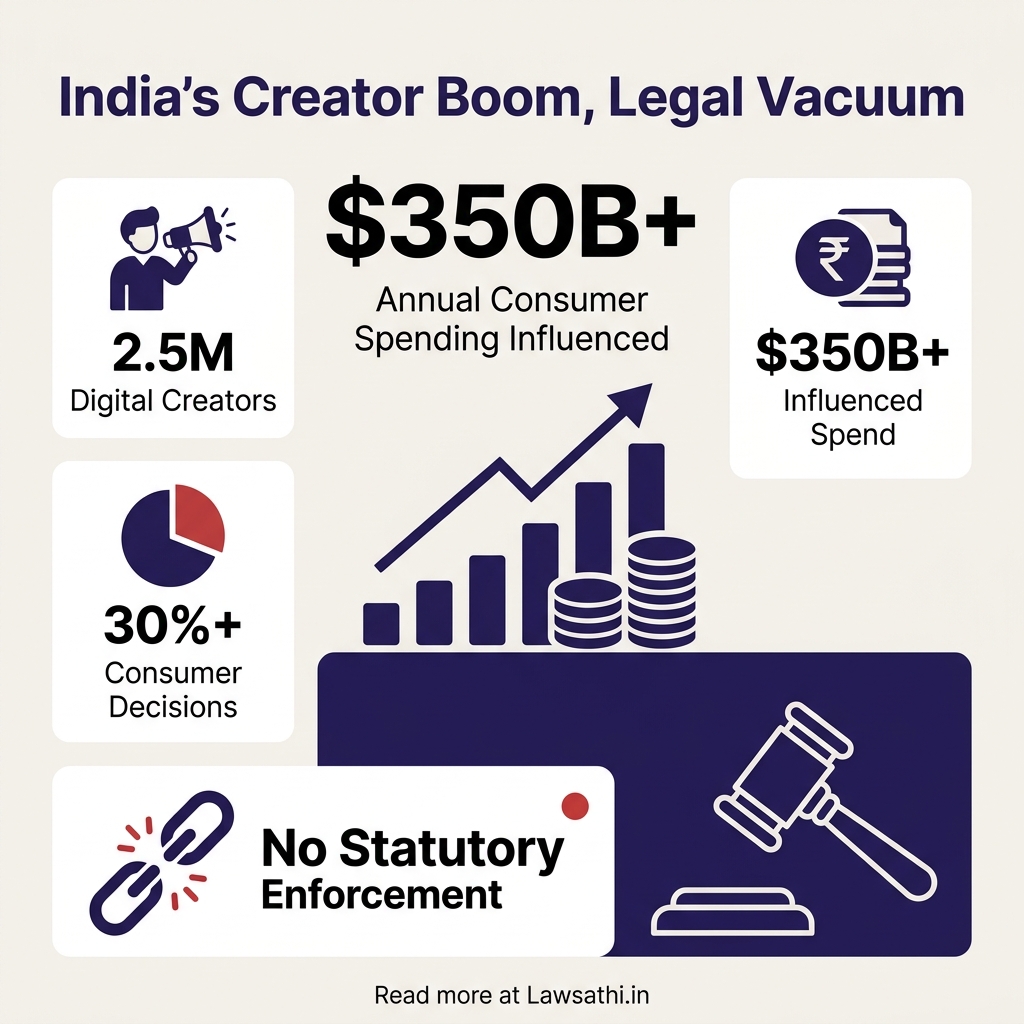
India's digital creator economy has exploded over the past three years. According to a BCG report released at WAVES 2025, India now hosts 2 to 2.5 million active digital creators. These creators influence over $350 billion in consumer spending annually [^1]. Furthermore, this figure is projected to surpass $1 trillion by 2030. However, this rapid growth created a legal vacuum regarding accountability for misleading endorsements. The Supreme Court's landmark ruling in the Patanjali misleading advertisements case has now fundamentally changed the legal landscape. Specifically, it clarifies how influencer liability under the Consumer Protection Act 2019 will be interpreted by courts across India. This decision establishes that social media influencers bear the same legal responsibility as traditional celebrity endorsers. They face identical consequences when promoting products with false claims.
Introduction: The Changing Landscape of Digital Endorsements
The Rise of India's Creator Economy
The influencer marketing industry in India has undergone a dramatic transformation between 2023 and 2026. Digital advertising revenue rose 26% to reach ₹947 billion. Meanwhile, digital media crossed the ₹1 trillion mark [^2]. Brands have scaled up their investments in creator marketing by 1.5 to 3 times during this period. Consequently, creators now influence more than 30% of consumer decisions in key product categories.
However, this influence came without clear legal accountability. Before the Supreme Court's intervention, influencers operated in a regulatory grey area. The Advertising Standards Council of India (ASCI) had issued guidelines in 2021. Yet, these were self-regulatory in nature. Additionally, they lacked statutory enforcement mechanisms. This created an uneven playing field. Traditional celebrities faced greater scrutiny than digital creators with millions of followers.
The Legal Vacuum Before the Ruling
The Consumer Protection Act 2019 introduced specific provisions for endorsers. However, no judicial pronouncement had explicitly clarified whether social media influencers fell within the definition of "endorser" under Section 2 of the Act. This ambiguity allowed many digital creators to avoid accountability for promoting questionable products. For example, some influencers claimed they merely provided "content" rather than formal endorsements. Others argued they lacked the technical expertise to verify product claims.
The Supreme Court's judgment in Indian Medical Association v. Union of India has now eliminated this ambiguity. Therefore, the Court's pronouncement creates binding precedent that lawyers must understand thoroughly. This understanding is essential when advising clients in the creator economy.
Case Background: Facts and Legal Questions Before the Court
The Patanjali Misleading Advertisements Case
The Indian Medical Association (IMA) filed a writ petition raising serious allegations against Patanjali Ayurved and its founders. The petition claimed that Patanjali conducted a false campaign against COVID-19 vaccination and modern medicine [^3]. Furthermore, the company advertised products as cures for serious diseases without any scientific evidence supporting these claims. Such representations were potentially dangerous. Consumers might abandon proven medical treatments in favor of unverified alternatives.
The advertisements in question violated multiple statutes. These included the Drugs and Magic Remedies (Objectionable Advertisements) Act, 1954, and the Consumer Protection Act 2019. Moreover, the Court found that Patanjali had continued publishing misleading advertisements even after giving undertakings to stop such practices.
Core Legal Questions on Endorser Liability
The Supreme Court addressed several fundamental questions about endorsement accountability. The primary issue was whether influencers and celebrities could be held liable for misleading claims made in advertisements [^4]. Additionally, the Court examined what constituted "due diligence" as a defense under the Consumer Protection Act 2019. The definition of "endorser" under Section 2(9) became central to this analysis.
Section 2(18) defines "endorsement" broadly. It includes any message or depiction that makes consumers believe it reflects the endorser's opinion or experience [^5]. This definition encompasses verbal statements, demonstrations, and use of one's name or likeness. The question was whether social media content fell within this statutory framework.
Arguments Presented Before the Court
The influencer's counsel raised several constitutional and practical arguments. First, they contended that freedom of speech under Article 19(1)(a) protected their promotional activities. Furthermore, they argued that influencers lacked the technical expertise to independently verify complex product claims. Many creators simply relied on information provided by brands. They had no reason to doubt its accuracy.
However, the Consumer Protection Authority presented counter-arguments emphasizing consumer vulnerability. They noted that influencers have significant impact on purchasing decisions. This is particularly true among younger demographics. Additionally, material connections with brands create fiduciary-like responsibilities toward audiences. The Authority stressed that digital reach often exceeds traditional media exposure. As a result, the potential harm becomes more widespread.
The Supreme Court Verdict: Interpreting Liability Under CPA 2019
Equating Influencers with Traditional Endorsers
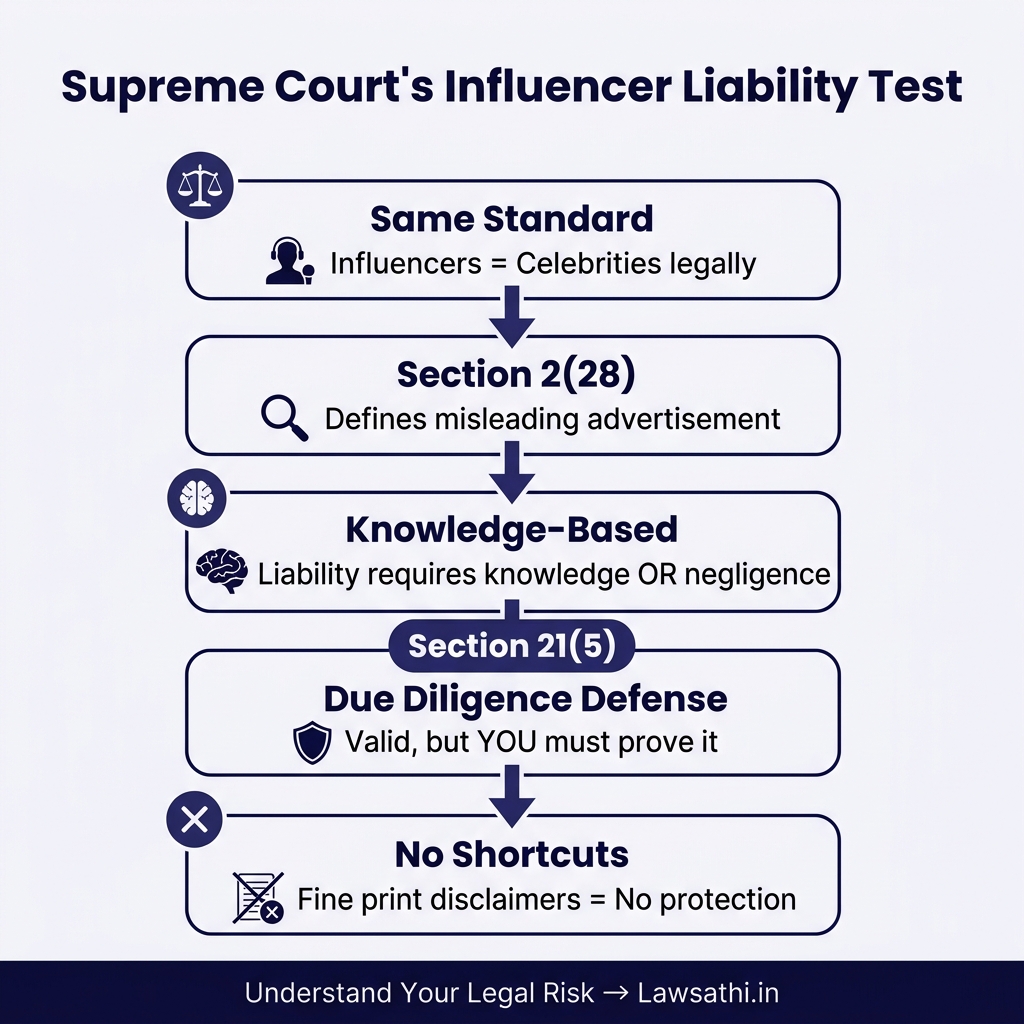
The Supreme Court delivered an unambiguous ruling on endorser accountability. Justices Hima Kohli and Ahsanuddin Amanullah observed that endorsements by public figures, influencers, and celebrities "go a long way in promoting a product" [^6]. Therefore, these individuals must "act with responsibility" when lending their name or image to any product or service.
The Court explicitly stated that influencers and celebrities are "equally responsible for issuing false and misleading advertisements." This pronouncement eliminates any distinction between digital creators and traditional celebrity endorsers. The reasoning is straightforward. Endorsements create significant impact in consumer minds regardless of the medium used. For instance, a YouTube video with millions of views influences consumer behavior as much as a television commercial featuring a film star.
Understanding Misleading Advertisement Under Section 2(28)
The Court's analysis relied heavily on the statutory definition of "misleading advertisement" in Section 2(28). This provision covers advertisements that falsely describe goods or services [^7]. It also includes representations about characteristics that products do not actually possess. Additionally, the section addresses false claims about the usefulness or necessity of products.
Advertisements that give guarantees or warranties not based on reasonable grounds fall within this definition. Price misrepresentations and concealment of material information also constitute misleading advertisements. The Court emphasized that celebrity endorsements amplify the reach and credibility of such misleading claims. Therefore, endorsers must share accountability for the resulting consumer harm.
Due Diligence as a Statutory Defense
Section 21(5) of the Consumer Protection Act 2019 provides a specific defense for endorsers [^8]. This provision states that no endorser shall be liable to penalty if they have "exercised due diligence to verify the veracity of the claims" made in the advertisement. However, the Supreme Court clarified that the burden of proving due diligence rests entirely on the endorser.
This represents a significant shift in evidentiary burden. Consequently, the accused influencer must now demonstrate proactive verification efforts. Passive reliance on brand-provided information will not satisfy the due diligence requirement. The Court indicated that endorsers must take reasonable steps appropriate to their knowledge and expertise. For health and financial products, this standard would naturally be higher than for consumer goods with obvious characteristics.
The Nature of Liability Under the Ruling
Importantly, the Supreme Court rejected the argument for strict liability. Endorser liability is not automatic or absolute under the Consumer Protection Act 2019. Instead, liability attaches when the endorser knew about the misrepresentation or failed to exercise due diligence. This knowledge-based standard provides some protection for genuine endorsers who verify claims reasonably.
However, the practical effect is significant. Courts will likely presume knowledge or negligence in many cases. The endorser must then produce evidence of verification efforts. Therefore, this creates a documentation requirement that lawyers must advise their clients about proactively.
Impact of the Guidelines on Prevention of Misleading Advertisements, 2022
CCPA Guidelines and Their Interaction with the Ruling
The Central Consumer Protection Authority (CCPA) issued comprehensive Guidelines on Prevention of Misleading Advertisements and Endorsements in June 2022 [^9]. These guidelines provide specific obligations for endorsers. The Supreme Court ruling now reinforces these obligations with judicial authority. Together, they create a robust regulatory framework for influencer marketing in India.
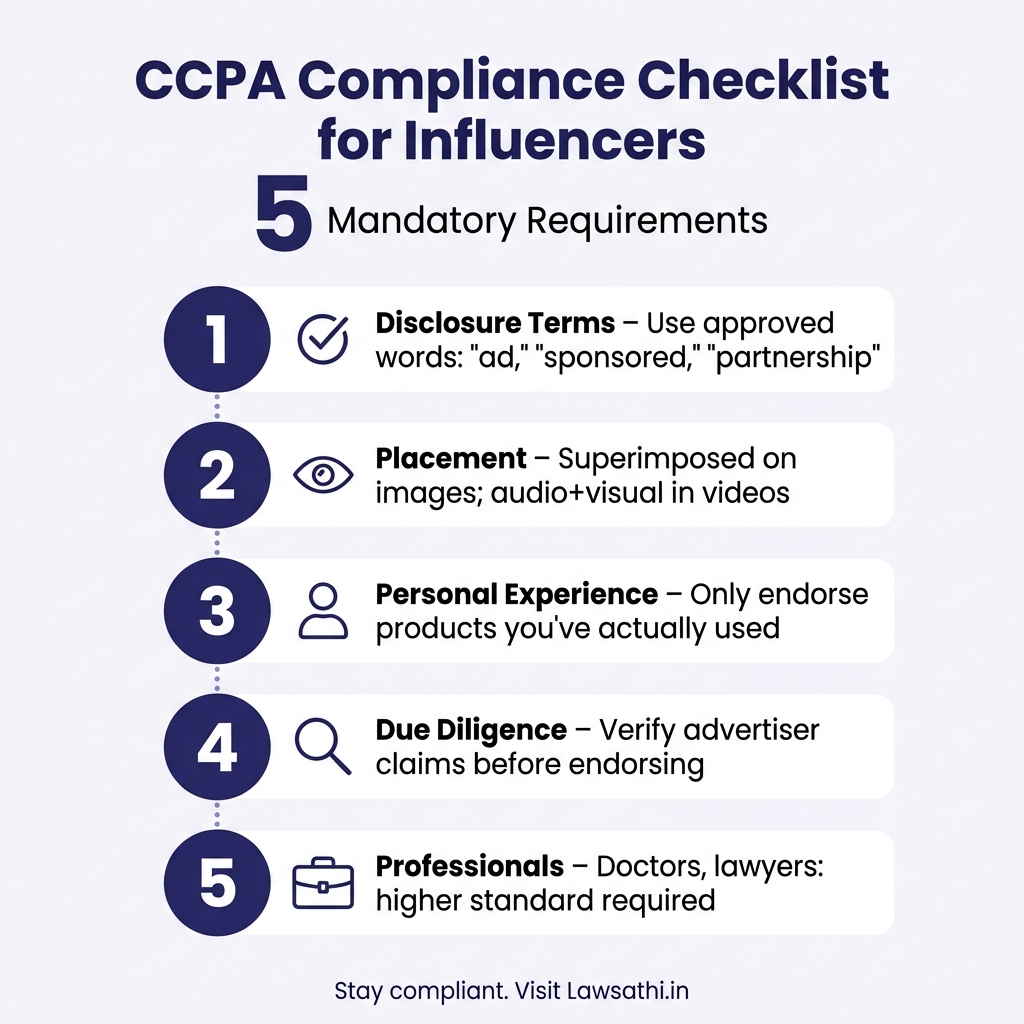
The guidelines require that endorsements reflect the endorser's "actual experience" with the product or service. Virtual or claimed experience without personal use violates this requirement. Additionally, celebrities and influencers must "review and satisfy themselves" that advertisers can substantiate all claims made in advertisements [^10]. This due diligence obligation is now backed by potential penalties.
Disclosure Requirements for Influencers
The CCPA guidelines mandate specific disclosure practices for sponsored content. Influencers must use clear terms like "advertisement," "ad," "sponsored," "collaboration," or "partnership" [^11]. These disclosures cannot be buried among other hashtags or links. Instead, they must appear prominently where consumers cannot miss them.
For image-based posts, disclosures should be superimposed over the image itself. Video content requires both audio and visual disclosures. Furthermore, live streamers must maintain visible disclosures throughout the entire broadcast. These format-specific requirements ensure transparency regardless of the medium used for promotion.
Personal Experience Verification Requirements
The guidelines establish a fundamental principle. Endorsers must not promote products they have not personally used or experienced. This requirement prevents influencers from accepting payment for endorsing products they have no knowledge about. Moreover, the Supreme Court's ruling strengthens this principle. It makes false claims about personal experience actionable under the CPA 2019.
For professional advisors like lawyers and doctors, the standard is even higher. Endorsed claims must be based on actual professional assessment or verification. Simply accepting testimonials from others without independent verification would likely fail the due diligence test established by the Court.
Enforceability of Disclaimer Norms
The Supreme Court addressed the issue of disclaimers and their legal effectiveness. Vague disclaimers in small print do not absolve endorsers of liability. Similarly, rapidly spoken verbal disclaimers offer no protection. The Court indicated that disclaimers must be meaningful and sufficiently prominent to inform consumer understanding. This guidance affects how lawyers should advise clients on endorsement contract drafting.
Penalties and Legal Consequences: What Lawyers Need to Know
Breakdown of Penalties Under Section 21
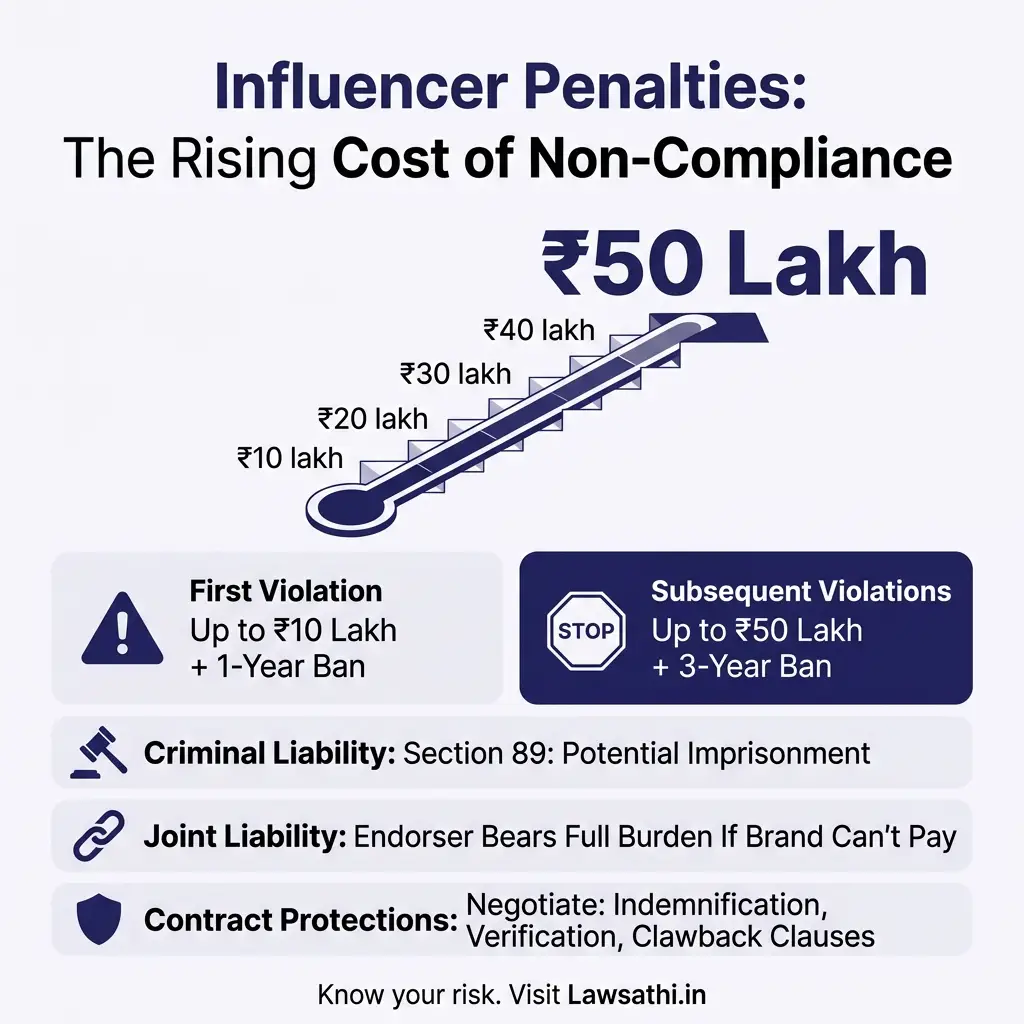
The Consumer Protection Act 2019 prescribes substantial penalties for misleading advertisements and endorsers [^12]. For a first contravention, manufacturers and endorsers face penalties up to ₹10 lakh. Subsequent violations attract penalties up to ₹50 lakh. These amounts represent a significant escalation from earlier consumer protection legislation.
Beyond monetary penalties, endorsers face potential prohibition from future endorsements. First-time violators may be barred from endorsements for up to one year. Repeat offenders face prohibition periods extending to three years. This reputational damage can far exceed any monetary penalty. This is particularly true for professional influencers whose income depends on brand partnerships.
Criminal Liability Under Section 89
Section 89 of the Consumer Protection Act 2019 introduces criminal punishment for false or misleading advertisements [^13]. This provision enables imprisonment in addition to monetary fines. While primarily targeting manufacturers and advertisers, endorsers could potentially face criminal proceedings in egregious cases. This applies when they had knowledge of false claims.
The criminal liability provisions underscore why lawyers must treat influencer compliance as a serious matter. A consumer complaint could escalate beyond the Central Consumer Protection Authority to criminal courts. Therefore, preventive legal counsel becomes essential for anyone operating in the influencer marketing space.
Joint and Several Liability Framework
The Act establishes joint and several liability for manufacturers, sellers, and endorsers. In other words, consumers can pursue compensation claims against any or all parties involved in promoting misleading products. An endorser with deep pockets could face the entire liability burden if the manufacturer cannot compensate affected consumers.
Consumer Disputes Redressal Commissions at district, state, and national levels adjudicate these claims [^14]. Jurisdiction depends on claim value. Cases range from up to ₹1 crore at district level to claims above ₹10 crore at the national level. The two-year limitation period begins when the cause of action arises.
Contract Implications for Endorsement Agreements
The Supreme Court ruling necessitates comprehensive changes to standard endorsement contracts. Lawyers drafting these agreements must now incorporate specific protective provisions. First, indemnification clauses should require brands to compensate endorsers for any penalties resulting from misleading claims. Additionally, verification rights must allow endorsers to review all advertising content before publication.
Mandatory product trial periods before endorsement should become standard practice. Lawyers should also negotiate access to testing data, certifications, and scientific studies supporting product claims. Furthermore, termination rights allowing withdrawal from agreements when claims prove misleading protect both reputation and legal exposure. Clawback provisions for fees paid can provide additional financial protection.
Practical Implications for Legal Practitioners
Drafting Compliance Checklists for Clients
Lawyers advising influencers and creators must develop comprehensive compliance frameworks. The pre-endorsement due diligence process should include verification of product claims through independent sources. Clients must obtain written assurances from brands about claim substantiation. Moreover, personal use and experience with the product before endorsement should be documented.
Regulatory verification is essential. Lawyers should check for FSSAI, FDA, or other relevant certifications depending on product category. Review of existing complaints or legal issues against the brand provides crucial risk assessment. These steps create an evidentiary record supporting the due diligence defense.
Building a Defense Strategy for Influencer Clients
When defending influencers facing penalty proceedings, lawyers must focus on documentation. Records of product testing or research conducted before endorsement provide critical evidence. Written verification requests sent to brands demonstrate proactive due diligence efforts. Additionally, independent expert consultations on complex claims strengthen the defense significantly.
The defense of "lack of knowledge" requires showing that the influencer had no reason to doubt the claims made. Evidence of reliance on professional advice from lawyers or technical experts supports this position. However, willful blindness cannot substitute for genuine verification efforts. Courts will examine whether the influencer acted reasonably given their expertise and the product category involved.
The Role of Consumer Commissions
Consumer Disputes Redressal Commissions serve as the primary forum for misleading advertisement complaints [^15]. Lawyers representing complainants must establish that the advertisement was misleading. Furthermore, they must show that the endorser failed to exercise due diligence. The Commission can order compensation, corrective advertisements, and discontinuation of misleading advertisements.
For defense lawyers, understanding Commission procedures is essential. The standard of proof is lower than in criminal proceedings. Complainants need only establish their case on a preponderance of probability. Consequently, this makes preventive compliance more important than reactive litigation strategies.
Future Contract Drafting Considerations
Endorsement agreements must evolve to address the clarified legal landscape. Lawyers should include specific representations from brands regarding claim accuracy. Warranties about regulatory compliance and product safety should be mandatory provisions. Moreover, the endorser's right to independent verification must be explicitly stated.
Limitation of liability clauses may provide some protection. However, their enforceability against statutory penalties remains uncertain. Force majeure provisions should address situations where regulatory changes affect endorsement viability. Most importantly, the agreement should clearly allocate responsibility for claim verification and legal compliance.
Conclusion: A New Era of Accountability
The Supreme Court's clarification on influencer liability under the Consumer Protection Act 2019 marks a fundamental shift in Indian consumer jurisprudence. The burden of proof now rests squarely on endorsers to demonstrate due diligence. Therefore, this shift requires lawyers to develop new advisory frameworks for clients in the creator economy.
Summary of Key Changes
The ruling establishes three critical principles. First, social media influencers and traditional celebrities face identical legal obligations for endorsements. Second, the due diligence defense requires proactive verification, not passive reliance on brand information. Third, substantial monetary and reputational penalties can attach to endorsers who fail their duty of care.
Impact on the Digital Marketing Landscape
The creator economy will likely see significant changes in practices. Influencers will become more selective about brand partnerships. They will conduct deeper due diligence before accepting endorsements. Furthermore, contract negotiations will become more complex. Legal review will become standard practice. Brands will face higher expectations for claim substantiation documentation.
Consumer awareness will increase regarding sponsored content transparency. This development ultimately serves the interests of both consumers and ethical creators. Those who build genuine relationships based on honest endorsements will benefit from the new accountability standards.
Balancing Commercial Speech and Consumer Rights
The Supreme Court's ruling affirms a fundamental principle. Freedom of speech does not include the freedom to mislead consumers for commercial gain. Commercial speech carrying misleading claims receives no constitutional protection. Instead, consumer rights to accurate information prevail over influencer commercial interests.
Lawyers practicing in consumer law, media law, and commercial contracts must update their advisory approaches to reflect this new reality. The Court has spoken clearly—influencer liability under the Consumer Protection Act 2019 is now firmly established in Indian law.
Stay ahead of evolving legal precedents. Use LawSathi's AI-powered case law research tools to analyze Consumer Court judgments and draft robust client advisories in minutes.