Introduction: Why 2026 is a Pivotal Year for Legal Data Privacy
India's legal profession stands at a critical crossroads in 2026. The Digital Personal Data Protection Rules 2026 have fundamentally transformed how law firms must handle client information. Furthermore, the transition from the IT Act, 2000 framework to the new DPDP regime demands immediate attention from every practicing lawyer. The Rules were notified on November 13, 2025. Moreover, core compliance obligations become effective from May 13, 2027, giving firms an 18-month transition period.
A New Era of Accountability
Law firms occupy a unique position in the data protection landscape. Specifically, they serve as custodians of highly sensitive personal data including litigation strategies, financial records, and health information. Consequently, the DPDP Act 2023 recognizes law firms as Data Fiduciaries with substantial obligations.
The Supreme Court's landmark judgment in Justice K.S. Puttaswamy v. Union of India (2017) 10 SCC 1 established a crucial precedent. It recognized the Right to Privacy as a fundamental right under Article 21. Therefore, the Digital Personal Data Protection Rules 2026 operationalize this constitutional mandate.
The Cost of Non-Compliance
Non-compliance carries severe consequences. For instance, penalties can reach up to ₹250 crore for specific violations under Section 33. Additionally, law firms face reputational damage that could end careers and destroy client trust built over decades.
Decoding the 2026 Rules: Key Definitions Every Lawyer Must Know
Understanding core terminology is essential before implementing compliance measures. The DPDP Act introduces specific definitions that reshape data handling obligations.
Data Fiduciary vs. Data Processor
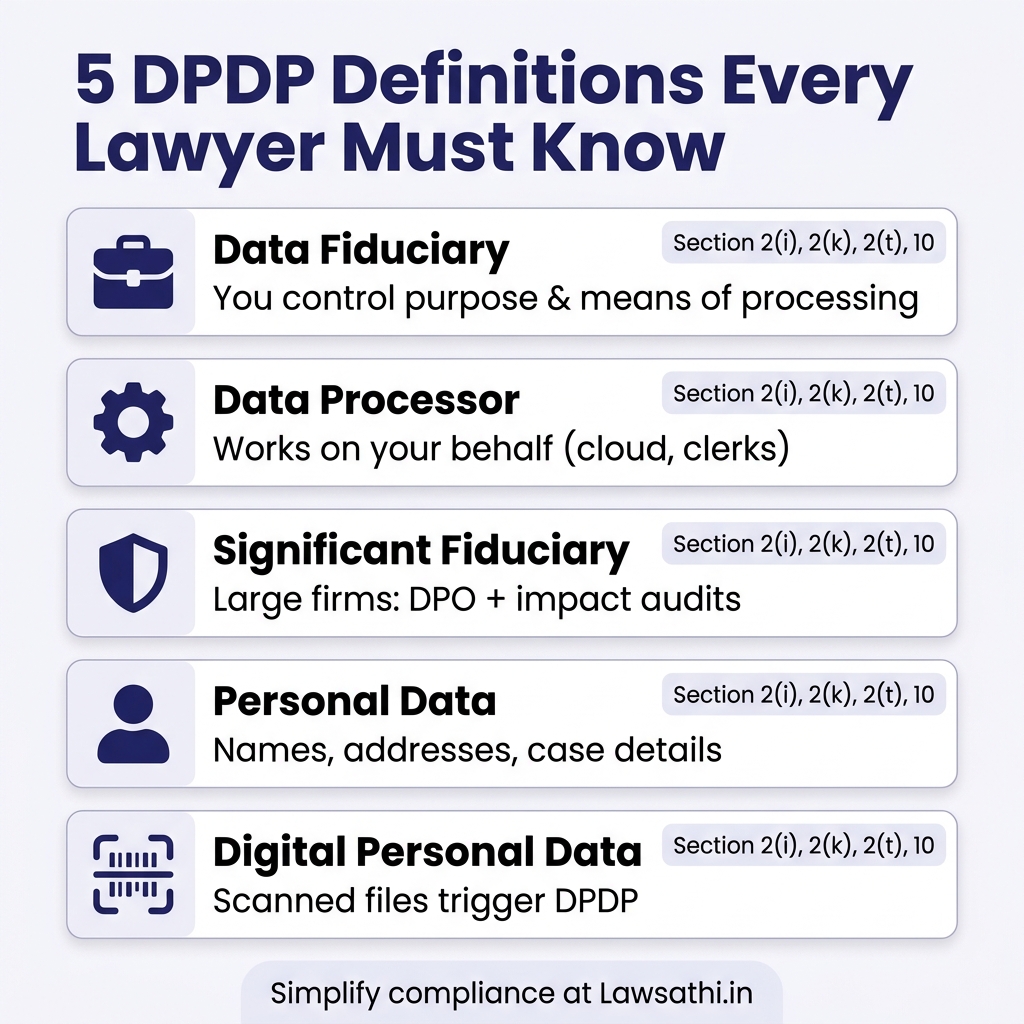
A Data Fiduciary under Section 2(i) has a specific legal meaning. It means "any person who alone or in conjunction with other persons determines the purpose and means of processing of personal data"[^12]. Law firms qualify as Data Fiduciaries because they determine why and how client data gets processed. This includes individual lawyers, partnerships, and corporate law firms.
In contrast, a Data Processor under Section 2(k) processes personal data on behalf of a Data Fiduciary[^8]. Examples include cloud service providers, court clerks, and external consultants engaged by your firm.
Understanding Personal Data
Personal Data under Section 2(t) has a broad scope. It means "any data about an individual who is identifiable by or in relation to such data". This definition encompasses client names, addresses, phone numbers, and case details.
Digital Personal Data includes personal data in digital form and offline data subsequently digitized. Therefore, scanning physical client files triggers DPDP obligations.
Significant Data Fiduciary Status

The concept of Significant Data Fiduciary (SDF) carries additional obligations under Section 10. Large law firms handling high volumes of sensitive data may qualify as SDFs. Such firms must appoint a Data Protection Officer. Additionally, they must conduct annual Data Protection Impact Assessments and undergo periodic audits.
The Compliance Checklist: 7 Essential Steps for Law Firms
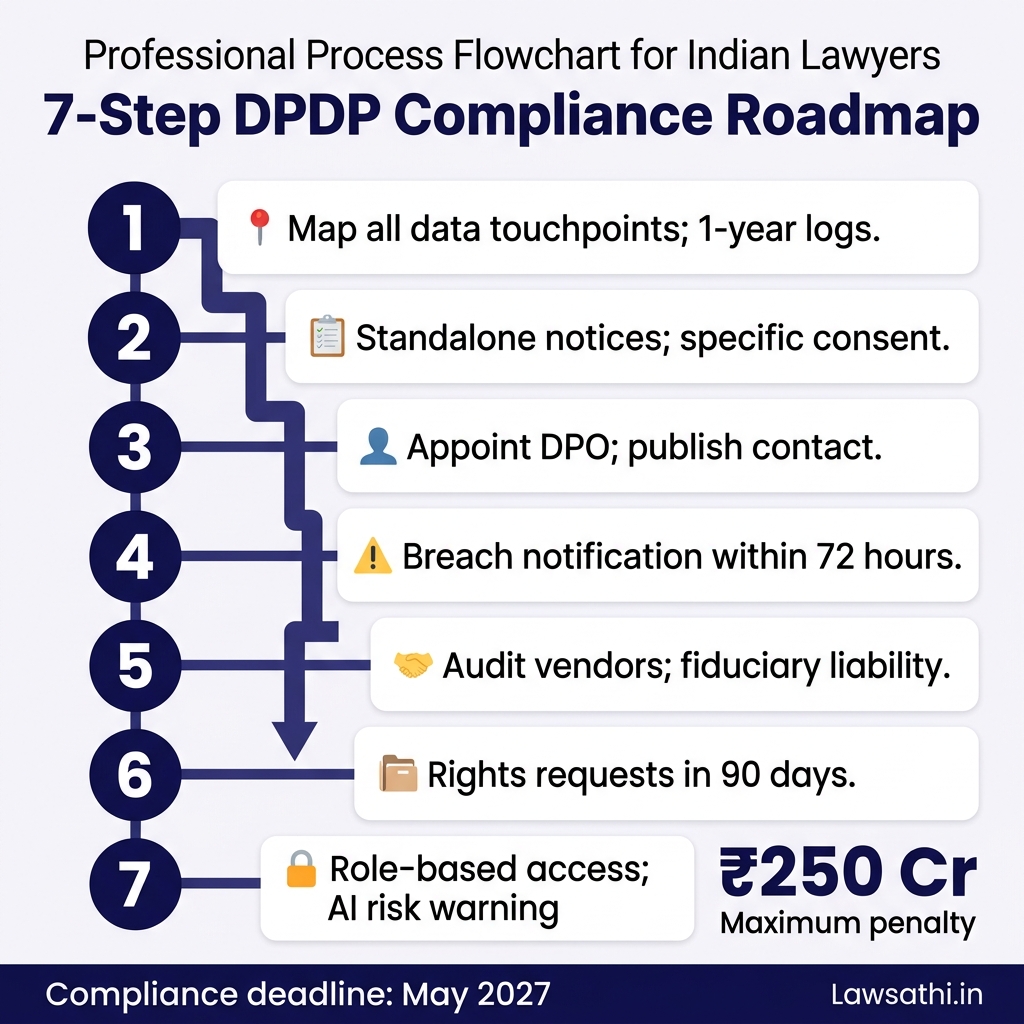
Every Indian law firm must implement these seven critical compliance measures before the May 2027 deadline.
Step 1: Data Mapping and Auditing
Begin by identifying all touchpoints where personal data enters your firm. This includes client intake forms, email correspondence, court filing systems, and physical case records. Furthermore, examine your website, CCTV cameras, biometric attendance systems, and HR portals.
Rule 6 mandates specific security safeguards. These include encryption, access controls, and logging mechanisms. Moreover, all logs and data must be retained for a minimum of one year.
Practical Example: A Delhi-based law firm discovered during auditing that its email archive contained unencrypted client wills and property documents. Consequently, this single finding prompted a complete security overhaul.
Step 2: Notice and Consent Management
Rule 3 requires notices to be clear, standalone, and in plain language. Notices must include an itemized list of personal data collected. Additionally, they must specify the purpose of processing and methods to withdraw consent.
Consent must be free, specific, informed, unconditional, and unambiguous under Sections 4-6. However, Section 7(i) provides an exemption for employment-related processing of current employees.
Action Point: Review all client engagement letters immediately. Additionally, add clear privacy notices explaining data collection purposes.
Step 3: Appointment of Data Protection Officer
Significant Data Fiduciaries must appoint a DPO at the CxO level. The DPO's contact information must appear on your firm's website. While mandatory only for SDFs, all law firms should consider voluntary appointment as best practice.
Furthermore, every Data Fiduciary must establish a grievance redressal mechanism. They must also publish contact details of the responsible person.
Step 4: Data Breach Response Protocols
Time is critical during a data breach. Firms must promptly notify affected Data Principals about breach details. Additionally, they must inform about mitigation steps taken and actions Data Principals should take.
More importantly, report breaches to the Data Protection Board within 72 hours. Initial reports must describe the breach nature, extent, timing, and likely impact. Failure to report can attract penalties up to ₹200 crore.
Step 5: Vendor and Third-Party Audits
Data Fiduciaries bear liability for their vendors' actions. Therefore, audit all third-party relationships including cloud providers, process servers, and external consultants. Ensure valid contracts contain data protection clauses.
Key Insight: Data Processors cannot claim safe harbor under IT Act Section 79. Specifically, they possess knowledge of personal data being processed.
Step 6: Rights Management Framework
Sections 11-14 grant Data Principals specific rights. These include access, correction, erasure, and grievance redressal. Firms must respond to requests within 90 days maximum.
Section 8(7) requires erasure when consent is withdrawn or the specified purpose ends. Therefore, provide 48-hour advance notice before erasure. However, maintain one-year retention for compliance records.
Step 7: Employee Training and Access Control
Rule 6 mandates encryption, role-based access controls, and monitoring for unauthorized access. Additionally, implement regular training programs focused on preventing insider breaches.
Warning: Employees pasting client data into public AI tools can trigger unauthorized data transfers. This constitutes a personal data breach under Section 2(u). Consequently, it carries potential ₹250 crore penalties.
Handling Sensitive Personal Data: Special Considerations for Litigators
Legal practitioners routinely handle sensitive personal data requiring enhanced protection measures.
Categories Common in Legal Practice
Litigation often involves health records, financial information, biometric data, and caste or tribal details. Matrimonial matters may involve sexual orientation data. Similarly, criminal cases frequently require biometric and forensic evidence.
The IT Act's SPDI Rules 2011 defined sensitive categories. These included passwords, financial information, health conditions, and biometric data. While the DPDP Act treats all personal data uniformly, these categories remain relevant for risk assessment.
Purpose Limitation and Consent
Personal data must only be processed for specified, lawful purposes. However, purpose limitation creates grey areas requiring careful documentation in engagement letters.
Consent must be specific to each purpose. Therefore, data collected for one matter cannot automatically be used for another without fresh consent.
Balancing Privacy with Legal Obligations
Attorney-client privilege is protected under the Bhartiya Sakshya Adhiniyam 2023, Sections 132-134. However, communications facilitating illegal purposes receive no protection.
The RTI Act Section 8(1)(j) has been amended to align with the DPDP framework. Nevertheless, public interest disclosures remain permitted under Section 8(2).
Cross-Border Data Transfers: Advising International Clients
Law firms handling cross-border matters face additional compliance requirements.
Transfer Restrictions Under Section 16
Personal data can generally be transferred outside India. However, the Central Government can restrict transfers to specific countries. Therefore, firms must monitor official notifications regarding blacklisted and white-listed jurisdictions.
Significant Data Fiduciary Restrictions
Rule 13(4) prohibits SDFs from transferring traffic data outside India. Traffic data means data pertaining to the flow of personal information. Consequently, this restriction significantly impacts firms handling international arbitration.
Compliance Beyond GDPR
Compliance with GDPR does not ensure DPDP compliance. The Indian framework has distinct requirements. For example, consent notices must be in Indian languages, and there is a right to nominate representatives. Foreign law firms operating in India must comply despite limited BCI practice permissions.
Penalties and Liabilities: What's at Stake?
The penalty structure under Section 33 demands serious attention from every law firm.
Maximum Penalty Schedule
| Violation | Maximum Penalty | |-----------|-----------------| | Failure to implement security safeguards (Section 8(5)) | ₹250 crore | | Failure to notify breach (Section 8(6)) | ₹200 crore | | Violations relating to children (Section 9) | ₹200 crore | | SDF violations (Section 10) | ₹150 crore | | Any other violation | ₹50 crore |
Key Characteristics of Penalties
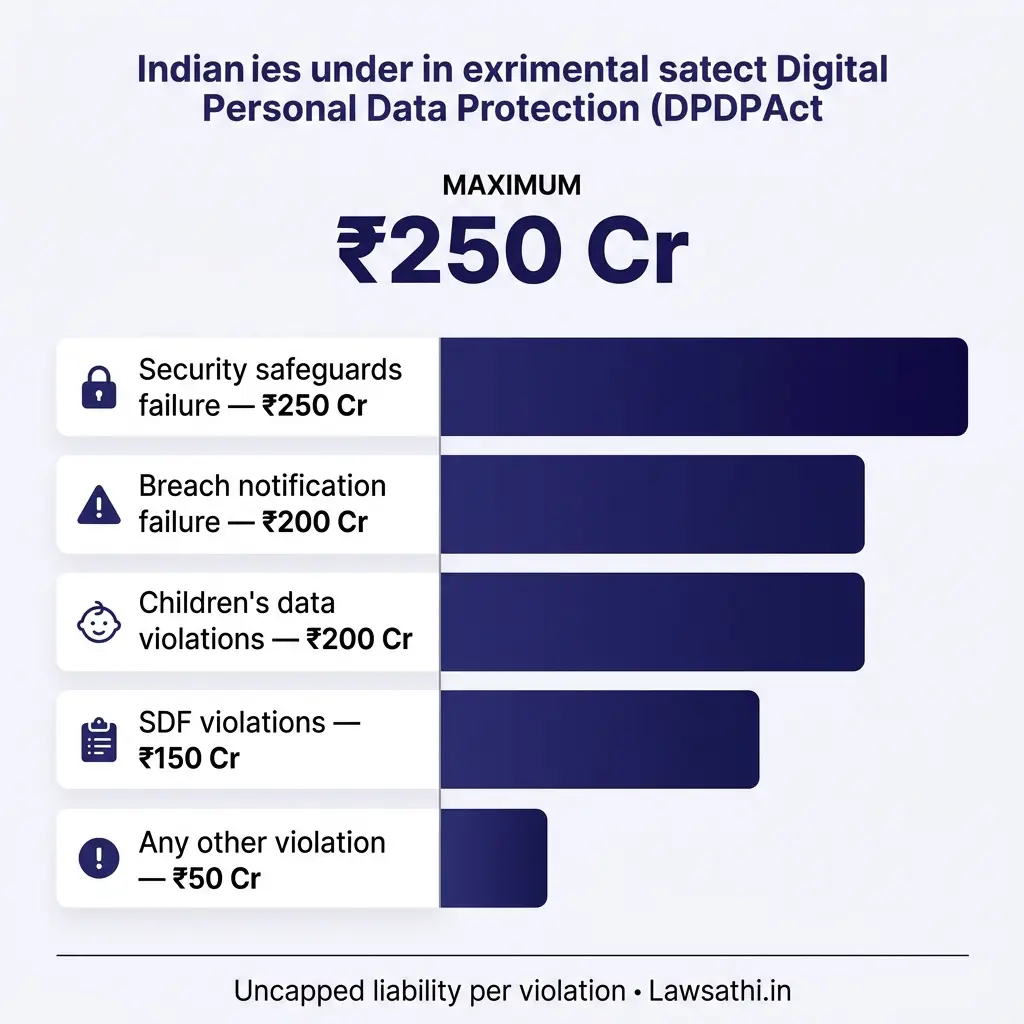
The DPDP framework imposes no criminal sanctions - only financial penalties. However, each violation attracts separate penalties. Consequently, this creates theoretically uncapped liability. The Data Protection Board considers factors including violation nature, organization size, and harm extent.
Liability of Partners and Management
Data Fiduciaries remain responsible regardless of internal agreements. Therefore, law firms cannot contract out of liability. Partners face professional and reputational consequences beyond monetary penalties.
How Legal Tech Simplifies DPDP Compliance
Manual compliance creates significant risks for modern law practices.
The Problem with Paper Systems
Paper-based systems make tracking consent records nearly impossible. Additionally, they lack automated audit trails and create data retention violation risks. Furthermore, responding to Data Principal requests within 90 days becomes challenging without digital systems.
Essential Software Features
Practice management software should include encryption at rest and in transit. Additionally, it needs role-based access control, comprehensive audit logging, and multi-factor authentication. Moreover, look for data retention automation and consent management modules.
Automation Benefits
Legal tech platforms can automate consent logs with timestamps, deletion reminders, and breach detection. Additionally, systematic tracking of Data Subject Access Requests ensures timely responses. Vendor management features help track contract compliance.
Conclusion: Future-Proofing Your Practice
The compliance timeline leaves no room for procrastination. Core obligations become effective May 13, 2027. Meanwhile, consent manager requirements kick in November 13, 2026.
Competitive Advantage Through Privacy
Privacy-first law firms gain enhanced client confidence and market differentiation. Additionally, they face reduced regulatory risk and better positioning for cross-border matters. Most importantly, they build trust that defines successful legal careers.
Immediate Action Required
Conduct comprehensive data mapping immediately. Additionally, review all engagement letters and vendor agreements. Train staff on data protection principles and establish breach response protocols.
Don't leave your compliance to chance. LawSathi helps Indian law firms secure client data with built-in encryption and automated audit trails. Start your 14-day free trial today to future-proof your practice against the DPDP Rules 2026.