
The Supreme Court illegal sand mining National Chambal Sanctuary case marks a watershed moment in Indian environmental jurisprudence. In March 2026, the apex court took suo motu cognizance of rampant illegal mining activities threatening one of India’s most critical wildlife habitats. Consequently, this intervention signals the judiciary’s growing impatience with state inaction on environmental protection.
For legal practitioners, this ruling carries profound implications. Therefore, understanding the court’s directions, statutory framework, and compliance requirements is essential. The case emerges from a disturbing pattern of state complicity and administrative failure. Specifically, authorities failed to protect the National Chambal Sanctuary. Furthermore, it highlights the tension between economic interests and constitutional obligations toward environmental preservation.
Why This Case Matters for Environmental Lawyers
The Supreme Court’s intervention in the National Chambal Sanctuary matter extends beyond immediate environmental concerns. In fact, the Court observed that protection of natural resources and fragile ecosystems is “not only a statutory obligation but a constitutional imperative” under Article 21. LiveLaw reported that the bench expressed “serious displeasure” at state authorities’ casual approach toward environmental degradation.
Additionally, the case establishes critical precedents for: – Personal accountability of government officials – Technology-driven enforcement mechanisms – Inter-state coordination in environmental matters – Application of precautionary principle in mining cases
Background: The National Chambal Sanctuary and Gharial Crisis
Geographical and Legal Framework
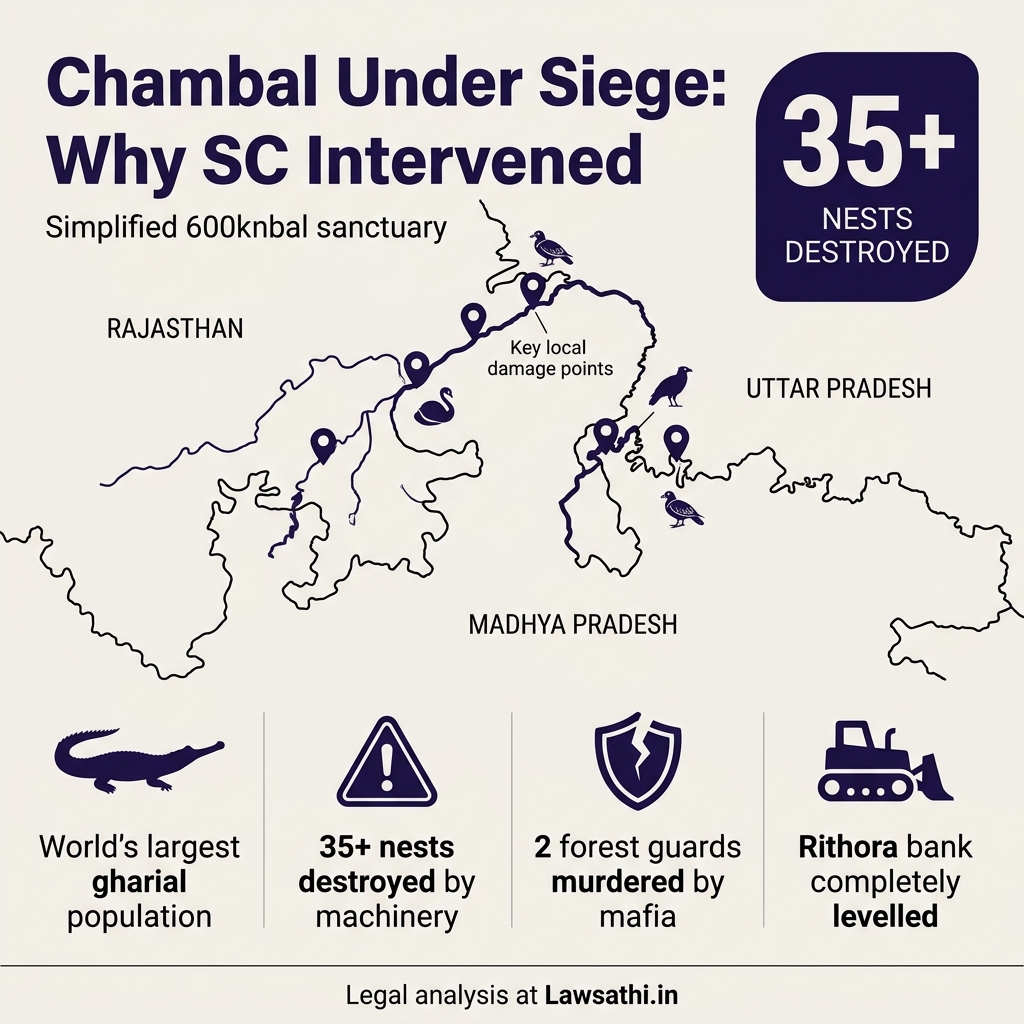
The National Chambal Sanctuary spans a 600 km stretch of the Chambal River. Moreover, it covers a tri-state area across Madhya Pradesh, Uttar Pradesh, and Rajasthan. The sanctuary extends approximately 43,500 hectares (435 sq km). As a result, it ranks among India’s largest riverine protected areas. According to the Wildlife Institute of India, this protected zone was specifically designated for gharial conservation.
Legal Status: – Declared under Section 18 of the Wildlife Protection Act, 1972 – UP Notification No. 7835/XIV-3-103-78 dated January 20, 1979 – Protected since 1978 specifically for crocodilian conservation
The Gharial Conservation Crisis
The National Chambal Sanctuary harbors the world’s largest population of gharials (Gavialis gangeticus). Unfortunately, these critically endangered reptiles face existential threats from illegal sand mining. The IUCN Red List classifies the gharial as critically endangered. Therefore, this sanctuary serves as their “last refuge.”
Ecological Damage from Mining Operations
The National Green Tribunal (NGT) documented catastrophic damage to nesting sites. In its order dated July 25, 2023, the NGT noted that the Rithora sand bank was “completely levelled.” Until 2019, this location hosted at least 35 gharial nests. However, the nesting site “does not exist anymore due to illegal mining.”
Furthermore, the NGT identified major mining sites at Rithora, Barwastn, and Gadhora showing increased activity. Heavy machinery, including JCB excavators, destroyed over 30 gharial nests. Additionally, several turtle nesting sites were decimated. Consequently, the tribunal warned of an “immediate threat to all aquatic reptiles” in the sanctuary.
The Petition and Legal Issues Raised
Suo Motu Proceedings Initiation
The Supreme Court illegal sand mining National Chambal Sanctuary case began through suo motu cognizance on March 13, 2026. As LiveLaw reported, the bench of Justice Vikram Nath and Justice Sandeep Mehta acted on disturbing media reports. Specifically, these reports highlighted mining mafias operating with impunity.
The Court issued notices to: – States of Madhya Pradesh, Rajasthan, and Uttar Pradesh – Director Generals of Police of all three states – Departments of Mining, Forests, and Water Resources – Ministry of Environment, Forest and Climate Change (MoEF&CC) – Central Empowered Committee (CEC)
Violent Incidents and Enforcement Failures
Murder of Forest Guard Harikesh Gurjar (April 8, 2026):
Forest Guard Harikesh Gurjar was killed between 5:30-6:00 AM during an anti-mining operation in Morena, Madhya Pradesh. Specifically, he was deliberately run over by a tractor-trolley near Ranpur village on NH-552. The attack caused instantaneous death due to severe head injuries.
Murder of Forest Guard Jitendra Singh Shekhawat (January 8-9, 2026):
In Dholpur, Rajasthan, Forest Guard Jitendra Singh Shekhawat was similarly run over by a tractor-trolley. He had attempted to stop an illegal mining vehicle at the Jhiri checkpoint. His leg was amputated. Tragically, he succumbed to injuries on January 9, 2026.
Pattern of State Complicity
The Court observed a disturbing pattern in investigation failures. According to the Supreme Court order, investigating agencies confined prosecution only to vehicle drivers. No meaningful investigation was undertaken to identify “masterminds” orchestrating organized criminal activities.
This pattern suggests “deliberate inaction and possible connivance at various levels.” Furthermore, the Court found that illegal excavation was occurring dangerously close to bridge pillars. Specifically, this occurred on NH-44 at the Morena-Dholpur border. The National Highways Authority of India (NHAI) was subsequently impleaded as a party respondent.
Supreme Court Directions and Key Observations
Comprehensive Monitoring Framework
The Supreme Court illegal sand mining National Chambal Sanctuary order dated April 17, 2026, established a comprehensive monitoring framework. As SCC Times analyzed, the directions mandate technology-driven enforcement mechanisms.
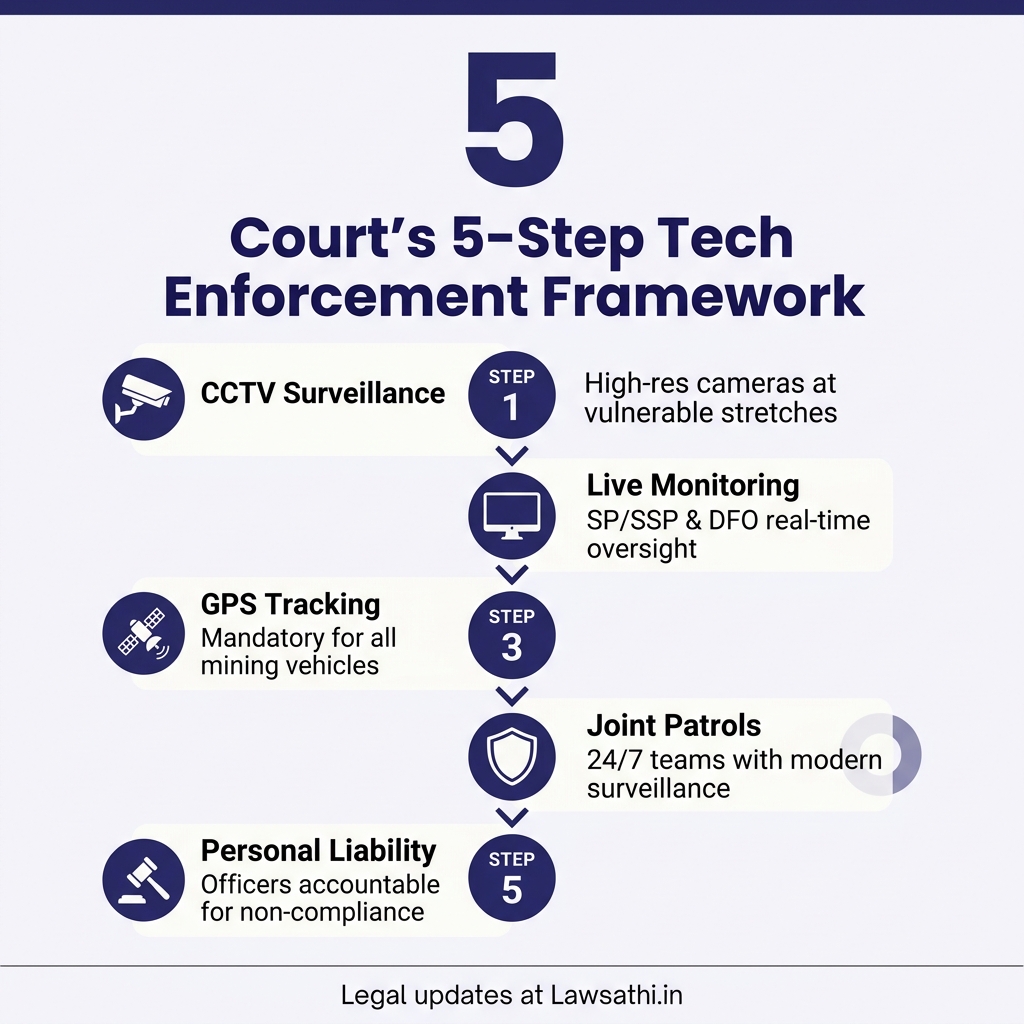
Direction A: CCTV Surveillance
The Court mandated high-resolution, Wi-Fi-enabled CCTV cameras at all routes used for illegal mining. Installation must occur at vulnerable river stretches in consultation with the CEC. Moreover, positioning should minimize ecological disturbance.
Direction B: Live Feed Monitoring
Direct control must vest with the SP/SSP and Divisional Forest Officer. Monitoring should be conducted by officers not below Sub-Inspector/SHO rank. Upon detection, enforcement teams must mobilize immediately.
Direction C: GPS Tracking Pilot Project
All mining vehicles in Morena (MP) and Dholpur (Rajasthan) must install GPS devices. This includes dredgers, loaders, excavators, and tractors. Data must be accessible to District Magistrates and police. Furthermore, non-compliance invites immediate seizure without Court permission for release.
Environmental Compensation and Polluter Pays Principle
The Court applied the “Polluter Pays Principle” for environmental compensation. Therefore, time-bound assessment and recovery from violators is mandatory. The methodology must be scientific, transparent, and objective. Above all, remediation of ecological damage forms the core purpose.
Direction F states: > “Environmental compensation shall be assessed and recovered from violators in a time-bound manner using a scientific, transparent, and objective methodology for remediation of ecological damage.”
Joint Patrol Teams and Safety Protocols
The Court mandated fully operational joint patrol teams comprising police and forest officials. These teams require: – Adequate, trained security personnel on 24/7 basis – Modern surveillance and communication equipment – Protective gear and appropriate arms – Deployment at check posts with adequate infrastructure
Additionally, a comprehensive inter-state Standard Operating Procedure (SOP) must govern protocols. Specifically, this covers interception, seizure, arrest, and emergency response. Real-time information sharing between states is essential.
Personal Accountability of Officials
Perhaps most significantly, the Court established personal accountability for dereliction of duty. Officers will be held personally accountable for non-compliance. Furthermore, contempt proceedings may follow “without exception.”
Rajasthan Officials Summoned for Personal Appearance
On May 14, 2026, the Court summoned senior Rajasthan bureaucrats for personal appearance on May 20, 2026. LiveLaw reported that the following officials were summoned:
1. Additional Chief Secretary, Home Department
2. Principal Secretary, Mining and Geology
3. Principal Secretary, Finance Department
4. Principal Secretary, Forest, Environment and Climate Change
5. Principal Secretary, Transport and Road Safety
The Court expressed “serious displeasure” at Rajasthan’s “casual, indifferent, and indolent approach.” CEC findings revealed that out of 40 vulnerable locations, only ONE CCTV camera was installed. Moreover, GPS integration remained a “non-starter.” Similarly, joint patrol teams were still “under consideration.”
—
Statutory Analysis: Wildlife Protection Act and EIA
Section 29 of the Wildlife Protection Act, 1972
The Supreme Court illegal sand mining National Chambal Sanctuary analysis necessarily involves Section 29 of the Wildlife Protection Act. As Indian Kanoon explains, this provision prohibits destruction, exploitation, or removal of wildlife from sanctuary limits.
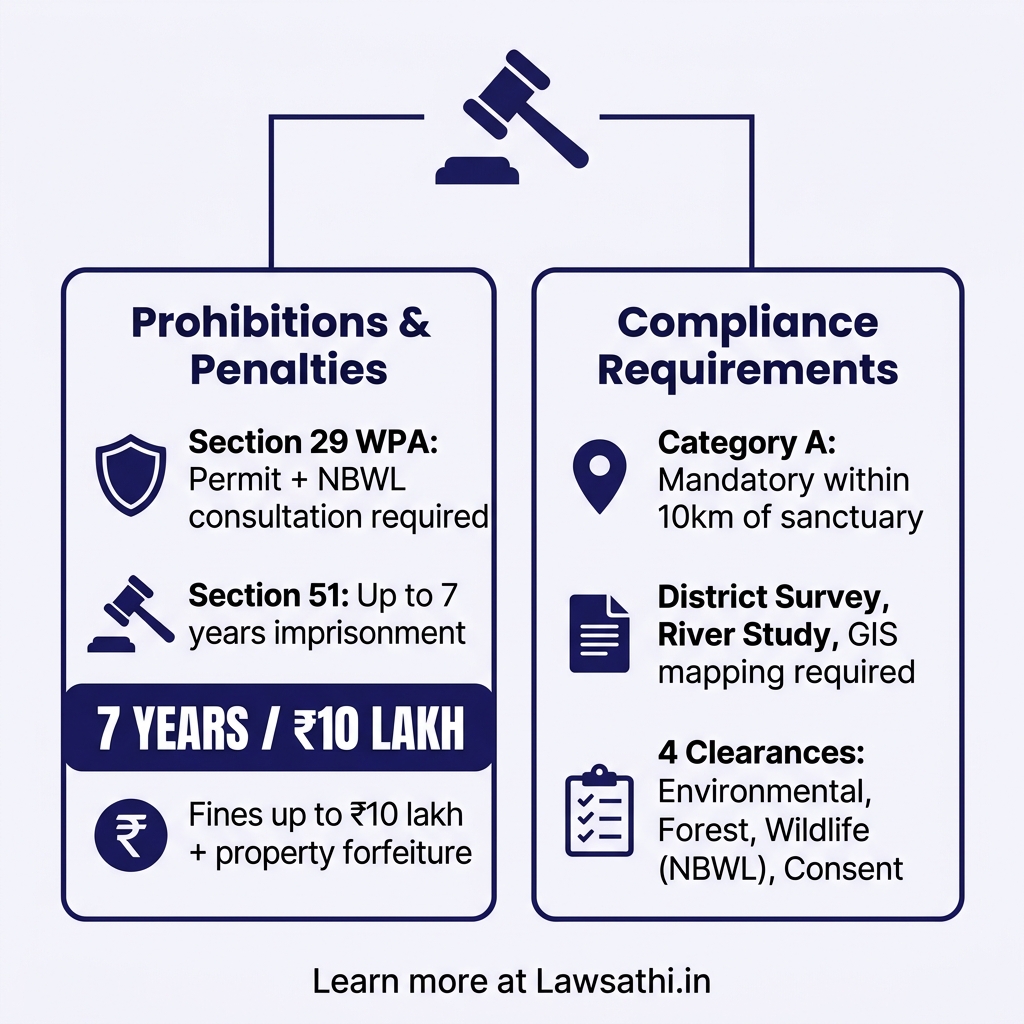
Section 29 provides: > “No person shall destroy, exploit or remove any wild life including forest produce from a sanctuary or destroy or damage or divert the habitat of any wild animal by any act whatsoever…”
Key Prohibitions: – Destruction/exploitation of wildlife or forest produce – Damage to habitat of any wild animal – Diversion, stoppage, or enhancement of water flow – Any act without permit from Chief Wild Life Warden
The permit can only be granted after State Government consultation with the National Board for Wildlife. Furthermore, the State Government must be satisfied that such removal is necessary for “improvement and better management of wildlife.” Importantly, forest produce removed cannot be used for commercial purposes.
Penal Provisions Under WPA, 1972
Section 51 prescribes punishment: – Imprisonment up to 3 years (extendable to 7 years for Schedule I species) – Fine minimum ₹25,000 (extendable to ₹10,00,000) – Forfeiture of property used in commission of offence
Therefore, mining activities within sanctuary limits attract severe criminal liability. Lawyers advising mining clients must thoroughly assess Wildlife Protection Act implications.
EIA Notification Requirements for Sand Mining
The Supreme Court in Deepak Kumar v. State of Haryana [(2012) 4 SCC 629] established critical requirements for sand mining. As LiveLaw notes, Environmental Clearance cannot be granted without replenishment studies.
Category A Projects (Central Clearance): – Mining of minerals > 250 hectares – Any project within protected areas under Wildlife Protection Act – Projects within notified Eco-sensitive zones
Category B Projects (State Clearance): – ≤ 250 hectares for major minerals – All minor mineral leases irrespective of lease area
General Conditions Triggering Higher Scrutiny
Projects within 10 km of protected areas automatically require Category A clearance. Consequently, mining leases near the National Chambal Sanctuary need MoEF&CC approval regardless of size. The EIA Notification 2020 further strengthened these requirements.
Mandatory Documentation: – District Survey Report (DSR) – Replenishment Study – GIS mapping of lease area – Distance verification from protected boundaries
—
Implications for Legal Practice and Compliance
Due Diligence Checklist for Mining Leases
Legal practitioners must advise clients on comprehensive due diligence before seeking mining leases near protected areas. The Supreme Court illegal sand mining National Chambal Sanctuary judgment raises compliance thresholds significantly.
Statutory Clearances Required:
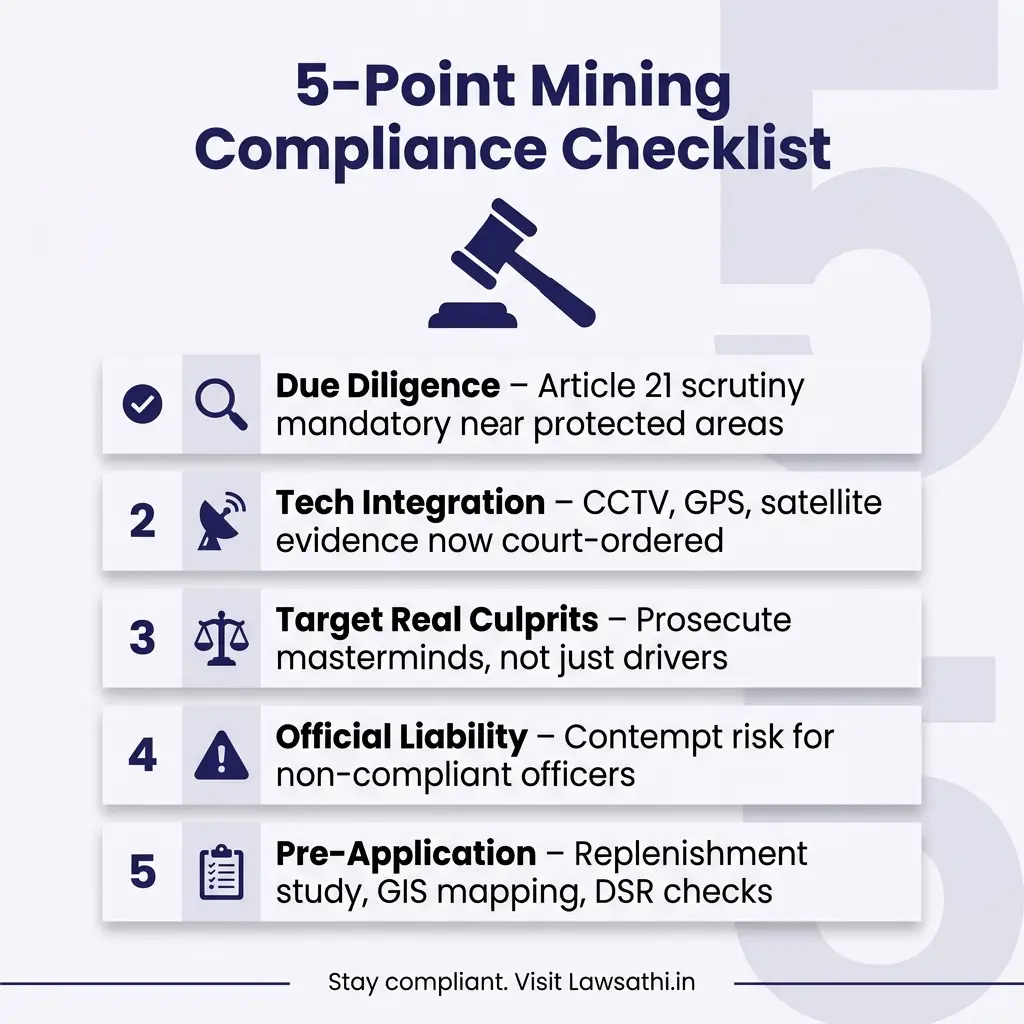
1. Environmental Clearance – Category A if within 10 km of sanctuary/ESZ 2. Forest Clearance – if forest land is involved under Forest Conservation Act, 1980 3. Wildlife Clearance – National Board for Wildlife approval required 4. Consent to Establish/Operate – State Pollution Control Board
Pre-Application Assessments: – River replenishment study mandatory – Distance verification from sanctuary boundaries – GIS mapping and satellite imagery analysis – District Survey Report compliance verification
Technology-Driven Evidence in Environmental Cases
The Supreme Court’s directions emphasize technological solutions. Therefore, lawyers must understand the evidentiary value of electronic evidence. CCTV surveillance, GPS tracking, and satellite imagery now constitute court-mandated enforcement tools.
Legal Implications: – Electronic evidence admissible under Indian Evidence Act – Satellite imagery can prove extent of illegal mining – Drone surveillance emerging as monitoring tool – Real-time control rooms for evidence collection
PIL Risks and State Liability
The case demonstrates that state inaction invites judicial intervention. Therefore, government lawyers must advise proactive compliance. The Supreme Court warned that continued non-compliance may result in: – Deployment of paramilitary forces – Complete ban on sand mining activities – Heavy environmental penalties – Personal liability of officials
Investigation into “Masterminds”
The Court directed investigation beyond vehicle drivers. Therefore, enforcement agencies must identify financiers, organizers, and beneficiaries of illegal mining. This shift demands thorough investigation strategies. Additionally, coordination between agencies is essential.
—
Conclusion: Strengthening Environmental Rule of Law
Key Takeaways for Legal Professionals
The Supreme Court illegal sand mining National Chambal Sanctuary judgment represents a paradigm shift in environmental jurisprudence. First, it establishes proactive judicial oversight through suo motu cognizance. Second, it mandates technology-driven enforcement with personal accountability for officials. Third, it strengthens constitutional environmental protection under Article 21.
For practitioners, several critical lessons emerge:
1. Heightened Due Diligence Standards – Mining projects near protected areas face rigorous scrutiny 2. Technology Integration Mandatory – CCTV, GPS, and control rooms now court-ordered 3. Personal Liability Real – Officials face contempt proceedings for non-compliance 4. Inter-State Coordination Essential – Uniform SOPs required across jurisdictions 5. Investigation Must Target Organizers – Courts demand prosecution of masterminds, not merely drivers
Long-Term Impact on Environmental Governance
The judgment strengthens the institutional role of the Central Empowered Committee. The Supreme Court’s earlier order institutionalized CEC as a permanent monitoring body. Consequently, environmental compliance now faces sustained judicial oversight.
For wildlife conservation, the ruling offers direct protection to critically endangered species habitats. Restoration of nesting sites may become possible through environmental compensation. Moreover, the case serves as a model for protected area management across India.
Final Observations
The National Chambal Sanctuary case underscores a fundamental principle. Specifically, environmental protection is a constitutional imperative. Therefore, legal practitioners must integrate environmental compliance into their advisory practice. The era of reactive, minimal compliance is over. Instead, proactive, technology-enabled, and constitutionally-grounded environmental governance defines the new standard.
Stay ahead of critical court updates. Use LawSathi to track environmental case law, manage litigation documents, and automate your legal research. Start your free trial today.