In the fast-paced world of Indian litigation, a Summary Suit is a formidable weapon for recovery. Unlike ordinary civil proceedings, the Order 37 CPC procedure is designed for the rapid disposal of money claims. This procedure ensures that defendants cannot use dilatory tactics to delay justice for liquidated debts.
Consequently, the burden of proof shifts significantly toward the defendant’s right to be heard. As a defense lawyer, you must act with extreme precision. If you miss a single step, your client faces an immediate decree.
Understanding the Summary Suit Framework
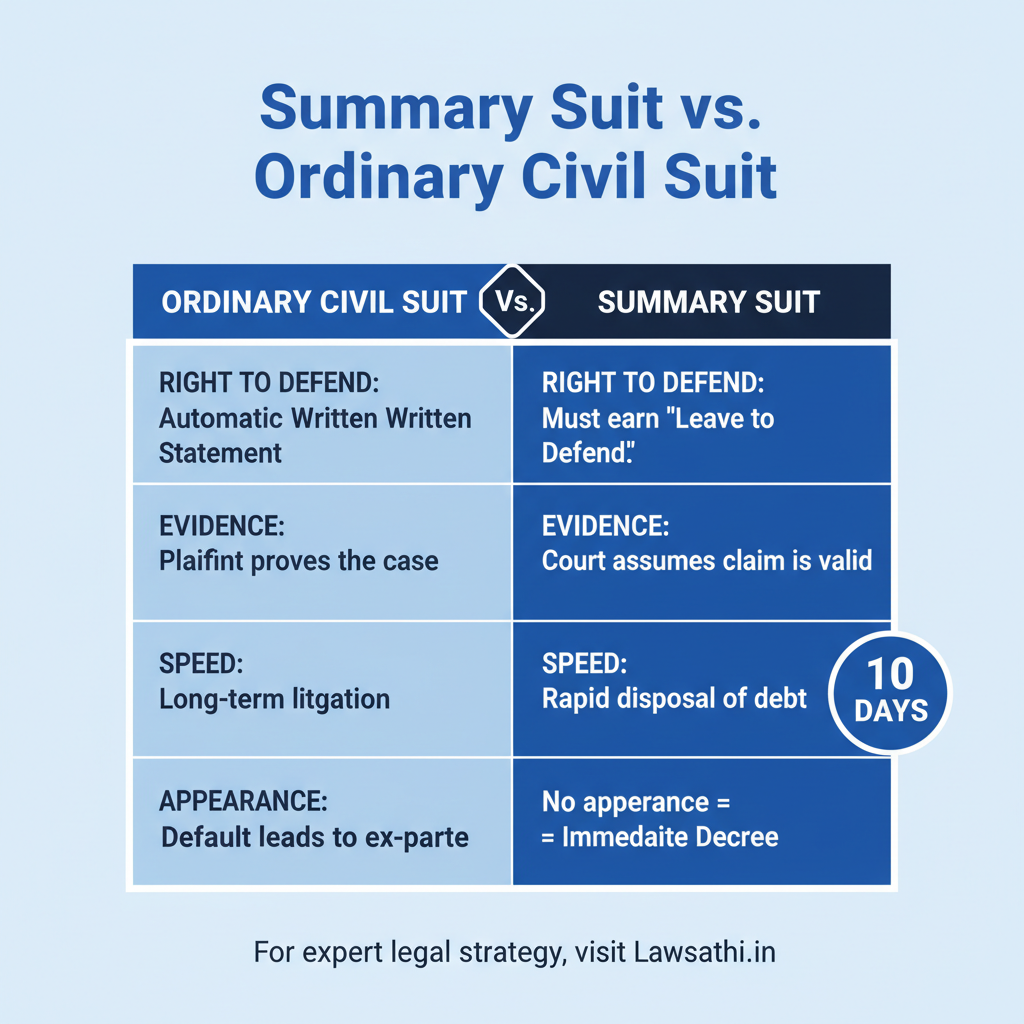
A Summary Suit applies specifically to claims based on written contracts, bills of exchange, or promissory notes. In an ordinary suit, a defendant has an automatic right to file a Written Statement.
However, under Order XXXVII of the CPC, that right does not exist. You must instead earn the right to defend. Therefore, understanding the strict procedural mechanics is the only way to protect your client’s interests.
Why Order 37 CPC Procedure Differs from Ordinary Suits
Ordinary suits often drag on for years due to procedural loopholes. In contrast, the Order 37 CPC procedure limits the defendant’s ability to delay. The court assumes the plaintiff’s claim is valid unless you prove otherwise.
Because of this, the law treats the plaintiff’s allegations as admitted if the defendant fails to appear. Most importantly, this creates a high-stakes environment where every day counts for the defense team.
Step 1: The Critical 10-Day Window for Filing Appearance
The most dangerous phase for any defendant is the first ten days after receiving the summons. According to Rule 2(3) of Order 37, the defendant must enter an appearance within exactly ten days.
If you fail to meet this deadline, the court will likely pass a decree in the plaintiff’s favor. Furthermore, you cannot simply file a reply. You must file a “Memo of Appearance” with the court instead.
Determining the Address for Service
First, you must provide an “Address for Service” within the jurisdiction of the court. This address is where all future notices will be delivered. Specifically, this includes the Summons for Judgment.
Lawyers must ensure this address is active and monitored daily. For example, a missed courier at this address could lead to a lost case. Additionally, the memo should clearly state the defendant’s intent to contest the suit.
Consequences of Empty Appearances
Entering an appearance does not mean you have won the right to trial. It merely tells the court that you are present in the litigation. However, if you miss this window, the court deems the suit’s facts as admitted.
Restoring a case after this stage requires proving “special circumstances” under Rule 4. Consequently, defense lawyers must treat the 10-day mark as an absolute and immovable deadline.
Step 2: Analyzing the Summons for Judgment
After you enter an appearance, the ball moves back to the plaintiff. They must then serve a “Summons for Judgment” using Form No. 4A in Appendix B.
This document includes an affidavit confirming the debt. It also states that there is no defense. Therefore, your first task is to scrutinize this affidavit for technical defects.
Verifying Service and Timelines
You have another strict 10-day window to respond starting from the date of service. Specifically, this ten-day period is for filing your Application for Leave to Defend.
If the plaintiff serves the summons via email or WhatsApp, verify if the court authorized such service. For example, improper service can sometimes buy your client vital time. Moreover, check if the plaintiff’s claim truly qualifies as a “liquidated demand.”
Identifying Improper Pleadings
Check if the plaintiff has attached the necessary original documents. For instance, a suit based on a photocopy of a cheque might be vulnerable.
Similarly, if the claim includes unliquidated damages or penalties, it may fall outside Order 37. In such cases, you can argue the suit should be treated as an ordinary civil suit. This strategy effectively removes the “summary” pressure from your client.
Strategic Drafting: Filing the Application for ‘Leave to Defend’
The Application for Leave to Defend is the most critical document in the Order 37 CPC procedure. In this affidavit, you must convince the judge that the case deserves a full trial.
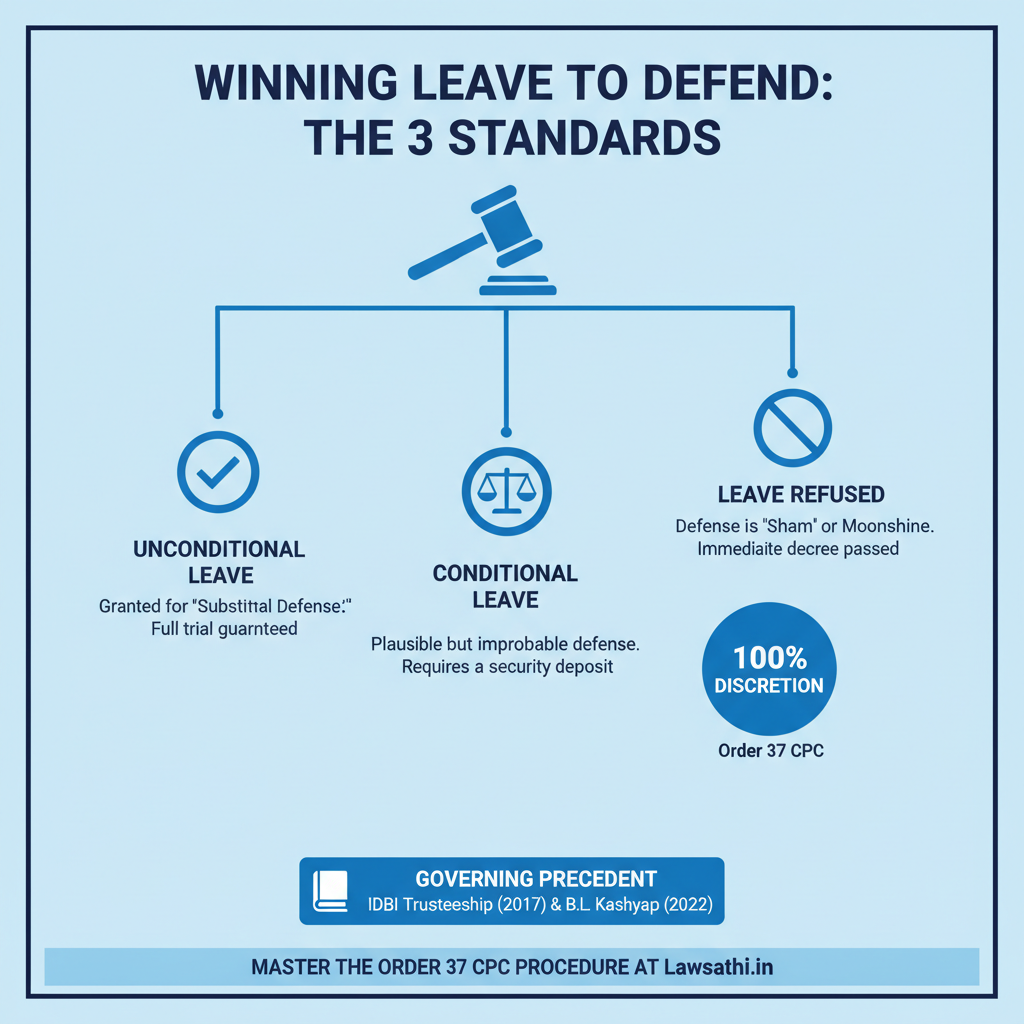
The Supreme Court provided clear guidelines for this in IDBI Trusteeship Services Ltd. v. Hubtown Ltd.. This ruling serves as the primary roadmap for granting leave.
Understanding the Five Directives of IDBI vs Hubtown
First, the court grants “Unconditional Leave” if you raise a “substantial defense.” This means your facts would likely defeat the plaintiff’s claim if proven.
Second, the court may grant “Conditional Leave” if the defense is plausible but improbable. In this scenario, the court might ask your client to deposit money. Finally, if the defense is a “sham,” the court will refuse leave and pass a decree.
Defining ‘Triable Issues’ for the Court
A “triable issue” is a factual or legal dispute that cannot be decided without evidence. For instance, you might claim the plaintiff forged the signature on a promissory note. In that case, you have raised a triable issue.
As noted in B.L. Kashyap & Sons Ltd. v. JMS Steels, leave to defend should be the rule rather than the exception. Courts should not conduct a “mini-trial” at this early stage. Therefore, focus your affidavit on facts that require cross-examination to resolve.
Common Defense Strategies and ‘Triable Issues’
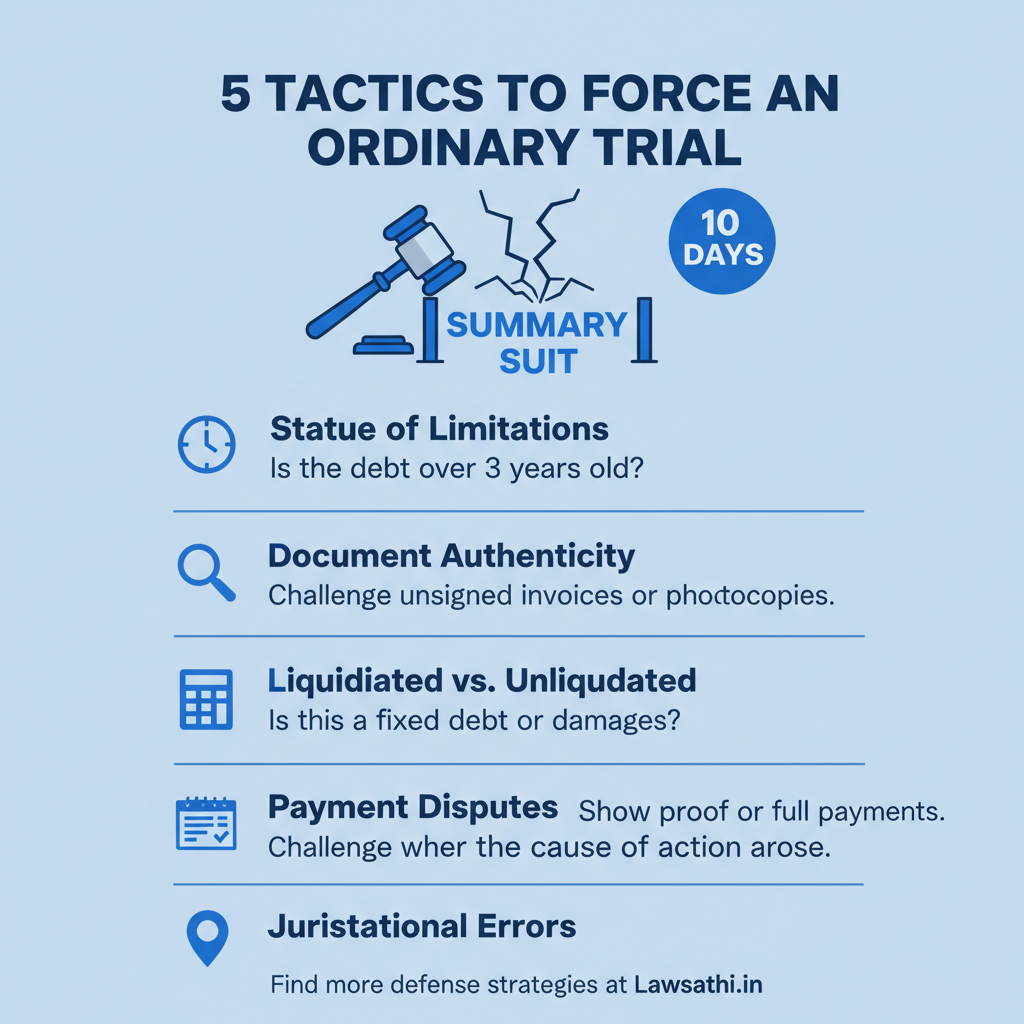
Effective defense lawyers look beyond the immediate debt. For example, you should always check the Statute of Limitations. If the debt is more than three years old, the suit is technically barred.
Additionally, challenge the nature of the claim itself. Only specific documents like bills of exchange or written contracts qualify under this Order.
Challenging the Nature of Written Contracts
Does a series of invoices constitute a “written contract”? Many courts have ruled that unsigned invoices do not meet the strict criteria of Order 37.
Consequently, you can argue that the claim is for unliquidated damages. This is different than a fixed debt. This often forces the plaintiff to move the case to the ordinary list. Furthermore, check for any suppression of material facts by the plaintiff in their initial filings.
Disputing the Debt Amount
If your client has already paid a portion of the debt, highlight this immediately. For example, providing bank statements that show partial payments creates a triable issue regarding the total amount.
In fact, showing even a small error in the plaintiff’s math can undermine their entire summary claim. Similarly, jurisdictional challenges can often halt a summary suit in its tracks. This happens if the cause of action arose elsewhere.
What to do if the Deadline is Missed: Condonation of Delay
Missing a 10-day deadline in the Order 37 CPC procedure is a crisis. However, it is not always a terminal one. Under Rule 4 of Order 37, the court has the power to set aside a decree.
But this requires “special circumstances.” This is a much higher legal standard than the “sufficient cause” usually required under the Limitation Act.
The Special Circumstances Test
The Supreme Court has clarified that Section 5 of the Limitation Act does not apply directly to suits. Therefore, you must rely on the specific language of Order 37 Rule 4.
You must prove two specific things to the court. First, explain why the defendant failed to appear. Second, show that they have a meritorious defense. For example, if your client was hospitalized and the records are clear, the court may show leniency.
Comparison with Ordinary Condonation
In ordinary suits, courts are generally liberal with delays. In contrast, summary suits demand strict discipline.
Furthermore, once a decree is signed, the execution process begins almost immediately. As a result, filing for a stay of execution alongside your Rule 4 application is essential. Most importantly, act the very moment you discover the missed date. This helps show bona fide intent to the judge.
How LawSathi AI Streamlines Order 37 Compliance
Managing multiple summary suits can be an administrative nightmare. Because of the dual 10-day windows, even a small clerical error can lead to professional negligence.
Thankfully, modern legal technology offers a solution. LawSathi’s AI-powered platform is designed specifically for the rigorous demands of the Indian legal system.
Automated Deadline Tracking
LawSathi features an intelligent “Case Clock” that tracks statutory windows. For example, you can log a summons for an Order 37 suit in the portal. The system then triggers alerts for the 10-day appearance deadline.
Additionally, it tracks the service of the Summons for Judgment. This ensures that you and your team never miss a filing date. In other words, the software acts as a fail-safe for your litigation practice.
AI-Powered Drafting and Research
LawSathi integrates tools similar to AMICUS AI to help you identify triable issues. By analyzing your case documents, the AI can suggest relevant precedents. It may highlight the IDBI or Milkhiram cases.
This speeds up the drafting of your Leave to Defend application. Furthermore, the centralized repository keeps all summons and service records in one secure location. This allows for instant access when you need it most.
Conclusion: Mastering the Order 37 CPC Procedure
Winning a summary suit defense requires more than just legal knowledge. It requires speed, tactical drafting, and impeccable timing. By identifying triable issues early and respecting the 10-day deadlines, you can effectively protect your client.
Most importantly, you must avoid an immediate decree. Remember, the goal is to shift the case from the summary track to a full trial. Use the strategies outlined above to ensure your Leave to Defend application is undeniable.
Stop stressing over 10-day deadlines. Use LawSathi’s AI-powered legal calendar to manage your Order 37 suits with precision. Book a free demo today!