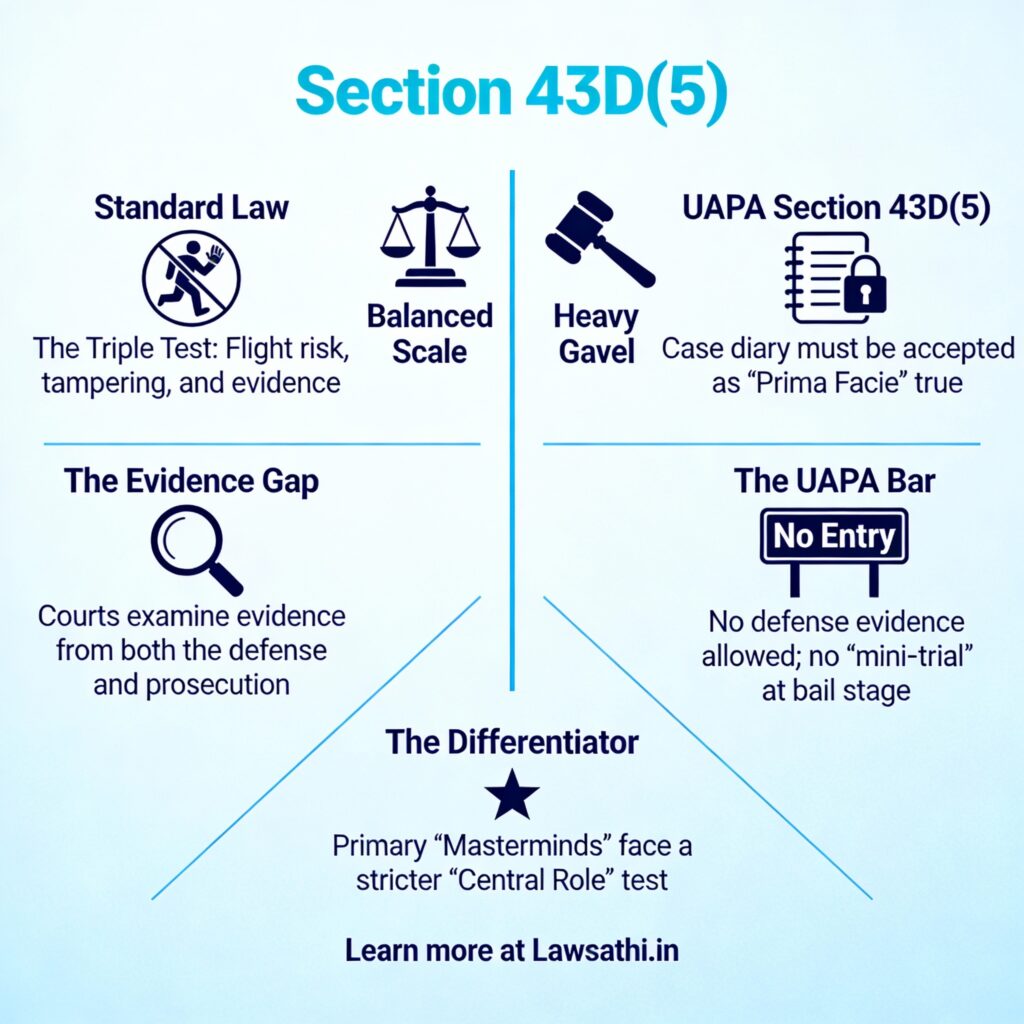
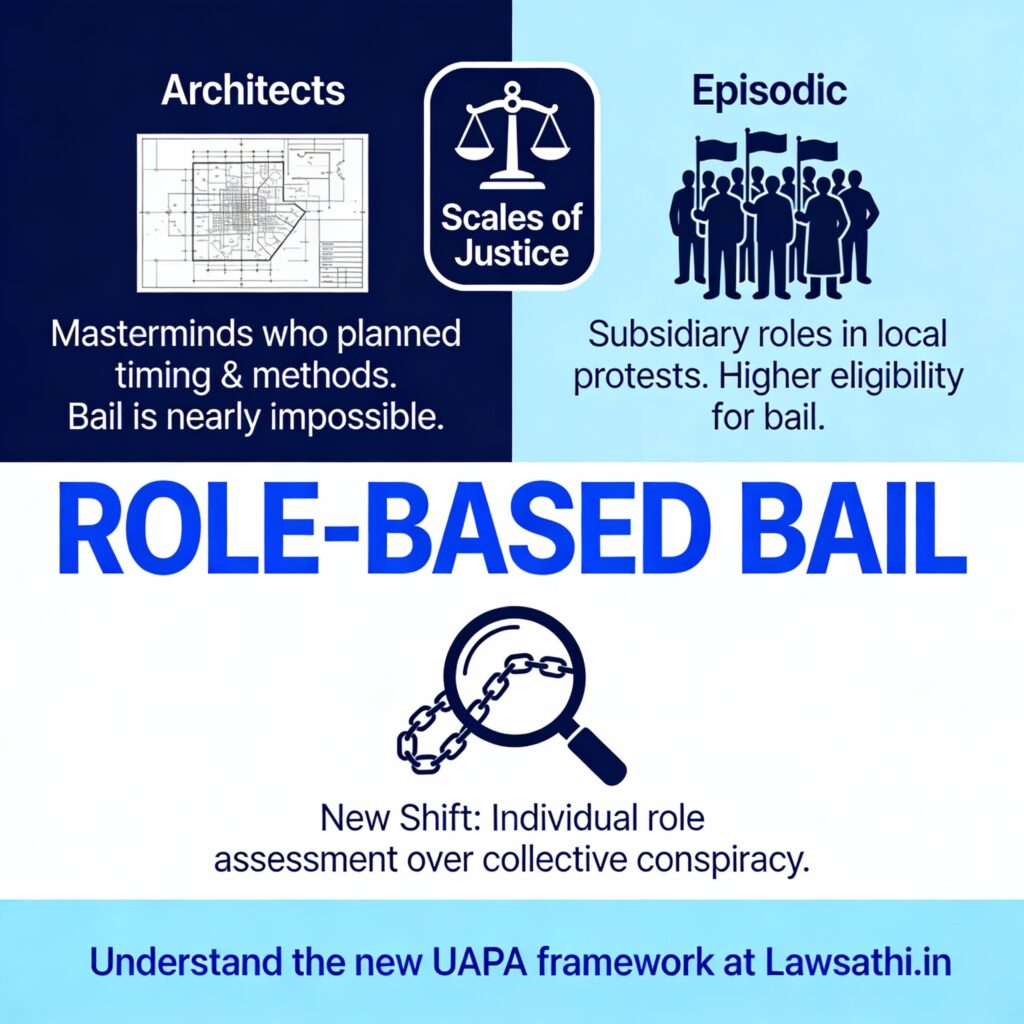
The Indian legal landscape recently witnessed a tectonic shift regarding personal liberty. In January 2026, the Supreme Court delivered a monumental verdict in the case of Arvind Dham v. Directorate of Enforcement (2026 INSC 12).
This judgment clarifies the boundary between stringent financial laws and fundamental rights. Specifically, it addresses how long the state can hold an individual without a trial.
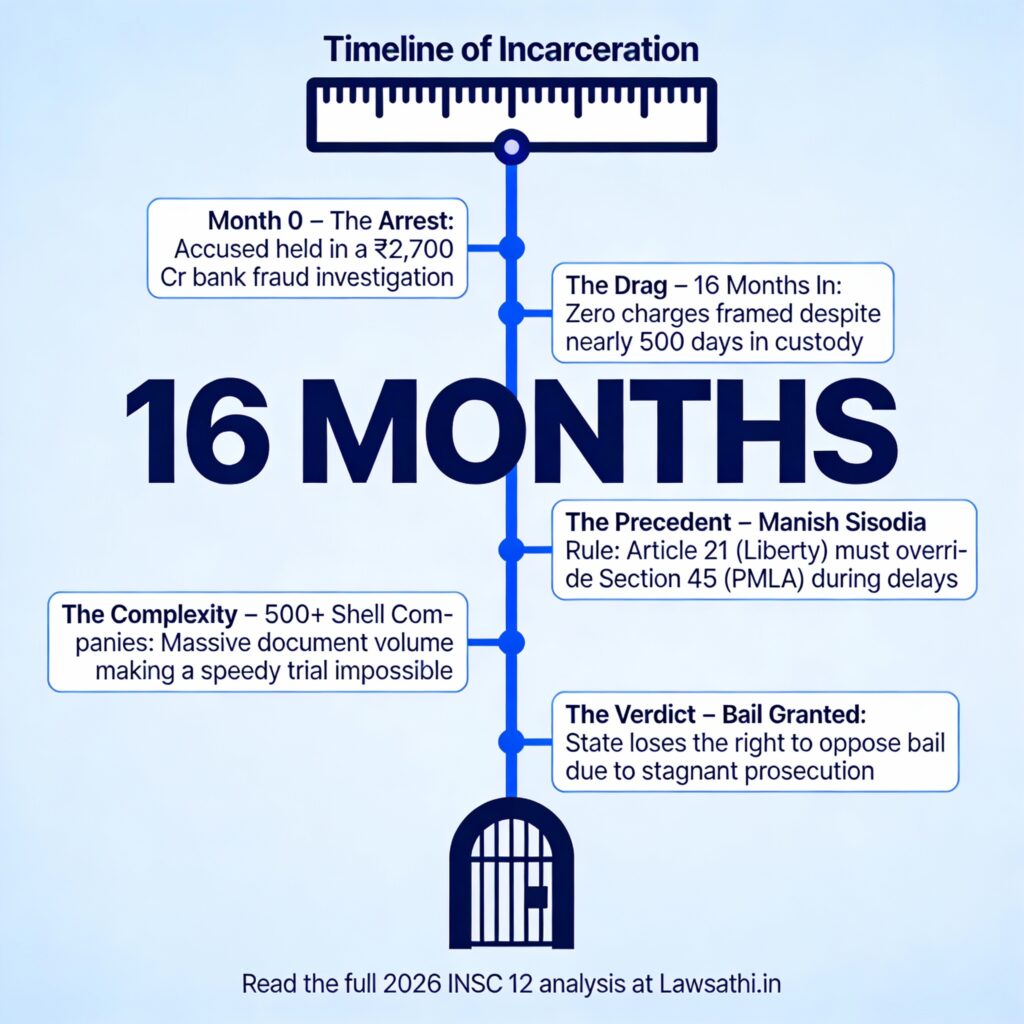
Arvind Dham, the promoter of Amtek Auto, spent nearly 16 months in custody. The Enforcement Directorate (ED) arrested him in a high-profile bank fraud case involving ₹2,700 crore. However, the Court decided that prolonged incarceration without progress is unacceptable. Consequently, the Arvind Dham bail Supreme Court 2026 INSC 12 ruling has become a beacon for defense lawyers across India.
A Conflict of Laws and Rights
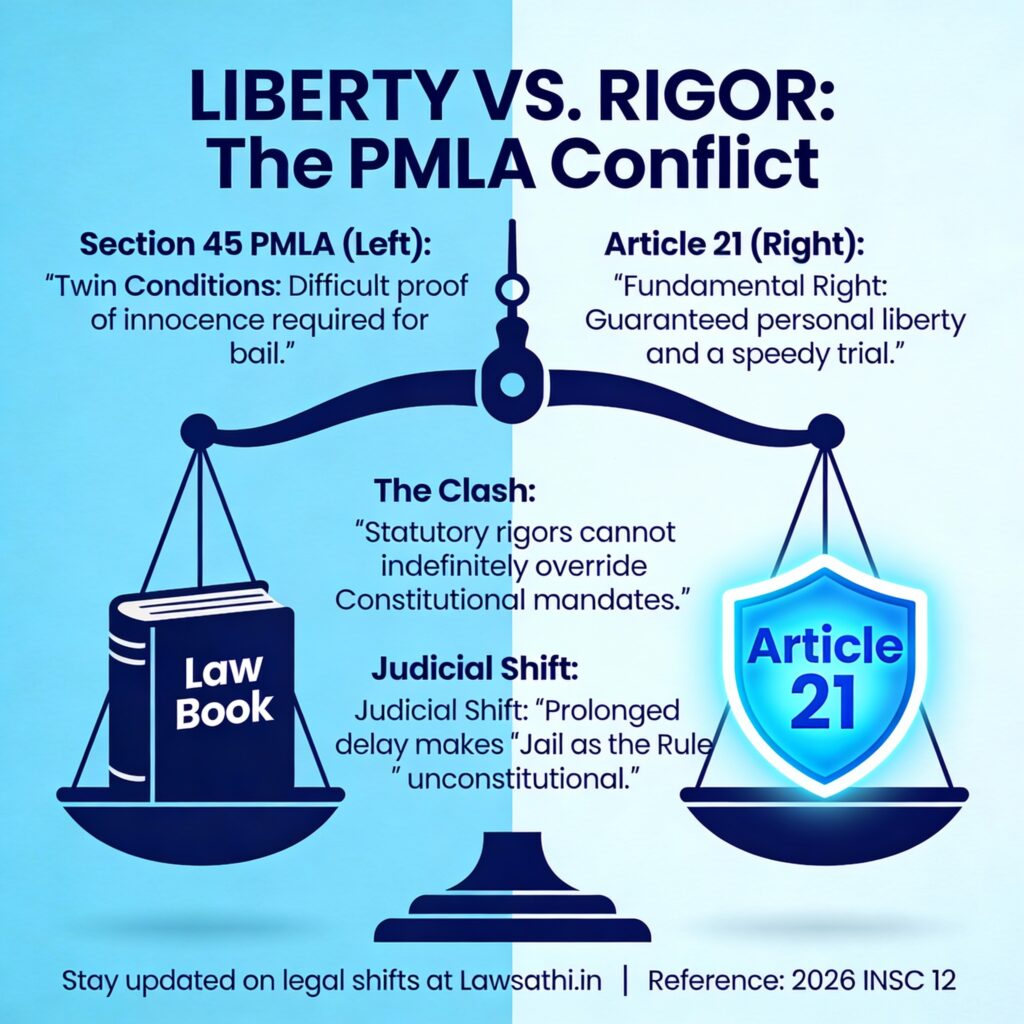
Specifically, the core conflict rested on the friction between statutory restrictions and the Constitution. Section 45 of the PMLA imposes “twin conditions” that make bail extremely difficult. Conversely, Article 21 guarantees the right to life and personal liberty. Above all, the Court ruled that constitutional mandates must eventually override statutory rigors.
The Legal Tussle: Section 45 PMLA vs. Article 21
Section 45 of the Prevention of Money Laundering Act is notoriously strict. To grant bail, a judge must believe the accused is likely not guilty. Furthermore, the court must be convinced the accused will not commit more crimes. These conditions often lead to “jail as the rule” in money laundering cases.
The Impact of Undue Trial Delay
In this instance, the Supreme Court observed that Arvind Dham had been in jail for over a year. Despite this long duration, the prosecution had not even framed charges. Therefore, the “twin conditions” cannot act as an absolute bar to liberty.
When a trial remains stagnant, the court must intervene. Specifically, the court must protect the accused from punitive pre-trial detention. In fact, prolonged detention without a trial violates the basic tenets of justice.
Balancing Statute and Constitution
Furthermore, the bench noted that systemic delays often turn incarceration into a punishment. This happens long before any actual conviction occurs. For example, if the state cannot ensure a speedy trial, it loses its moral right to oppose bail. Consequently, the Arvind Dham bail Supreme Court 2026 INSC 12 judgment serves as a reminder that Article 21 remains supreme.
Analyzing the 2026 INSC 12 Judgment Hooks
The bench provided clear reasoning for its decision in 2026 INSC 12. Most importantly, the judges focused on the “likelihood of trial completion.” They found that the ED’s case involved over 500 shell companies and thousands of complex documents. As a result, the chances of finishing the trial soon were minimal.
Precedents of Liberty and Fair Trials
The Court drew heavily from earlier landmark rulings. Specifically, it cited the Manish Sisodia (2024) case. It also referenced the principles found in Vijay Madanlal Choudhary.
These cases establish that long delays violate the spirit of “fair trial.” Therefore, the bench concluded that the Arvind Dham bail Supreme Court 2026 INSC 12 must follow this path of liberty. In other words, statutory rules cannot crush individual rights forever.
Minimal Progress and Judicial Concern
Moreover, the bench expressed concern over the “web of documents” relied upon by the prosecution. Because the investigation was so vast, the trial could potentially take years. In fact, an accused cannot be held hostage to the complexity of the state’s own investigation. This logic provides a powerful tool for defense attorneys handling similar economic offenses.

Implications for Indian Defense Lawyers and PMLA Litigants
This judgment changes the strategy for PMLA litigation in 2026. For example, defense lawyers can now use trial delay as a primary ground for bail. Additionally, if the trial has not progressed within 12 to 18 months, a strong case for bail exists.
Redefining Reasonable Time for Trials
What exactly constitutes a “reasonable time” for a trial in India? The 2026 INSC 12 ruling suggests that 16 months of stagnation is far beyond the limit. Consequently, prosecutors can no longer hide behind supplemental charge sheets.
They cannot use these documents to keep individuals in “perpetual custody.” Moreover, this strengthens the push to return to the principle of “Bail as a rule, Jail as an exception.” Therefore, the burden shifts back to the state to justify continued detention.
Strategic Takeaways for Legal Teams
Furthermore, litigants can point to the Delhi High Court history of this case. This helps show why early denial of bail should be reconsidered. Legal teams should focus on documenting every day of delay.
For illustration, keep a log of every hearing where the ED failed to produce records. Above all, use the Arvind Dham bail Supreme Court 2026 INSC 12 to show that liberty cannot be ignored. Even in cases involving ₹2,700 crore, constitutional rights must prevail.

Managing Complex PMLA Briefs with LawSathi AI
Managing massive PMLA cases requires modern solutions. Charge sheets in money laundering cases often run into thousands of pages. Fortunately, AI tools like LawSathi help lawyers track these massive documents efficiently. By using AI, you can map issues across multiple case bundles quickly.
Automating Article 21 Notifications
Interestingly, technology now allows lawyers to automate “Article 21 Notifications.” LawSathi’s AI can monitor trial timelines for your entire firm. For example, it can alert your team when a client’s incarceration crosses the 12-month threshold.
As a result, you can move for bail immediately. You can effectively cite the Arvind Dham bail Supreme Court 2026 INSC 12 precedent. This ensures that no client stays in jail longer than legally necessary.
Enhancing Legal Research with Intelligence
Moreover, native AI tools are changing legal tech globally. Using LawSathi, you can cross-reference new ED allegations against existing testimonies in seconds. Specifically, this allows you to highlight inconsistencies that suggest a lack of “reasonable grounds.” Thus, you can meet the Section 45 burden with data-driven evidence.
Conclusion: The Future of Liberty in Special Statutes
The Arvind Dham bail Supreme Court 2026 INSC 12 is more than just a bail order. Instead, it represents a maturing of Indian jurisprudence. It balances the state’s power to investigate crimes with the individual’s right to liberty.
Consequently, we expect a wave of similar bail applications in the coming months. To summarize, trials must be speedy to be fair. If the state cannot ensure a swift conclusion, the judiciary will step in.
Therefore, lawyers must stay updated on these evolving standards of Article 21. By prioritizing liberty, the Supreme Court has re-established the constitutional equilibrium in India.
Stay ahead of landmark judgments like 2026 INSC 12. Use LawSathi’s AI-powered insights to manage your PMLA briefs and never miss a trial deadline. Request a demo today.