The Supreme Court of India has taken a firm stance on transparency in bail proceedings. In a significant ruling, the Court has made criminal history disclosure in bail applications mandatory for all petitioners. This landmark judgment fundamentally changes how criminal lawyers must approach bail matters at the highest level of the judiciary.
The ruling emerged from growing concerns about petitioners concealing their criminal antecedents. Justice Dipankar Datta and Justice Manmohan delivered this crucial judgment. Furthermore, the Court emphasized that approaching with “clean hands” is not merely a principle but now a binding requirement.
Introduction: The Supreme Court’s Strict Stance on Transparency
The Munnesh Judgment: A Turning Point
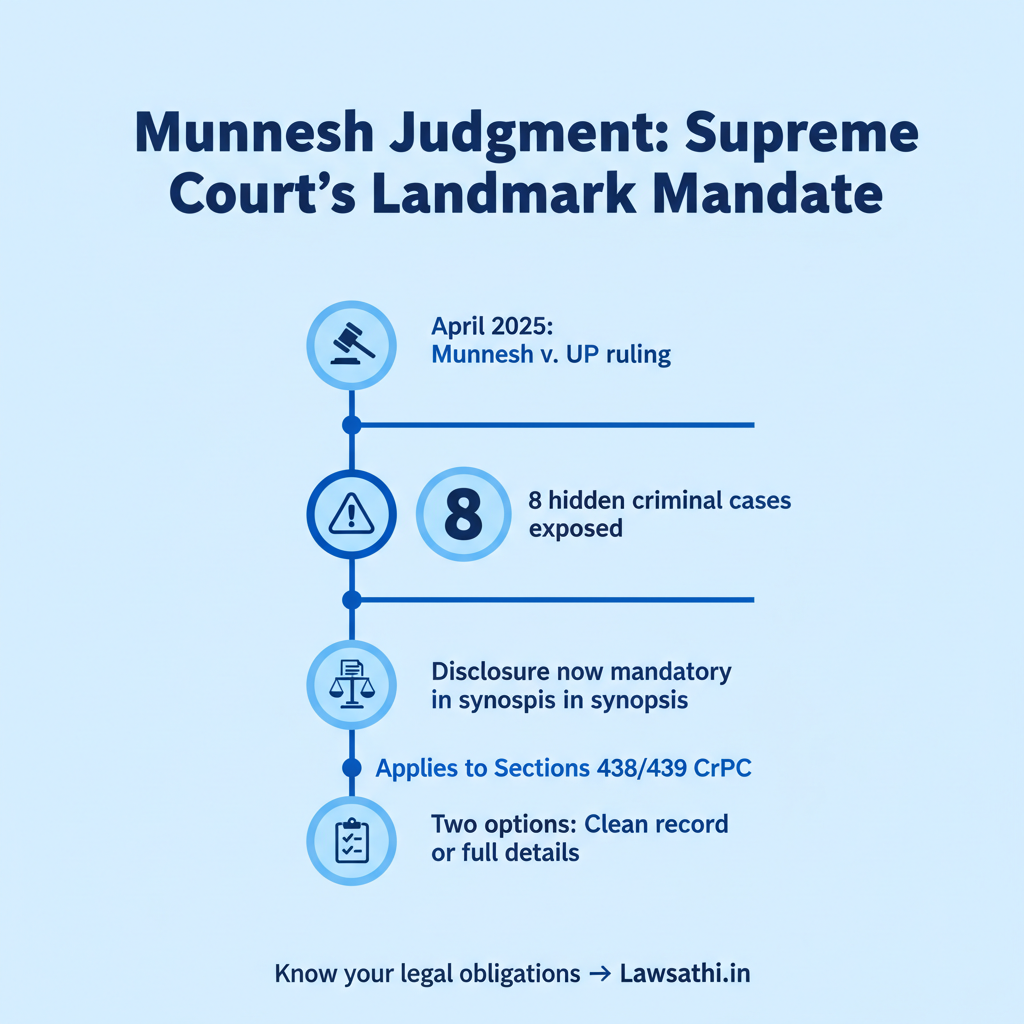
In Munnesh v. State of Uttar Pradesh (April 2025), the Supreme Court confronted a disturbing pattern of non-disclosure. The petitioner was arrested in 2018 for murder under Section 302 IPC. He had approached the Court after the Allahabad High Court rejected his bail application. However, he failed to disclose eight criminal cases in his Special Leave Petition. These included a conviction under Sections 379 and 411 IPC [1].
The Court observed unequivocally that it would no longer tolerate such suppression. Justice Datta remarked that the Supreme Court must not be taken for granted. Specifically, he stated the Court must not be “taken for a ride.” Such deliberate concealment undermines the sanctity of proceedings before the highest court of the land [2].
The Mandatory Directive
The Court issued a comprehensive directive that fundamentally alters bail practice. Every individual approaching the Supreme Court with an SLP challenging bail orders must disclose their criminal antecedents. This must now mandatorily appear in the synopsis itself. Consequently, the rule applies to petitions under Sections 438/439 of CrPC. It also covers Sections 482/483 of the Bharatiya Nagarik Suraksha Sanhita [7].
Petitioners have two clear options under this mandate. First, they can declare that they have “clean antecedents.” Alternatively, if they have any criminal involvement, they must clearly indicate all cases with their current stages. As a result, false disclosures will lead to immediate dismissal of petitions.
Why This Ruling Matters
This judgment represents a significant shift from observation to enforcement. Previously, courts made observations about non-disclosure without concrete action. Now, therefore, the Supreme Court has established a mandatory procedural requirement. This comes with clear consequences [6].
Moreover, the ruling protects the Court’s extraordinary jurisdiction under Article 136 from abuse. It sends a strong message against forum-shopping and strategic concealment of material facts. Therefore, criminal lawyers must fundamentally reassess their approach to bail applications.
Scope of Disclosure: What Constitutes ‘Criminal History’?
Comprehensive Definition Under the Mandate
The criminal history disclosure in bail applications must cover all pending and past criminal matters. Specifically, petitioners must disclose all FIRs registered against them. This applies regardless of the current status. Additionally, chargesheets filed and pending trials must be included with their current stages [3].
The disclosure requirement extends to prior convictions as well. Whether an accused has been declared a proclaimed offender must also be stated clearly. In fact, the Supreme Court has left no room for ambiguity about what constitutes “criminal history.”
Specific Details Required
The Munnesh directive specifies particular details that must appear in the synopsis. Petitioners must state whether they have clean antecedents or provide complete case details. Case numbers, sections involved, and the stage of proceedings are all mandatory elements [1].
For example, a petitioner cannot simply state “I have pending cases.” Instead, they must specify: “FIR No. 123/2020 under Sections 420, 468 IPC at PS Connaught Place, currently at evidence stage.” This level of detail enables courts to make informed decisions on bail.
Acquitted Cases: The Gray Area
A common question arises regarding acquitted cases. Must lawyers disclose cases where the client has been acquitted? The Supreme Court’s approach suggests comprehensive disclosure is safer. In Satish Chandra Yadav v. Union of India (September 2022), the Court upheld a dismissal. A CRPF constable had failed to disclose a pending criminal case [9].
The pendency at the time of filling the verification form was the relevant factor. It was not the subsequent acquittal. Therefore, practitioners should advise clients to disclose both pending and past cases. This includes acquittals. Such an approach eliminates any risk of suppression allegations later.
Prior Bail Applications Must Be Disclosed
The Kusha Duruka v. State of Odisha (January 2024) judgment added another layer to disclosure requirements. Bail applications must mention details of earlier bail applications and orders passed. Additionally, any pending bail applications in any court must be disclosed [11].
If no application is pending, a clear statement to that effect must appear in the petition. The Court also directed registries to annex system-generated reports. These reports cover decided and pending bail applications in the same case. Consequently, accidental omissions become much harder to justify.
Suppression of Material Facts: Legal Consequences
Non-Disclosure as Grounds for Cancellation
The legal consequences of suppression are severe and far-reaching. Non-disclosure of criminal antecedents amounts to suppression of material facts. Courts view this as obtaining bail through fraud or misrepresentation [14].
In Deepak Yadav v. State of U.P. (May 2022), the Supreme Court outlined illustrative circumstances. These specifically relate to bail cancellation. They include ignoring past criminal records while granting bail. Additionally, courts must not overlook the influential position of the accused [15].
The Court stated that cancellation becomes necessary when the order granting bail is “apparently whimsical, capricious and perverse.” Furthermore, suppression of material facts falls squarely within these grounds.
The Conduct-Centric Framework
The M/s Netsity Systems Pvt. Ltd. v. State (NCT of Delhi) (2025) case established a conduct-centric bail scrutiny framework. The accused failed to disclose rejection of anticipatory bail when seeking regular bail. Additionally, they had undertakings before the High Court that they reneged upon [8].
The Supreme Court quashed the bail order and directed surrender. This judgment emphasizes that prior conduct must be considered. This is especially true for undertakings to superior courts. Therefore, non-disclosure of prior bail rejection amounts to suppression of material facts [12].
The Clean Hands Doctrine
The principle of approaching courts with “clean hands” has deep roots in Indian jurisprudence. In Kusha Duruka, Justice Vikram Nath and Justice Rajesh Bindal quoted earlier precedents extensively. They emphasized that “the stream of administration of justice has to remain unpolluted” [11].
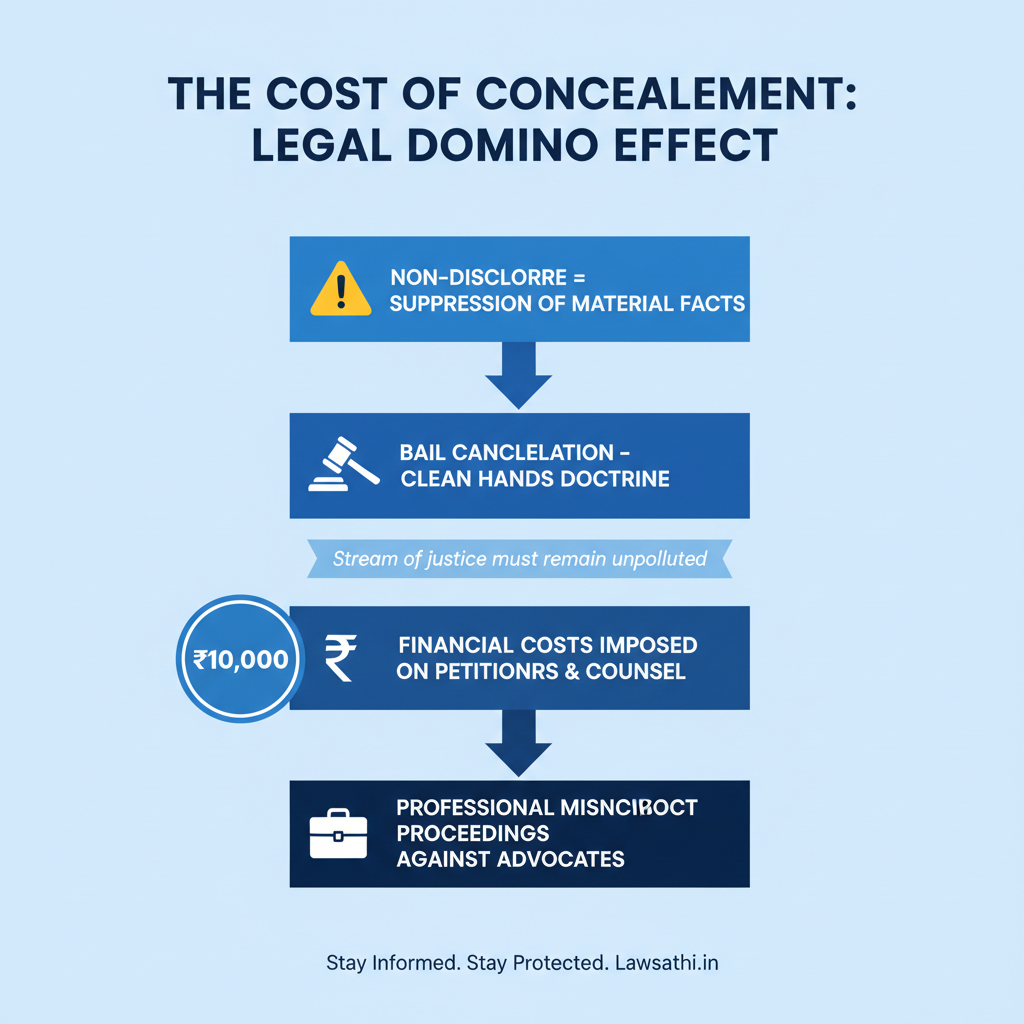
The Court further referenced K.D. Sharma v. Steel Authority of India. It noted that an applicant without candid facts cannot hold a writ with “soiled hands.” Moreover, suppression of material facts is not advocacy. Instead, it is “jugglery, manipulation, manoeuvring or misrepresentation” [13].
Costs and Professional Consequences
Beyond bail cancellation, courts may impose costs on petitioners and potentially their counsel. In the Kusha Duruka case, the Supreme Court imposed a token cost of ₹10,000. The Court also directed that copies of the order be sent to Registrars General of all High Courts [11].
In egregious cases, professional misconduct proceedings against advocates may follow. The Bar Council of India has already directed state bar councils to act. They must ensure criminal background checks before enrolling advocates [16]. This indicates a systemic approach to maintaining integrity in the legal profession.
Practical Implications for Criminal Lawyers and Law Firms
Enhanced Duty of Due Diligence
The Munnesh judgment places a significant burden on legal practitioners. Petitioners and their legal representatives must conduct thorough checks on antecedents before filing. The Court made clear that ignorance will no longer be excusable. This applies whether it is genuine or strategic [1].
The Supreme Court has emphasized advocates’ duty in Saumya Chaurasia v. Directorate of Enforcement (December 2023). Every advocate acts as an officer of the court. Therefore, they have a duty to diligently verify facts from the record [17]. This duty becomes particularly crucial in bail matters.
Verification Methods and Resources
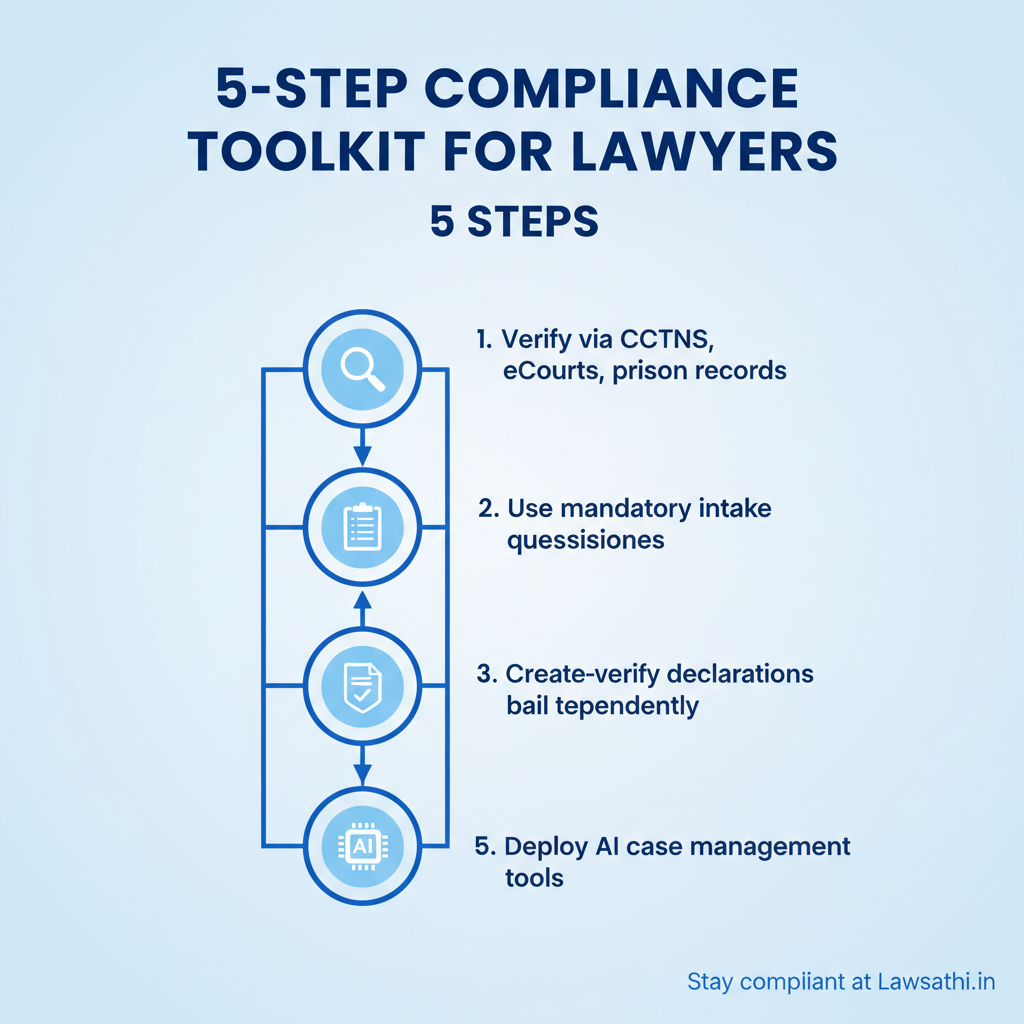
Criminal lawyers must establish robust verification protocols for client backgrounds. Several resources are available for conducting such verification. For instance, the CCTNS (Crime and Criminal Tracking Network and Systems) provides a national database for criminal records [4].
Additionally, district-level police verification certificates offer another verification avenue. The eCourts services portal allows lawyers to search court records for pending cases. Similarly, prison department records can reveal prior incarcerations that clients might omit [5].
Client Intake Best Practices
Law firms should implement mandatory intake questionnaires for criminal matters. These questionnaires must specifically ask about all criminal involvement. This includes both pending and closed cases. Clients should sign declarations attesting to the accuracy of their disclosures.
Furthermore, lawyers should verify client declarations against independent sources. Relying solely on client instructions may expose practitioners to risk. The Delhi High Court has noted that advocates are bound by client instructions. However, they must still exercise professional judgment [18].
Drafting Comprehensive Bail Applications
Drafting bail applications now requires greater attention to mandatory disclosure fields. Practitioners should create checklists to ensure all required information is included. The synopsis must clearly state either clean antecedents or provide exhaustive details [7].
Standard templates should incorporate disclosure requirements as mandatory fields. This prevents accidental omissions that could prove fatal to the petition. Additionally, lawyers should attach supporting documents verifying the disclosed information.
Streamlining Case Management with LawSathi
AI-Powered Solutions for Disclosure Compliance
Managing disclosure requirements manually can be challenging for busy criminal law practices. LawSathi offers AI-powered tools that streamline case management and ensure compliance. Specifically, the platform helps lawyers track and manage client case histories systematically [20].
Centralized case history management allows storage of all client information in one place. Lawyers can track multiple FIRs, chargesheets, and pending matters effortlessly. As a result, the system auto-generates criminal antecedent summaries for easy reference.
Preventing Accidental Omissions
LawSathi’s mandatory field templates ensure nothing gets overlooked. Bail application templates come with built-in disclosure fields that cannot be bypassed. Checklist prompts appear before filing, alerting lawyers to any missing information [19].
Document verification features cross-reference client declarations with uploaded documents. The system flags inconsistencies before submission. Consequently, this prevents potential suppression allegations. Real-time case status tracking automatically updates the stage of proceedings for disclosures.
Building Client Trust Through Transparency
Using technology to ensure compliance builds credibility with courts and clients alike. Audit trails show exactly what was disclosed and when. Moreover, standardized questionnaires capture all required information consistently.
Client attestation modules create evidence of due diligence. Integration with eCourts provides real-time verification of case status. Therefore, these features protect both the client’s interests and the lawyer’s professional standing.
Conclusion: Ensuring Compliance in Legal Practice
Summary of Supreme Court Directives
The Supreme Court’s mandate on criminal history disclosure in bail applications represents a paradigm shift. The Munnesh judgment requires mandatory disclosure in the synopsis for all bail-related SLPs. Petitioners must either declare clean antecedents or provide complete criminal case details [7].
The Kusha Duruka judgment added requirements for disclosing prior bail applications. Courts will now impose costs and may cancel bail for non-compliance. Consequently, these directives apply equally to petitions under CrPC and the new Bharatiya Nagarik Suraksha Sanhita [11].
Ethical Obligations Moving Forward
The legal profession must embrace these requirements as part of its ethical obligations. Courts demand the “clean hands” approach in its truest sense. In fact, partial disclosure equals no disclosure in the eyes of the judiciary [6].
Client ignorance cannot excuse a lawyer’s omission. Technology must aid professional judgment, not replace it. Therefore, law firms should implement mandatory intake procedures and verification protocols immediately.
The Supreme Court’s message is unambiguous: transparency is non-negotiable. Criminal practitioners must adapt their practices accordingly or face serious consequences. Ultimately, this mandate protects the integrity of the judicial process and ensures fair consideration of bail matters.
Ensure your bail applications are comprehensive and compliant. Try LawSathi’s AI-powered case management tools today to streamline your practice.