The legal landscape in India changed significantly with the arrival of the Bharatiya Nagarik Suraksha Sanhita (BNSS). Specifically, Section 43 BNSS has redefined how citizens participate in law enforcement. A landmark 2026 Supreme Court ruling recently brought much-needed clarity to this provision.
Transitioning from Section 43 CrPC to Section 43 BNSS
For decades, Section 43 of the Code of Criminal Procedure (CrPC) governed “Citizen’s Arrest.” However, the new Sanhita introduces a more rigorous procedural framework. Therefore, lawyers must understand the shift from a state-centric model to community participation.
The 2026 ruling addressed a case where a private citizen detained a suspect based on a phone call. The Court had to decide if “hearsay” suffices for an arrest. Consequently, this judgment sets the tone for modern Indian criminal jurisprudence.
Comparing Procedural Shifts
Under the 1973 Code, the police were required to “re-arrest” the individual. In contrast, the BNSS uses the phrase “take him into custody.” This indicates a more seamless transition between private restraint and official police action.
Furthermore, the PIB Comparative Analysis highlights how the BNSS integrates citizen duties into the formal legal process. Above all, the Court emphasized that private arrest is a civic duty. It is not an invitation to vigilantism.
The Core of the Ruling: Interpreting “Non-Bailable and Cognizable”
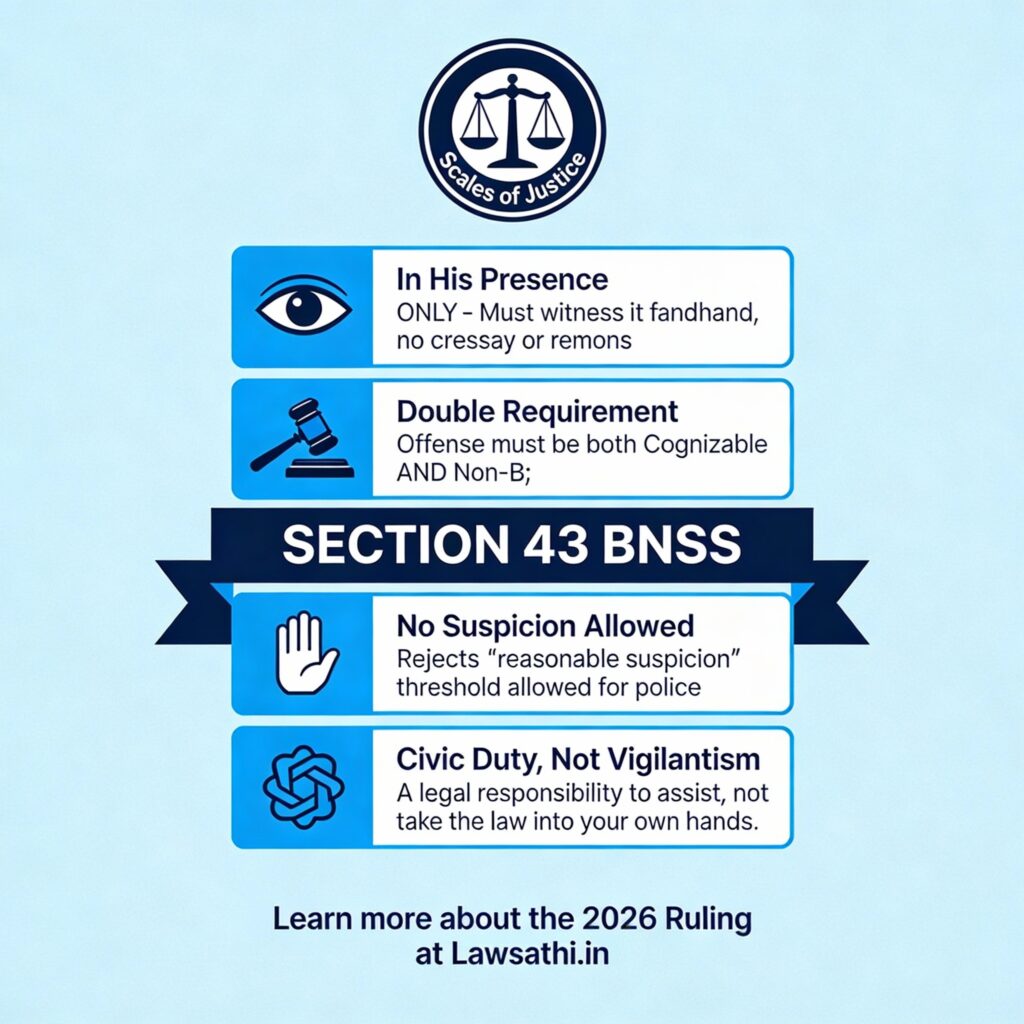
The Supreme Court has now set a high threshold for private intervention. Under Section 43 BNSS, a private person can only arrest if the offense occurs “in his presence.” Additionally, the offense must be both cognizable and non-bailable.
Defining “In His Presence”
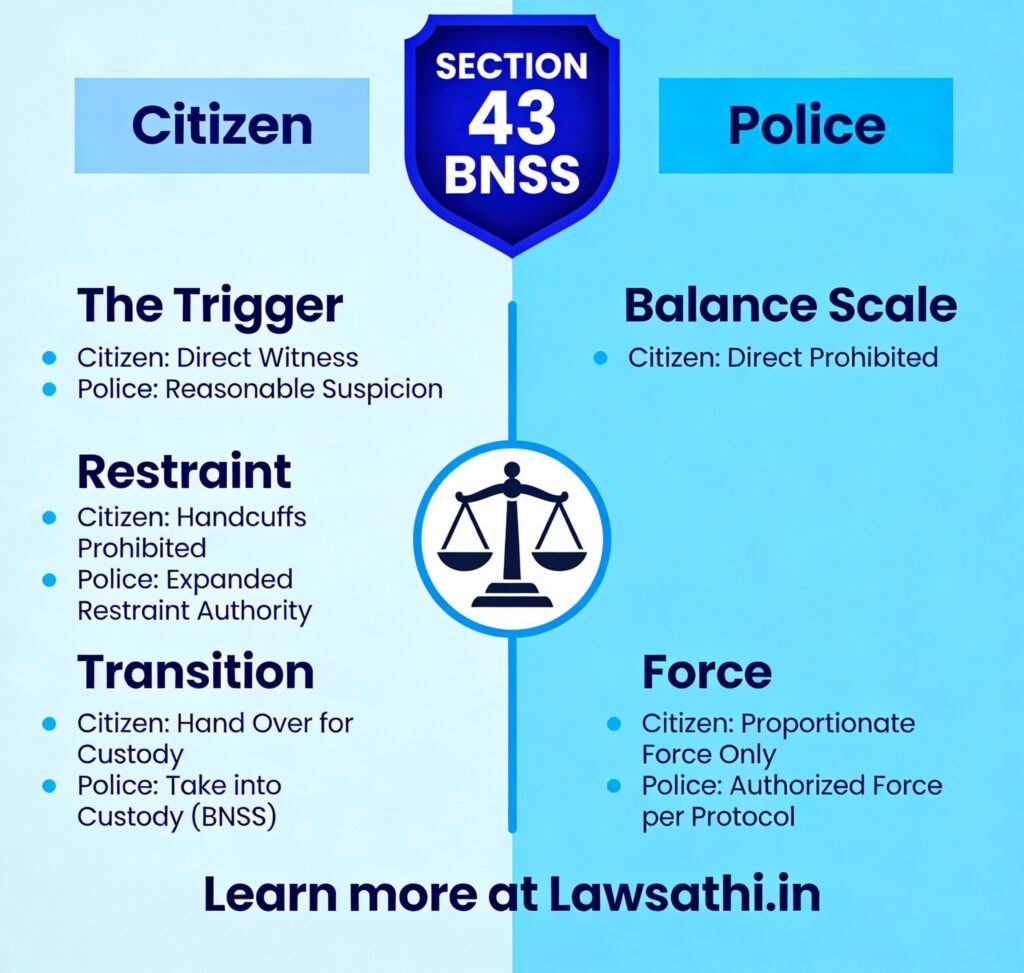
The 2026 ruling explicitly rejects the idea of “reasonable suspicion” for citizens. While police can arrest on suspicion under Section 35, citizens cannot. Specifically, the arrestor must be a direct witness to the criminal act.
For example, hearing a scream from another room does not satisfy this requirement. In other words, “knowledge” gained through secondary sources is insufficient. This ensures that citizens do not act on rumors or half-truths.
Tightening the Threshold
The Court clarified that the offense must be non-bailable at the time of the act. If a citizen arrests someone for a bailable offense, they risk legal blowback. Consequently, the BNSS Section Table serves as a vital tool for determining these categories quickly.
Procedural Mandates: “Without Unnecessary Delay”
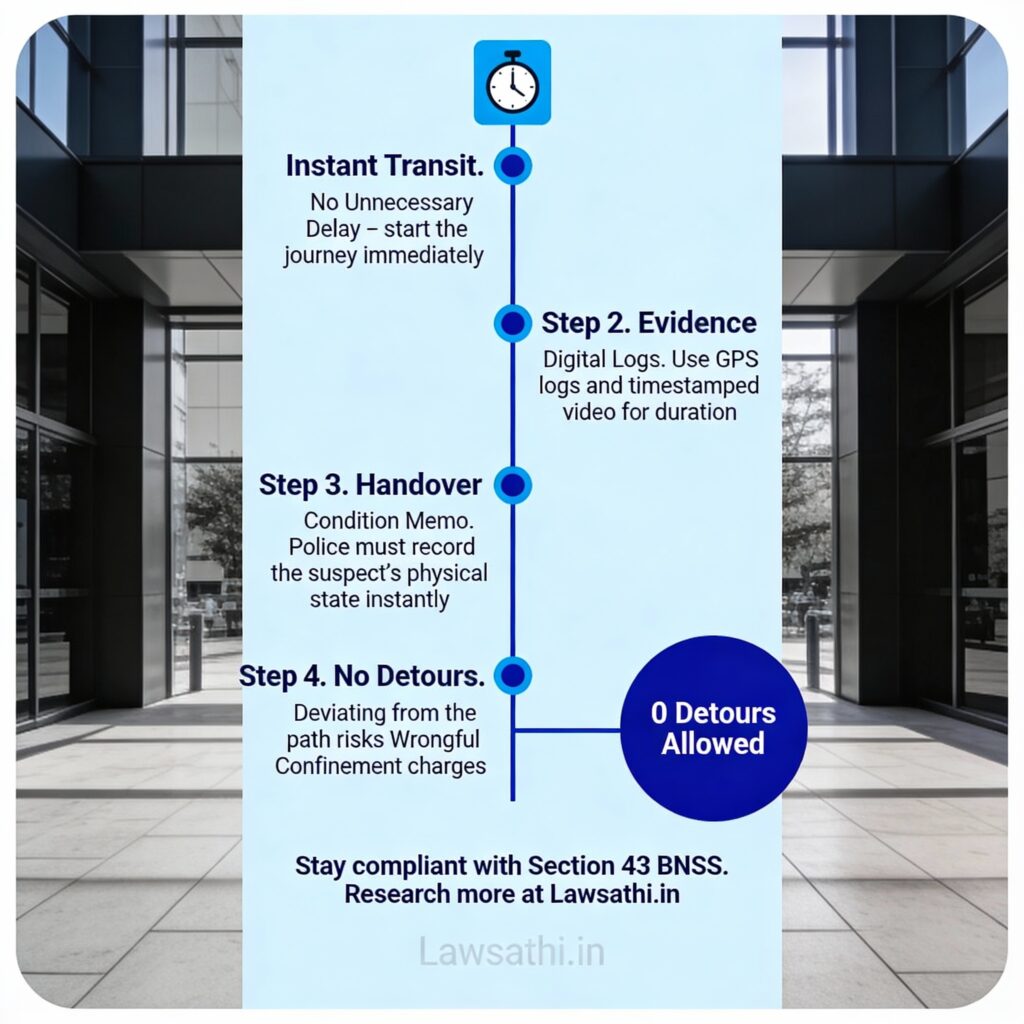
Once an arrest is made, the clock starts ticking immediately. The Supreme Court mandate defines “without unnecessary delay” as the instant start of transit to the police station. Therefore, any detour could lead to charges of wrongful confinement.
The Role of Digital Evidence
In 2026, technology plays a massive role in proving legal compliance. The Court now looks at GPS logs and timestamped mobile videos. For instance, these digital footprints verify how long a suspect was held.
If a citizen delays for 60 minutes without a safety reason, the arrest may become illegal. In fact, many practitioners now advise clients to record the entire handover process. This creates a transparent record for the Mandatory BNSS Reporting requirements.
Recording Physical Condition
The police must now record the suspect’s physical condition immediately upon handover. This prevents allegations of “private custodial torture.” Moreover, it protects the citizen from false claims of assault.
Liability and Protection for Citizens: Preventing Mob Justice
One of the greatest fears regarding Section 43 BNSS is the rise of mob justice. To counter this, the Supreme Court distinguished between a “Citizen’s Arrest” and “Mob Lynching.”
Determining Reasonable Force
Force used during an arrest must be “proportionate to the resistance.” For example, striking a restrained individual is strictly prohibited. If the suspect is not a threat to life, using weapons is an offense under the Bharatiya Nyaya Sanhita (BNS).
Identifying Lawful Participation
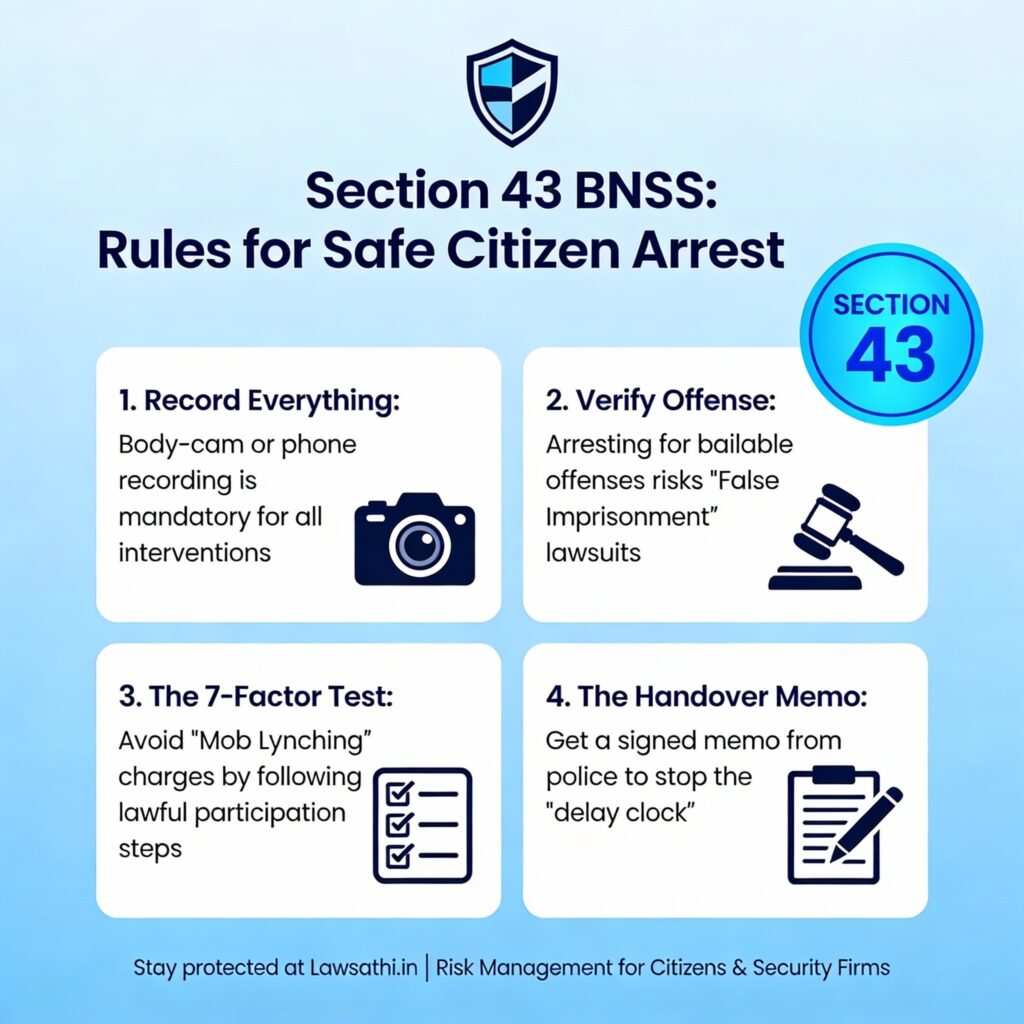
The Court also provided a 7-factor test to identify unlawful assembly members. This prevents innocent bystanders from being caught in legal crosshairs. Therefore, accidental presence at a crime scene is no longer a guaranteed conviction.
Civil and Criminal Liability
Citizens act at their own peril when exercising these powers. If they arrest based on mistaken identity, they may face civil damages. Specifically, they could be sued for “False Imprisonment.”
Furthermore, arresting for a bailable offense can lead to criminal prosecution. As a result, the Supreme Court 2025 Digest warns against overzealous private enforcement.
Comparative Analysis: How BNSS 2026 Jurisprudence Differs
The 2026 rulings represent a shift toward “Community Policing.” This philosophy encourages citizens to help the state. However, it also imposes stricter rules on how that help is provided.
Restrictions on Handcuffing
A major difference exists between police and private arrest powers. Specifically, the police have expanded handcuffing powers under Section 43(3). In contrast, citizens do not have this authority.
In fact, private citizens are strictly prohibited from using handcuffs unless an escape is imminent and violent.
Bypassing Section 35 Notices
A private arrest bypasses the typical “Notice of Appearance” required by Section 35 BNSS. Consequently, the Supreme Court mandates higher transparency. This ensures that police do not use citizens as proxies to avoid serving Physical Section 35 Notices.
Impact on Legal Practice: Advice for Practitioners
Legal practitioners must adapt to these new guidelines quickly. When defending a citizen, lawyers should focus on the “Cognizable and Non-Bailable” nature of the offense. If the crime was bailable, the defense of Section 43 BNSS fails.
Strategies for Security Firms
Corporate security firms must update their Standard Operating Procedures (SOPs). For instance, they should mandate body-cam recording for all guards. Additionally, firms must ensure duty officers sign a “Handover Memo” immediately.
This memo stops the “Unnecessary Delay” clock and protects the firm. Similarly, practitioners can use the Andhra Pradesh High Court Ruling to argue that procedural violations render detention invalid.
Challenging Wrongful Arrests
To challenge a private arrest, examine the direct witness requirement. If the citizen arrestor was not physically present, the arrest is unauthorized. Therefore, the subsequent police detention may also be tainted.
Conclusion
The 2026 Supreme Court interpretation of Section 43 BNSS provides a tightrope for citizens. It empowers them to protect their communities. Simultaneously, it demands strict adherence to the law.
Lawyers must now be experts in both the Sanhita’s text and these evolving judicial mandates. Stay ahead of the new BNSS mandates. Use LawSathi’s AI-powered research tools to find the latest 2026 case law summaries in seconds. Start your free trial today.