
A landmark Supreme Court judgment has fundamentally clarified the relationship between religious conversion and Scheduled Caste status in India. In a significant ruling delivered on March 24, 2026, the Supreme Court rules conversion from Hinduism, Sikhism, Buddhism disqualifies Scheduled Caste status entirely. This decision has profound implications for legal practitioners advising clients on caste-based rights.
Therefore, understanding this ruling is essential for every legal professional practicing in India.
Understanding the Case Background
The Facts That Led to Supreme Court
The case originated from Andhra Pradesh, where a man born into the Madiga caste (a Scheduled Caste) converted to Christianity. Subsequently, he worked as a Pastor for over a decade. When he faced alleged caste-based abuse and assault, he filed an FIR under the Scheduled Castes and Scheduled Tribes (Prevention of Atrocities) Act, 1989.
However, the Andhra Pradesh High Court quashed the proceedings in April 2025. Justice Harinath N held that the caste system is alien to Christianity. Consequently, the complainant could not invoke the SC/ST Act after converting to Christianity.
The matter then reached the Supreme Court through a Special Leave Petition. The apex court was called upon to decide a crucial question. Specifically, the Court examined whether converts to religions other than Hinduism, Sikhism, or Buddhism can retain Scheduled Caste status.
Core Constitutional Question
The fundamental question before the Supreme Court was straightforward yet constitutionally significant. Can a person who has converted to Christianity claim Scheduled Caste benefits? Furthermore, what happens to SC status upon religious conversion?
The answer rests on the Constitution (Scheduled Castes) Order, 1950. As the Supreme Court rules conversion from Hinduism, Sikhism, Buddhism disqualifies Scheduled Caste status, the presidential order becomes central. This order, issued under Article 341 of the Constitution, specifically limits SC status to followers of three religions.
The Constitutional Framework
Constitution (Scheduled Castes) Order, 1950
The President of India issued the Constitution (Scheduled Castes) Order, 1950, under Article 341. This order specifies which castes qualify as Scheduled Castes for each state and union territory. Clause 3 of this Order%20ORDER%201950%20dated%2010081950.pdf) contains a crucial religious restriction.
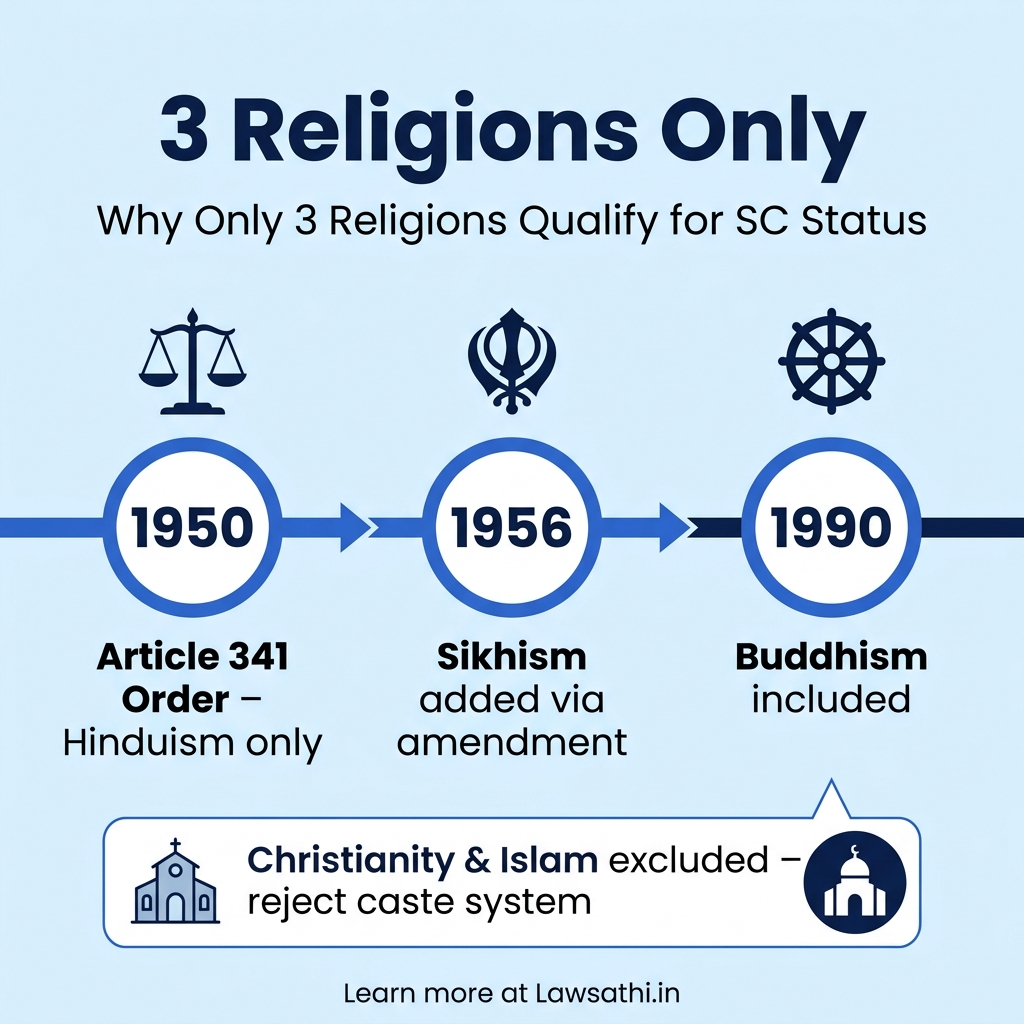
The clause states: “No person who professes a religion different from the Hindu, the Sikh or the Buddhist religion shall be deemed to be a member of a Scheduled Caste.”
Originally, in 1950, only Hinduism was included. The Sikh religion was added through an amendment in 1956. Subsequently, Buddhism was included in 1990 through Act 15 of 1990. This evolutionary expansion reflects the constitutional understanding of caste as linked to specific religious traditions.
Why Religion Matters for SC Status
The Supreme Court’s reasoning reveals why religion remains central to Scheduled Caste identification. The caste system originated within Hinduism and later extended to Sikhism and Buddhism. Therefore, the constitutional framework recognizes caste-based discrimination as inherently tied to these religious structures.
For example, Christianity and Islam theoretically reject caste distinctions. As a result, the Constitution does not extend SC status to converts to these faiths. This approach ensures that affirmative action benefits those who face caste-based discrimination within the recognized religious framework.
Seven Key Principles Established by Supreme Court
Principles Governing SC Status and Conversion
Justice Prashant Kumar Mishra, authoring the judgment, laid down seven comprehensive principles. These principles now govern all questions relating to Scheduled Caste status and religious conversion in India.
First, any claimant must demonstrably belong to a caste specifically notified under Clause 2 of the 1950 Order. This must be established through clear, cogent, and unimpeachable evidence.
Second, no person professing a religion other than Hinduism, Sikhism, or Buddhism can be deemed an SC member. This bar under Clause 3 is categorical and absolute.
Third, no statutory benefit, protection, reservation, or entitlement can be claimed by those excluded by Clause 3. The bar admits no exception whatsoever.
Fourth, a person cannot simultaneously practice an excluded religion and claim SC membership. These two positions are mutually exclusive under the constitutional scheme.
Immediate Effect of Conversion
Fifth, the Court established that loss of SC status is automatic and immediate upon conversion. All eligibility for statutory benefits, reservations, and protections terminates the moment conversion occurs. Therefore, legal practitioners must advise clients that even an uncanceled caste certificate provides no protection post-conversion.
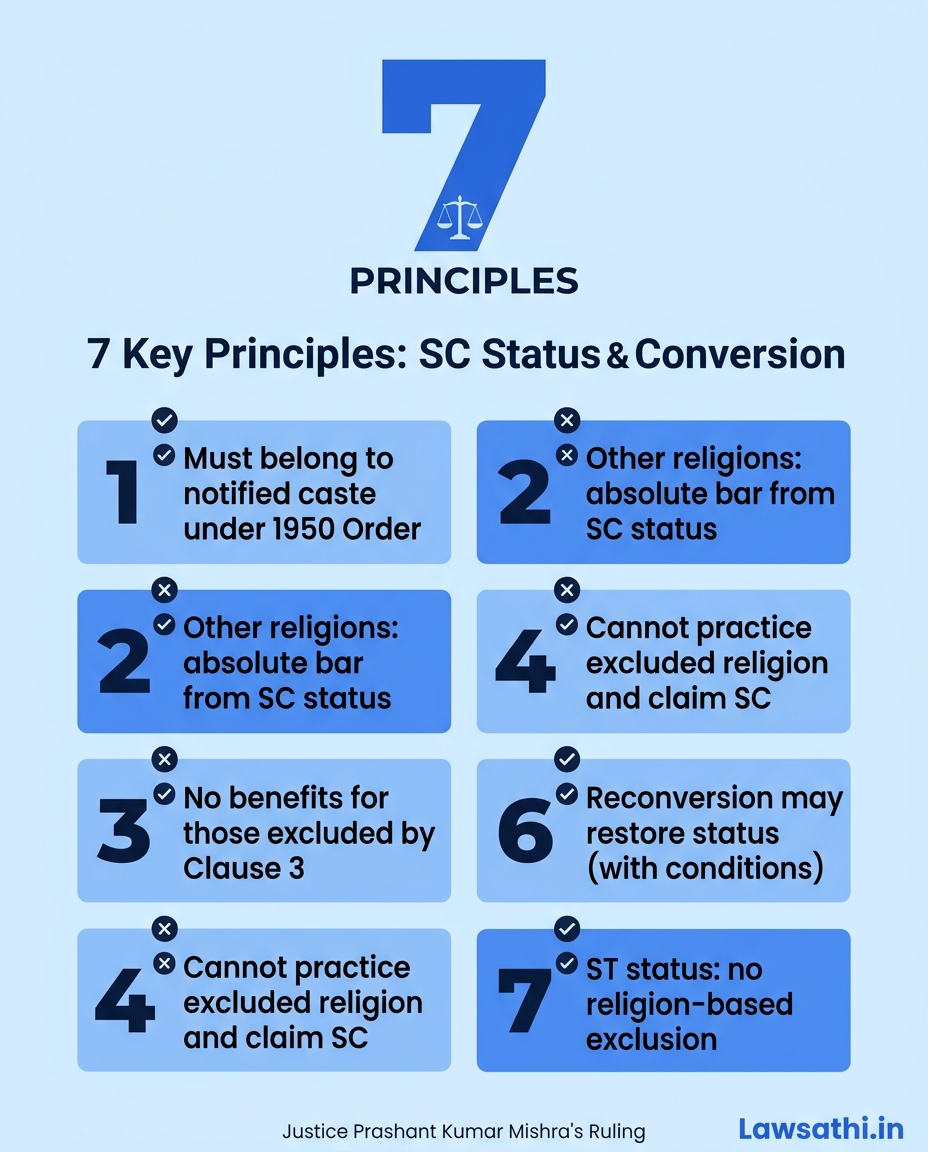
Sixth, the judgment specifically addresses reconversion to Hinduism, Sikhism, or Buddhism. This aspect deserves detailed examination for its practical implications.
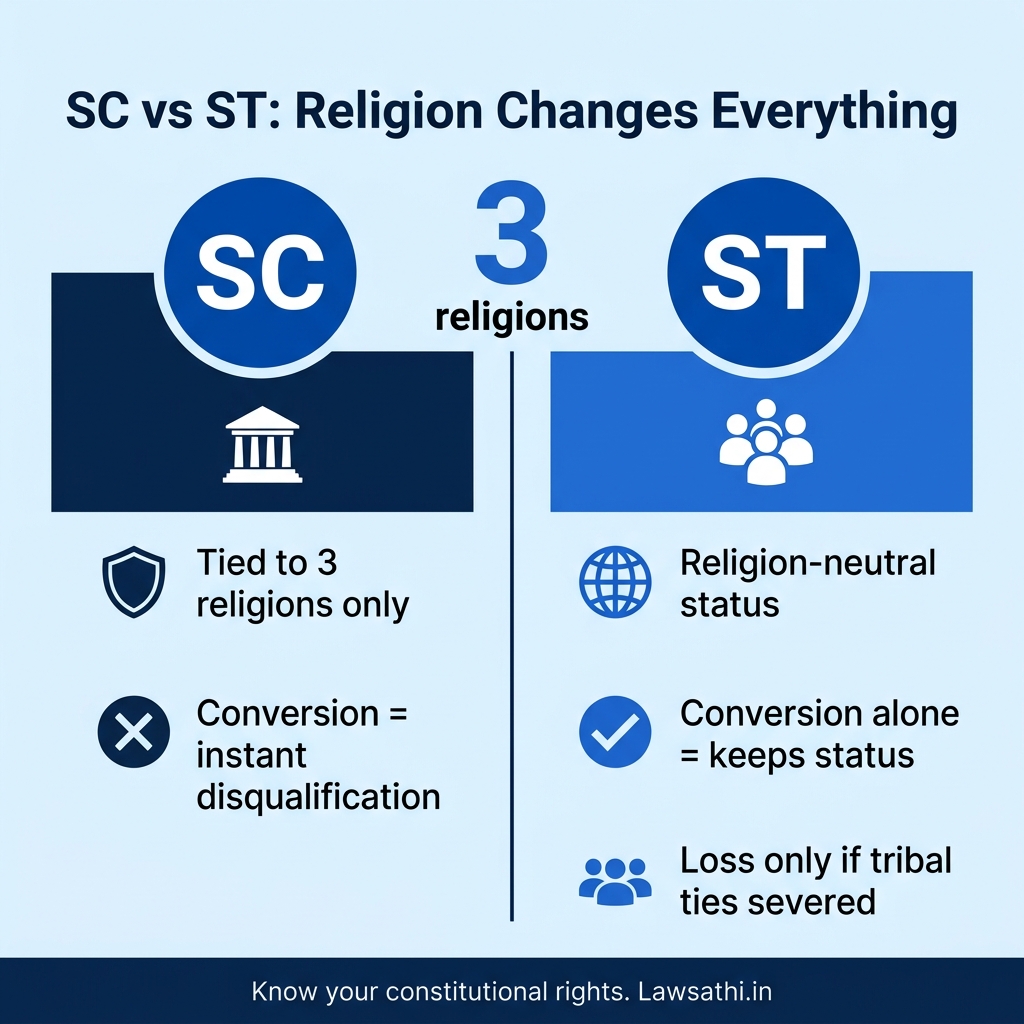
Seventh, significantly, the Court distinguished Scheduled Tribes from Scheduled Castes. The Constitution (Scheduled Tribes) Order, 1950 contains no religion-based exclusion. Conversion does not automatically terminate ST status, as discussed later in this article.
Reconversion: The Only Path to Regain SC Status
Three Mandatory Conditions for Reconversion
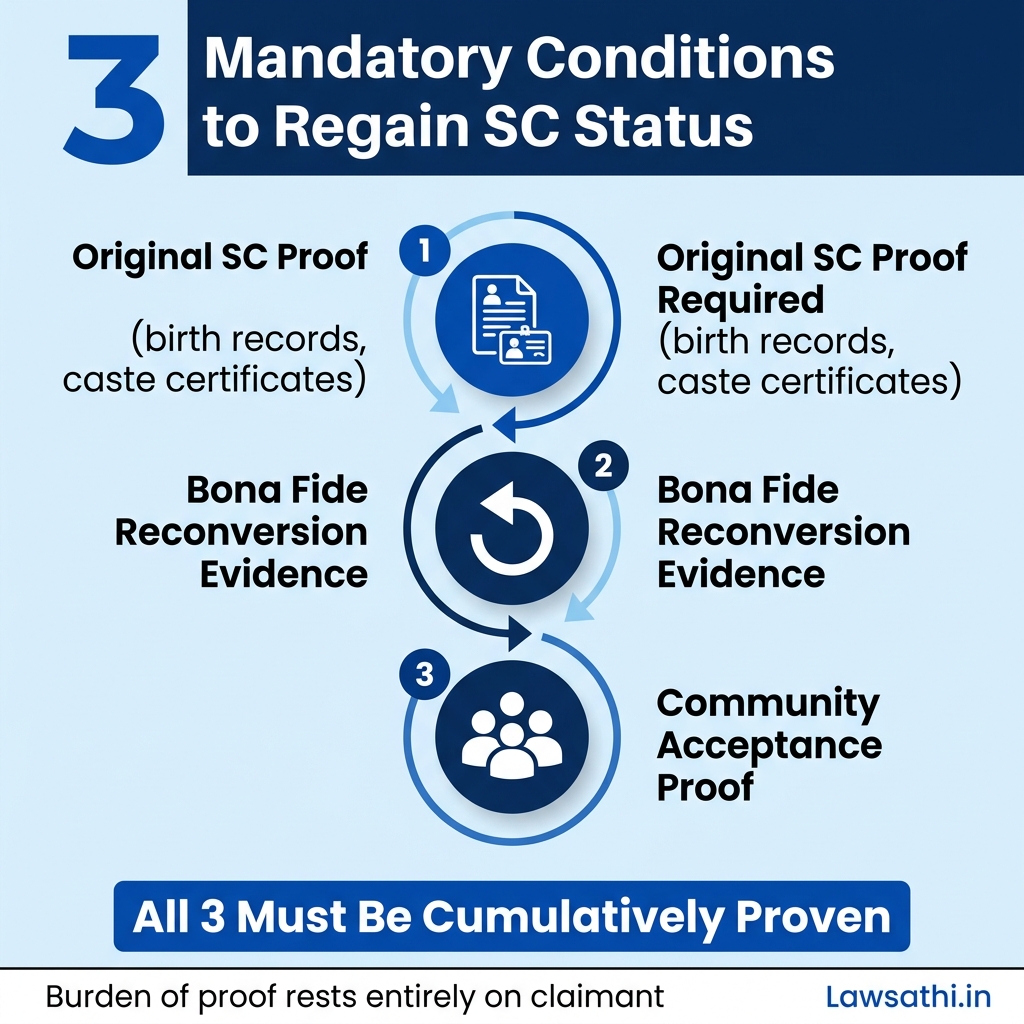
The Supreme Court recognized that persons who reconvert to Hinduism, Sikhism, or Buddhism may regain SC status. However, this is not automatic. The Court established three mandatory conditions that must be cumulatively and conclusively established.
Condition One requires clear proof that the person originally belonged to a notified Scheduled Caste. Documentary evidence such as birth records, family records, or previous caste certificates may suffice.
Condition Two demands credible evidence of bona fide reconversion. This must include complete and unequivocal renunciation of the converted religion. Additionally, the person must actually adopt the customs, usages, practices, rituals, and religious obligations of the original caste. Mere self-declaration is entirely insufficient.
Condition Three requires satisfactory evidence of acceptance by the original caste community. The claimant must prove assimilation back into the caste fold. Community recognition and acceptance are essential components of this condition.
Burden of Proof on the Claimant
The Supreme Court placed the entire burden of proving reconversion on the claimant. This burden must be discharged through unimpeachable evidence. Failure to establish even one condition renders the entire claim unsustainable.
For legal practitioners, this means clients seeking to regain SC status need substantial documentation. Religious conversion certificates, community acceptance letters, and evidence of following caste customs all become crucial. Therefore, maintaining meticulous records becomes essential for successful claims.
Different Treatment for Scheduled Tribes
Religion-Neutral ST Status
A critical distinction emerges from this judgment regarding Scheduled Tribes. Unlike Scheduled Castes, ST status does not depend on religious affiliation. The Constitution (Scheduled Tribes) Order, 1950 prescribes no religion-based exclusion.
However, this does not mean conversion has no impact on ST status. The Supreme Court clarified that ST status determination must consider several factors. These include whether the claimant continues to possess essential attributes of tribal identity. Additionally, courts must examine whether the person follows customary practices and maintains community life.
Factors Determining ST Status Post-Conversion
The Court held that ST status depends on acceptance by the concerned tribal community. Where conversion results in complete severance from the tribal way of life, ST status may be lost. Conversely, where tribal attributes demonstrably subsist, the claim cannot be rejected mechanically.
Therefore, lawyers advising tribal clients must understand this nuanced position. Religious conversion alone does not terminate ST status. However, complete abandonment of tribal customs and community life may have that effect. Each case requires fact-specific analysis.
Practical Implications for Legal Practice
Advising Clients on Caste Certificates
This judgment has immediate practical implications for legal practitioners across India. Clients holding caste certificates must understand that conversion automatically terminates SC status. The existence of an uncanceled certificate provides no legal protection whatsoever.
For example, a client who converted to Christianity years ago cannot invoke the SC/ST Act for caste-based atrocities. Similarly, such clients cannot claim reservation benefits in education or employment. The legal position is now absolutely clear.
Lawyers must therefore advise clients honestly about the consequences of religious conversion. Clients cannot simultaneously enjoy the benefits of their new religion and retain caste-based protections. As the Supreme Court rules conversion from Hinduism, Sikhism, Buddhism disqualifies Scheduled Caste status, this position is now constitutionally settled.
Evidence Strategy for Reconversion Cases
For clients seeking to regain SC status through reconversion, evidence strategy becomes paramount. The judgment requires unimpeachable proof of all three conditions.
Practitioners should advise clients to gather:
– Original caste certificates or birth records showing SC status – Religious conversion ceremonies documenting return to Hinduism, Sikhism, or Buddhism – Evidence of renouncing the previously adopted religion completely – Community acceptance letters from caste panchayats or associations – Proof of following caste customs, rituals, and practices
The Court emphasized that seeking reservation benefits through superficial conversion amounts to “fraud on the Constitution.” Therefore, reconversion must be genuine and bona fide.
Impact on Pending and Future Cases
Cases Under the SC/ST Act
This ruling will significantly impact pending cases under the Scheduled Castes and Scheduled Tribes (Prevention of Atrocities) Act. Defense lawyers can now challenge the maintainability of cases where the complainant has converted to Christianity or Islam. The prosecution must prove the victim’s SC status at the time of the alleged offense.
Furthermore, courts must verify the religious status of complainants before proceeding with SC/ST Act cases. This adds a new dimension to criminal practice in such matters.
Reservation and Employment Disputes
The judgment also affects employment and education reservation disputes. Any person who converted from Hinduism, Sikhism, or Buddhism cannot claim SC reservation benefits. Educational institutions and government departments must verify religious status alongside caste status.
Legal practitioners handling service matters must now address this additional layer of scrutiny. Appointment orders based on SC certificates held by converts may face legal challenges. Similarly, promotions under reserved quotas may require re-examination.
Conclusion: A Definitive Constitutional Position
The Supreme Court judgment in Chinthada Anand vs. State of Andhra Pradesh provides definitive clarity on a long-debated constitutional question. As the Supreme Court rules conversion from Hinduism, Sikhism, Buddhism disqualifies Scheduled Caste status, this position is now absolute and categorical.
Key takeaways for legal professionals include:
First, conversion to Christianity, Islam, or any religion other than Hinduism, Sikhism, or Buddhism immediately terminates SC status. No exceptions exist under the constitutional framework.
Second, SC/ST Act protections cannot be invoked by persons professing excluded religions. Mere possession of an uncanceled caste certificate provides no legal shield.
Third, reconversion offers a path to regain SC status, but only through strict compliance with all three conditions. Bona fide reconversion with community acceptance is mandatory.
Fourth, Scheduled Tribes follow a different standard. ST status depends on continued tribal identity and customs, not religious affiliation alone.
Fifth, the burden of proof always rests on the claimant in reconversion cases. Comprehensive documentation becomes essential for successful claims.
For Indian lawyers handling caste-based matters, this judgment provides much-needed certainty. The constitutional linkage between specific religions and Scheduled Caste status is now beyond dispute. Therefore, advising clients accurately on these matters becomes both a professional obligation and ethical responsibility.
Stay ahead of landmark judgments that impact your practice. Track Supreme Court rulings, manage case documents, and streamline your legal practice with LawSathi. Try LawSathi free for 15 days and experience the future of legal practice management in India.