
Introduction: The Supreme Court’s Stance on Dowry Death Bail Orders
The Supreme Court of India delivered a significant judgment on April 30, 2026. The case was Mahesh Chand v. State of U.P. 2026 SCC OnLine SC 793. This ruling cancelled the bail granted by the Allahabad High Court to an accused in a dowry death case. Therefore, the judgment carries immense significance for crimes against women in India.
Justice J.B. Pardiwala and Justice Vijay Bishnoi constituted the Bench. They made strong observations about the High Court’s approach to granting bail. In fact, Justice Pardiwala remarked that the Court failed to understand what was wrong with the High Court. He noted that bail was granted where it should not have been.
Significance for Crimes Against Women
The Supreme Court emphasized that courts must not appear to take crimes against women lightly. This intervention reinforces the judicial commitment to protect victims of dowry harassment. Furthermore, it sends a clear message to lower courts about bail jurisprudence in sensitive cases. The ruling in Mahesh Chand v. State of U.P. 2026 serves as a precedent for future cases involving dowry deaths.
Factual Matrix and Procedural History
The case involves tragic circumstances surrounding the death of a young woman. She died within seven years of marriage at her matrimonial home in Ghaziabad, Uttar Pradesh. The marriage took place on February 8, 2019. However, the deceased died on July 11, 2024, under suspicious circumstances.
Allegations of Dowry Harassment
The father of the deceased had given substantial dowry at the time of marriage. This included a car, cash, jewellery, and household articles. Subsequently, the accused allegedly demanded an additional Fortuner car and Rs. 10 lakhs. The FIR narrates persistent cruelty including physical assault, starvation, and threats.
Under pressure, the complainant transferred Rs. 4 lakhs and paid further amounts. Therefore, the allegations clearly point to continuous dowry harassment. The deceased spoke to her father on the morning of July 11, 2024. She was in a distressed condition and stated she was being beaten and threatened.
Later that day, the father received information that the accused had strangulated and hanged the deceased. The body was found in a hospital with visible injuries. Importantly, none of the in-laws were present at the hospital.
FIR and Charges Under BNS 2023
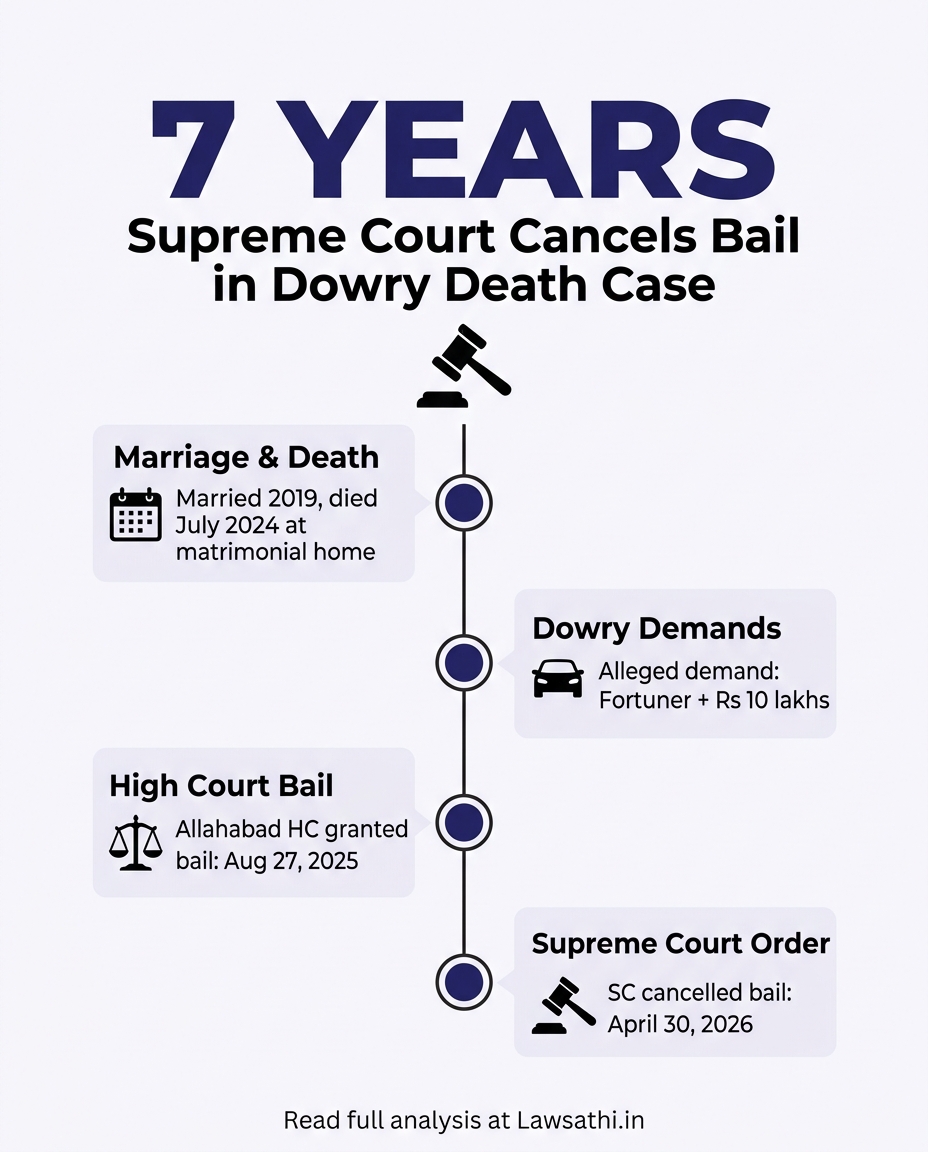
The FIR was registered on July 12, 2024, at Kavi Nagar Police Station, Ghaziabad. The police named eight persons as accused. The charges include:
– Section 80 BNS (Dowry death – equivalent to erstwhile Section 304B IPC) – Section 85 BNS (Cruelty by husband/relatives – equivalent to erstwhile Section 498A IPC) – Sections 115(2), 351(2), 352 BNS – Sections 3 and 4, Dowry Prohibition Act, 1961
The Sessions Court rejected the bail application initially. However, the Allahabad High Court granted bail on August 27, 2025. The deceased’s father then filed a Special Leave Petition before the Supreme Court. He challenged this order in the apex court. The Supreme Court’s analysis in Mahesh Chand v. State of U.P. 2026 ultimately cancelled this bail.
Legal Grounds for Cancellation of Bail
The Supreme Court identified several legal grounds for cancelling the bail granted by the High Court. These grounds reveal significant errors in the High Court’s reasoning. Additionally, they highlight the need for careful scrutiny in dowry death cases.
Failure to Apply Statutory Presumption
Section 118 of the Bharatiya Sakshya Adhiniyam, 2023 (erstwhile Section 113B, Evidence Act) mandates a presumption. When death occurs within seven years of marriage, courts must consider specific factors. If cruelty for dowry is shown “soon before death,” the court shall presume the accused caused the dowry death. The High Court committed an “egregious error” by not applying this presumption.
Therefore, the Supreme Court found that the High Court overlooked crucial statutory provisions. This failure rendered the bail order legally untenable. The Court emphasized that statutory presumptions must guide bail decisions in dowry death cases.
Superficial Consideration of Medical Evidence
The High Court relied on the cause of death being “asphyxia due to hanging.” However, the Supreme Court noted the post-mortem report recorded several significant findings. These included a ligature mark around the neck and multiple ante-mortem injuries. Furthermore, the report showed multiple contusions and abrasions.
These injuries prima facie suggested strangulation rather than suicide. The Supreme Court criticized the superficial analysis of medical evidence. For this reason, the Supreme Court bail cancellation judgment becomes crucial reading for practitioners.
No Actual Delay in FIR Registration
The High Court had cited delay in FIR registration as a ground for bail. However, the Supreme Court questioned this reasoning. The death occurred on July 11, 2024. The FIR was registered on July 12, 2024, the very next day.
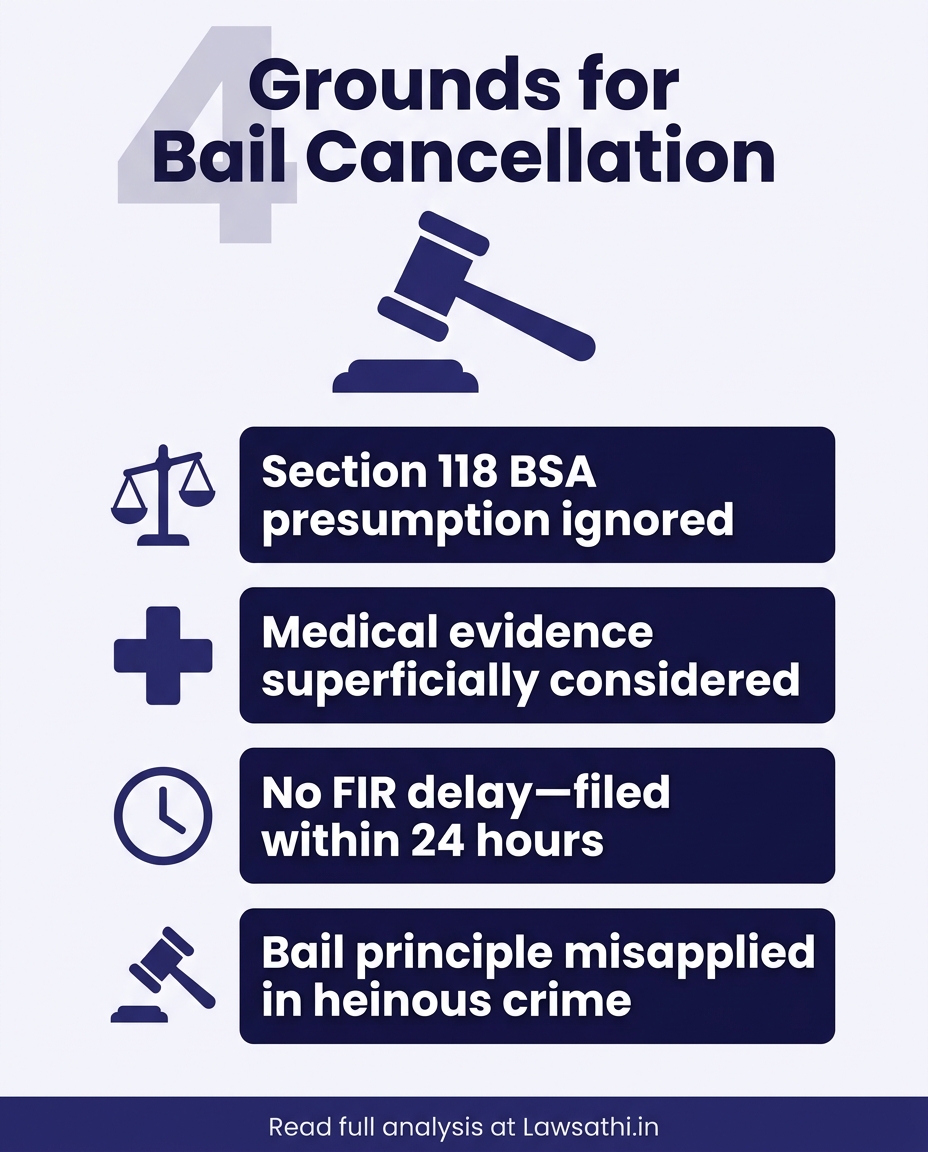
The Court asked: “Where is the delay in registration of the FIR?” Moreover, it questioned whether delay alone should be grounds for bail in serious crimes. This observation in Mahesh Chand v. State of U.P. 2026 guides future bail proceedings.
Limitations of “Bail is the Rule” Principle
The Court acknowledged the fundamental principle that “bail is the rule, jail is the exception.” However, it emphasized that this principle has limitations in heinous crimes. The gravity of the offence must be considered. Additionally, the societal impact must be weighed carefully.
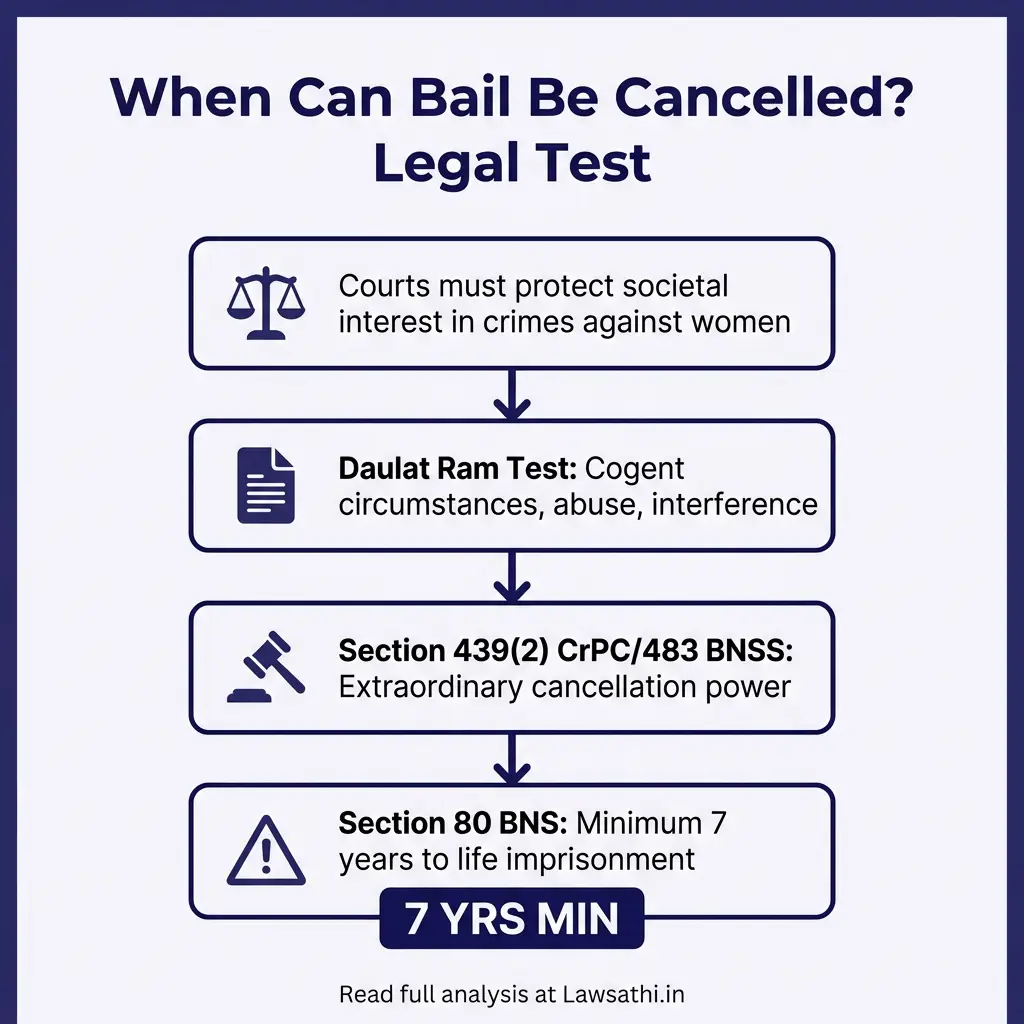
The Supreme Court stated that courts must not appear to take crimes against women lightly. Therefore, individual liberty cannot override societal interest in such cases. This balance forms a crucial aspect of bail jurisprudence in dowry death matters.
Key Legal Principles Reiterated by the Supreme Court
The judgment in Mahesh Chand v. State of U.P. 2026 reiterated several important legal principles. These principles guide courts in granting and cancelling bail in sensitive cases.
Duty to Protect Societal Interest
The Supreme Court emphasized the duty of courts to protect societal interest in dowry death cases. Courts must ensure fair trial by preventing witness tampering. Furthermore, bail orders should not undermine public confidence in the judicial system. The Court observed that granting bail in dowry death cases despite evidence of direct involvement shakes public confidence in judiciary.
Principles from Daulat Ram v. State of Haryana
The Court relied on the landmark judgment in Daulat Ram v. State of Haryana (1995) 1 SCC 349. This precedent established that cancellation of bail requires “very cogent and overwhelming circumstances.” The grounds for cancellation include interference with the administration of justice. Additionally, evasion of due course of justice constitutes valid ground. Furthermore, abuse of the concession granted to the accused constitutes valid ground.
The Supreme Court expanded these principles further. Bail can be revoked where the court considered irrelevant factors. Similarly, ignoring relevant material also warrants cancellation. The gravity of the offence, conduct of the accused, and societal impact also matter. This expansion provides a comprehensive framework for cancellation under Section 439(2) CrPC.
Standard of Judicial Discretion
Section 439(2) CrPC (now Section 483 BNSS) governs the power to cancel bail. This power is extraordinary and must be exercised with extreme care. However, it should not be used as disciplinary proceedings against the accused. The Court clarified that cancellation of bail under Section 439(2) CrPC applies when liberty counteracts proper trial requirements.
Importance of Assessing Severity and Evidence Tampering
The Court emphasized the importance of assessing the severity of punishment. Section 304B IPC (now Section 80 BNS) carries a minimum of seven years imprisonment. It extends up to life imprisonment. Therefore, the severity demands careful scrutiny before granting bail.
Furthermore, the potential for tampering with evidence requires consideration. In dowry death cases, family members serve as key witnesses. The accused may influence or threaten these witnesses. Consequently, courts must assess this risk while deciding bail applications.
Implications for Legal Practitioners and Law Firms
The judgment provides valuable guidance for both defense counsel and prosecutors. Understanding these implications helps practitioners navigate bail proceedings effectively.
Strategies for Defense Counsel in Sensitive Cases
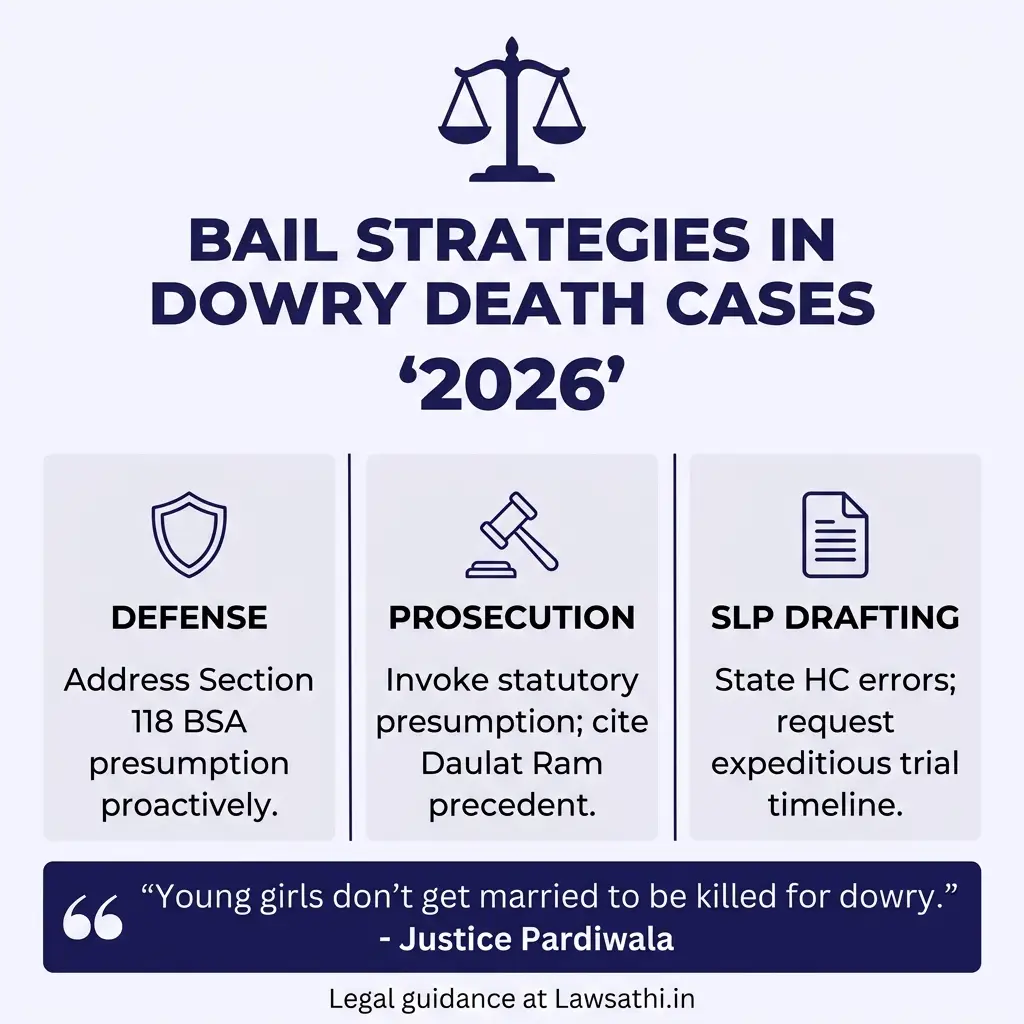
Defense counsel must address statutory presumptions directly under Section 118 BSA. Ignoring this presumption weakens the bail application significantly. Instead, counsel should anticipate and counter the presumption argument proactively.
Additionally, presenting detailed medical evidence strengthens the defense case. Engaging expert opinion on post-mortem findings helps when cause of death is disputed. Counsel should demonstrate lack of prima facie involvement through cogent evidence.
Furthermore, highlighting personal circumstances supports the bail application. Age, health, family situation, and dependent care responsibilities matter. Most importantly, showing cooperation with investigation through regular appearance helps build credibility.
Arguments for Prosecution to Oppose Bail
Prosecutors should invoke the Section 118 BSA presumption effectively. Death within seven years combined with cruelty evidence triggers this presumption. Additionally, they must highlight the gravity of the offence under Section 304B/80 BNS. This section carries a minimum seven-year sentence extendable to life imprisonment.
Moreover, prosecutors should emphasize ante-mortem injuries in medical evidence. These injuries indicate struggle or assault before death. The potential for witness tampering also warrants consideration. Family members serve as crucial witnesses in dowry death cases.
Prosecutors can cite relevant precedents including Daulat Ram v. State of Haryana. Additionally, Shabeen Ahmad v. State of U.P. (2025 INSC 307) supports opposition to bail in dowry death matters.
Drafting SLPs Against High Court Bail Orders
Special Leave Petitions against bail orders require careful drafting. The petition must clearly state the error committed by the High Court. For example, ignoring Section 118 BSA presumption constitutes a serious error. Similarly, overlooking medical evidence constitutes valid ground.
Additionally, the petition should demonstrate the prima facie case through FIR extracts. Highlighting societal impact of crimes against women strengthens the petition. Pre-emptively addressing counter-arguments helps anticipate defense counsel’s grounds.
The petition should seek specific reliefs including cancellation of bail. Furthermore, requesting expeditious trial completion within a specified timeline proves beneficial. These elements make the SLP comprehensive and effective.
Conclusion: Strengthening the Legal Framework Against Dowry Deaths
The Supreme Court’s decision in Mahesh Chand v. State of U.P. 2026 marks a significant development. The Court cancelled the bail and directed the accused to surrender within one week. Additionally, it directed trial completion within one year.
Powerful Observations on Marriage Sanctity
The Court made powerful observations about the sanctity of marriage. Justice Pardiwala remarked: “Young girls don’t get married to be killed for dowry.” He noted that a young girl marries with dreams of happy marital life. However, she does not get married to be killed mercilessly for want of dowry.
Message to Lower Courts
This judgment sends a clear message to lower courts. Courts must avoid casual grant of bail in serious offenses. They must apply statutory presumptions under Section 118 BSA rigorously. Furthermore, scrutinizing medical evidence carefully rather than superficially becomes essential.
The judgment emphasizes that courts must consider societal impact in bail orders. Most importantly, orders should not appear to trivialize serious crimes against women. This guidance will shape future bail proceedings in dowry death cases.
Balancing Individual Liberty and Societal Justice
The Court acknowledged the fundamental principle of “bail is the rule, jail is the exception.” However, it emphasized that this principle has limitations in heinous crimes. Individual liberty cannot override societal interest in such matters. Courts must ensure fair trial by preventing witness tampering.
The presumption of innocence does not mean ignoring prima facie evidence. Therefore, practitioners must understand this nuanced balance when arguing bail matters. The Mahesh Chand v. State of U.P. 2026 judgment serves as an authoritative reference for this principle.
Streamline your legal research with LawSathi. Use our AI-powered platform to access case summaries, track court updates, and manage your practice efficiently. Sign up for a free trial today.