The intersection of property law and insolvency legislation has long created uncertainty for lessors dealing with defaulting tenants. A landmark ruling by the Gujarat High Court has now clarified a critical question. Does lease termination during IBC moratorium violate the statutory protection afforded to corporate debtors?
The Court answered in the affirmative. It held that terminating a lease constitutes “recovering property” barred under Section 14 of the Insolvency and Bankruptcy Code, 2016.
This judgment in Gujarat Hydrocarbons and Power SEZ Ltd. v. Gujarat Industrial Development Corporation 2026 SCC OnLine Guj 2517 has significant implications. It affects insolvency practitioners, lessors, and resolution professionals across India. Therefore, understanding this ruling is essential for any lawyer navigating the Corporate Insolvency Resolution Process (CIRP).
Introduction: The Conflict Between Lease Rights and IBC Moratorium
The Fundamental Tension
When a corporate debtor enters CIRP, Section 14 of the IBC imposes a moratorium. This moratorium freezes all recovery actions against the debtor. However, this protection creates an inherent conflict with lessors’ proprietary rights.
Lessors traditionally hold the common law right to terminate leases for breach. They can also recover possession of their property.
The Gujarat High Court’s ruling in Gujarat Hydrocarbons and Power SEZ Ltd. addresses this precise tension. The Court held that lease termination during IBC moratorium amounts to “recovering property” prohibited under Section 14(1)(d). This applies regardless of the grounds for termination.
Core Ruling and Its Significance
The Single Judge bench of Justice Niral R. Mehta quashed both the lease termination notice and the subsequent eviction order. Both were passed during the moratorium period.
On May 6, 2026, a Division Bench comprising Chief Justice Sunita Agarwal and Justice D.N. Ray affirmed this order.
Importantly, the Court ruled that Section 238 of the IBC overrides state-level eviction statutes. Specifically, the Gujarat Public Premises (Eviction of Unauthorized Occupants) Act, 1972 cannot circumvent the moratorium’s protective umbrella.
Factual Matrix of Gujarat Hydrocarbons and Power SEZ Ltd.
Background of the Dispute
The corporate debtor, Gujarat Hydrocarbons and Power SEZ Ltd., operated in a specific business sector. It developed and maintained Special Economic Zones.
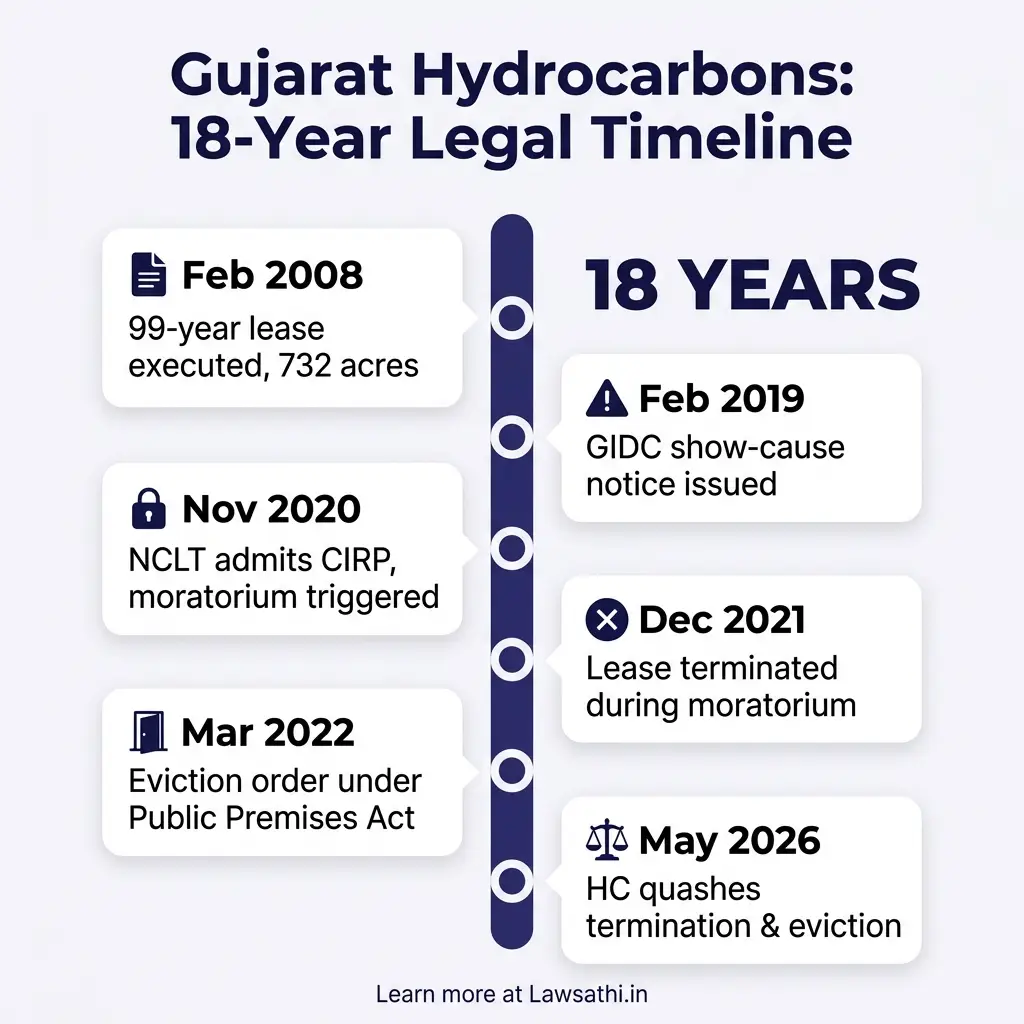
On February 21, 2008, it executed a 99-year lease deed with the Gujarat Industrial Development Corporation (GIDC). This lease covered approximately 732 acres of land in Vilayat Industrial Estate, District Bharuch.
This land constituted the “principal and virtually the only asset” of the corporate debtor. The SEZ developer would sub-lease portions of this land to industrial undertakings. This formed part of its core business operations.
Timeline Leading to Litigation
The dispute escalated through several critical phases. On February 4, 2019, GIDC issued a show-cause notice alleging breach of lease conditions.
Subsequently, on November 18, 2020, the National Company Law Tribunal (NCLT) admitted the corporate debtor into CIRP. This admission came under Section 7 of the IBC. As a result, the statutory moratorium was triggered.
GIDC submitted a claim of Rs. 180.62 crore as an operational creditor on March 10, 2021. The Committee of Creditors (CoC) approved a Resolution Plan on August 23, 2021. However, this plan offered GIDC only Rs. 6.14 crore against its claimed amount.
The Triggering Events During Moratorium
The critical events occurred during the moratorium period. On December 13, 2021, GIDC terminated the lease deed while CIRP was ongoing.
Subsequently, on March 10, 2022, GIDC passed an eviction order. This order was passed under the Gujarat Public Premises Act.
The Resolution Professional and the corporate debtor challenged these actions. They filed a writ petition on February 28, 2022. By September 19, 2023, the NCLT had approved the Resolution Plan. The successful Resolution Applicant had paid the agreed sum to GIDC.
GIDC’s Arguments Before the Court
GIDC advanced several arguments to justify its actions. First, it contended that termination was based on “repeated and continuing breaches.” These breaches were unrelated to insolvency.
Second, GIDC argued that the Explanation to Section 14(1) only bars termination “on grounds of insolvency.” Therefore, termination for contractual breaches remained permissible.
Furthermore, GIDC emphasized that the corporate debtor had ceased business operations for over 15 years. The lessor claimed it was not a going concern. As a result, termination became necessary.
Additionally, GIDC highlighted the disparity between its claimed dues and the Resolution Plan award. It claimed Rs. 180 crore but received only Rs. 6.14 crore in the Resolution Plan.
Legal Issue: Does Section 14 Moratorium Protect Possession of Leased Property?
The Framed Question
The Court framed the central legal question precisely. It asked whether GIDC, as an operational creditor, was justified in passing termination and eviction orders during the moratorium period.
This question required interpreting the scope of Section 14(1)(d). That provision prohibits “the recovery of any property by an owner or lessor where such property is occupied by or in the possession of the corporate debtor.”
Interpretation of Relevant Provisions
The Court examined multiple statutory provisions to reach its conclusion. Section 3(27) defines “property” broadly to include land. It also includes every description of interest in property, whether present or future, vested or contingent.
Under this definition, leasehold rights clearly constitute “property” entitled to protection. Section 14(1)(d) explicitly bars recovery of property by any lessor. This applies when such property remains in the corporate debtor’s possession.
Lessor’s Status Under the IBC Framework
A critical aspect of this case involved GIDC’s dual status. GIDC had participated in the CIRP by filing its claim as an operational creditor.
However, simultaneously, it sought to enforce proprietary rights outside the IBC framework. The Court found this approach inconsistent.
By lodging its claim, GIDC had submitted to the IBC process. Therefore, it could not unilaterally terminate the lease during the moratorium.
Court’s Reasoning and Reliance on Precedents
Plain Reading of Section 14(1)(d)
The Court adopted a purposive interpretation of Section 14(1)(d). Justice Mehta observed that once the moratorium is declared, a statutory prohibition immediately activates. This prohibition covers “recovery of any property by an owner or lessor.”
This prohibition applies regardless of the grounds for termination. The Court explicitly held that the Explanation to Section 14(1) cannot be read to “defeat clauses (a) to (d) of Section 14(1).”
The Explanation limits terminations “on grounds of insolvency.” However, the main provision contains no such limitation.
The Going Concern Principle
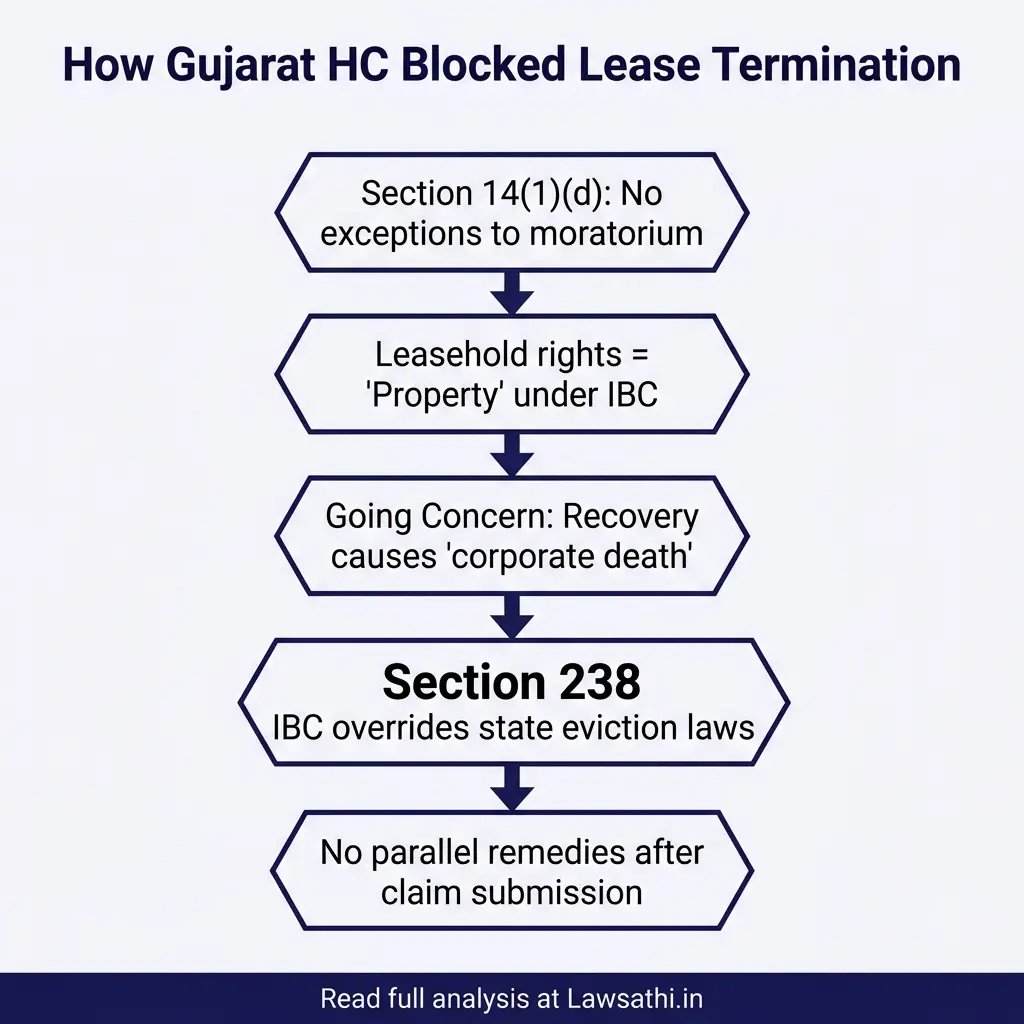
Central to the Court’s reasoning was the preservation of the corporate debtor as a going concern. The leased land was the corporate debtor’s primary asset.
If GIDC recovered possession, there would remain “nothing left in the company.” This would effectively cause the “death of the Corporate Debtor.”
This principle aligns with the Supreme Court’s reasoning in Gujarat Urja Vikas Nigam Ltd. v. Amit Gupta (2021) 7 SCC 209. In that case, the apex court held that leasehold rights constitute “property” under Section 3(27). Furthermore, termination resulting in “corporate death” can be restrained.
Distinguishing Precedents: TCS v. Vishal Ghisulal Jain
GIDC relied heavily on Tata Consultancy Services Ltd. v. Vishal Ghisulal Jain (2021) 11 SCC 274. In TCS, the Supreme Court held Section 14 inapplicable where the corporate debtor was the lessor, not the lessee.
The Gujarat High Court distinguished TCS on its facts. In Gujarat Hydrocarbons, the corporate debtor was the lessee. GIDC, the lessor, sought to recover possession. Therefore, Section 14(1)(d) squarely applied to this situation.
Operational Creditor Cannot Claim Priority
The Court delivered a stern observation regarding GIDC’s conduct. As an operational creditor, GIDC “cannot have higher rights than the financial creditors.”
The Court rejected the argument that public exchequer interests should elevate GIDC’s standing. It could not claim priority above other creditors.
Moreover, the Court invoked the doctrine of approbate and reprobate. Having filed its claim under the IBC, GIDC could not simultaneously pursue remedies outside the statutory framework.
Implications for Lessors and Resolution Professionals
Practical Impact on Lessors
This ruling significantly restricts lessors’ enforcement rights during CIRP. Lessors cannot terminate leases during the moratorium even for genuine contractual breaches.
Furthermore, they cannot initiate eviction proceedings under state laws. For example, the Gujarat Public Premises Act cannot be invoked.
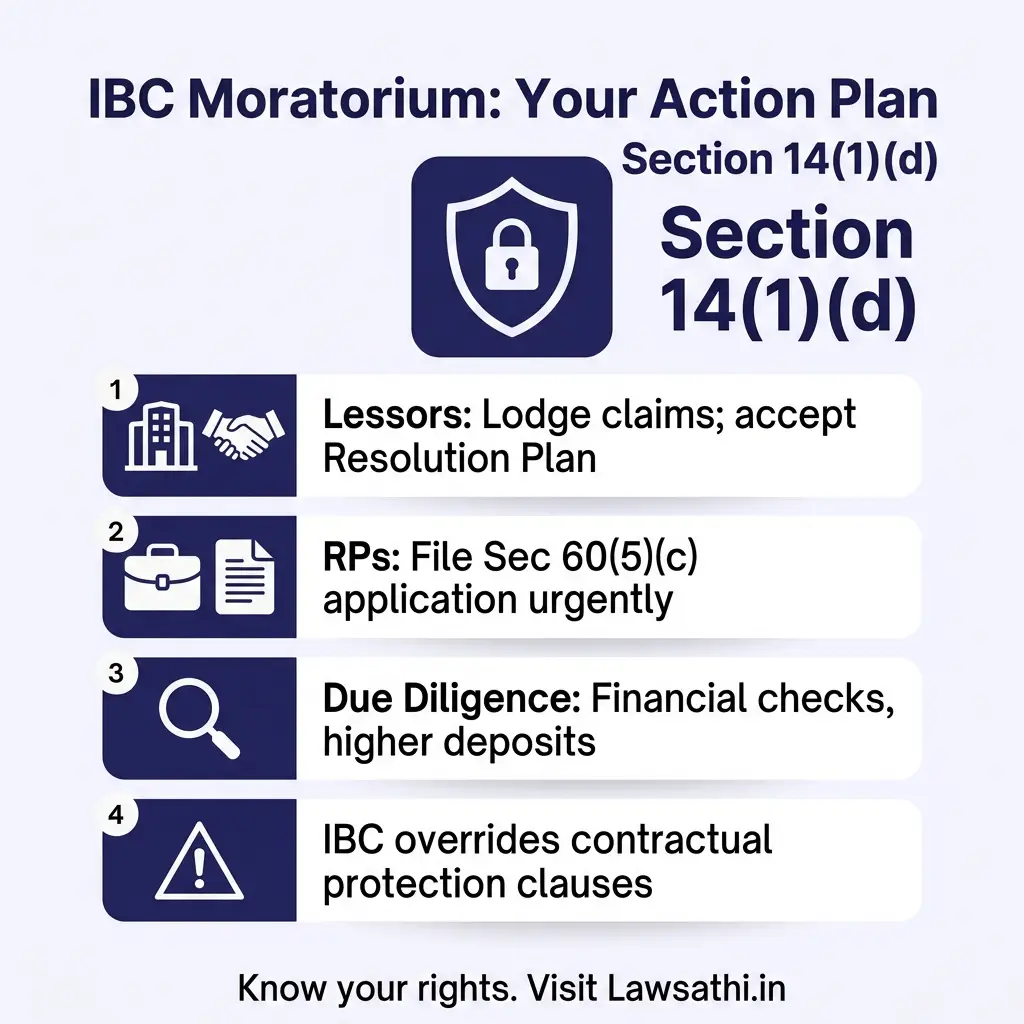
Instead, lessors must lodge claims as operational or financial creditors. They must accept the Resolution Plan terms approved by the CoC and NCLT. Most importantly, they must wait until the moratorium lifts or CIRP concludes.
Advisory for Resolution Professionals
Resolution Professionals (RPs) bear specific duties under Section 25 of the IBC. These include preserving and protecting the corporate debtor’s assets. Additionally, RPs must take immediate custody and control of all assets.
When a lessor issues a termination notice during moratorium, RPs should act swiftly. They must file urgent applications under Section 60(5)(c) before the NCLT.
The RP should document all leased assets in the Information Memorandum. Furthermore, they should ensure CIRP costs cover current rent payments.
Strategic Lease Drafting Considerations
For lessors, this ruling underscores the importance of proactive risk mitigation. Conducting thorough financial due diligence on tenants before executing leases is essential. Including higher security deposits or bank guarantees can provide some protection.
Additionally, lessors should consider shorter lease terms with renewal options. They might insert specific provisions for pre-CIRP default scenarios. Continuous monitoring of tenant financial health helps identify risks before CIRP initiation.
However, lawyers must caution clients that IBC’s overriding effect may limit contractual protections. The Gujarat High Court’s interpretation of lease termination during IBC moratorium suggests that even carefully drafted clauses may face judicial scrutiny.
Comparative Analysis with Other High Court Rulings
Conflicting Approaches in NCLT Decisions
Some NCLT benches have adopted different approaches. In GPT Steel Industries Ltd. v. GIDC, the NCLT Ahmedabad held that GIDC’s leased property was not the corporate debtor’s “absolute property.” It directed the Resolution Professional to approach GIDC’s appellate authority.
However, the Gujarat High Court’s ruling carries greater precedential weight. Moreover, the GPT Steel order arose under Section 33(5) (liquidation). In contrast, the present case concerns Section 14 (moratorium during CIRP).
Supreme Court Clarifications
The Supreme Court has provided important clarifications on related issues. In Sincere Securities v. Chandrakant Khemla (August 2024), the Court held that voluntary surrender of leased property to the lessor is permissible. This requires corporate debtor or RP consent. It does not permit unilateral lessor action.
Additionally, the Supreme Court has clarified that moratorium cannot revive extinguished contractual rights. If a contract was lawfully terminated before CIRP initiation, it does not constitute an “asset” entitled to protection.
Evolving Judicial Consensus
Despite some variations, an emerging consensus supports strict moratorium interpretation. Courts increasingly prioritize going concern value preservation over individual creditor enforcement rights.
The Gujarat High Court’s ruling aligns with this trend. It emphasizes successful resolution over proprietary remedies.
As of May 2026, GIDC has filed Company Appeals before the NCLAT challenging Resolution Plan approval. The Supreme Court has not yet admitted any appeal specifically addressing lease termination during IBC moratorium issues.
Conclusion: The Way Forward for Legal Practitioners
Key Takeaways from the Judgment
The Gujarat Hydrocarbons ruling establishes several critical principles. First, CIRP moratorium under Section 14 overrides contractual termination rights during the moratorium period.
Second, Section 14(1)(d) bars any recovery of property by lessors. This applies regardless of breach grounds.
Third, leasehold rights constitute “property” under Section 3(27). Therefore, they are entitled to full IBC protection.
Fourth, Section 238 gives the IBC overriding effect over state eviction laws. Finally, operational creditors cannot pursue parallel remedies outside the IBC framework after submitting claims.
Practical Advice for Lawyers
For lawyers advising lessors, several precautions become essential. Clients must understand that initiating CIRP against a tenant fundamentally alters enforcement rights. Due diligence on tenant financial stability should precede lease execution.
For insolvency practitioners, immediate action becomes critical when lessors issue termination notices. The Resolution Professional must invoke NCLT jurisdiction promptly under Section 60(5)(c). Documentation of leased assets and ongoing rent obligations ensures proper CIRP management.
Need for Legislative Clarity
This judgment highlights the need for clearer legislative provisions. The IBC would benefit from explicit statutory guidance on third-party asset rights.
Specifically, Parliament should consider amendments addressing different property interests. These include freehold, leasehold, and licenses.
The Explanation to Section 14 requires refinement to explicitly address lease terminations on non-insolvency grounds. Such amendments would provide greater certainty to lessors, creditors, and insolvency professionals. As a result, navigating India’s evolving bankruptcy framework would become easier.
Managing complex litigation and IBC deadlines? Streamline your practice with LawSathi’s AI-powered matter management and automated court date tracking. Start your free trial today.