
Environmental litigation in India has witnessed unprecedented growth over the past decade. The National Green Tribunal (NGT), established under the NGT Act, 2010, stands as India’s specialized environmental court with unique sui generis characteristics. With over 25,929 e-filed cases and 16,449 registered advocates, the Tribunal has become the primary forum for environmental justice. Therefore, understanding the NGT Original Application procedure is now essential for every Indian legal practitioner handling environmental matters.
The Tribunal’s jurisdiction extends beyond mere adjudication. The Supreme Court noted this in Municipal Corporation of Greater Mumbai v. Ankita Sinha [1]. Specifically, the NGT performs a four-fold role: adjudicatory, supervisory, preventive, and restorative. This comprehensive guide equips practitioners with procedural clarity on jurisdiction, documentation, and expert evidence requirements.
—
Decoding Jurisdictional Thresholds: When to File an OA
Understanding Section 14: The Substantial Question Test
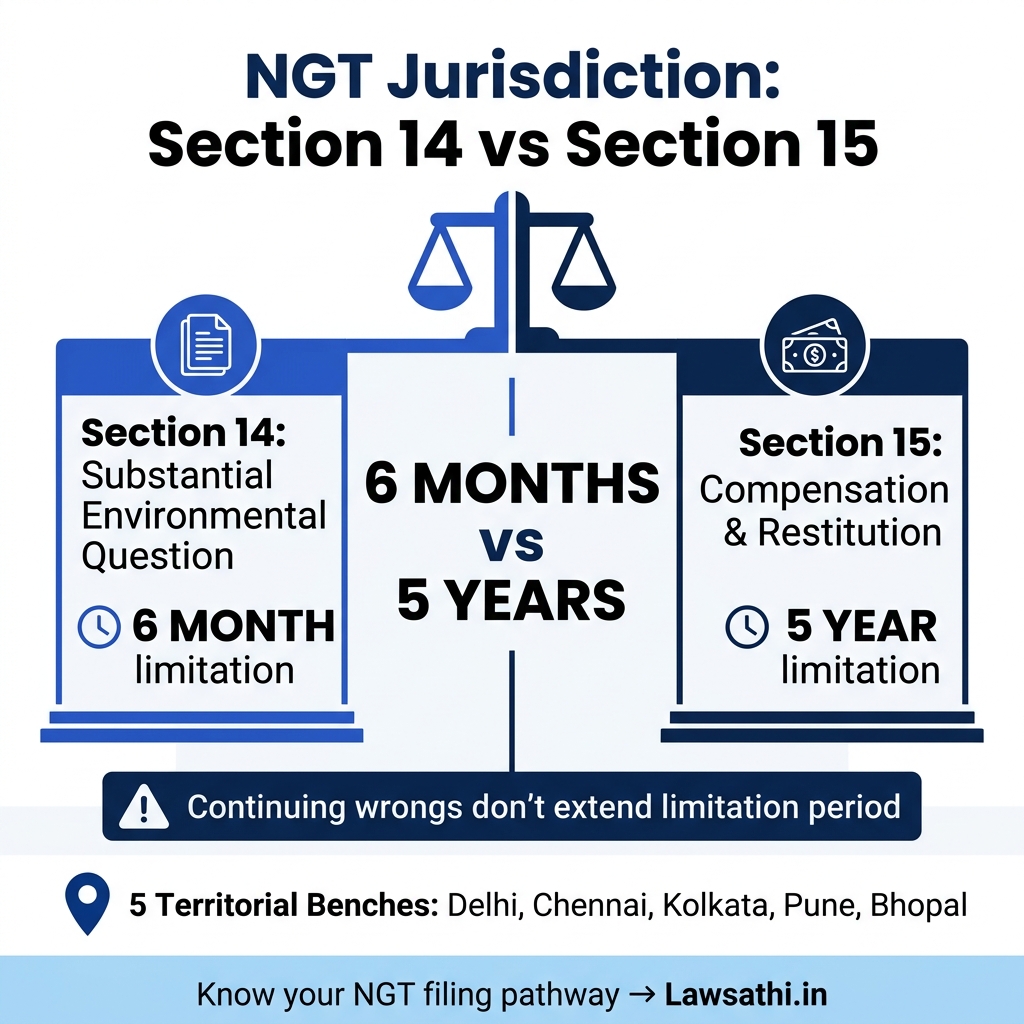
Section 14 of the NGT Act establishes the primary jurisdictional threshold. The Tribunal entertains civil cases where a “substantial question relating to environment” arises from enactments specified in Schedule I. These include the Water Act, Air Act, Environment Protection Act, and Forest Conservation Act among others.
Practitioners must carefully frame their pleadings to demonstrate this substantial question. The cause of action must directly relate to environmental protection or enforcement of legal rights concerning the environment. Moreover, mere incidental environmental issues may not satisfy this threshold.
Section 15: Compensation and Restitution Powers
Section 15 grants the NGT distinct powers for awarding relief and compensation. Unlike Section 14, this provision operates as “an entire island of power and jurisdiction.” Furthermore, this characterization applies when read with Section 20 [5]. The Tribunal can award three types of relief under this section.
First, compensation to victims of pollution and environmental damage. Second, restitution of property damaged due to environmental violations. Third, restitution of the environment itself in affected areas. Therefore, practitioners must identify which form of relief they seek and structure their claims accordingly.
Critical Limitation Periods and Exceptions
The limitation period differs significantly between Sections 14 and 15. For Section 14 applications, the limitation is six months from when the cause of action “first arose.” In contrast, Section 15 permits applications within five years for compensation claims.
However, practitioners often misunderstand the concept of “continuing wrongs.” This was clarified in Rajinder Krishan Sharma v. Union of India (NGT July 2024). Importantly, continuing wrongs do not extend the limitation period once the cause first arose. Therefore, filing promptly remains crucial.
Territorial Jurisdiction and Bench Selection
India’s NGT operates through five Benches across the country. These include the Principal Bench (New Delhi), South Zone (Chennai), East Zone (Kolkata), West Zone (Pune), and Central Zone (Bhopal). Filing in the incorrect Bench can lead to dismissal or transfer delays.
The Supreme Court has observed that the Principal Bench’s jurisdiction is limited to Northern Zone matters. Consequently, practitioners must verify territorial jurisdiction before filing their Original Application.
Pre-Filing Procedural Requirements and Documentation
Form I: Structuring Your Original Application
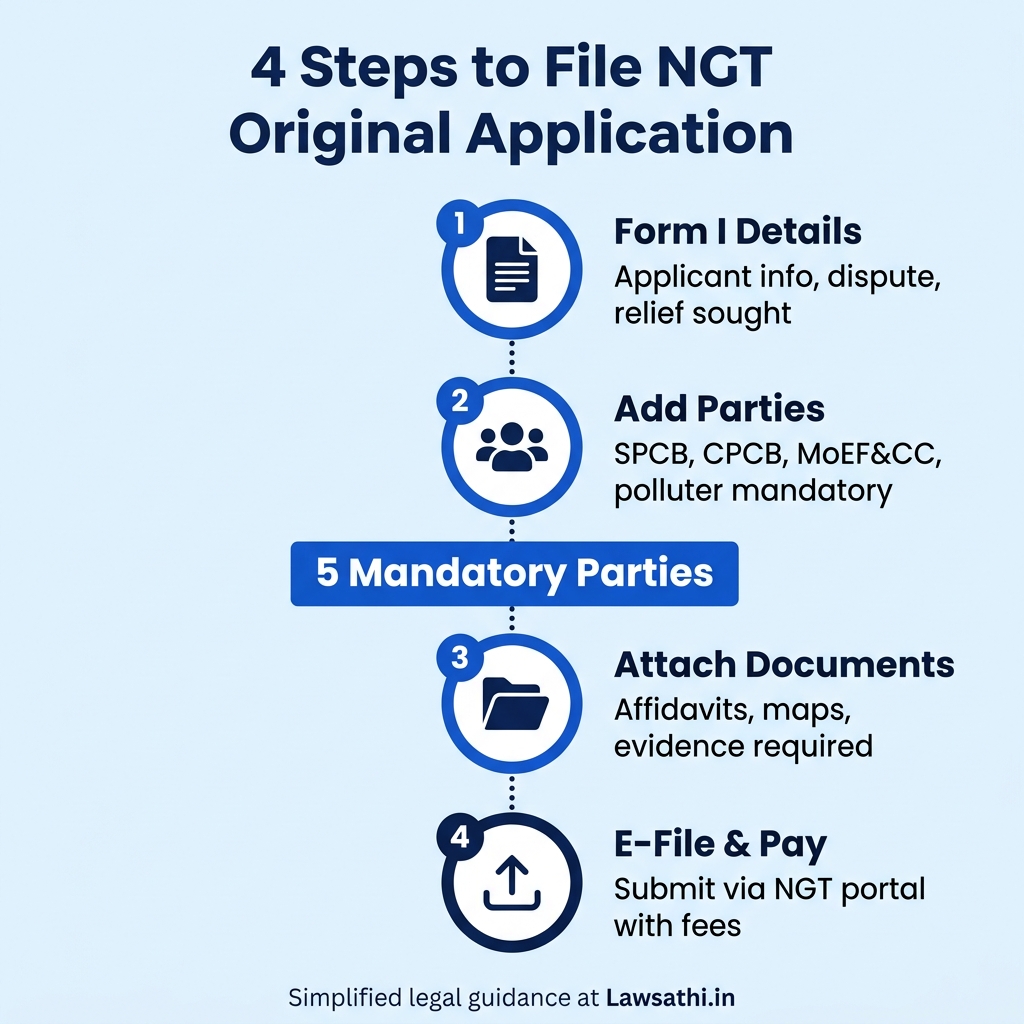
The NGT (Practice & Procedure) Rules, 2011 mandate specific formatting requirements [6]. Form I requires comprehensive details from applicants. These include the applicant’s name and address, complete description of the dispute, relief sought, and list of parties.
Supporting documents must accompany the application. These include affidavits verifying the contents, relevant maps or site plans, and all documentary evidence supporting the environmental claim. As a result, incomplete applications face rejection at the filing stage.
Identifying and Impleading Necessary Parties
Proper party impleadation is critical for maintaining the application. Mandatory parties include the concerned State Pollution Control Board (SPCB), Central Pollution Control Board (CPCB) where applicable, and the District Magistrate or Collector.
Additionally, practitioners must implead regulatory authorities like the Ministry of Environment, Forest and Climate Change (MoEF&CC). The project proponent or alleged polluter must also be named as a party. Failure to implead necessary parties can result in procedural dismissal [8].
Court Fees and Filing Procedures
Court fees vary based on the nature and value of claims. Environmental compensation claims require fee payment as prescribed under the NGT Rules. The Tribunal’s e-filing portal streamlines the submission process [7].
Unlike consumer forums, the NGT does not mandate pre-litigation mediation or notice. However, practitioners should document any prior communications with regulatory authorities. This demonstrates the applicant’s bona fides and exhaustion of alternative remedies.
The Crucial Role of Expert Evidence: Standards and Admissibility
Why Expert Evidence Forms the Bedrock
Environmental litigation inherently involves technical and scientific questions. Pollution levels, damage assessment, and restoration costs require specialized knowledge. Therefore, expert evidence becomes indispensable for establishing claims.
The NGT operates under Section 19, which mandates application of “principles of natural justice.” The Tribunal is not strictly bound by the Indian Evidence Act. Nevertheless, expert evidence must meet credibility standards to withstand scrutiny.
Types of Admissible Expert Evidence
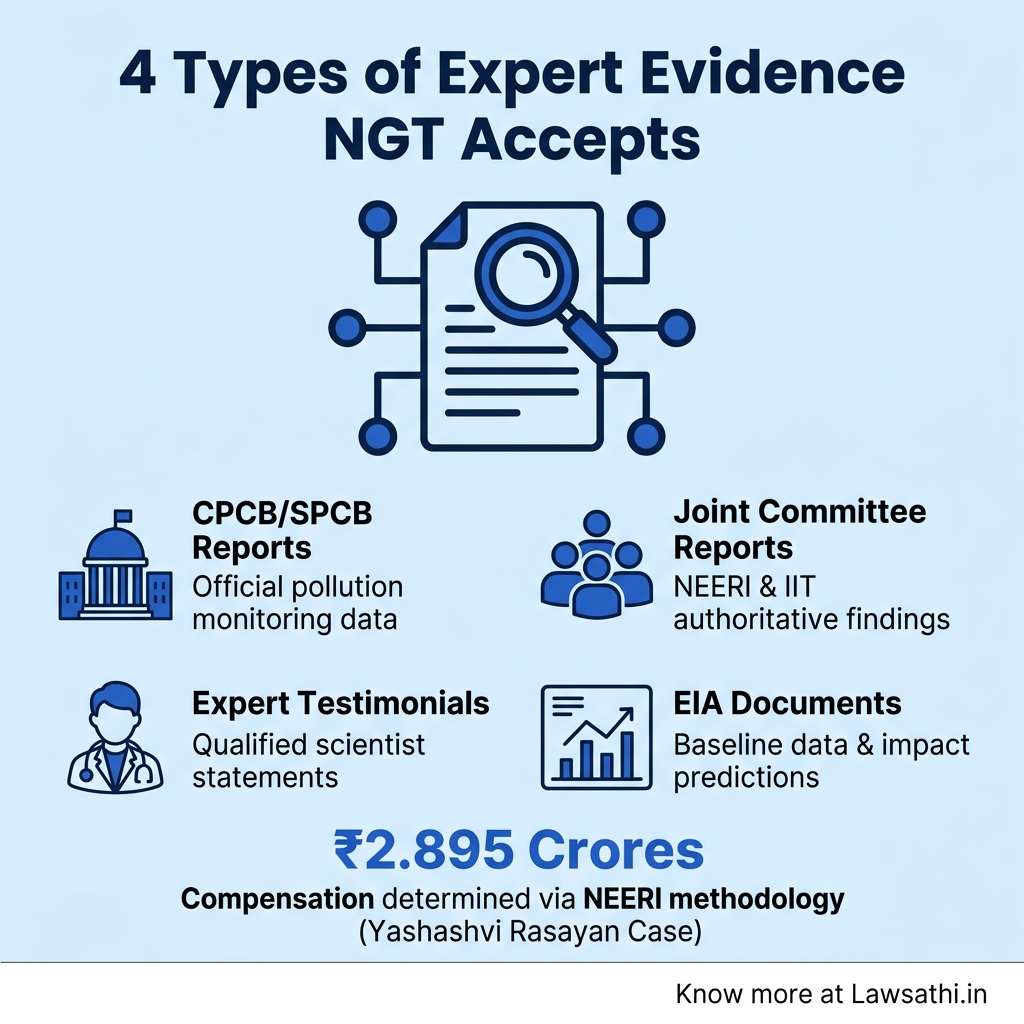
CPCB and SPCB reports carry significant weight in NGT proceedings. These official pollution monitoring documents provide baseline data for environmental claims [15]. Additionally, Joint Committee Reports, often constituted by the NGT with experts from NEERI and IITs, serve as authoritative evidence.
Independent expert testimonials from qualified scientists and environmental engineers can supplement official reports. Environmental Impact Assessments (EIA) provide crucial baseline data and impact predictions. Furthermore, damage assessment reports quantify the extent of environmental harm.
The Yashashvi Rasayan Case: A Practical Illustration
In Aryavart Foundation v. Yashashvi Rasayan (OA 22/2020), the NGT relied on NEERI’s expert report for compensation calculation. NEERI applied the “Value Transfer Method” to calculate damages. Specifically, they computed Rs. 2.895 crores for air pollution from an industrial explosion [12].
This case demonstrates how expert methodology directly impacts compensation outcomes. Therefore, practitioners should engage qualified experts early in case preparation.
Qualifications and Standards for Expert Witnesses
Expert witnesses must possess relevant educational qualifications and professional experience. Fields include hydrology, toxicology, ecology, and environmental engineering. Moreover, government scientific bodies like CPCB, NEERI, and IITs carry presumptive credibility.
The Supreme Court emphasized this in Veena Gupta v. CPCB (2024). Moreover, the Court stressed procedural fairness even when relying on expert evidence [16]. Experts must be available for examination if the opposite party demands it.
Quantifying Environmental Compensation: Methodologies and Evidence
The Polluter Pays Principle in Practice
Section 20 of the NGT Act mandates application of the polluter pays principle. This principle requires the polluter to bear the cost of remediation and compensation. However, translating this legal theory into mathematical claims requires robust evidence.
The Supreme Court’s landmark judgment in M.C. Mehta v. Union of India (Oleum Gas Leak) established absolute liability for hazardous industries. This precedent continues guiding NGT compensation orders today [3].
Supreme Court’s 2026 Ruling on Project Turnover Methodology
In a significant development, the Supreme Court clarified compensation calculation methodology. This occurred in M/s. Rhythm County v. Satish Sanjay Hegde (January 2026) [11]. The Court upheld NGT’s power to use project turnover or cost as a relevant yardstick.
The ruling affirmed that NGT’s powers under Sections 15, 17, and 20 are “wide, flexible, and principle-oriented.” However, compensation must remain “rational, proportionate and reasoned.” In the Rhythm County case, Rs. 5 crores represented 1.49% of project cost, which the Court found reasonable.
CPCB’s Three-Category Classification
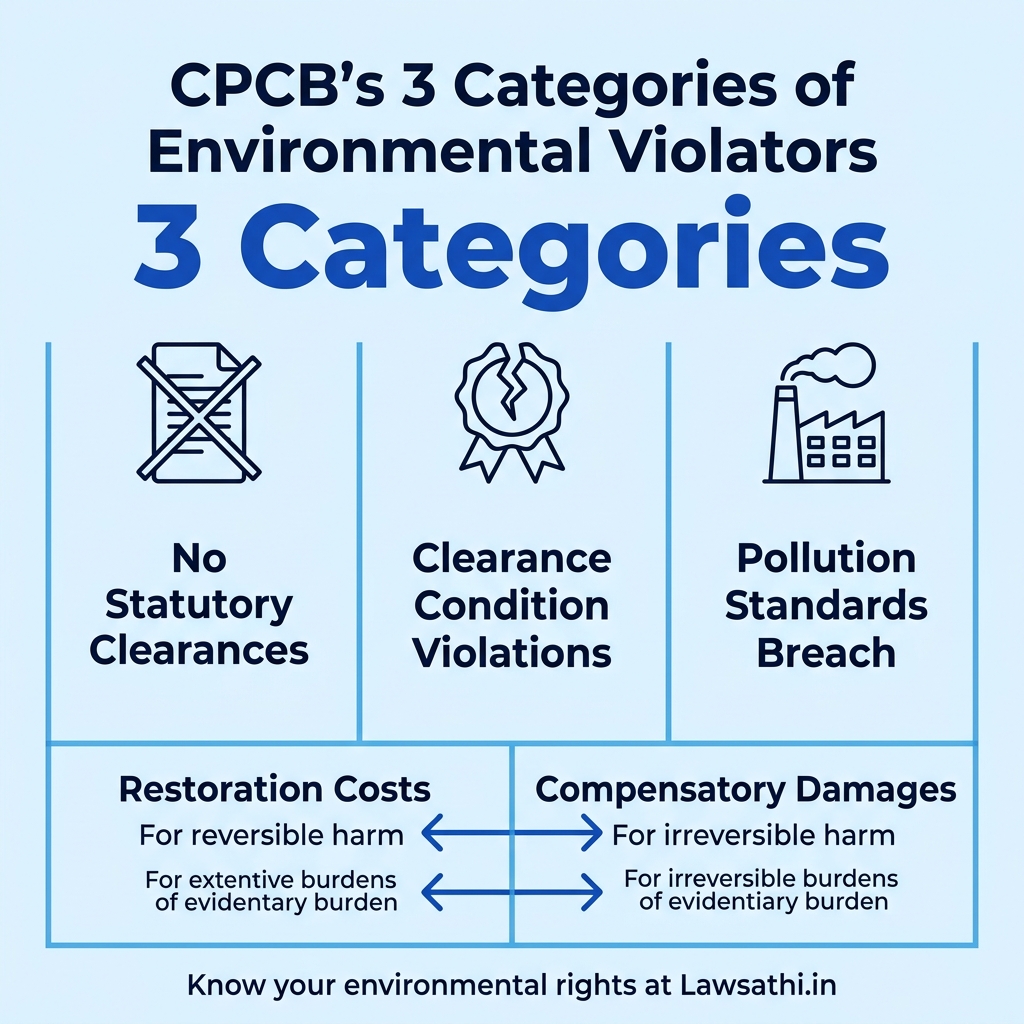
CPCB guidelines classify environmental violators into three categories [13]. First, entities operating without statutory clearances. Second, those violating clearance conditions. Third, industries violating pollution standards.
Each category attracts different compensation calculation approaches. Factors include whether the polluter is corporate or individual, whether pollution affects the community, and whether damage is reversible.
Restoration Costs vs. Compensatory Damages
Practitioners must distinguish between restoration costs and compensatory damages. Restoration costs represent actual expenditure needed to return the environment to its original state. This includes remediation, clean-up, and ecological restoration.
In contrast, compensatory damages apply where complete restoration is impossible. Loss of biodiversity, long-term health impacts, and irreversible environmental changes fall under this category. Therefore, the evidentiary burden differs significantly for each type of claim.
Common Procedural Pitfalls and Best Practices for Practitioners
Reasons for Application Dismissal
Jurisdictional errors remain the primary cause for OA dismissal. Applications that fail to raise a “substantial question relating to environment” face rejection at the threshold stage. For example, the Muslim Kassar Vikas Sangthan v. DDA case illustrates this principle [4].
Limitation bar presents another common obstacle. Filing beyond six months for Section 14 or five years for Section 15 requires condonation. Additionally, defective pleadings and incomplete Form I submissions also lead to rejection.
Supreme Court’s Caution on Ex-Parte Orders
The Supreme Court in Veena Gupta v. CPCB (2024) expressed concern over NGT’s “frequent ex-parte orders.” The Court emphasized that environmental protection must balance with due process rights. Consequently, Tribunals must issue proper notices and provide hearing opportunities before imposing compensation.
Practitioners should anticipate this scrutiny when seeking interim orders. Documenting environmental urgency helps justify expedited proceedings.
The Limited Scope of Review Petitions
Review petitions before the NGT have narrow grounds. As held in Nand Lal v. Dhermendra Tomar (2024), mere disagreement with the order is insufficient [17]. Valid grounds include discovery of new evidence, error apparent on the face of record, or other sufficient reason.
Practitioners should not treat review as an alternative appeal. The NGT Monthly Reviews provide valuable insights into procedural trends [18].
Strategies for Expert Witness Cross-Examination
Cross-examining expert witnesses requires thorough preparation. Practitioners should challenge the methodology and underlying assumptions of expert reports. Additionally, questioning qualifications and potential bias also proves effective.
Presenting contradictory expert opinions can weaken the opponent’s evidence. Focusing on gaps in data collection or analysis often reveals vulnerabilities. Furthermore, visual aids like pollution dispersion models help communicate technical challenges to the Tribunal.
—
Conclusion: Streamlining Environmental Practice
The NGT Original Application procedure demands meticulous attention to jurisdictional thresholds, procedural requirements, and evidentiary standards. Success depends on correctly framing the substantial environmental question, impleading proper parties, and presenting robust expert evidence.
NGT jurisprudence continues evolving through Supreme Court interventions and the Tribunal’s own precedents. The 2026 ruling on project turnover methodology demonstrates this evolution. Therefore, practitioners must stay updated on these developments to effectively represent environmental matters.
The ethical duty of lawyers in environmental protection extends beyond individual cases. Proper procedural conduct ensures that genuine environmental claims receive adjudication. In conclusion, technical competence in handling expert evidence advances the cause of environmental justice.
Struggling to manage complex environmental case files and strict NGT deadlines? Simplify your practice with LawSathi. Our AI-powered platform organizes your case documents, automates deadline tracking, and streamlines legal research for Original Applications. Start your free trial today and focus on winning cases.