
Introduction: A Landmark Day for Legal Ethics and Procedure
March 26, 2026 marked a watershed moment for the Indian legal fraternity. The Supreme Court of India addressed three critical issues that will reshape legal practice across the country. Specifically, the rulings covered Supreme Court fake AI judgments, procedural compliance in criminal trials, and judicial recruitment reforms.
For practicing advocates, these developments carry profound implications. The Court addressed the intersection of technology, procedural law, and judicial recruitment in a single day of significant hearings. Therefore, understanding these rulings is essential for every legal professional navigating the evolving landscape of Indian jurisprudence.
Why These Rulings Matter for Indian Lawyers
The Supreme Court’s observations on AI-generated fake judgments signal a new era of accountability. Additionally, the clarification on unsigned charge sheets provides much-needed certainty for criminal practitioners. Meanwhile, judicial aspirants received important guidance on examination relaxations.
These rulings collectively demonstrate the Court’s commitment to balancing technological advancement with ethical practice. Moreover, they reinforce the principle that procedural fairness must prevail over technicalities.
Supreme Court’s Stern Stance on Fake AI-Generated Judgments
The Gummadi Usha Rani Case: A Wake-Up Call
The Supreme Court fake AI judgments issue came to the forefront in Gummadi Usha Rani v. Sure Mallikarjuna Rao 2026 SCC OnLine SC 341. A trial court in Andhra Pradesh had relied on four fabricated precedents in its order dated August 19, 2025. The Bench of Justice P.S. Narasimha and Justice Alok Aradhe took serious note of this disturbing development.
The fake citations included cases with telling errors. For instance, one citation bore the year “1071” – an obvious AI hallucination that no human lawyer would make. The Court observed that a decision based on non-existent judgments is not merely an error. Rather, it “may amount to misconduct and entail legal consequences” SCC Online Blog.
Heart & Soul Entertainment: The Bombay High Court Connection
In another significant case, the Supreme Court addressed AI misuse in rent control litigation. The matter of Heart & Soul Entertainment Ltd v. Deepak s/o Shivkumar Bahry involved fabricated submissions before the Bombay High Court. That court had identified clear “give-away features” of AI-generated content Bar & Bench.
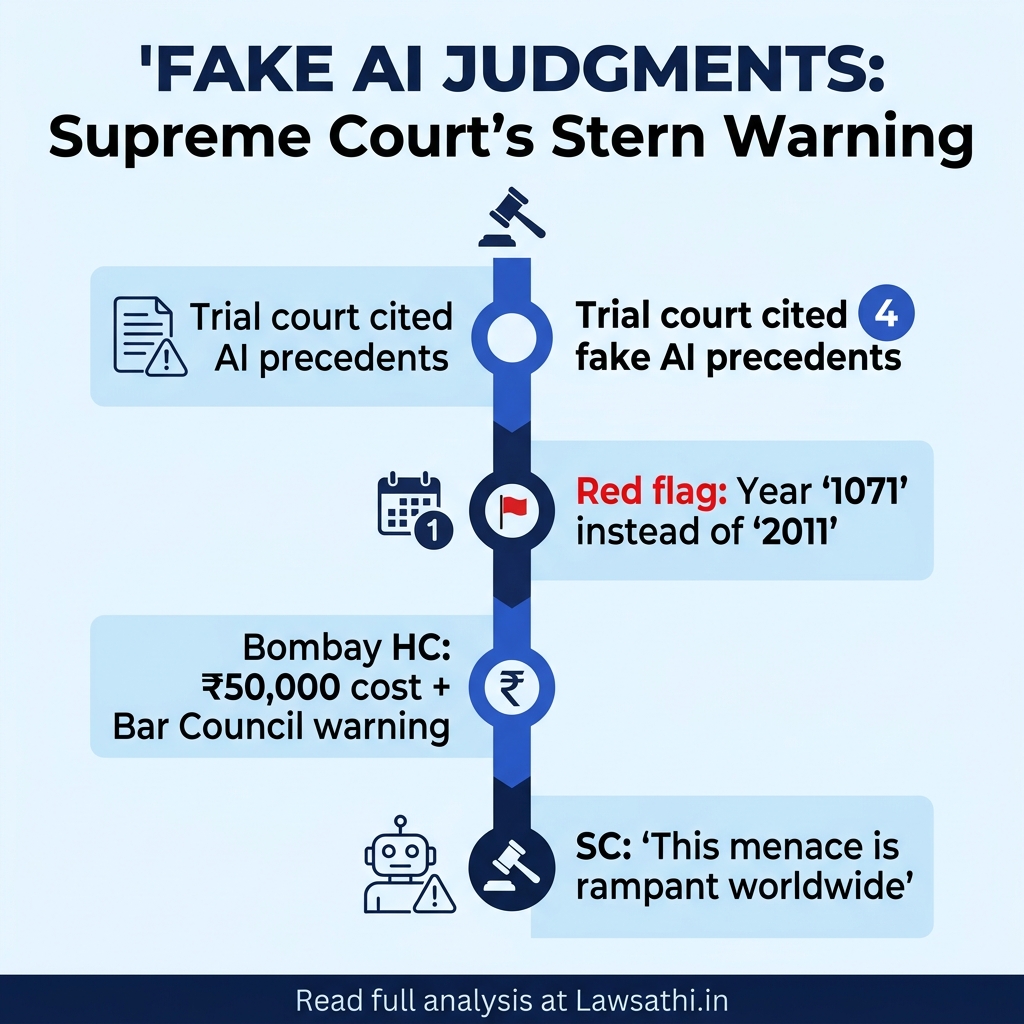
These included green-box tick-marks and repetitive bullet points characteristic of AI outputs. The High Court imposed ₹50,000 costs on the appellant. Furthermore, it warned of potential referral to the Bar Council for advocates engaging in such practices.
Supreme Court’s Stern Observations
Justice Rajesh Bindal and Justice Vijay Bishnoi delivered unambiguous observations on March 26, 2026. The Court stated clearly: “This menace is rampant in all Courts now, not only in India rather throughout the world” LiveLaw.
Therefore, the Supreme Court has explicitly acknowledged that Supreme Court fake AI judgments represent a global crisis. The Court also noted it is “already seized of this matter on judicial side.” As a result, comprehensive guidelines may be forthcoming.
Understanding AI “Hallucinations” in Legal Research
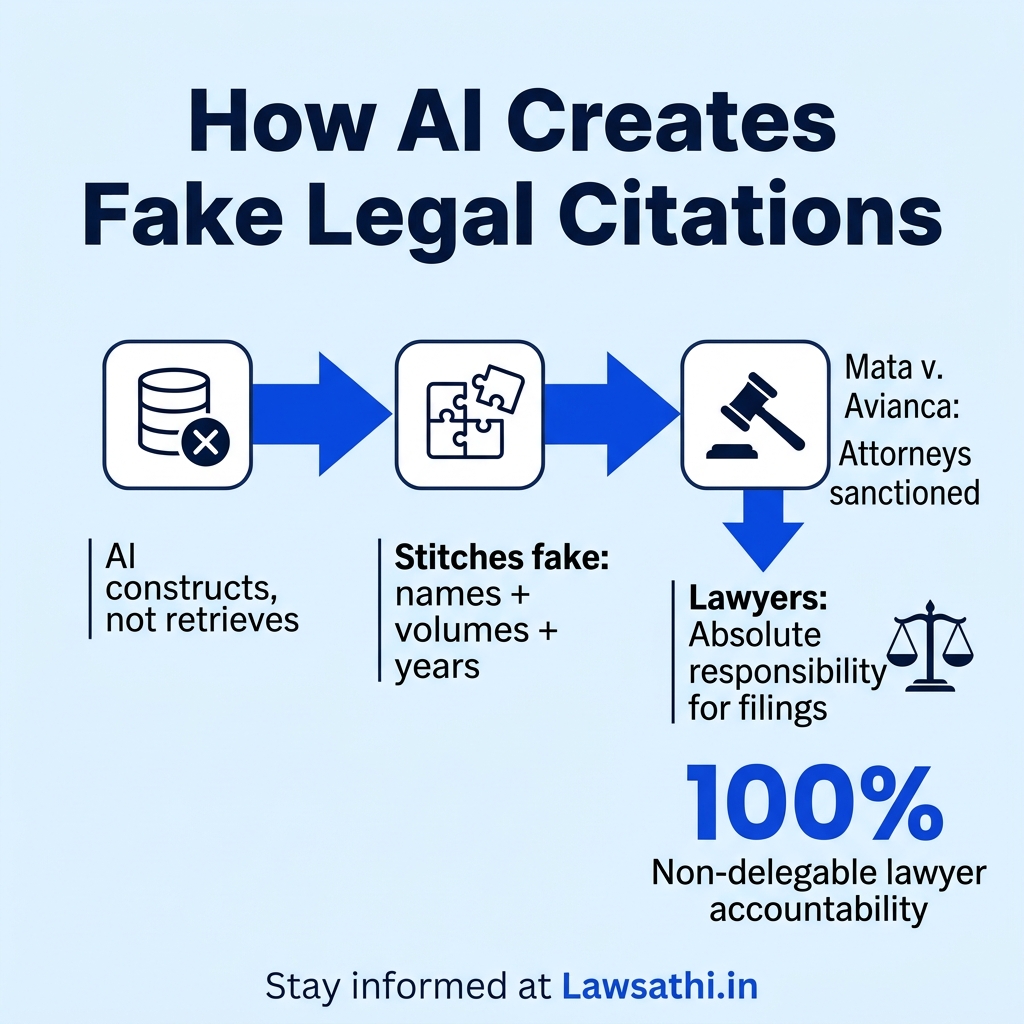
Generative AI models do not retrieve documents from verified legal databases. Instead, they construct responses probabilistically. They calculate the most statistically likely sequence of words LiveLaw Analysis.
When asked for case law, AI “stitches together” mathematically probable citations. It combines appellant names, respondent names, reporter volumes, and years. The machine is not trying to deceive. However, it simply lacks internal verification mechanisms to confirm the existence of cited cases.
Global Precedents on AI Misuse
The United States faced similar challenges in Mata v. Avianca Inc. before the Southern District of New York. Legal counsel submitted briefs containing non-existent judicial opinions generated by ChatGPT. Consequently, the court imposed financial sanctions on the attorneys involved.
The key principle established was clear. Lawyers bear absolute and non-delegable responsibility for the accuracy of their filings. This principle now resonates strongly in Indian courts as well.
Validity of Unsigned Charges: Procedural Lapse or Fatal Error?
The Legal Question Before the Court
In Sandeep Yadav v. Satish, the Supreme Court addressed a crucial procedural question. Does an unsigned charge sheet vitiate criminal proceedings entirely? The Bench of Justice Ahsanuddin Amanullah and Justice R. Mahadevan delivered the judgment on March 25, 2026 LiveLaw.
The case originated from a land dispute in Aligarh that led to firing and death. Charges were framed on March 27, 2009, but the order sheet remained unsigned. This occurred because one accused was absent. However, all accused appeared on June 1, 2009. On that date, charges were read over and explained to them.
Substantial Justice Over Technicalities
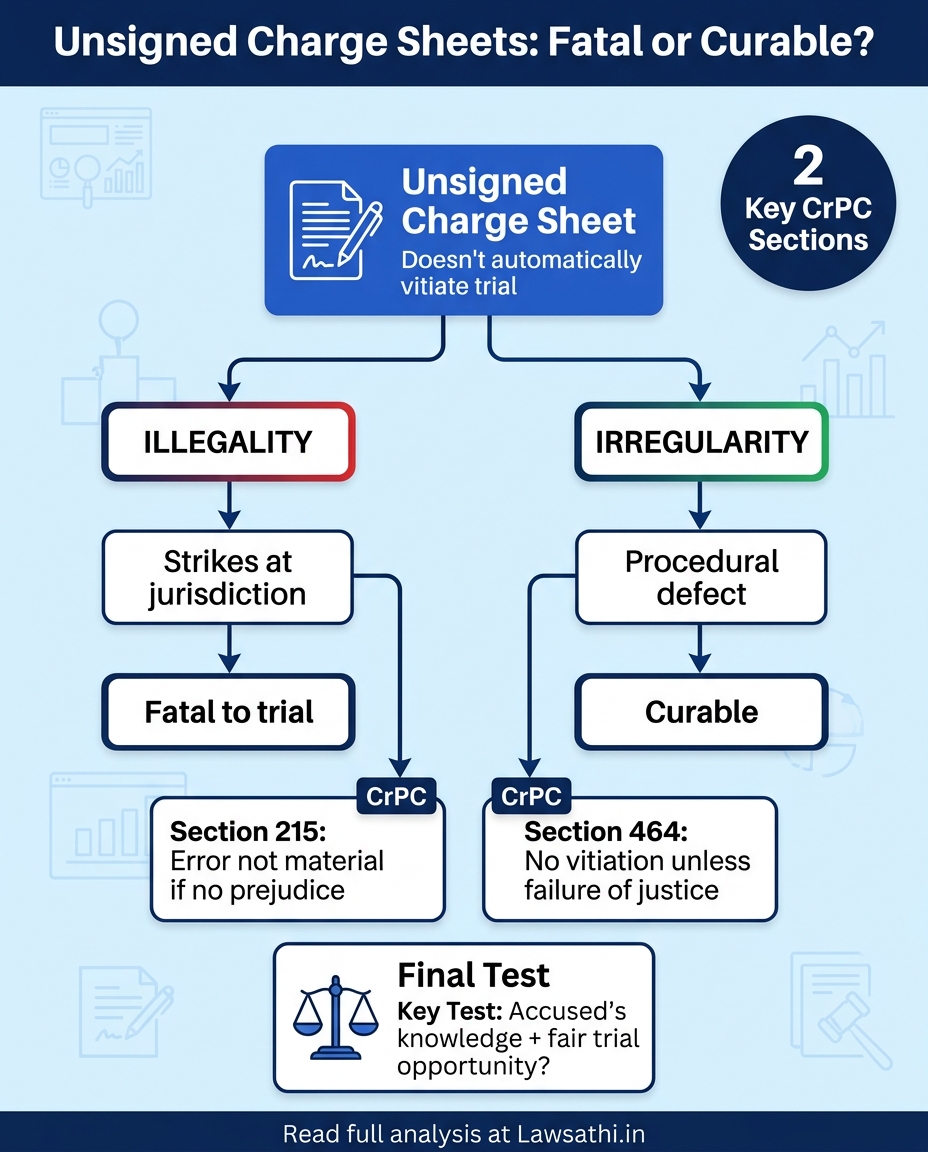
The Supreme Court reaffirmed the principle from Willie (William) Slaney v. State of M.P. (1955) 2 SCC 340. Where there is substantial compliance with legal requirements, mere procedural errors do not vitiate the trial. The key test is whether the accused had a fair trial. Specifically, courts must determine if the accused had full knowledge of the case against them.
Distinction Between Illegality and Irregularity
The Court drew a crucial distinction between illegalities and irregularities. An illegality strikes at the root of jurisdiction and renders the trial fundamentally unfair. In contrast, an irregularity is merely a defect in procedure. It doesn’t vitiate proceedings unless prejudice is demonstrated SCC Online.
Section 215 of the CrPC explicitly provides that no error in charge is material unless the accused was misled. Similarly, Section 464 states that omission to frame charge does not vitiate proceedings. This applies unless failure of justice occurred.
Impact on Pending Criminal Trials
This ruling significantly impacts criminal trials where charge sheets lack proper signatures. The Supreme Court held that de novo trials should be ordered only in exceptional circumstances. These include serious illegality, lack of jurisdiction, or prevention of parties from leading material evidence SCC Times.
The trial in this case had substantially progressed over 14 years. Some key witnesses had died during this period. Therefore, ordering a de novo trial would have “irretrievably prejudiced the prosecution.”
Relaxation in Civil Judge Examination: Opening Doors for the Judiciary
Background: The 3-Year Practice Requirement
In May 2025, the Supreme Court restored the requirement of minimum three years’ practice for Civil Judge (Junior Division) posts. This decision in All Indian Judges Association v. Union of India reversed the position since 2002. Previously, fresh law graduates could directly appear.
The rationale was to ensure competence and practical understanding of trial court functioning. However, this change sparked significant concern among law graduates nationwide.
Supreme Court’s March 2026 Hearing
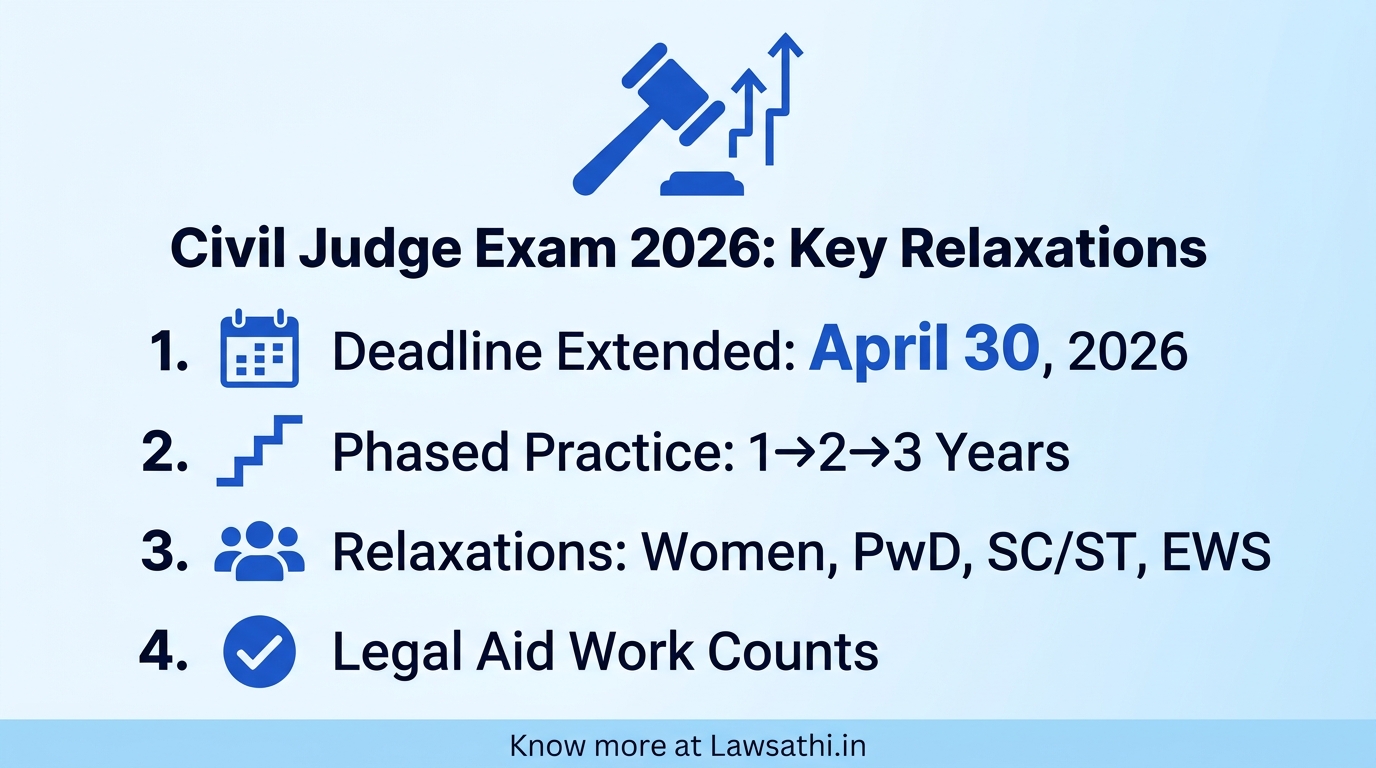
Chief Justice Surya Kant led a Bench hearing review petitions on March 13, 2026. The Court extended application deadlines to April 30, 2026 across all states LiveLaw.
CJI Surya Kant made crucial observations during the hearing. He acknowledged that the requirement should have been imposed in a phased manner. “It should have been one year, then two years, then three years,” he stated.
Concerns Raised by Petitioners
Petitioners highlighted that the requirement disproportionately affects women candidates. Additionally, candidates from economically weaker and socially disadvantaged backgrounds face significant hardship. Those in non-litigation roles like law firms and PSUs also possess relevant legal experience LiveLaw.
The Court is considering possible relaxations for persons with disabilities. Moreover, free legal aid work has been mentioned favorably as qualifying experience.
Relief for Marginalized Categories
In Diksha Kalson v. State of Haryana, the Supreme Court addressed a different aspect of judicial recruitment. An SC woman candidate fell short of the 45% minimum criteria. She missed the cutoff by just 1.9 marks LiveLaw.
The Court urged the High Court to “sympathetically consider” relaxation for SC category candidates. Only nine candidates were recommended against 39 vacancies in that category.
Practical Takeaways for Indian Legal Professionals
AI Verification Checklist for Lawyers
Before filing any submission, lawyers must cross-verify every citation on official databases. SCC Online, Indian Kanoon, and e-SCR are reliable sources for verification. Additionally, confirm paragraph references carefully. AI often invents paragraphs that don’t exist in actual judgments.
Watch for suspicious years in citations. For example, “1071” instead of “2011” indicates an obvious AI hallucination. Furthermore, obtain actual judgment copies. Always verify that quoted text matches the original.
Procedural Safeguards for Trial Lawyers
Ensure signatures on charge-framing order sheets without fail. Document that charges were read over and explained to the accused in a language they understand. Additionally, maintain clear records of the accused’s participation in proceedings and cross-examination.
If a defect is discovered late in proceedings, demonstrate that no prejudice occurred to the accused. The decisive test remains whether the accused was misled in conducting their defence.
Guidance for Judicial Aspirants
Enroll as an advocate immediately after graduation to begin accumulating practice experience. Maintain documented proof through case diaries and vakalatnamas. Additionally, consider free legal aid work, which the Chief Justice mentioned favorably.
Track state-wise advertisements and deadlines carefully. The current deadline extension to April 30, 2026 applies across all states. Furthermore, stay updated on review petition outcomes for possible further relaxations.
Conclusion: Navigating the New Legal Landscape
The Supreme Court fake AI judgments rulings mark a decisive shift toward stricter accountability for technology use in litigation. Lawyers bear absolute responsibility for verifying their submissions. Moreover, the Court’s characterization of AI-generated fake citations as a “menace” signals that contempt proceedings may follow future violations.
The unsigned charge sheet ruling reinforces the primacy of substantive justice over procedural technicalities. Courts will examine actual prejudice rather than mere defects. Therefore, this principle provides certainty for criminal practitioners dealing with procedural irregularities.
For judicial aspirants, the 3-year practice requirement remains but with possible phased implementation. Extended deadlines and category-specific relaxations offer some relief. However, the coming months will bring further clarity on modalities.
The Indian legal profession stands at an inflection point. Technology offers tremendous efficiency gains but demands heightened vigilance. Procedural compliance remains essential, yet courts prioritize fairness over form. Meanwhile, judicial recruitment evolves to balance competence with accessibility.
Stay ahead of evolving legal standards with LawSathi. Our AI-powered platform is trained on verified Indian case law, eliminating the risk of hallucinated citations. Streamline your practice management and ensure accuracy today. Start your free trial.