
In high-stakes commercial disputes, the battle often begins long before the arbitral tribunal is constituted. The ability to preserve assets can determine whether a final award holds any value. Therefore, practitioners must master the procedure for obtaining Section 9 Arbitration and Conciliation Act interim relief. This provision empowers courts to grant protective measures. Consequently, the arbitral process remains meaningful and enforceable.
For Indian lawyers, understanding the nuances of Section 9 is crucial. It serves as the first line of defense against asset dissipation. Furthermore, it bridges the gap between the dispute’s origin and the tribunal’s constitution.
The Strategic Battleground
Section 9 acts as a powerful protective mechanism. It allows parties to approach a court for interim measures before, during, or after arbitral proceedings. The primary goal is preventing the arbitral award from becoming a “paper award.” Consequently, it is often the first battleground in high-value commercial disputes.
Section 9 vs. Section 17: Understanding the Distinction
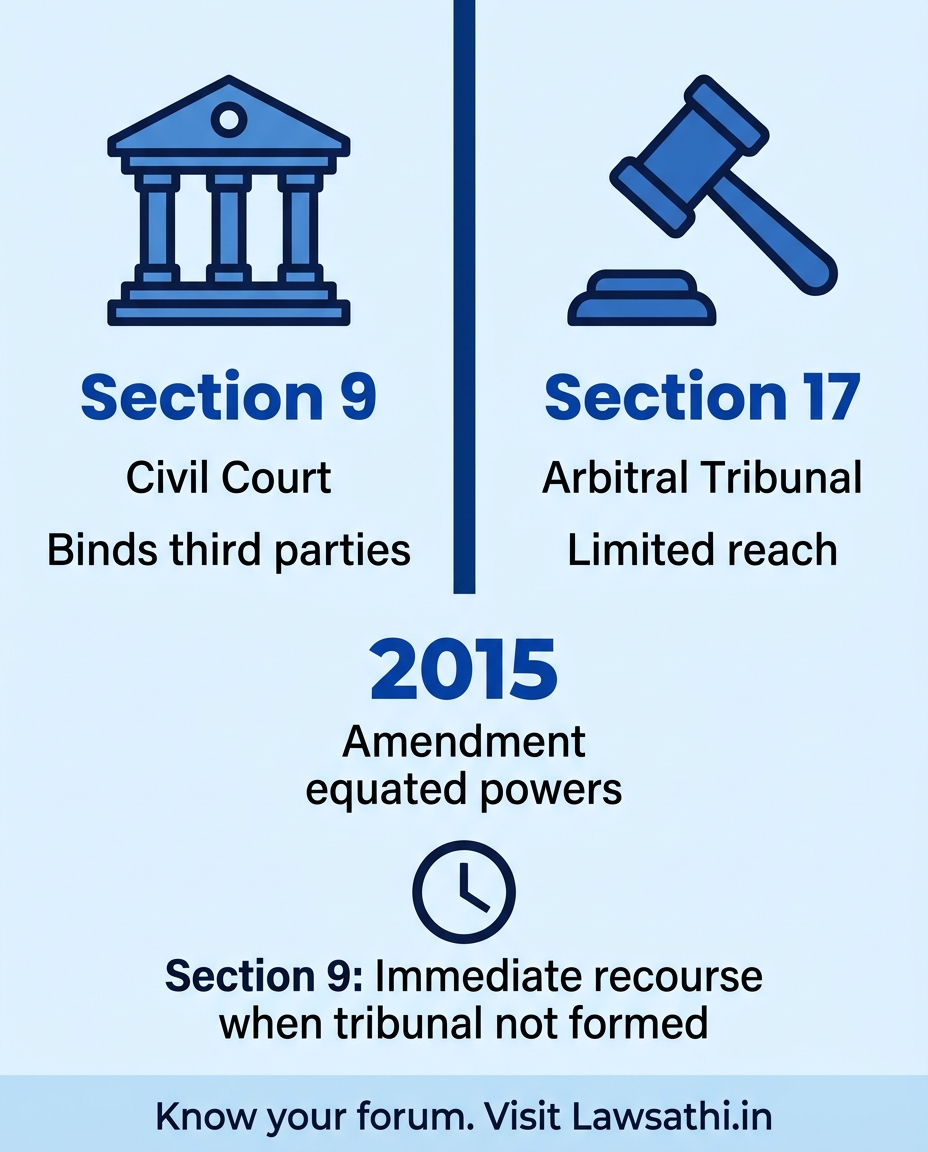
It is vital to distinguish between court-appointed interim measures and tribunal powers. Section 9 applications are made to a civil court. In contrast, Section 17 applications are directed to the arbitral tribunal.
Before the 2015 Amendment, tribunals had limited powers. However, the Amendment equated Section 17 powers with those of the court. Despite this, Section 9 remains critical. Courts can bind third parties, a power tribunals often lack. Moreover, courts provide immediate recourse when the tribunal is not yet functional.
Jurisdictional Nuances: Identifying the Correct Forum
Choosing the correct court is the first procedural hurdle. A mistake here can delay relief significantly. Therefore, practitioners must carefully analyze jurisdictional thresholds.
Definition of “Court” Post-2015 Amendment
The definition of “Court” under Section 2(e) is pivotal. It refers to the Principal Civil Court of original jurisdiction. Additionally, it covers a High Court with ordinary original civil jurisdiction. The 2015 Amendment refined this definition to prevent parallel proceedings. It aimed to curb “jurisdiction shopping” by litigants.
According to legal analyses, the amendment clarifies which court has authority [1]. As a result, this prevents conflicting orders from different forums.
Pecuniary and Territorial Jurisdiction
Jurisdiction depends on pecuniary thresholds. If the claim exceeds the district court’s limit, the High Court may have jurisdiction. However, territorial jurisdiction depends on the “seat” of arbitration.
The Supreme Court has ruled that courts must decline jurisdiction if the agreement specifies a different seat. For instance, in Sundaram Finance Ltd. v. T. Thankam, the Court addressed territorial nuances [6]. Practitioners must verify the seat before filing.
The “Entertained” Doctrine
A critical question arises when the tribunal is constituted during a pending Section 9 petition. Does the court lose jurisdiction immediately?
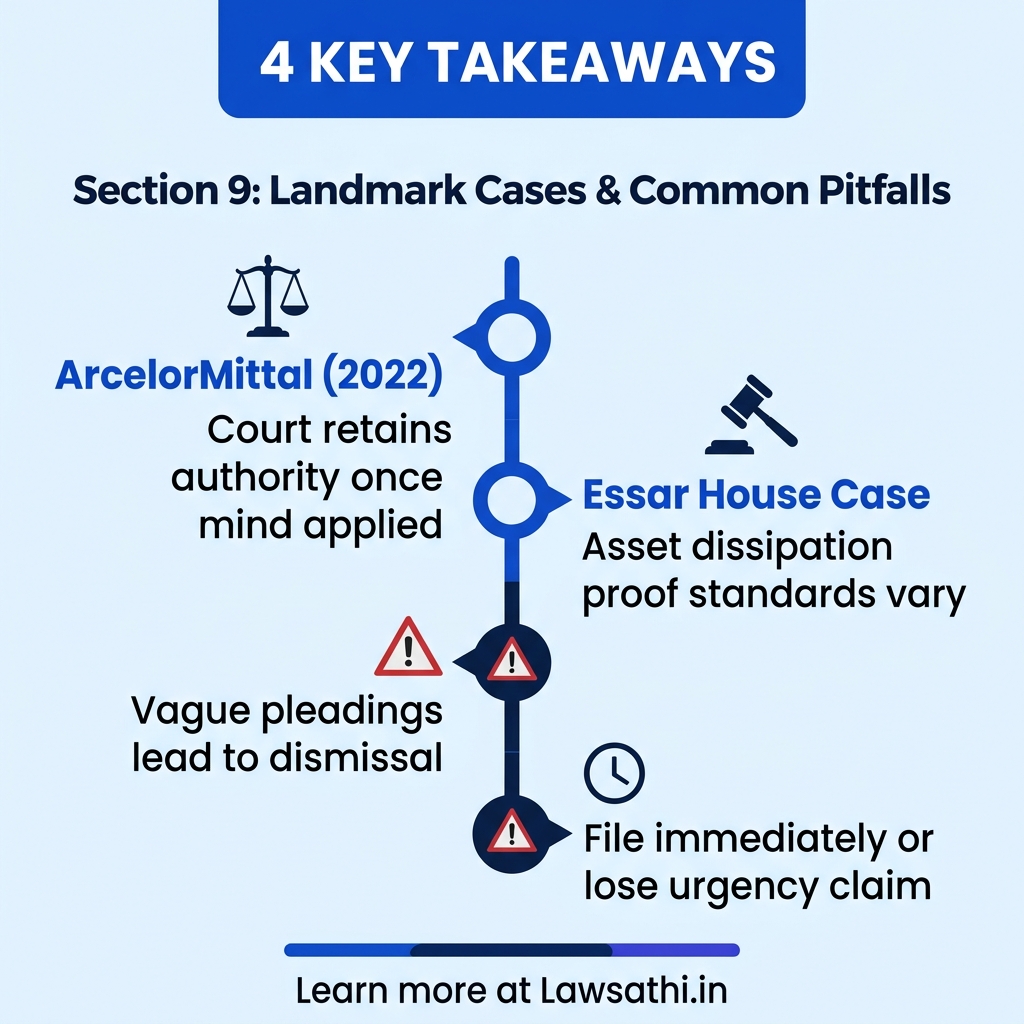
The Supreme Court answered this in ArcelorMittal Nippon Steel India Ltd. v. Essar Bulk Terminal Ltd. [18]. The Court held that once a court has “entertained” an application, it retains authority. Specifically, “entertained” means the court has applied its mind to the issues. Therefore, the court can continue hearing the matter even after the tribunal forms.
Procedural Requirements for Filing a Section 9 Petition
Filing a Section 9 Arbitration and Conciliation Act interim relief petition requires precision. Courts scrutinize these applications closely. As a result, missing documents or vague pleadings can lead to rejection.
Essential Pre-conditions for Filing
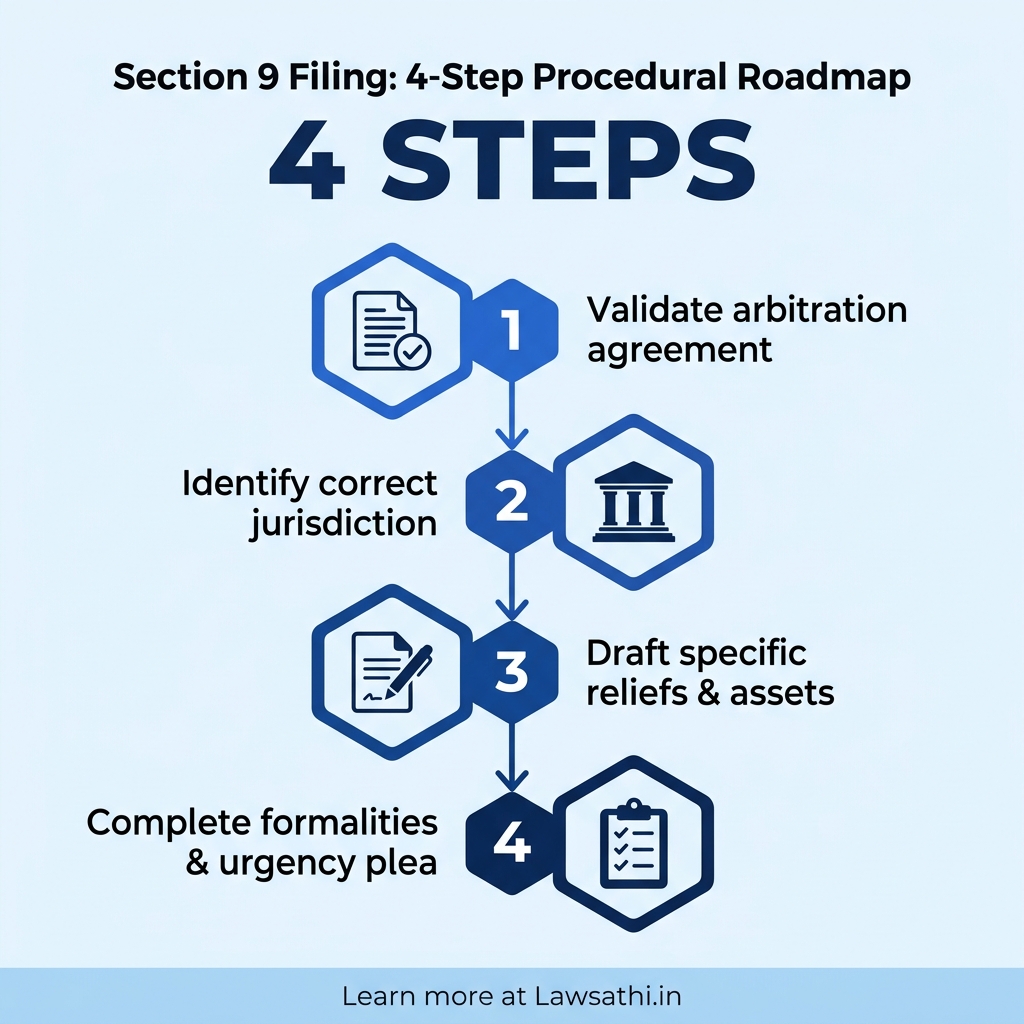
First, the petitioner must prove the existence of a valid arbitration agreement. Second, there must be an anticipation of arbitral proceedings. The petitioner must demonstrate they are ready and willing to arbitrate.
Timing is flexible. You can file before issuing a notice of arbitration. Alternatively, you can file during the proceedings or post-award. However, if you file before starting arbitration, Section 9(2) imposes a time limit. You must commence arbitral proceedings within 90 days of the court’s order.
Drafting the Petition and Reliefs
Specificity is key when drafting the petition. You must clearly describe the reliefs sought. Section 9(1)(ii) lists various interim measures available:
Preservation or custody of goods. Securing the amount in dispute. Detention or inspection of property. Interim injunctions or appointment of receivers. * Any other just and convenient measure.
Vague prayers like “general injunction” are often dismissed. Instead, identify specific assets and their locations. For example, request freezing a specific bank account number.
Procedural Formalities and Court Fees
Procedural compliance is mandatory. You must pay the applicable court fees, which vary by state. Some states charge ad valorem fees. Others have fixed rates. Additionally, you must file an accompanying affidavit verifying the facts.
A vakalatnama is also required. If seeking ex-parte ad-interim relief, you must justify the urgency. Courts grant ex-parte orders only in “very exceptional circumstances” [13]. Therefore, the applicant must prove that notifying the defendant would defeat the purpose of the relief.
Grounds for Granting Interim Relief: The Legal Test
Courts do not grant interim relief automatically. The petitioner must satisfy a specific legal test. As a result, relief is granted only when necessary.
The Tripartite Test for Interim Relief
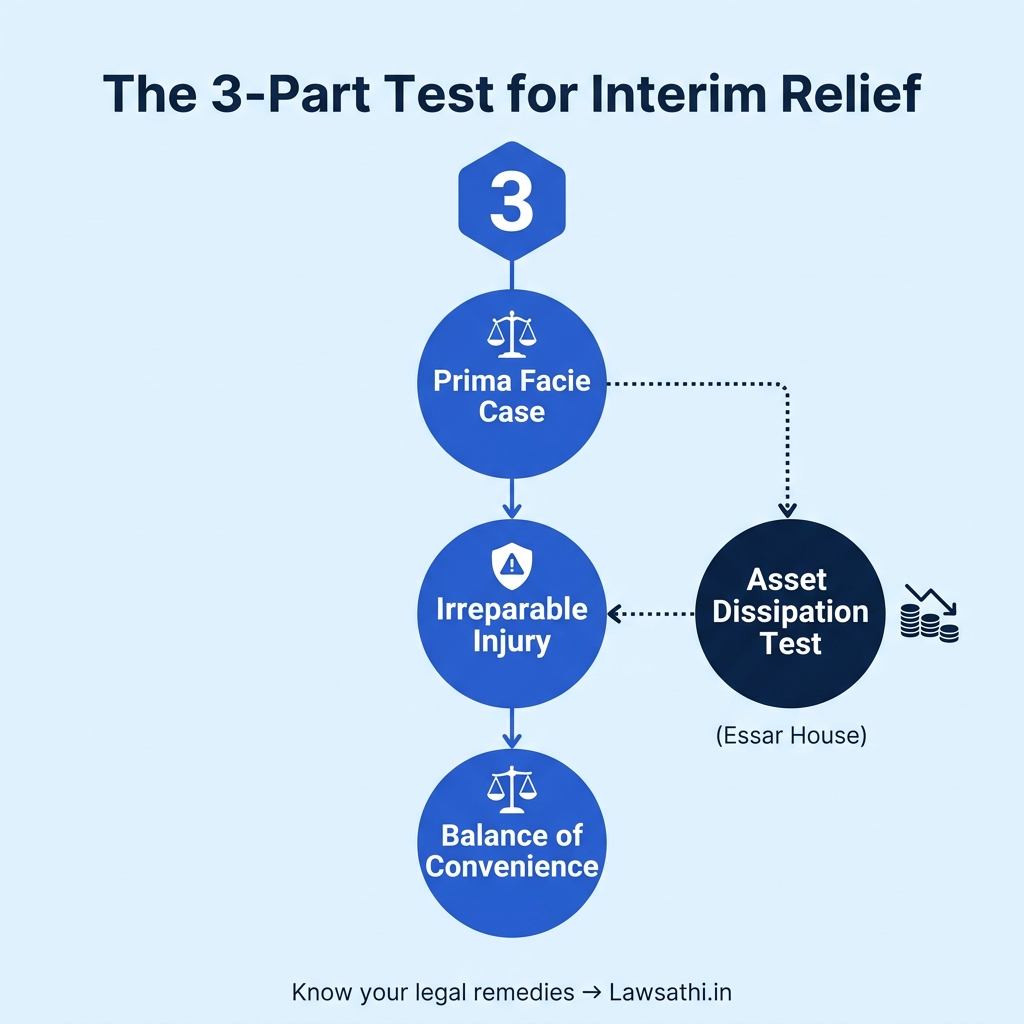
The courts generally apply a tripartite test similar to Order 39 of the CPC. The petitioner must establish:
1. A prima facie case: There must be a strong initial case on merits. 2. Irreparable injury: The loss must be irreparable or not compensable in money. 3. Balance of convenience: The balance must tilt in favor of the petitioner.
However, the application of this test varies. Some judges take a flexible approach. Others are stricter.
The “Asset Dissipation” Test
Proving asset dissipation is central to interim measures arbitration India. You must show that the respondent is likely to defeat the award. Does this require proving actual attempts to dispose of assets?
The Supreme Court addressed this in Essar House (P) Ltd. v. ArcelorMittal Nippon Steel India Ltd. [4]. The Court held that actual attempts are not imperative. Instead, a “strong possibility of diminution of assets” suffices.
Furthermore, the Court stated that Section 9 powers are wider than Order 38 Rule 5 of the CPC. Courts are not strictly bound by CPC technicalities. However, a later judgment in Sanghi Industries Ltd. v. Ravin Cables Ltd. took a stricter view. It required satisfaction of CPC preconditions for attachment-like orders.
Currently, Delhi High Court precedents tend to follow the stricter Sanghi Industries standard [4]. Therefore, practitioners should prepare for the stricter test to be safe.
Navigating the Section 9 and Section 17 Interface
The relationship between court and tribunal jurisdiction is complex. The 2015 Amendment attempted to clarify this interface. Yet, debates persist.
When Does Court Power Cease?
Section 9(3) provides a general rule. Once an arbitral tribunal is constituted, courts shall not entertain Section 9 applications. The logic is simple. The tribunal is now competent to grant relief.
However, there is a crucial exception. The court can still act if the remedy under Section 17 is “inefficacious.”
When is Section 17 Remedy Ineffective?
There are specific scenarios where approaching the tribunal is not viable. For example:
Third-party measures: Tribunals cannot bind non-signatories. If you need to attach assets held by a third party, Section 9 is your only option. Non-functional tribunal: The tribunal may be unable to convene due to vacancies or illness. * Extreme urgency: The tribunal cannot act quickly enough to prevent asset dissipation.
In such cases, the court retains jurisdiction. The ArcelorMittal case clarified that the “entertained” doctrine applies to pending applications [18]. Therefore, if the court has already started hearing the matter, it can continue.
Strategic Choice of Forum
Litigators must make a strategic choice. If third parties are involved, choose the court. However, if the tribunal is functional and urgency is moderate, Section 17 might be more cost-effective. It avoids court fees and potential delays. Recent analyses suggest understanding the harmony between these sections is vital [1].
Landmark Supreme Court Judgments Every Litigator Must Know
Precedents shape the interpretation of Section 9 petition jurisdiction. Therefore, Indian lawyers must be familiar with these landmark rulings to argue effectively.
ArcelorMittal Nippon Steel India Ltd. v. Essar Bulk Terminal Ltd.
This 2022 judgment is foundational. It clarified the legislative intent behind Section 9(3). The Supreme Court stated that the purpose was to prevent courts from being inundated with applications. It was not to deny relief to parties who had already approached the court. As a result, the “entertained” doctrine became a cornerstone of Section 9 practice [18].
Essar House (P) Ltd. v. ArcelorMittal Nippon Steel India Ltd.
Delivered the same year, this case expanded the scope of court powers. The Court ruled that Section 9 powers are broader than Order 38 Rule 5 CPC. It emphasized that a mere possibility of asset dissipation is sufficient. Consequently, this judgment supports a more flexible approach to interim relief [4].
Sanghi Industries Ltd. v. Ravin Cables Ltd.
In contrast, this judgment took a stricter stance. The Court held that preconditions under Order 38 Rule 5 CPC must be satisfied for attachment orders. It cautioned against converting unsecured claims into secured ones without proper evidence [4].
This divergence creates a complex landscape. Therefore, lawyers must argue based on the specific facts and the jurisdiction’s prevailing precedent.
Sundaram Finance Ltd. v. T. Thankam
This earlier judgment set the tone for broad judicial intervention. It established that courts could intervene to protect the arbitral process. As a result, it remains relevant for understanding the purposive interpretation of the Act [6].
Common Pitfalls and Drafting Best Practices
Even experienced litigators make mistakes in commercial arbitration litigation procedure. Therefore, avoiding these pitfalls can save clients from disaster.
Avoiding Vague Pleadings
The most common mistake is vagueness. Generic claims like “the respondent is disposing of assets” will fail. You must provide specific details.
For example, in Zion Shipping Ltd. v. Sanam Rice Mills, the Andhra Pradesh High Court dismissed a petition in January 2026 [12]. The court found the allegations of asset dissipation to be “vague and unsupported.” The petitioner failed to identify specific assets or provide cogent evidence.
Therefore, always describe the asset, its location, and the specific threat.
The Importance of Timing
Delay can be fatal to an interim application. If you wait too long after the cause of action, the court may question the urgency. For instance, in the Zion Shipping case, a five-month delay was held to negate the appellant’s bona fides [12].
Ideally, file the Section 9 petition as soon as you detect a threat to assets. Sometimes, filing before the notice of arbitration is strategic. It prevents the respondent from hiding assets immediately after receiving the notice.
Documentation Checklist
Before filing, ensure you have the following documents ready:
A copy of the arbitration agreement or clause. Evidence of the dispute, including notices and correspondence. Evidence of asset vulnerability, such as financial statements or property records. An affidavit with specific averments supporting the tripartite test. * Calculation of the amount in dispute.
Conclusion: Streamlining Your Arbitration Practice
Mastering Section 9 Arbitration and Conciliation Act interim relief is essential for every commercial litigator in India. The jurisdictional nuances, procedural requirements, and evolving judicial standards demand precision. The 2015 Amendment and subsequent Supreme Court rulings have brought clarity to many issues. However, the tension between flexible and strict interpretations of powers persists.
Looking ahead to 2026, India continues to refine its arbitration framework. The focus remains on making India a pro-arbitration hub. For practitioners, efficiency is key. Specifically, managing deadlines, documentation, and drafting errors can make or break a case.
Simplify your arbitration workflow with LawSathi. Automate your Section 9 petition drafts, manage critical court deadlines, and access a database of precedents instantly. Start your free trial today.