
The Union Cabinet’s historic decision on May 5, 2026, marks a significant milestone for the Indian judiciary. The Supreme Court judges appointment 2026 process received a major boost. Specifically, the Cabinet approved increasing the apex court’s sanctioned strength from 34 to 38 judges [^1]. This expansion comes at a critical time. The Supreme Court faces mounting pressure from staggering case pendency.
For legal practitioners across India, this development signals potential relief. In fact, it promises both reduced courtroom delays and new opportunities for practice.
Introduction: A Milestone Expansion for the Apex Court
The Cabinet’s approval for The Supreme Court (Number of Judges) Amendment Bill, 2026 represents a major breakthrough. Notably, this is the first significant expansion of judicial capacity since 2019 [^2]. Currently, the Supreme Court operates with 33 judges against a sanctioned strength of 34. Therefore, one vacancy remains unfilled [^3]. This decision directly addresses the urgent need for enhanced judicial infrastructure.
Why This Expansion Matters Now
The timing of this approval reflects growing concerns about judicial delays. Justice Abhay S. Oka recently remarked at an SCAORA event: “With such pendency, can we truly say the justice delivery system meets the expectations of the common man?” His words capture the frustration many citizens feel. Furthermore, the government’s proactive stance suggests recognition of systemic challenges facing the judiciary.
Significance for the Legal Ecosystem
For lawyers and litigants, this expansion offers hope. Additional judges mean more benches can function simultaneously. Consequently, case listings may accelerate. Moreover, waiting periods for final hearings could reduce significantly. However, the actual impact depends on how quickly new appointments proceed. The Collegium process must complete after Parliament passes the Bill.
The Numbers Game: Understanding Sanctioned vs. Working Strength
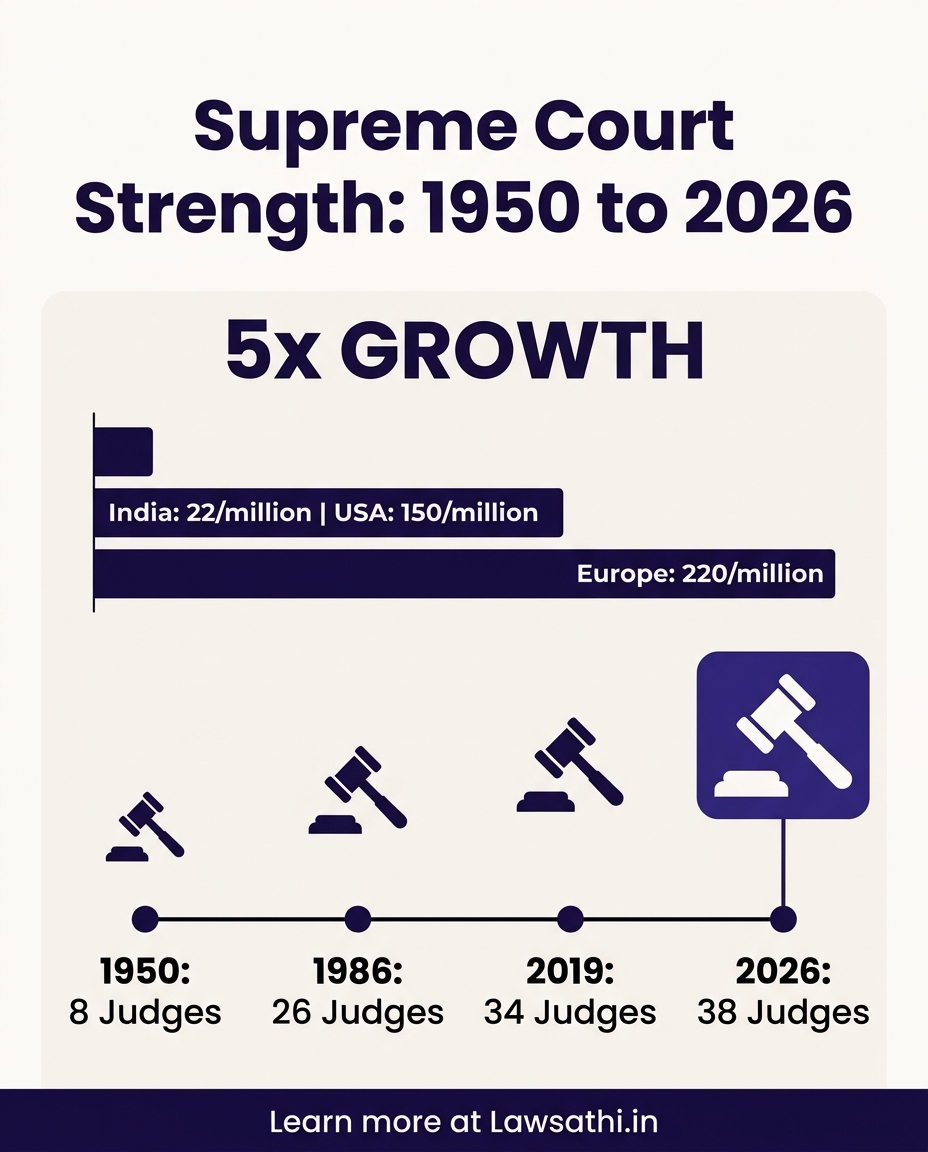
The Supreme Court of India sanctioned strength has evolved significantly since independence. In 1950, the Constitutional limit stood at just 8 judges including the Chief Justice [^4]. Today, that number has grown nearly five-fold to 38. This growth reflects both population increase and rising litigation.
Historical Evolution of Judge Strength
| Year | Total Judges (with CJI) | |——|————————| | 1950 | 8 | | 1960 | 14 | | 1977 | 18 | | 1986 | 26 | | 2008 | 31 | | 2019 | 34 | | 2026 | 38 |
Each increase responded to mounting judicial workload. However, critics argue these expansions have never kept pace with the exponential growth in litigation.
The Judge-to-Population Ratio Problem
India’s judge-to-population ratio remains concerning. Currently, India has approximately 16-22 judges per million population [^5]. In contrast, the Law Commission’s 120th Report (1987) recommended 50 judges per million. Comparatively, the United States has around 150 judges per million. Meanwhile, European nations average 220 per million [^6].
Therefore, even with this expansion, India falls short of international standards. The gap highlights the need for more comprehensive judicial reforms beyond numerical increases.
Current Vacancy Landscape
As of April 1, 2026, the Supreme Court’s working strength stands at 33 judges [^3]. The High Courts face an even grimmer picture. Specifically, they have 321 vacancies against a sanctioned strength of 1,122 [^7]. Consequently, the bottleneck in judicial appointments affects the entire justice delivery chain.
Who Are the New Appointees? Profiles and Backgrounds
It is crucial to clarify an important point. The Cabinet has approved the increase in sanctioned strength, not specific appointments [^1]. The actual names of new judges will emerge through the Collegium process. This occurs after Parliament enacts the legislation.
The Collegium’s Role in Selection
The Chief Justice of India and the Collegium will recommend candidates once the Bill becomes law. Typically, new Supreme Court judges are elevated from High Court Chief Justices. Alternatively, they come from senior High Court judges. Therefore, the selection process considers multiple factors.
Criteria for Selection
The Collegium evaluates candidates based on seniority, merit, and regional representation. Additionally, diversity considerations increasingly influence recommendations. For example, gender balance has become an important factor. However, the final selection remains confidential until official announcements.
What to Expect
Legal observers anticipate the Collegium will prioritize Chief Justices from major High Courts. Furthermore, candidates with specialized expertise may receive preference. This includes constitutional law, commercial disputes, or criminal jurisprudence. The legal fraternity eagerly awaits formal recommendations.
The Appointment Process: From Collegium to Cabinet
Understanding the Supreme Court collegium recommendations process helps practitioners appreciate the timeline ahead. The appointment mechanism involves multiple stages. These range from initiation to final appointment.
Step-by-Step Appointment Procedure
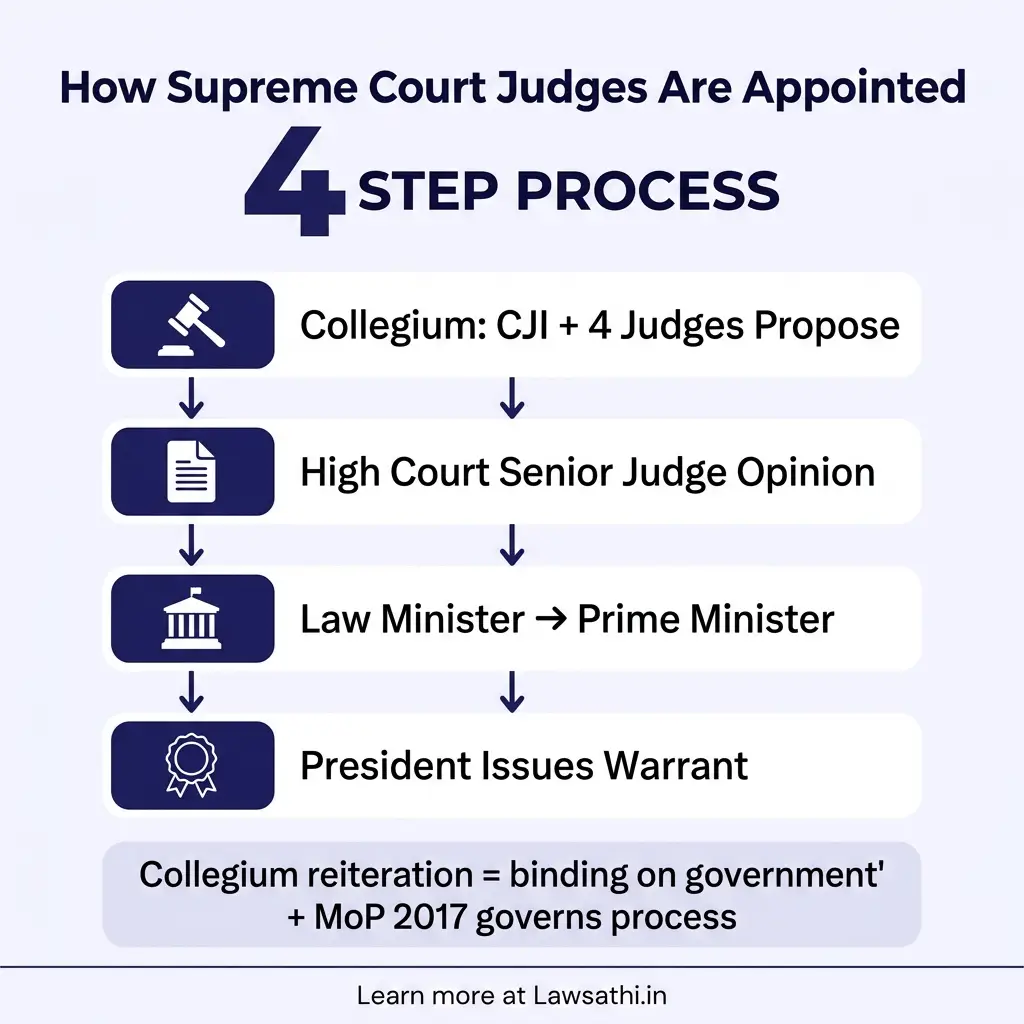
First, the Chief Justice of India initiates the proposal when a vacancy is expected [^8]. The CJI consults the four seniormost puisne judges of the Supreme Court. Together, they form the Collegium’s view.
Second, the Collegium seeks written opinions from another key figure. Specifically, they consult the seniormost Supreme Court judge from the candidate’s parent High Court. These views must be documented and transmitted formally.
Third, the recommendation moves to the government. The Union Minister of Law, Justice & Corporate Affairs presents it to the Prime Minister [^9].
Finally, the Prime Minister advises the President, who issues the appointment warrant.
The Memorandum of Procedure
The Memorandum of Procedure (MoP) governs this entire process. Finalized in March 2017, it followed a 17-month standoff between the Centre and Judiciary. Notably, it includes “national security” as an eligibility criterion [^10]. Additionally, secretariats established in the Supreme Court maintain candidate databases. Each High Court also maintains its own database.
Executive-Judiciary Dynamics
The government can return recommendations for reconsideration. However, if the Collegium reiterates the name, the government is bound to appoint [^11]. This safeguard preserves judicial independence in appointments.
In recent years, delays between Collegium recommendations and government clearance have sparked debates. Therefore, practitioners should monitor developments closely.
Impact on Case Pendency and Judicial Administration
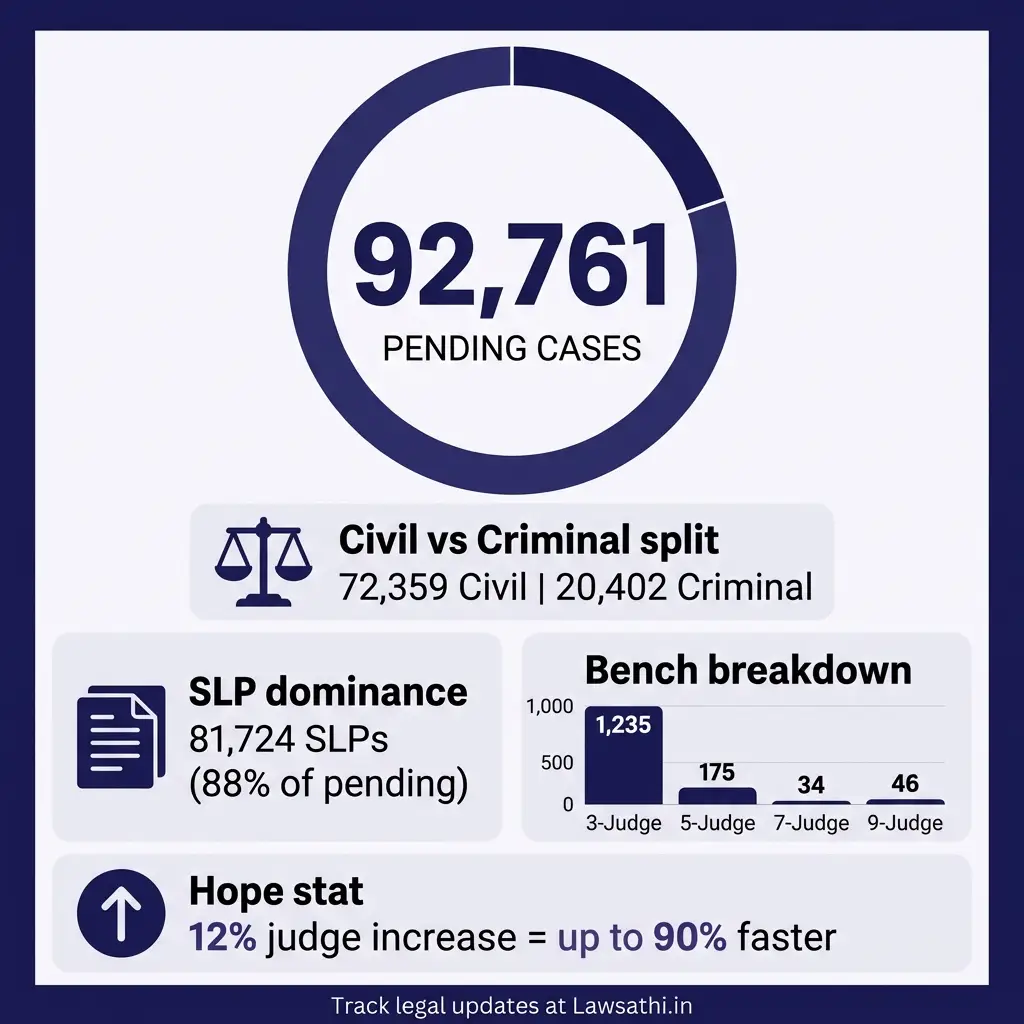
The pendency of cases in Supreme Court has reached alarming proportions. As of April 2026, 92,761 cases await adjudication [^12]. This backlog includes 72,359 civil matters and 20,402 criminal cases.
Breaking Down the Numbers
The coram-wise pendency reveals deeper challenges:
| Bench Type | Pending Cases | |———–|—————| | 3-Judge Bench | 1,235 | | 5-Judge Bench | 175 | | 7-Judge Bench | 34 | | 9-Judge Bench | 46 |
Constitutional matters requiring larger benches face the longest delays. Therefore, additional judges could accelerate the constitution of these critical benches.
Special Leave Petitions: The Core Challenge
Article 136 Special Leave Petitions constitute the majority of filings. Approximately 81,724 SLPs crowd the docket [^12]. This figure includes 23,307 civil SLPs and 5,852 criminal SLPs pending. Consequently, this flood of petitions overwhelms the Court’s capacity.
Quantifying the Potential Impact
Studies suggest a 7% increase in bench strength could reduce average delays by up to 90% [^13]. The current expansion represents approximately a 12% increase in sanctioned strength. Therefore, practitioners can reasonably expect meaningful improvements in case disposal rates.
Specialized Benches: A Possibility
Additional judges enable the Chief Justice of India to experiment with specialized benches. For instance, dedicated benches for commercial disputes could emerge. Similarly, environmental matters or tax cases might receive specialized attention. Such specialization could improve both efficiency and judgment quality.
What This Means for Legal Practitioners and Law Firms
The Indian judiciary news regarding this expansion carries significant implications for practicing lawyers. Strategic adaptations may be necessary to leverage the changed circumstances.
Roster Management and Case Listing
More judges mean more courts functioning simultaneously. In March 2026, the Supreme Court announced an important initiative. Specifically, they plan to deploy AI for case listing and bench allocation [^14]. Therefore, increased strength combined with technology could transform courtroom dynamics.
Practitioners should anticipate several changes:
– Faster case listings, especially for final hearings – Reduced adjournments due to judge unavailability – More predictable listing schedules
Opportunities for Younger Advocates
An expanded Bench creates new opportunities for junior counsel. Additional courts require more arguing counsel. Consequently, young advocates may find more opportunities to present matters independently.
Furthermore, the designation of new judges often brings fresh perspectives to the Bench. Younger judges may be more receptive to innovative arguments from junior practitioners.
Strategic Considerations for Law Firms
Law firms should reassess their Supreme Court practice strategies. Key considerations include:
First, firms must monitor roster allocations closely. New judges will receive specific subject assignments based on expertise.
Second, briefing patterns may shift. Firms should identify which new judges specialize in their practice areas.
Third, case management systems must adapt to potentially accelerated timelines.
Technology Integration: The Bigger Picture
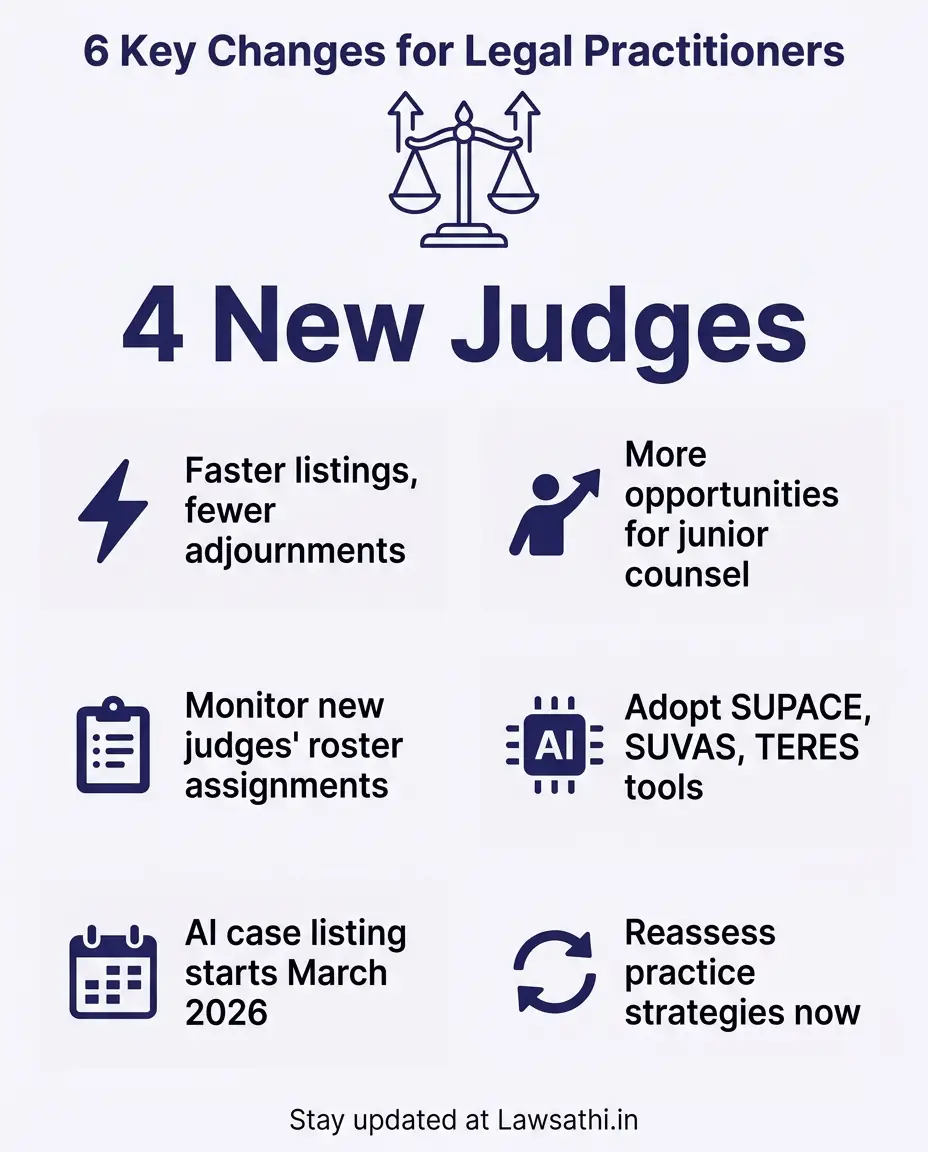
The Supreme Court is actively integrating AI tools. SUPACE assists with legal research and case summarization [^15]. SUVAS provides AI-powered translation services. Additionally, TERES offers real-time transcription of proceedings.
Therefore, practitioners must embrace technology alongside procedural changes. Firms using modern case management platforms will adapt more quickly to the evolving landscape.
Conclusion: A Step Towards Judicial Reform
The Supreme Court judges appointment 2026 initiative represents meaningful progress. However, numerical expansion alone cannot solve systemic challenges. The judiciary needs comprehensive reforms. These must address infrastructure, technology, and procedural efficiency.
What Still Needs to Change
The government remains party to approximately 50% of 54 million pending cases [^16]. This statistic reveals a fundamental problem. Administrative reforms in government litigation policy could dramatically reduce court burdens.
Additionally, India spends only 0.08% of GDP on courts [^17]. The Ministry of Law & Justice received just ₹4,509 crore in the 2026 budget. Without adequate funding, even additional judges cannot function optimally.
The Road Ahead
The Law Commission’s target of 50 judges per million remains distant. Even with 38 Supreme Court judges, India’s judicial infrastructure lags behind global standards. Therefore, this expansion should mark the beginning of reform efforts, not the end.
Furthermore, technological adoption must accelerate. The e-Courts Phase III project promises transformative changes with its ₹7,210 crore outlay [^15]. AI, machine learning, and blockchain integration could revolutionize case management.
A Call for Holistic Reform
Additional judges provide necessary capacity. However, sustainable improvement requires multiple interventions:
– Faster High Court appointments to reduce pipeline congestion – Government litigation policy reform – Technology adoption across all court levels – Adequate funding for judicial infrastructure
Stay ahead of critical court updates and manage your practice efficiently. Try LawSathi’s AI-powered case management platform for free today.
References: [^1]: Cabinet approves increase in the Judge strength of the Supreme Court of India [^2]: Union Cabinet Approves Increase in Supreme Court Judge Strength [^3]: Sanctioned strength, working strength, vacancies as on 01.04.2026 [^4]: Union Cabinet approves decision to increase strength of Supreme Court from 34 to 38 judges [^5]: What Is India’s Judges to Population Ratio? [^6]: Strengthening Justice Delivery System – Justice R.V. Raveendran [^7]: Press Information Bureau – Judge to Population Ratio [^8]: Memorandum of Procedure – Department of Justice [^9]: Supreme Court publishes entire process of judges’ appointment [^10]: SC Collegium Finalises MoP; Agreement On Secretariat Too [^11]: Judges Appointment – Existing MoP Is Final [^12]: Supreme Court April 2026: Key Judgments and Stories [^13]: Uncluttering the Supreme Court: Institutional Remedies [^14]: Supreme Court to deploy AI for case listing [^15]: From Backlogs to Breakthroughs: AI in India’s Judiciary [^16]: The illusion of judicial inefficiency [^17]: Press Information Bureau – AI in Judiciary