Is a missing notice truly a death knell for your arbitration case? For many years, Indian lawyers viewed the Section 21 Arbitration and Conciliation Act notice as an unbreakable requirement.
However, recent judicial shifts are changing the landscape for practitioners across India. These changes offer new hope for cases with minor procedural flaws.
Introduction: The Long-Standing Debate over Section 21
The Section 21 Arbitration and Conciliation Act serves as the starting gun for legal battles. Specifically, it states that arbitral proceedings begin when the respondent receives a request for arbitration.
Traditionally, courts viewed this notice as a strict prerequisite. Most practitioners believed that skipping this step would end their legal journey immediately.
The Evolution of the Traditional View
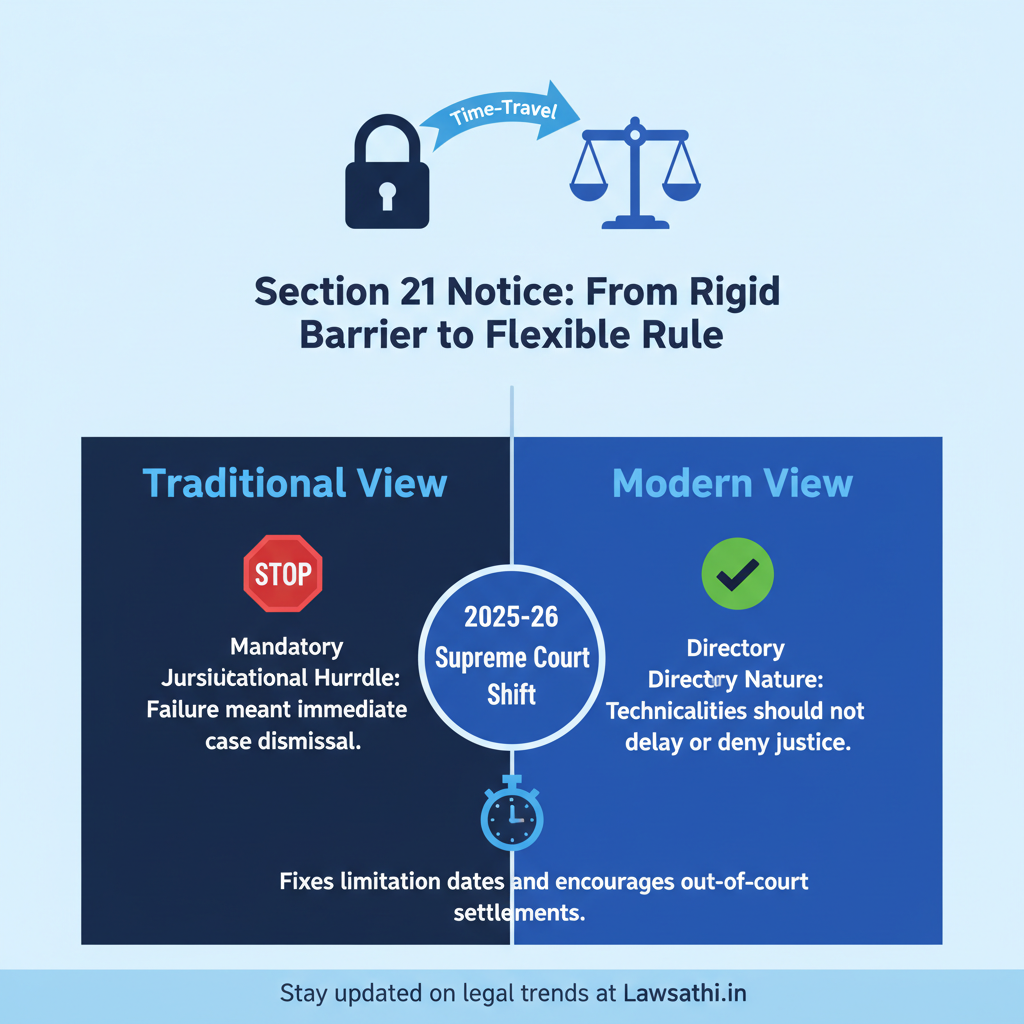
High Courts in Delhi and Bombay historically treated this notice as mandatory. For example, if you filed a Section 11 application without it, the court would likely dismiss your plea.
In fact, many saw it as a jurisdictional hurdle. Therefore, a failure to serve notice often resulted in a complete loss of the claim.
Seeking Efficiency in Modern Law
The primary purpose of the notice is to fix the date of commencement. This date is vital for calculating limitation periods under Indian law.
Furthermore, the notice allows parties to settle or agree on an arbitrator without court help. As a result, it encourages parties to resolve disputes outside the courtroom whenever possible.
Recent Supreme Court Clarifications
However, the legal landscape shifted in early 2026. The Supreme Court recently clarified the “fatal” nature of procedural irregularities.
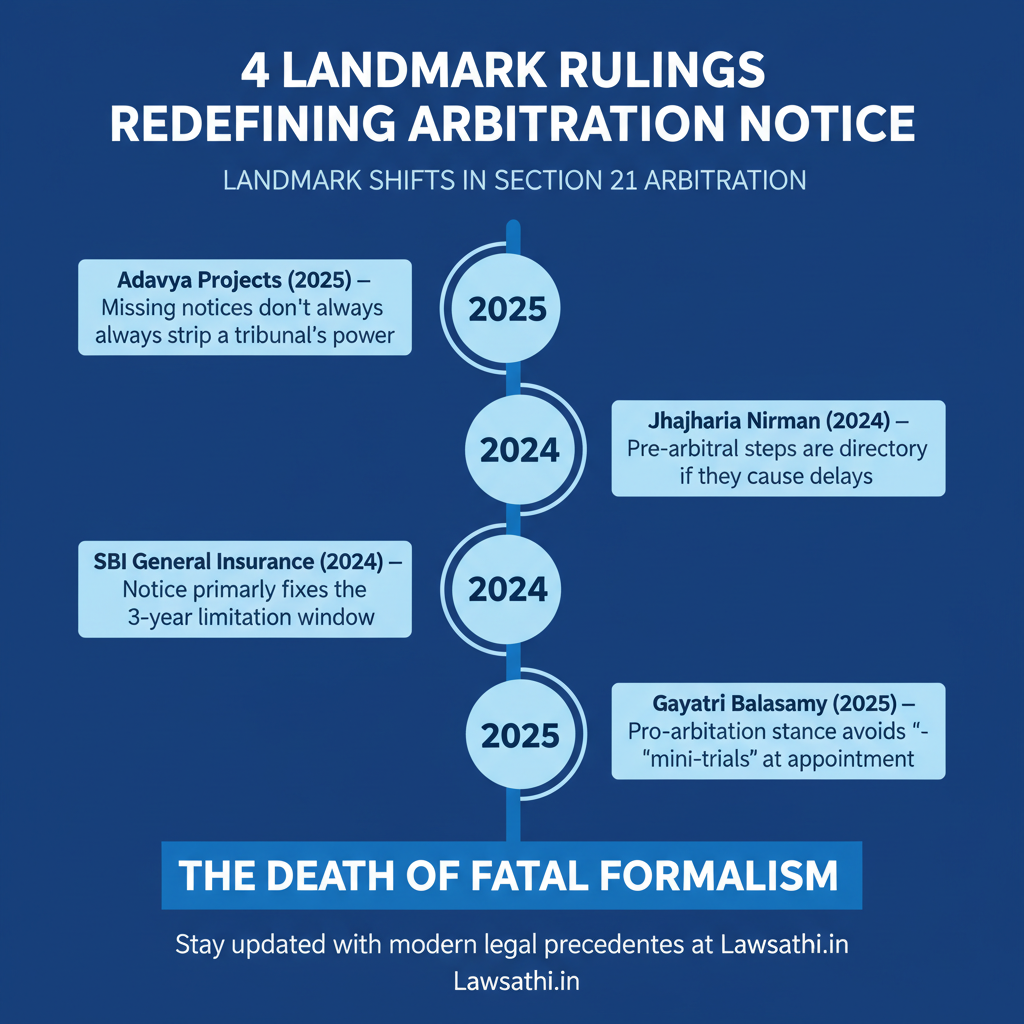
Specifically, in Adavya Projects Pvt Ltd. v. Vishal Structurals Pvt Ltd (2025), the court showed new flexibility. It suggested that missing notices for every single party might not strip a tribunal of its power.
The Core Legal Question: Mandatory vs. Directory
The debate now centers on whether the Section 21 Arbitration and Conciliation Act notice is mandatory or directory. A mandatory rule must be followed strictly.
In contrast, a directory rule allows for some procedural leeway. This applies if the core intent of the law is still met. Consequently, this distinction changes how lawyers approach their initial filings.
Analyzing the Court’s Shift
The Supreme Court is moving away from a rigid “mandatory” approach. Therefore, judges now distinguish between the act of invoking arbitration and the technical service of notice.
In other words, the court wants to see the intent to arbitrate. This shift prevents parties from using technicalities to delay justice. Moreover, it ensures that cases move forward on their merits.
Breaking Down the Directory Approach
When a rule is directory, the court looks at the bigger picture. If the respondent already knew about the dispute, the court might overlook a missing notice.
For example, if a dispute requires urgent relief, courts prioritize substance over form. Consequently, a directory approach keeps the arbitration process moving forward. This approach avoids unnecessary setbacks in the legal pipeline.
Substantive Rights Over Procedural Technicalities
In Jhajharia Nirman Ltd. v. South Western Railways (2024), the Delhi High Court highlighted this.
It held that pre-arbitral steps are directory if they lead to unnecessary delays. This ensures that technical errors do not destroy substantive legal rights. Most importantly, it protects the claimant from losing their right to seek justice.
Key Takeaways from the Supreme Court’s Clarification
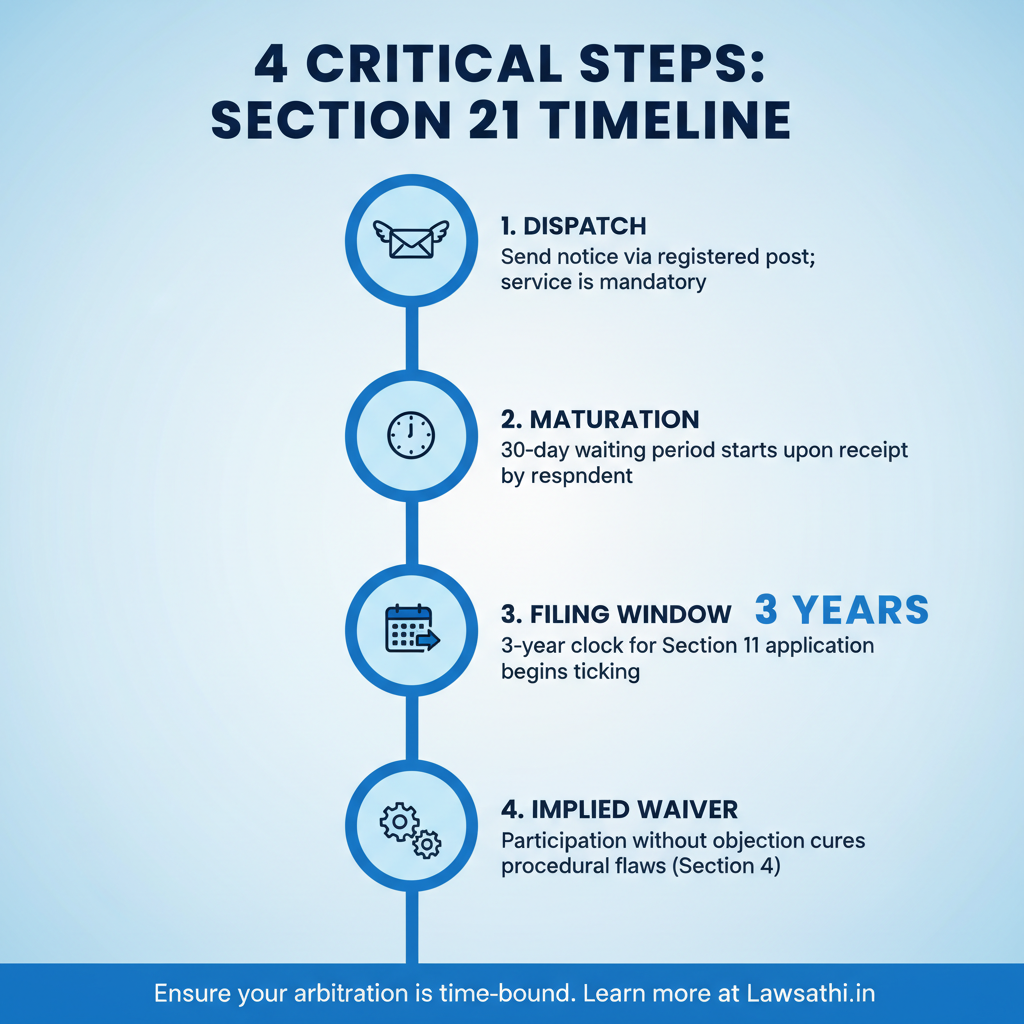
A major takeaway from the 2026 rulings is the concept of “implied waiver.” If a party participates in proceedings without objecting to the lack of notice, they cannot complain later.
Specifically, they essentially waive their right to object under Section 4 of the Act. As a result, silent participation acts as a legal consent to the proceedings.
Section 21 and the Limitation Act
The Section 21 Arbitration and Conciliation Act notice remains critical for the Limitation Act. The three-year window for a Section 11 petition only starts after the notice matures.
Specifically, the clock ticks 30 days after the respondent receives the notice. Therefore, the notice date acts as a legal anchor for the entire litigation timeline.
Impact on Section 11 Applications
Courts still check for notice during Section 11 applications for appointing arbitrators. However, in SBI General Insurance Co. Ltd. v. Krish Spinning (2024), the court emphasized using notice to fix the limitation.
Consequently, a missing notice might not stop the case, but it complicates the timeline. To avoid this, lawyers must track their service dates with extreme precision.
Reinitiating Proceedings Correctly
If an award is set aside for procedural flaws, you must act carefully. In such cases, you must send a fresh Section 21 notice to restart the process.
As noted in Amit Guglani v. L&T Housing Finance, it is as if the initial proceedings never occurred. Furthermore, this restart requires a completely new notification to all involved parties.

Practical Implications for Indian Trial Lawyers and Law Firms
Despite the shift toward a “directory” view, you should always send a formal notice. It remains the safest drafting strategy for any Indian lawyer.
In fact, proving receipt is still a high bar in many courts. Therefore, skipping this step creates an unnecessary risk for your client’s case.
Why Proof of Receipt Matters
In Indian Spinal Injuries Centre v. M/S Galaxy India (2024), the court made a vital point. It ruled that merely sending a notice is not enough.
You must prove the respondent actually received it. Therefore, using registered post with acknowledgment is non-negotiable. Additionally, digital proofs like email-read receipts can serve as secondary evidence.
Defensive Strategies for Respondents
If you represent a respondent, analyze the notice date immediately. You may find that the Section 11 petition was filed too early.
On the other hand, the claimant might have waited more than three years. In both scenarios, the client has a powerful limitation defense. Specifically, a bad notice can lead to the total dismissal of the claim.
Reducing Modern Litigation Delays
The Judiciary wants to avoid “mini-trials” at the appointment stage. In Gayatri Balasamy v. ISG Novasoft Technologies Ltd (2025), the 5-judge bench urged a pro-arbitration stance.
Therefore, lawyers should focus on the existence of the arbitration agreement. Minor procedural slips should not derail the entire process. Above all, the goal is to reach a resolution on the merits.
How LawSathi and Legal Tech Streamline Arbitration Compliance
Managing these timelines manually is risky for busy law firms. Modern practitioners now use LawSathi for arbitration lawyers to ensure total compliance.
Technology bridges the gap between procedural rules and daily practice. Specifically, it reduces the human error that leads to missed deadlines.
Tracking Critical Limitation Periods
Software allows firms to set automated alerts for the 30-day response window. Additionally, you can track the 3-year limitation period for Section 11 filings.
This prevents the nightmare of a time-barred claim. As a result, firms can focus on legal strategy instead of administrative monitoring.
Automating Section 21 Notice Templates
Standardizing your notices ensures that you include all relevant claims. This is important because parties often try to arbitrate “dead claims” not listed in the original notice.
Automated templates help maintain consistency across all files. Moreover, they ensure that every statutory requirement is met with every single click.
Centralizing Vital Case Documents
Proving service requires organized records of tracking IDs and email logs. LawSathi centralizes digital “Proof of Delivery” for every case.
Consequently, you can instantly provide evidence of receipt if a party tries to deny they were notified. In short, this organization makes you bulletproof during court hearings.
Conclusion: A Pro-Arbitration Stance by the Judiciary
The 2026 legal landscape favors efficiency over rigid technicality. While the Section 21 Arbitration and Conciliation Act notice is no longer always “fatal,” it remains a vital procedural pillar.
The focus is shifting toward the core intent of the arbitration agreement. Furthermore, this change reflects a broader movement toward modernizing Indian law.
In summary, the Supreme Court wants to streamline the ADR process in India. By reducing the weight of technical objections, they are making India a global hub for arbitration.
For lawyers, this means focusing on the merits while using technology to handle the procedural hurdles. Above all, staying informed and prepared is the key to success.
Ensure your arbitration filings are never late. Use LawSathi’s AI-powered deadline tracking and document automation to stay ahead of Section 21 requirements. Book a demo today!