
A recent judicial intervention has significant implications for urban governance and environmental preservation in Uttar Pradesh. The Allahabad High Court UP Parks Act ruling marks a crucial development in public park litigation India. Therefore, this decision deserves close examination by legal practitioners and municipal authorities alike.
The Court has directed the State Government to bring all parks under the statutory framework of the UP Parks Act. Specifically, this applies to the Parks, Playgrounds and Open Spaces (Preservation and Regulation) Act, 1975. This decision came in response to a Public Interest Litigation raising concerns about arbitrary exclusion of certain parks from legal protection. The ruling specifically addresses commercial activities in Janeshwar Mishra Park, Lucknow. Furthermore, it sets an important precedent for environmental law India.
Introduction: The Judicial Intervention in Urban Park Management
The PIL That Triggered Judicial Action
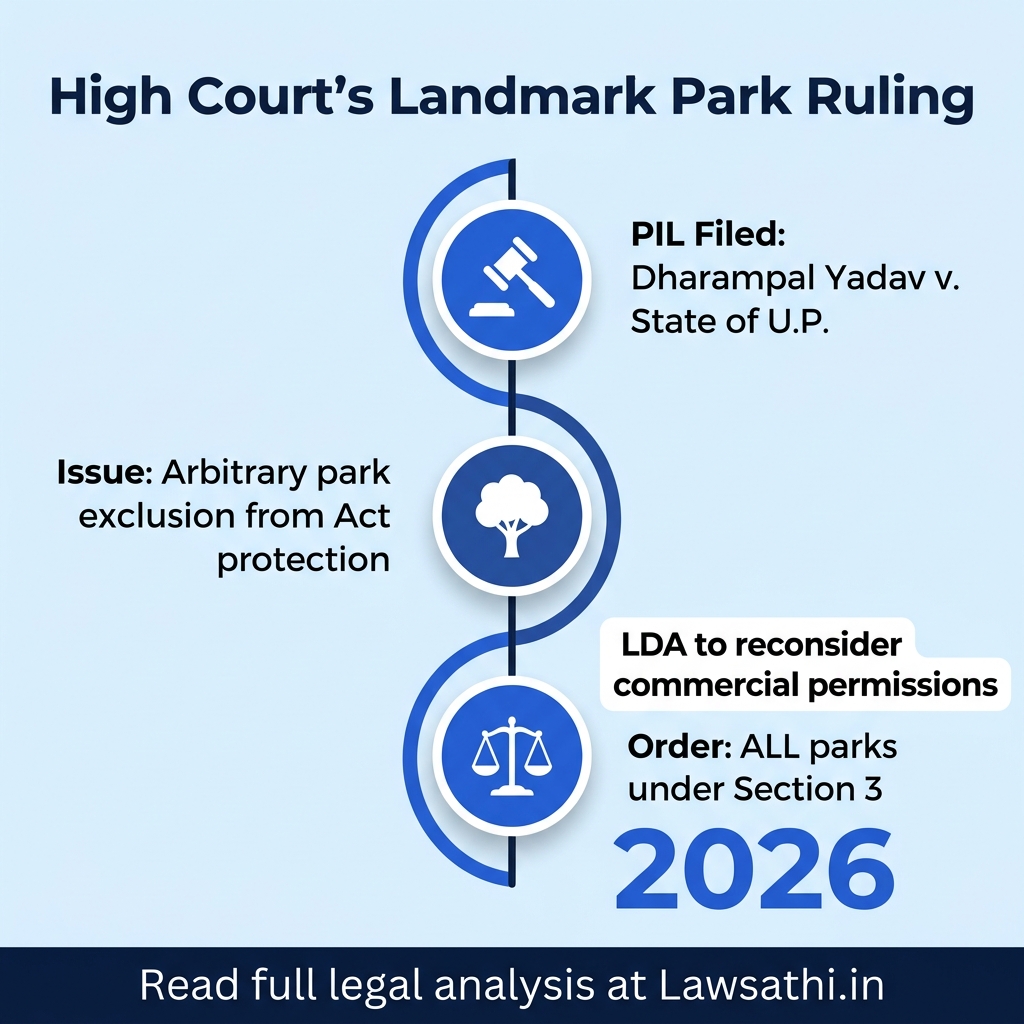
Specifically, the case originated from a writ petition filed before the Allahabad High Court. In Dharampal Yadav v. State of U.P., 2026 SCC OnLine All 570, the petitioner raised fundamental questions about park governance. The petition questioned why certain parks remained excluded from the statutory protection of the UP Parks Act. Additionally, it highlighted unauthorized commercial activities operating within public green spaces.
Summary of the Court’s Directive
Consequently, the Allahabad High Court delivered a comprehensive ruling in March 2026. It directed that all parks, playgrounds, and open spaces in Uttar Pradesh must be included under Section 3 of the UP Parks Act. Furthermore, the Court instructed the Lucknow Development Authority to reconsider permissions for commercial establishments within Janeshwar Mishra Park. This ruling reinforces the legal framework for preserving public green spaces across the state.
Significance for Municipal Governance
Importantly, this judgment carries profound implications for environmental governance in Uttar Pradesh. It addresses the arbitrary exclusion of certain parks from statutory protection mechanisms. Moreover, it strengthens accountability for municipal authorities managing public spaces. The ruling also establishes clearer boundaries for permissible activities within public parks.
Background of the Case: Context and Petitioner Arguments
Understanding the UP Parks Act, 1975
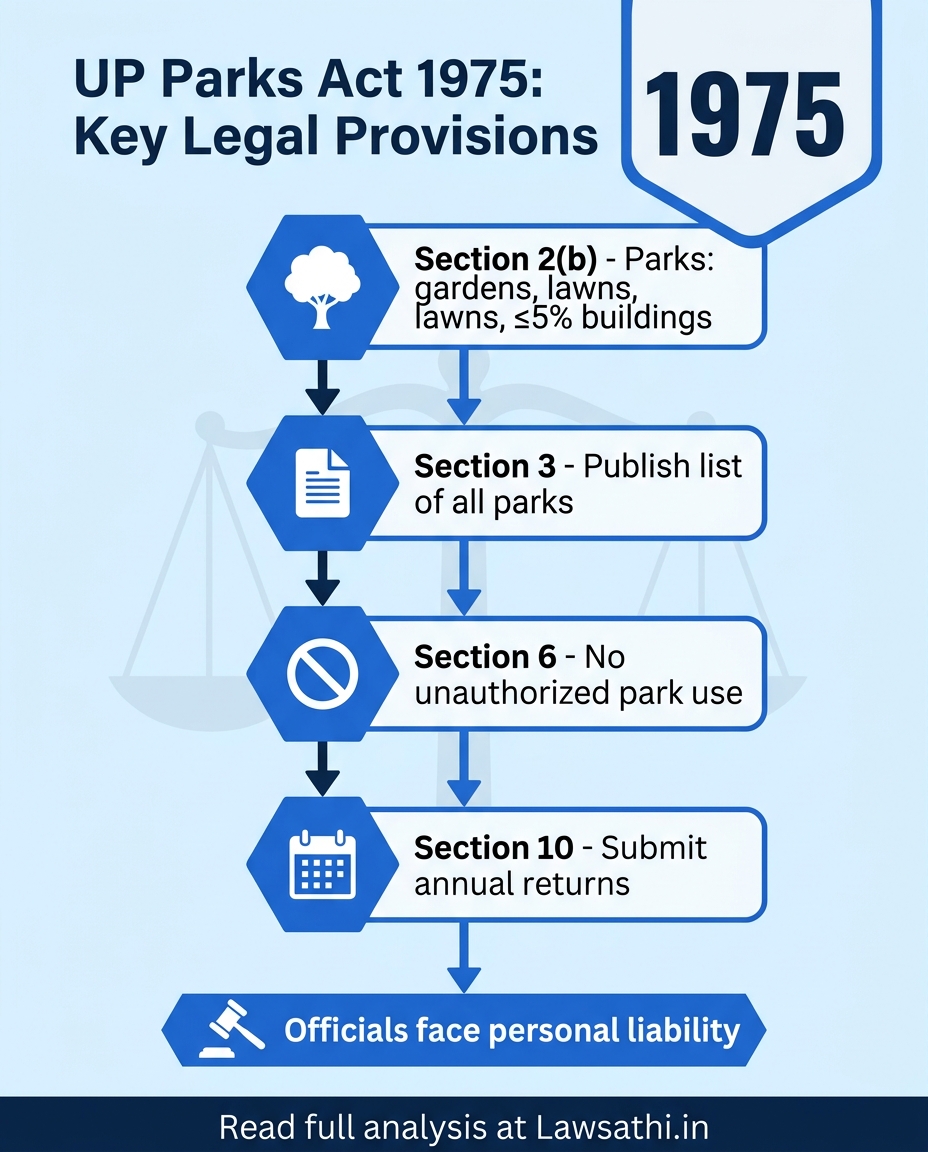
The Uttar Pradesh Parks, Playgrounds and Open Spaces (Preservation and Regulation) Act was enacted in 1975. This legislation provides comprehensive protection for public green spaces across the state. According to UP Act No. 55 of 1975, the Act defines “park” broadly under Section 2(b).
A park includes any land maintained as a garden, lawn, or meadow for public recreation. The definition specifically covers spaces where not more than one-twentieth part is covered with buildings. Additionally, Section 3 mandates the preparation and publication of lists containing all parks, playgrounds, and open spaces. Furthermore, Section 6 prohibits using parks for purposes other than those designated without prior sanction.
The Petitioner’s Core Arguments
The petitioner highlighted several critical concerns before the Court. First, they pointed out the arbitrary exclusion of certain parks from the Act’s purview. Second, they emphasized unauthorized commercial activities encroaching upon public green spaces. Furthermore, the petition raised concerns about parks being used for marriage functions, political meetings, and commercial establishments.
These practices directly contravened the legislative intent behind the UP Parks Act. Therefore, the petitioner argued that selective application of the law violated constitutional principles of equality. Additionally, such arbitrary exclusion undermined environmental protection objectives.
Precedent from the Gomti Nagar Case
Importantly, this was not the first time the Allahabad High Court addressed park commercialization. In Gomti Nagar Jan Kalyan Maha Samiti v. Lucknow Development Authority, decided on May 24, 2017, the Court had already established important principles.
The Court held that parks, stadiums, and open places cannot be used for purposes other than those for which they were created. The 2017 judgment explicitly prohibited parks from being used for commercial, political, or private functions. Moreover, it warned that officials allowing such violations would face personal criminal and civil liability. As a result, this earlier precedent strengthened the petitioner’s arguments in the current case.
The Allahabad High Court’s Observations and Directives
Interpreting the Definition of “Park”
To begin, the Court analyzed the statutory definition of “park” under the 1975 Act. It emphasized that the definition is intentionally broad and inclusive. Any land maintained for public recreation, air, or light falls within this category. Therefore, the arbitrary exclusion of certain parks violated the legislative intent.
The Court found no justification for treating similar parks differently under the law. Such selective application undermined the uniform protection Parliament intended for all public green spaces. Consequently, the Court directed comprehensive inclusion of all parks under the statutory framework.
Notification Requirements Under Section 3
Specifically, the Allahabad High Court UP Parks Act ruling addresses Section 3 compliance. The State Government must issue notifications bringing all parks under the Act’s ambit. This includes preparation of comprehensive lists with plans and maps for each park.
Additionally, the publication must follow prescribed timeframes and procedures. The public must have inspection facilities at designated locations. Furthermore, authorities must consider objections from interested persons regarding the notifications.
Applying the Public Trust Doctrine
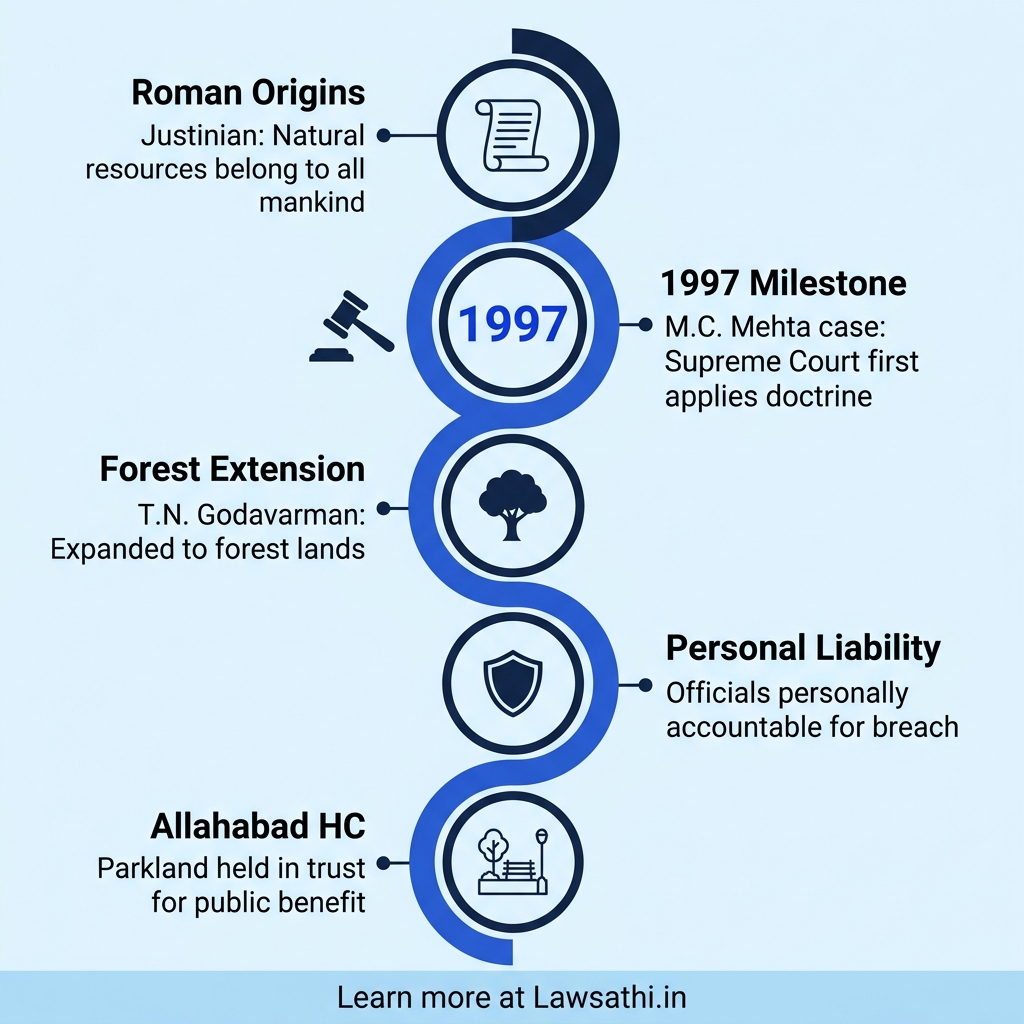
Moreover, the Court’s analysis draws upon the well-established Public Trust Doctrine in Indian jurisprudence. This doctrine holds that natural resources are held in trust by the government for public use. As noted in analysis of India’s Public Trust Doctrine, this principle prevents appropriation of public resources for private commercial interests.
The Supreme Court first applied this doctrine in M.C. Mehta v. Kamal Nath (1997). The Court quashed a lease granted to Span Motels encroaching upon River Beas. Similarly, the Allahabad High Court recognized that parkland cannot be diverted for commercial purposes. In other words, the government holds these spaces in trust for public benefit and recreation.
Focus on Janeshwar Mishra Park: Reconsideration of Commercial Use
About Janeshwar Mishra Park
For context, Janeshwar Mishra Park is located in Gomti Nagar, Lucknow. According to official government information, it spans approximately 376 acres. This makes it one of the largest parks in Asia. The park was named after the late politician Janeshwar Mishra. Furthermore, it was developed by the Lucknow Development Authority.
Commercial Activities Under Scrutiny
Specifically, the PIL highlighted commercial establishments operating within Janeshwar Mishra Park. Restaurants and commercial shops were found operating within the park premises. These establishments charged commercial rates for services within a public green space. Therefore, the petitioner argued such commercialization violated the park’s designated purpose.
Consequently, the Court instructed the administration to reconsider and review all such permissions. The Lucknow Development Authority must evaluate whether these activities align with the park’s intended use. As a result, this directive has significant implications for similar commercial operations in other parks statewide.
Distinguishing Public Facilities from Commercial Activities
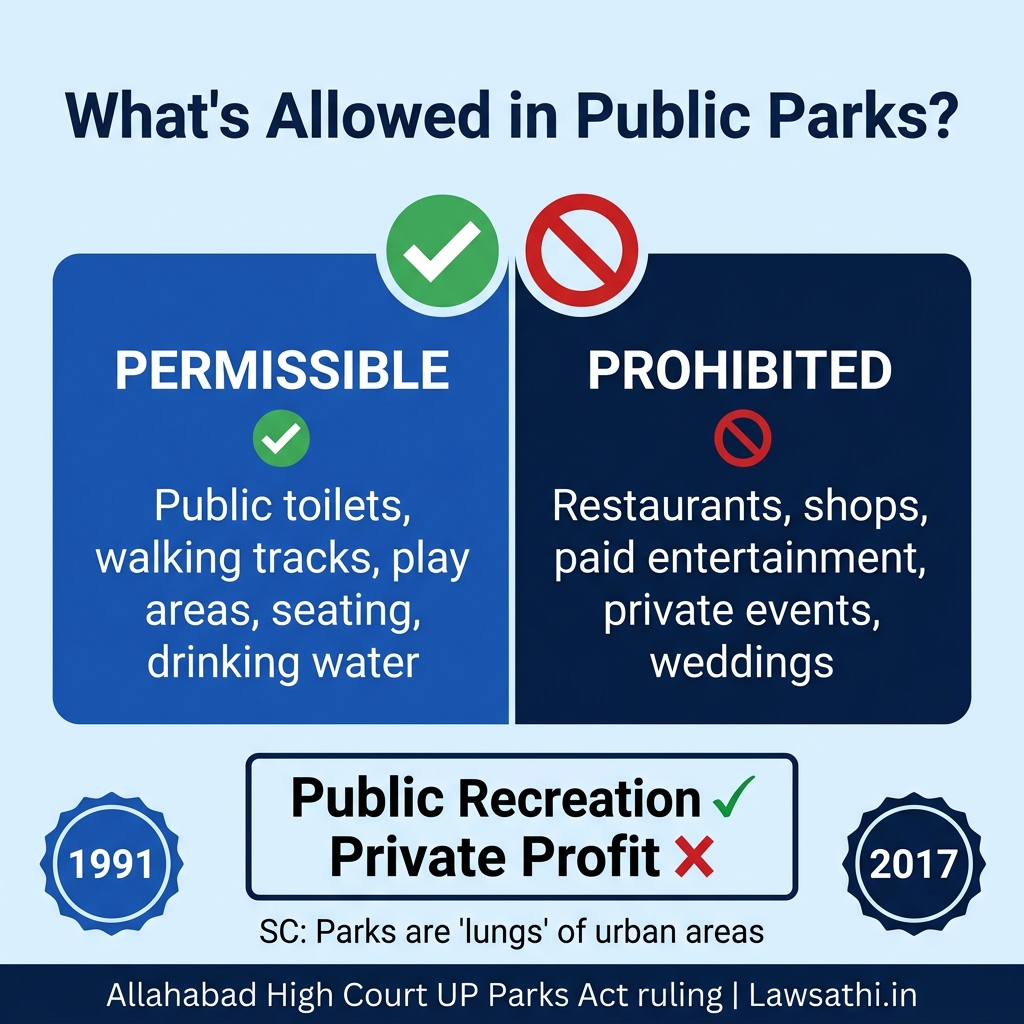
The legal framework recognizes a crucial distinction between permissible and prohibited activities. Public facilities that serve park visitors are generally allowed. These include public toilets, drinking water facilities, walking tracks, and children’s play areas. Seating arrangements and basic amenities fall within this permissible category.
However, commercial activities are distinct and often prohibited. These include restaurants charging commercial rates, merchandise shops, and paid entertainment facilities. Private events and wedding functions also constitute prohibited commercial use. In other words, the distinction lies in whether the activity serves public recreation or generates private profit.
Supreme Court Guidance from Bangalore Medical Trust
For guidance, the Supreme Court provided authoritative precedent in Bangalore Medical Trust v. B.S. Muddappa. The 1991 judgment established that open spaces for public parks are essential features of modern planning. The Court eloquently stated that parks serve as “lungs” for urban areas.
Once land is dedicated as a public park, it cannot be converted to any other purpose. The State Government cannot alter development plans to deprive the public of parkland. This principle applies even when the proposed alternative use serves civic amenities like hospitals. Therefore, the Allahabad High Court’s ruling aligns with this established precedent.
Implications for the UP Parks (Regulation and Management) Act
Strengthening Statutory Implementation
Importantly, this judgment significantly strengthens the implementation of the UP Parks Act. The Court’s directive ensures comprehensive coverage of all parks under the statutory framework. No park can now claim exemption from the Act’s protective provisions.
Furthermore, the ruling establishes clear accountability mechanisms. Authorities must complete notification procedures within specified timelines. Consequently, failure to comply exposes officials to potential legal consequences.
Procedural Changes Required
Specifically, the judgment mandates several procedural changes for park management. First, the State must issue Section 3 notifications for all parks systematically. Second, park management committees must be constituted according to rules. Third, annual returns under Section 10 must be submitted regularly.
These requirements create a comprehensive compliance framework. Therefore, municipal authorities across Uttar Pradesh must align their practices accordingly. Non-compliance risks contempt proceedings and personal liability for officials.
Impact on Land-Use Planning and Master Plans
Furthermore, the ruling affects broader land-use planning under the UP Urban Planning and Development Act, 1973. Master plans must now align with Parks Act requirements more carefully. Development authorities cannot arbitrarily exclude parks from the statutory framework.
Section 13 of Master Plan provisions reinforces this protection. The basic characteristics of development plans cannot be altered arbitrarily. Open spaces designated for parks form basic features that remain unamendable. Therefore, authorities must ensure master plans properly reflect all park areas.
Broader Legal Precedents and Environmental Jurisprudence
Evolution of the Public Trust Doctrine
Historically, the Public Trust Doctrine has evolved significantly in Indian jurisprudence. Roman Emperor Justinian first articulated the principle that air, water, and sea belong to all mankind. American jurisprudence developed this concept further in the landmark Illinois Central Railroad case.
India adopted this doctrine through judicial innovation in environmental cases. The T.N. Godavarman case extensively discussed its application to forest lands. The Supreme Court held that the doctrine binds ministers and officials personally. Consequently, breach invites personal consequences for responsible authorities.
Supreme Court Jurisprudence on Green Cover
Moreover, Indian courts have consistently protected green spaces through progressive judgments. The Bangalore Medical Trust case established that parks form essential urban infrastructure. The D.D. Vyas case described parks as “gifts of modern civilization” to citizens.
In D.D. Vyas v. Ghaziabad Development Authority, the Court emphasized constitutional duty under Article 51A(g). Authorities failing to protect green spaces violate their constitutional obligations. As a result, this creates enforceable duties rather than mere policy preferences.
The Role of PILs in Urban Planning Enforcement
Additionally, Public Interest Litigations have proven instrumental in enforcing urban planning laws. Courts recognize the locus standi of residents and civil society organizations. Citizens can challenge violations affecting public spaces and environmental quality.
The Gomti Nagar case exemplifies successful PIL intervention in park protection. The current Janeshwar Mishra Park ruling continues this judicial tradition. Therefore, PILs remain effective tools for holding authorities accountable to their statutory duties.
Practical Takeaways for Legal Practitioners
For practitioners, legal professionals handling environmental cases should note several key points. First, the statutory framework under the UP Parks Act provides strong protection mechanisms. Second, the Public Trust Doctrine is firmly established in Indian jurisprudence. Third, PILs remain viable strategies for environmental and urban planning enforcement.
Additionally, master plan provisions reinforce park protection significantly. These cannot be arbitrarily altered by development authorities. Finally, officials face personal liability for allowing violations. Consequently, this creates leverage for litigation and negotiation strategies.
Conclusion and Future Outlook
Compliance Timeline and Requirements
Consequently, the Allahabad High Court has directed immediate action from State authorities. The government must issue notifications bringing all parks under the Act without delay. The Lucknow Development Authority must specifically reconsider commercial permissions at Janeshwar Mishra Park.
Implementation requires systematic identification of all parks, playgrounds, and open spaces. Authorities must prepare comprehensive lists with proper plans and maps. Furthermore, public consultation processes must follow prescribed procedures.
Anticipated Implementation Challenges
However, several challenges may affect implementation of this ruling. Administrative inertia often delays compliance with judicial directives. Existing commercial establishments may challenge orders through legal proceedings. Resource constraints could affect proper maintenance of expanded park coverage.
Furthermore, political considerations sometimes influence land-use decisions. Authorities may face pressure to accommodate commercial interests. Therefore, continued judicial monitoring may become necessary to ensure compliance.
The Judiciary’s Evolving Role in Urban Governance
Significantly, this ruling demonstrates the judiciary’s increasing involvement in urban governance matters. Courts are filling gaps where executive action remains inadequate. The Public Trust Doctrine provides constitutional foundation for environmental protection.
Future litigation will likely address implementation monitoring and compliance verification. Disputes may arise regarding what constitutes permissible versus prohibited activities. Therefore, the legal profession must stay alert to these developing issues.
Summary of Key Points
In summary, the Allahabad High Court UP Parks Act ruling represents a significant judicial intervention. It mandates comprehensive inclusion of all parks under statutory protection. Commercial activities in public green spaces face stricter scrutiny. Furthermore, authorities bear personal accountability for violations.
For lawyers practicing environmental, municipal, or property law, this judgment offers valuable precedents. It strengthens arguments against commercialization of public spaces. Moreover, the ruling reinforces existing statutory frameworks while expanding their application.
Stay updated on critical court judgments affecting your practice. Use LawSathi’s AI-powered case management to track precedents and manage your litigation workflow effortlessly. Start your free trial today.