
Recognizing the Economic Value of Unpaid Domestic Labour
The Supreme Court has fundamentally transformed how Indian courts value homemakers in motor accident compensation claims. In a landmark judgment delivered on June 11, 2026, the Court established a standardized compensation model. This model finally recognizes the economic worth of unpaid domestic labour. This ruling marks a decisive shift from nominal awards to substantial, calculated recognition of the homemaker’s contribution.
For decades, Motor Accident Claims Tribunals (MACT) across India struggled with inconsistent approaches to valuing homemaker deaths. Some tribunals awarded merely ₹3,000 per month as notional income. Others applied minimum wage standards for unskilled workers. Consequently, this resulted in paltry compensation that barely acknowledged the deceased’s contribution. The new Supreme Court homemaker compensation framework addresses these disparities head-on.
A Paradigm Shift in Judicial Recognition
Justice Sanjay Karol, writing for the bench, declared that homemakers are “nation builders” deserving of proper economic recognition. The Court quantified a homemaker’s monthly contribution at a minimum of ₹30,000. This creates a new compensation head called “Loss of Domestic Care.” Furthermore, it serves as a stand-in for monthly income. According to LiveLaw’s analysis, this standardized baseline replaces arbitrary notional income calculations that previously plagued MACT proceedings.
The judgment cited compelling statistics on women’s unpaid caregiving work. Specifically, this work contributes 15-17% of India’s GDP. However, this work remains largely unrecognized in economic analyses and compensation frameworks. This ruling changes that trajectory significantly.
The Legal Precedent: Evolution from Earlier Cases
The trajectory of notional income jurisprudence reveals a gradual but consistent movement toward recognizing homemakers’ economic value. Understanding this evolution helps practitioners appreciate the significance of the current framework.
Historical Development of Notional Income
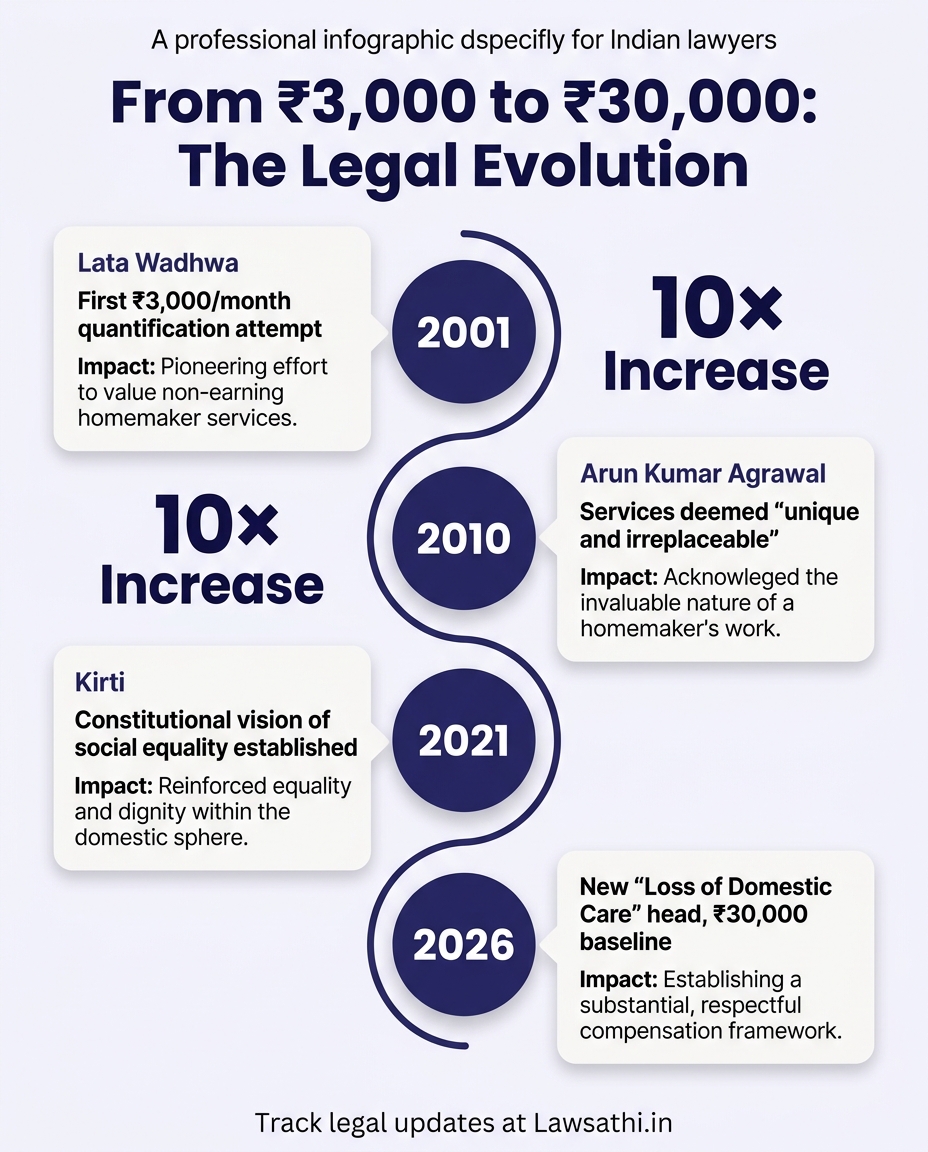
In Lata Wadhwa v. State of Bihar (2001), the Supreme Court awarded ₹3,000 per month for housewives aged 34-59. This represented the first meaningful attempt to quantify domestic contributions. However, the approach remained largely ad hoc. Additionally, the Arun Kumar Agrawal v. National Insurance Co. Ltd. (2010) judgment recognized homemakers’ services as “unique and irreplaceable.” Yet it stopped short of establishing a concrete formula.
The SCC Online analysis notes that subsequent cases like Kirti v. Oriental Insurance (2021) laid crucial groundwork. Justice N.V. Ramana and Justice Surya Kant established that fixing notional income furthers the “constitutional vision of social equality and ensuring dignity to all.” Moreover, they emphasized that courts should assess compensation neither “too conservatively, nor too liberally.”
Problems with the Earlier Approach
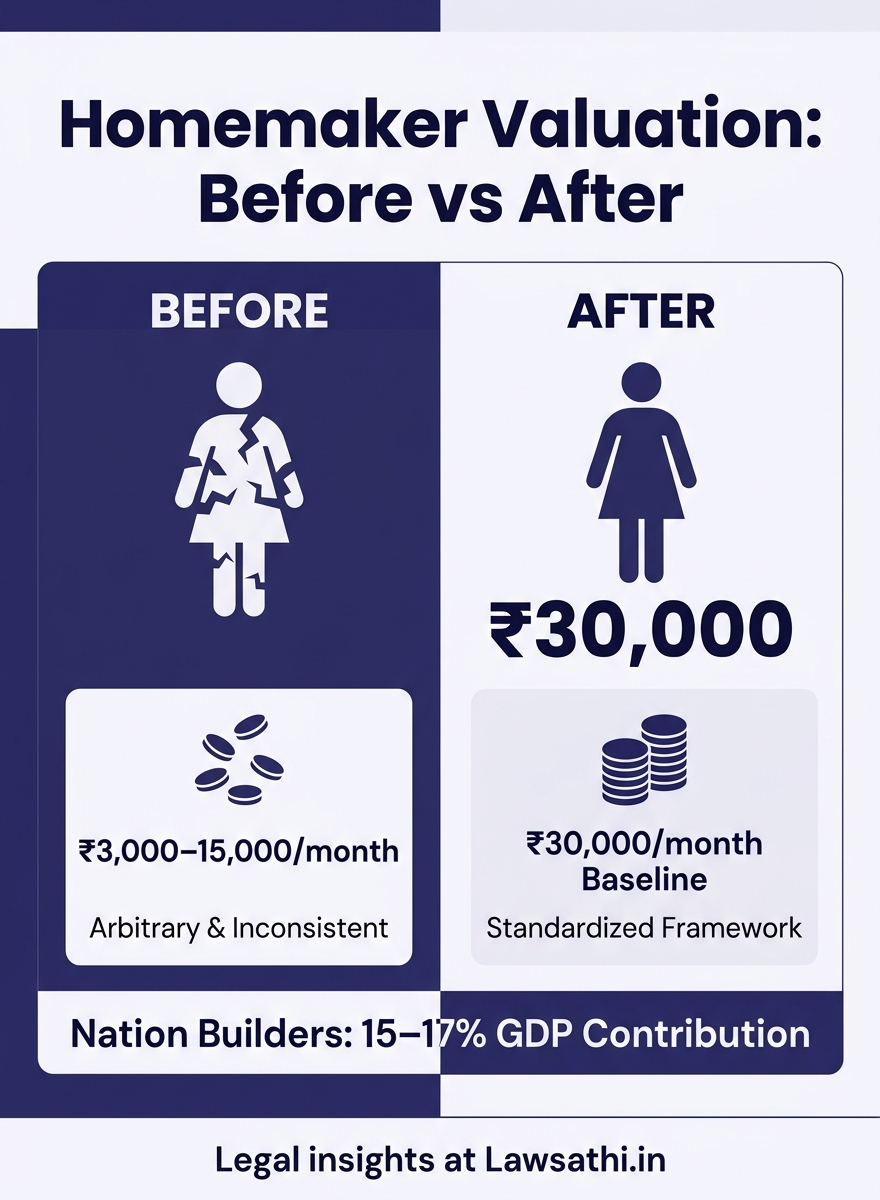
The Supreme Court homemaker compensation framework emerged from identified problems in earlier jurisprudence. Compensation based on “conservatively computed notional income” created what the Court called “inherent disadvantage.” Tribunals and High Courts across different states applied vastly different standards. For example, a homemaker in one state might receive compensation based on ₹5,000 monthly notional income. Meanwhile, another state tribunal might apply ₹15,000 for identical cases.
The Shishu Pal v. Surjeet case itself highlighted these systemic failures. The accident occurred in November 2001. However, the Supreme Court judgment came in June 2026—a staggering 25-year delay. As Bar & Bench reported, the Court called for Chief Justices of High Courts to monitor MACT proceedings. This aims to prevent such extraordinary delays.
The Calculation Matrix: Understanding the New Framework
The Supreme Court’s calculation matrix provides practitioners with a clear, standardized approach. Therefore, this replaces the earlier inconsistent methodologies with a predictable formula.
Core Components of the Formula
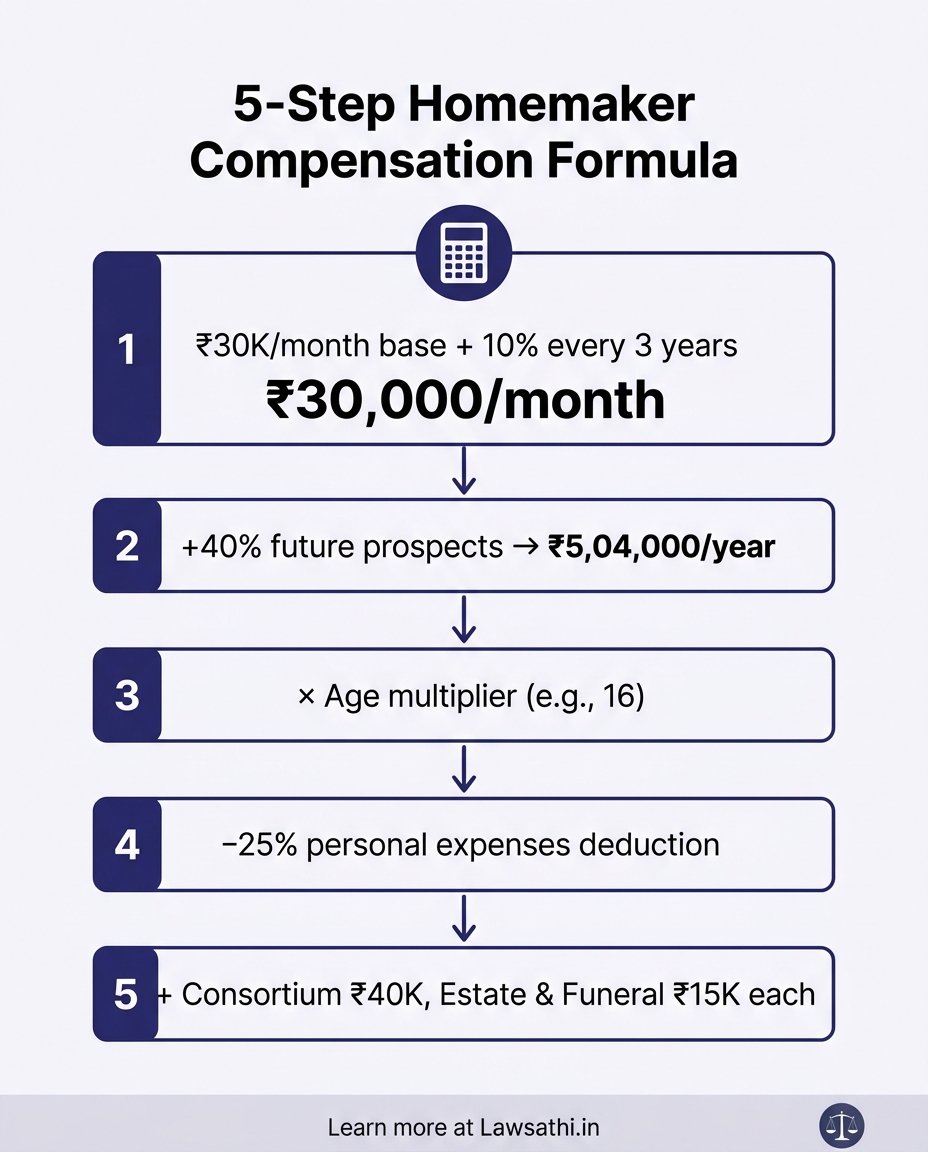
The Court established several key parameters in its calculation table. First, the monthly baseline for “Loss of Domestic Care” stands at ₹30,000. This amount will revise upward by 10% cumulatively every three years. Consequently, the annual income therefore begins at ₹3,60,000. Future prospects add 40% to this figure. As a result, annual income with future prospects reaches ₹5,04,000.
The multiplier method applies based on the deceased’s age. This follows established precedents like Sarla Verma and Pranay Sethi. For a middle-aged homemaker, a multiplier of 16 might apply. Therefore, the gross loss of dependency calculation would yield ₹80,64,000 before deductions.
Deduction and Enhancement Parameters
The LiveLaw breakdown shows that personal expenses deduction stands at one-fourth (25%) rather than the traditional one-third. This lower deduction reflects the higher dependency of family members on the homemaker’s services. After deduction, the loss of dependency in the Shishu Pal case amounted to ₹60,48,000.
Conventional heads receive separate treatment. Loss of consortium starts at ₹40,000 per dependent with 10% enhancement every three years. Similarly, loss of estate and funeral expenses each begin at ₹15,000 with similar periodic enhancements. In the Shishu Pal case, these additions brought total compensation to ₹62,77,900.
Section 166 vs Section 140 Implications
Practitioners must distinguish between Section 166 and Section 140 claims under the Motor Vehicles Act. Section 166 allows full compensation claims with proof requirements. In contrast, Section 140 provides no-fault liability with statutory caps. The Supreme Court homemaker compensation framework primarily applies to Section 166 claims. Here, detailed evidence supports the compensation calculation.
Evidentiary Standards and Advocacy Strategies for Lawyers
Successful MACT claims require strategic documentation and effective advocacy. Therefore, the new framework demands a more structured approach to evidence presentation.
Documentary Requirements
The Supreme Court specified clear documentary requirements. Official proof of age must be provided, excluding Aadhaar cards. For homemaker claims, practitioners should gather salary slips, income tax returns, or employer certificates if any income existed. Furthermore, proof of dependency relationships remains essential.
The Punjab & Haryana High Court judgment from January 2026 provides valuable guidance. Justice Sudeepti Sharma enhanced compensation from ₹58.22 lakh to ₹1.18 crore. Specifically, the Court listed services that homemakers render—meal preparation, grocery procurement, house maintenance, financial planning, childcare, elderly care, and healthcare coordination.
Argument Strategies Against Insurance Defenses
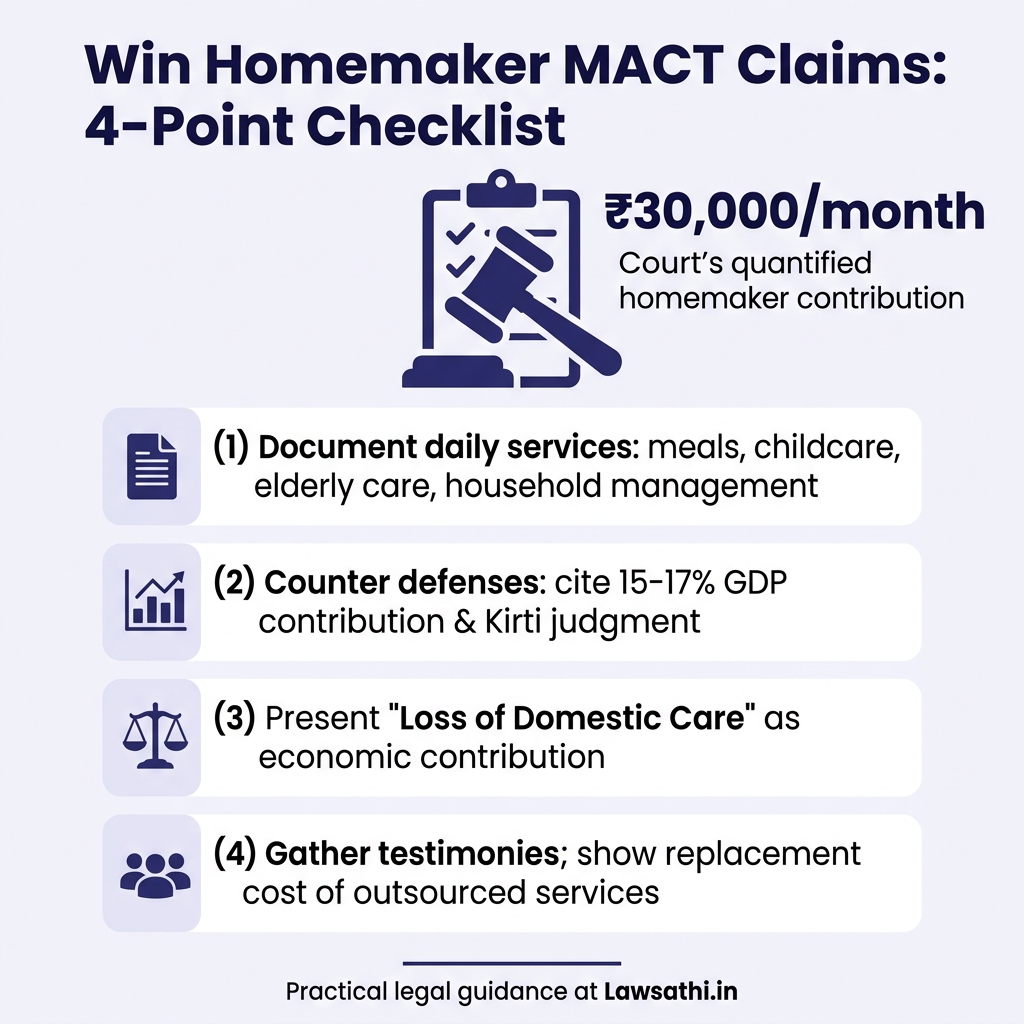
Insurance companies typically argue that homemakers have no “earned” income. However, practitioners can effectively counter this defense. First, cite the Kirti judgment’s observation that “the conception that homemakers do not ‘work’ is problematic.” Additionally, reference the GDP contribution statistic (15-17%) of unpaid domestic work.
Present the new “Loss of Domestic Care” head as Supreme Court recognition of economic contribution. This head compensates the economic and managerial contribution within the household. Moreover, it differs from loss of consortium, which primarily compensates emotional loss.
Cross-Examination for Establishing Dependency
Effective cross-examination requires documenting the daily services the homemaker provided. Obtain testimonies from neighbors and relatives who witnessed these activities. Furthermore, demonstrate the replacement cost if the family had to outsource these services. Highlight both tangible and intangible losses—maternal support, spousal care, household management.
The Nempal v. Hawa Singh case from February 2026 illustrates proper calculation methodology. The Punjab & Haryana High Court assessed a 20-year-old homemaker’s income using skilled worker rates. Additionally, it applied a multiplier of 18 based on age and awarded consortium for multiple dependents.
Impact on Insurance and Future Litigation Trends
The new framework will significantly affect insurance practices and litigation patterns. Therefore, practitioners must anticipate these changes in their case strategy.
Compensation Enhancement Patterns
The disparity between earlier awards and current standards is striking. In Shishu Pal, the MACT awarded ₹2,42,000 in 2003. Subsequently, the High Court enhanced this to ₹8,43,400 in 2024. The Supreme Court finally awarded ₹62,77,900—a 7.4 times increase from the High Court award.
The Punjab & Haryana High Court’s January 2026 judgment similarly doubled compensation from ₹58.22 lakh to ₹1.18 crore. These examples signal a fundamental recalibration of homemaker valuations nationwide.
Insurance Premium Implications
Third-party insurance premiums will likely increase to accommodate higher claim amounts. Insurance companies must reassess their actuarial calculations. Specifically, higher baseline compensation means greater liability exposure for insurers.
However, standardization may actually reduce litigation time. Clear benchmarks from the Supreme Court homemaker compensation framework provide predictable outcomes. As a result, parties can negotiate settlements with greater confidence, potentially avoiding prolonged tribunal proceedings.
Systemic Reform Directions
The Supreme Court issued directions under Section 169 of the Motor Vehicles Act for speedy disposal. As the Hindi LiveLaw report noted, the Court emphasized that victims wait years for justice. Therefore, the Court expects Section 169 implementation in letter and spirit across all jurisdictions.
Practical Implementation: Automating Complex Calculations
The new multi-variable formula presents practical challenges for practitioners. Consequently, manual calculations risk errors that could significantly affect client outcomes.
Challenges in Manual Calculation
The compensation formula involves multiple variables. Practitioners must track the base monthly income with periodic 10% enhancements every three years. Additionally, they must calculate annual income and apply the 40% future prospects addition. The age-based multiplier requires reference to established tables.
Deduction percentages vary—25% for homemakers versus potentially different rates for other categories. Furthermore, conventional heads require their own enhancement calculations. Interest calculations from the filing date add another layer of complexity.
The Role of Legal Technology
Legal practice management platforms can automate these calculations. They ensure accuracy by applying the correct formulas and enhancement timelines. Additionally, digital case files help track documentation requirements and filing deadlines.
LiveLaw’s analysis of motor accident compensation awards highlights the importance of precise calculations. Errors can result in significant under-compensation or unnecessary appeals. Therefore, technology solutions minimize these risks while improving practice efficiency.
Benefits of Digitized Case Management
Organized case files become essential for MACT disputes. Tracking precedents and enhancement timelines requires systematic record-keeping. Additionally, bank account details for direct transfers must be maintained accurately. The Supreme Court’s Parminder Singh v. Honey Goyal direction requires insurance companies to deposit compensation within six weeks. Digital systems help monitor compliance and track payments.
Conclusion: A Step Toward Economic Justice
The Supreme Court homemaker compensation framework represents more than a procedural change. Specifically, it embodies a constitutional commitment to equality and dignity for all individuals.
Constitutional Foundation
Article 14’s guarantee of equality supports equal recognition of unpaid domestic labour. Additionally, Article 21’s protection of life encompasses the dignity of homemakers. The judgment fulfills India’s international law obligations on gender equality. As the Kirti judgment stated, fixing notional income advances the “constitutional vision of social equality and ensuring dignity to all.”
Long-Term Impact on Indian Law
This framework transforms how society views homemakers—from dependents to contributors. It recognizes that homemakers “contribute to the economic condition of the family and the economy of the nation.” Furthermore, standardization reduces arbitrariness and ensures consistent treatment across jurisdictions.
For practitioners, this ruling demands a more data-driven approach. Track the periodic enhancements (10% every three years) diligently. Additionally, document all services the homemaker rendered comprehensively. Adopt calculation methodologies that ensure accuracy and maximize client recovery.
A New Standard for Practice
The Supreme Court’s declaration that homemakers are “nation builders” carries profound significance. It signals judicial recognition of work that remained invisible for too long. Therefore, practitioners must rise to this moment by ensuring every homemaker’s family receives just compensation.
Simplify your MACT case management and ensure accurate compensation calculations. Try LawSathi’s AI-powered legal practice tools today for seamless claim processing.