
The Supreme Court West Bengal electoral roll revision order has emerged as a landmark intervention in electoral jurisprudence. It addresses the delicate balance between maintaining electoral roll integrity and protecting citizens’ voting rights. For legal practitioners, this ruling offers crucial insights into procedural fairness, constitutional protections, and administrative law principles that govern India’s democratic framework.
The Court’s intervention came amid concerns about the Special Intensive Revision (SIR) process in West Bengal. Specifically, the issue involved the deletion of names from electoral rolls without adequate notice or opportunity to be heard. This case highlights how constitutional courts can safeguard democratic processes while respecting administrative efficiency.
Introduction: The SC Intervention in West Bengal’s SIR Process
The Supreme Court’s recent interim order regarding the Special Intensive Revision in West Bengal marks a significant development in election law. A bench comprising Chief Justice Surya Kant, Justice Joymalya Bagchi, and Justice Vipul M. Pancholi delivered the order. According to NewsOnAir’s report, the Court directed that the SIR process must continue without any hindrance while ensuring procedural safeguards.
The Core Constitutional Conflict
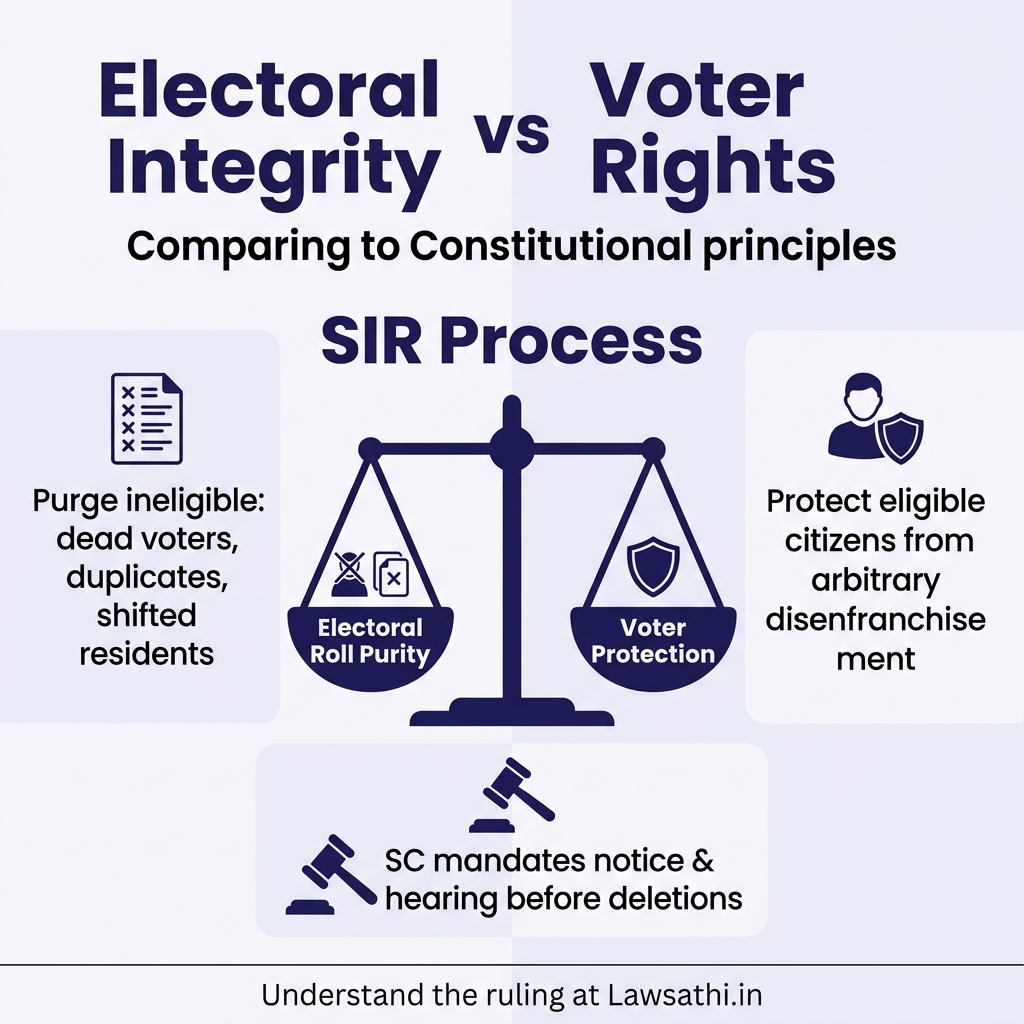
At the heart of this litigation lies a fundamental tension. On one side stands the need to purge electoral rolls of ineligible entries—dead voters, shifted residents, and duplicates. On the other side sits the constitutional imperative of protecting eligible citizens from arbitrary disenfranchisement.
The Court recognized both concerns as equally valid. Therefore, it crafted a balanced approach that preserves electoral integrity while mandating procedural fairness. As LiveLaw’s analysis notes, the judgment emphasizes transparency in the deletion process without disrupting the revision timeline.
Significance of the Transparency Directive
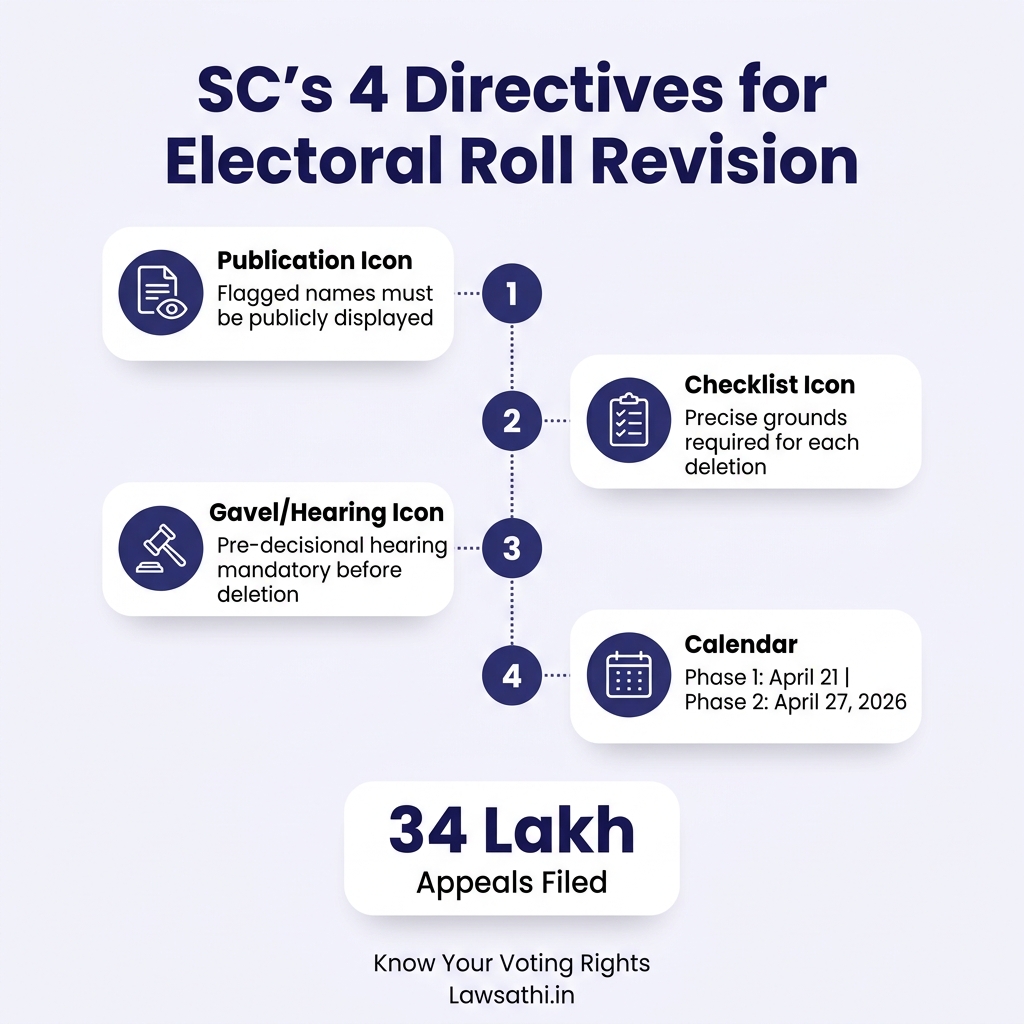
The most crucial aspect of the Supreme Court West Bengal electoral roll revision order concerns transparency. The Election Commission of India was directed to publicly display names flagged for deletion under “Logical Discrepancies” and “Unmapped” categories. This requirement ensures affected voters can identify potential threats to their franchise and respond accordingly.
Furthermore, the Court mandated that specific reasons accompany each flagged name. Voters deserve to know why authorities suspect their eligibility. Without such information, the opportunity to be heard becomes meaningless.
Understanding Special Intensive Revision (SIR) Under the Law
Legal Foundation for Electoral Roll Revision
The Representation of the People Act, 1950 provides the statutory framework for electoral roll maintenance. Section 21 empowers the Election Commission to direct special revision of electoral rolls at any time. The Commission must record reasons for such direction and specify the manner of revision.
Two types of revision exist under the law. Summary revision involves updating existing rolls based on available information. Intensive revision, by contrast, requires complete door-to-door verification and preparation of fresh rolls. The Registration of Electors Rules, 1960, further elaborates these procedures under Rule 25.
Objectives of Special Intensive Revision
The primary objectives of SIR remain straightforward. First, authorities must delete names of deceased persons from the rolls. Second, they must remove names of those who have shifted residence permanently. Third, duplicate entries require elimination to prevent voter fraud. Finally, correction of erroneous particulars ensures roll accuracy.
However, achieving these objectives cannot come at the cost of arbitrary deletion. The Section 21 provision grants power but also imposes responsibility. The Election Commission must exercise this power within constitutional boundaries.
Key Directives from the Supreme Court Bench
Mandatory Publication of Flagged Names
The Supreme Court’s order establishes clear transparency requirements. According to ECI directions issued after the judgment, authorities must publicly display names proposed for deletion. This display must include specific reasons for each proposed action.
The categories requiring publication include “Logical Discrepancies” and “Unmapped” entries. Voters appearing in these lists need immediate notification. Additionally, the display must specify a timeline for submitting representations and supporting documents.
Specific Reasons Requirement
Vague justifications for deletion no longer suffice. The Court demanded that registration officers specify precise grounds. Under Rule 21A of the Registration of Electors Rules, acceptable reasons include death, shifting residence, not ordinarily residing at the address, or being otherwise ineligible.
This specificity matters enormously for practical purposes. A voter who knows the specific allegation can respond effectively. For instance, if flagged for “not found at address,” the voter can provide current proof of residence. However, without knowing the reason, meaningful response becomes impossible.
Opportunity for Representation
Perhaps the most significant directive concerns the hearing requirement. The Court reaffirmed that pre-decisional hearing is mandatory before deletion. This principle flows directly from Section 22 of the Representation of the People Act.
As SCC Online’s report explains, the Court constituted 19 Appellate Tribunals in West Bengal. These tribunals, headed by former Chief Justice T.S. Sivagnanam and other former High Court judges, received approximately 34 lakh appeals. This enormous number demonstrates the scale of potential grievances.
Timeline Stipulations
The Court established strict deadlines balancing fairness with electoral requirements. For Phase 1 constituencies, appeals had to be decided by April 21, 2026. Phase 2 constituencies received a deadline of April 27, 2026. Polling occurred on April 23 and April 29, 2026, respectively.
Importantly, the Court clarified that pending appeals do not entitle excluded persons to vote. This pragmatic ruling prevents last-minute disruption while preserving appellate rights.
Constitutional Framework: Article 326 and Due Process
Adult Suffrage as Constitutional Mandate
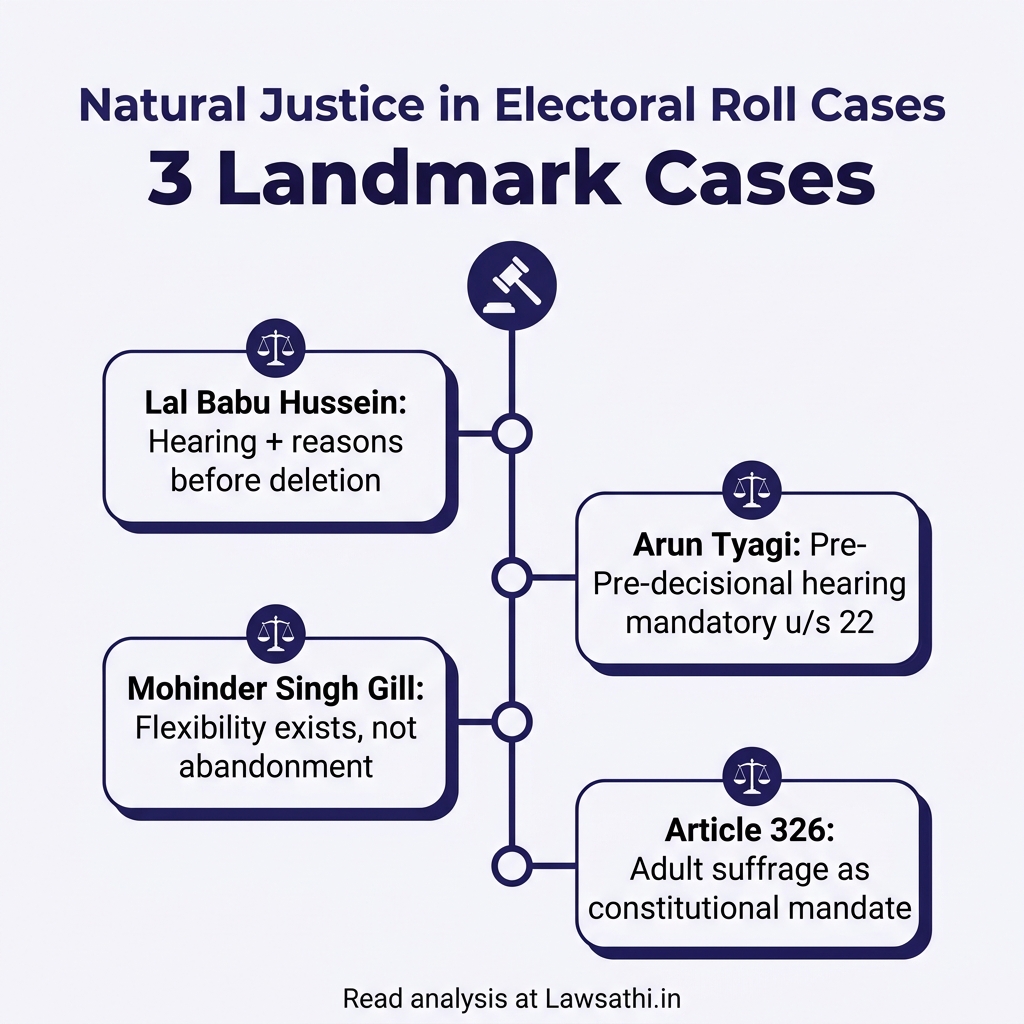
Article 326 of the Constitution establishes adult suffrage as the basis for elections. Every citizen above eighteen years of age, not otherwise disqualified, can register as a voter. This provision creates a constitutional foundation for voting rights.
However, judicial interpretation has evolved significantly. The Supreme Court in Anoop Baranwal v. UOI engaged with this question extensively. A 4:1 majority held that voting is a constitutional right. Justice Rastogi dissented, calling it part of fundamental rights.
The Paradox of Voting Rights
The judicial position reveals an interesting paradox. As LiveLaw’s commentary notes, democracy forms an essential feature of the Constitution. Yet, somewhat paradoxically, the right to vote has not been recognized as a fundamental right. It remains termed a “mere” statutory right in many contexts.
Nevertheless, this classification does not diminish procedural protections. Even statutory rights require fair procedure before deprivation.
Natural Justice Principles in Electoral Deletion
The Lal Babu Hussein v. ERO judgment established crucial precedent on natural justice in electoral matters. The Supreme Court held that before deletion, except in cases of death, the person must receive an opportunity to be heard. More importantly, the person must know why suspicion arose about their status.
This requirement ensures meaningful hearing rights. Without knowing the specific allegation, a voter cannot mount an effective defense. The Court emphasized that mere formal hearing without substantive information violates natural justice.
Pre-Decisional Hearing Mandate
The Arun Tyagi v. ECI judgment from Delhi High Court further clarified this requirement. The court held that pre-decisional hearing is imperative under Section 22. Post-decisional hearing or appellate hearing cannot substitute the statutory requirement. When deletion affects democratic rights, procedural safeguards become essential.
Additionally, Mohinder Singh Gill v. CEC established that natural justice principles must adapt to electoral exigencies. The audi alteram partem rule remains flexible but cannot be abandoned entirely.
Practical Implications for Legal Practitioners
Advising Clients with Flagged Names
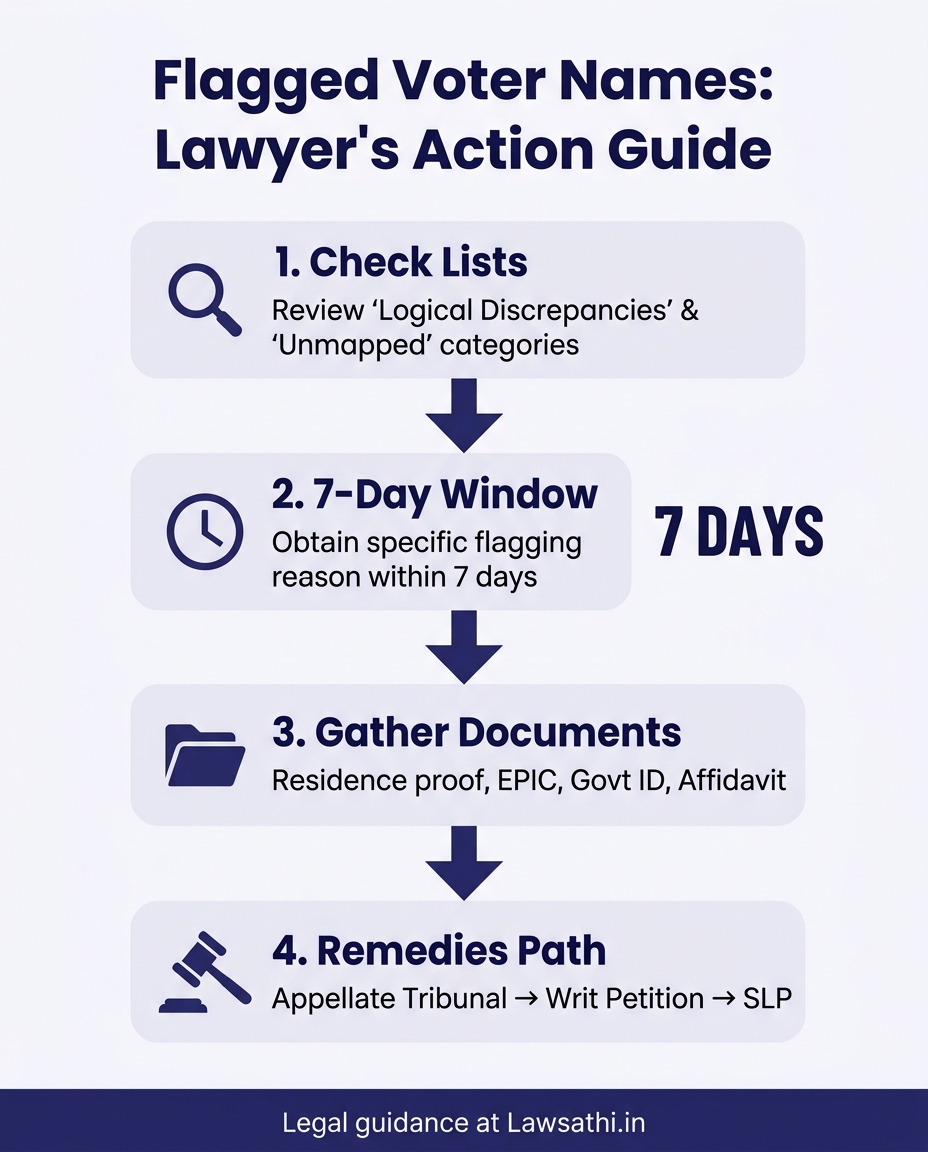
Lawyers must guide clients through a structured process when names appear flagged for deletion. The first step involves checking whether the name appears in public lists. Clients should examine “Logical Discrepancies” and “Unmapped” categories immediately upon publication.
Second, obtaining the specific reason for flagging becomes crucial. The Electoral Registration Officer must provide this information within seven days of request. Third, clients must gather documentation proving continued residence. Finally, filing representation with supporting documents must occur within the stipulated timeline.
Documentation Requirements
Effective representation requires comprehensive documentation. Proof of ordinary residence stands as the primary requirement. Acceptable documents include utility bills, Aadhaar card, ration card, and bank statements showing the registered address.
Additionally, clients should submit their EPIC (Voter ID card) copy. Any government-issued identification with the current address strengthens the case. An affidavit affirming continued residence at the registered address often proves valuable.
Understanding Form 7 Procedure
The Form 7 application serves two purposes. Citizens can object to wrongful inclusion of others in the roll. Alternatively, they can seek deletion of their own name if they have shifted residence.
Practitioners must understand the procedural sequence. The registration officer prepares a list of names proposed for deletion. This list gets exhibited on the notice board with time and place for consideration. Publication occurs in the prescribed manner. Finally, the officer considers objections and decides after giving reasonable opportunity.
Legal Remedies for Wrongful Deletion
If wrongful deletion occurs despite representation, multiple remedies exist. The first avenue involves appeal to Appellate Tribunals under Section 24. The Election Commission has confirmed that due process is mandatory.
If the tribunal fails to provide relief, writ jurisdiction under Article 226 becomes available. High Courts can examine violations of natural justice or arbitrary administrative action. For substantial questions of law, Special Leave Petition under Article 136 offers the final remedy.
Monitoring BLO Compliance
Booth Level Officers play a critical role in verification. Lawyers should ensure BLOs conduct genuine physical verification. The reasons for flagging must be documented in writing. Proper notice must be served before any deletion decision. The hearing must be substantive, not merely procedural.
Political and Administrative Impact
Scale of Administrative Operations
The Supreme Court West Bengal electoral roll revision case revealed massive administrative efforts. According to NewsOnAir, 19 Appellate Tribunals were constituted to handle appeals. Approximately 34 lakh appeals were filed, demonstrating the enormous stake involved.
The state government submitted 8,505 Group-B officers for appointment as micro-observers. Judicial officers from West Bengal, Jharkhand, and Odisha were deployed for adjudication. The Court acknowledged this “truly herculean task” completed within remarkably short time.
Election Timeline Pressures
The revision process operated under strict election deadlines. Phase 1 polling occurred on April 23, 2026. Phase 2 followed on April 29, 2026. These timelines constrained the Tribunal’s working period significantly.
Chief Election Commissioner Gyanesh Kumar assured the public that no one would be allowed to take law into their hands. Strict action would follow all violations. This commitment aimed to balance efficiency with fairness.
Balancing Purity of Rolls with Voter Protection
The Court explicitly acknowledged competing imperatives. Pure electoral rolls remain essential for free and fair elections. Yet, protecting eligible voters from wrongful exclusion matters equally. The solution requires procedural rigor without administrative paralysis.
Justice Bagchi’s observation captured this balance perfectly. Even if a person is excluded today and unable to vote in this particular election, unjustified exclusion can be corrected later. The Tribunal’s decision can restore inclusion for future elections.
Conclusion: Upholding Electoral Democracy
The Supreme Court West Bengal electoral roll revision order represents a careful balancing act. The Court navigated between electoral integrity, franchise protection, procedural fairness, and electoral timelines. Each constitutional value received due recognition without undermining others.
For practitioners, several lessons emerge. Transparency in deletion processes has become legally mandatory. Natural justice requirements cannot be bypassed for administrative convenience. Appellate mechanisms provide real remedies when properly implemented. The qualifying date determines inclusion rights for specific elections.
Key Takeaways for Lawyers
First, transparency is paramount—names flagged for deletion must be publicly displayed with reasons. Second, natural justice cannot be bypassed—pre-decisional hearing remains mandatory. Third, appellate mechanisms matter—19 Tribunals provided real remedy in this case. Fourth, qualifying date controls inclusion—late applications cannot guarantee voting rights in ongoing elections.
The judgment affirms that procedural fairness strengthens rather than weakens electoral integrity. When citizens trust the process, voluntary compliance increases. Arbitrary deletion, by contrast, breeds litigation and public cynicism.
Future Outlook
Looking ahead, the final electoral roll publication with supplementary lists will set important precedents. Future challenges may arise on procedural compliance in other states. Systemic reforms could prevent large-scale disputes in future revisions. The principles established here will guide similar situations nationwide.
The Supreme Court has demonstrated that courts can protect democratic processes while respecting administrative needs. This model of balanced intervention serves Indian democracy well.
Stay ahead of critical legal developments. Use LawSathi’s AI-powered case tracking to monitor election law updates and manage your client representations efficiently.