
The Supreme Court Aadhaar citizenship debate has reignited. A fresh judicial intervention could reshape how India’s most ubiquitous identity document is used. On June 16, 2026, the Supreme Court issued notice to multiple parties. The respondents include the Centre, all State governments, Union Territories, and the Election Commission of India.
The bench comprised Chief Justice Surya Kant and Justice V Mohana. They were responding to a Public Interest Litigation seeking to restrict Aadhaar’s use strictly to proof of identity. This development carries significant implications for legal practitioners. It affects those navigating the complex intersection of identity verification and citizenship law.
Introduction: The SC’s Recent Judicial Intervention
The PIL was filed as W.P.(C) No. 654/2026 by Ashwini Kumar Upadhyay. It raises fundamental questions about the scope of Aadhaar in India’s legal framework. According to LiveLaw’s report on the hearing, the petition seeks explicit directions. Specifically, it aims to prohibit using Aadhaar as proof of citizenship, domicile, address, or date of birth.
The Bench Composition and Notice
The Supreme Court bench took a serious view of the matter. As noted by Bar and Bench, notice was issued to multiple respondents. These include the Election Commission and various government departments.
This broad approach signals the Court’s recognition of the issue’s scope. The matter spans multiple government departments and regulatory frameworks.
Significance in the Current Context
This hearing arrives at a critical juncture in Indian constitutional law. The Supreme Court Aadhaar citizenship question has persisted since 2016. That was when the Aadhaar Act was first enacted.
Furthermore, ongoing debates around the National Register of Citizens (NRC) add urgency. The Citizenship Amendment Act (CAA) discussions also demand clarification. The core conflict is straightforward yet profound. Aadhaar establishes identity, but citizenship requires far more stringent proof.
The Statutory Conflict: Aadhaar Act vs. Citizenship Act, 1955
Section 9: The Critical Statutory Bar
Section 9 of the Aadhaar Act, 2016 contains an explicit prohibition. It states that the Aadhaar number shall not, by itself, confer any right of citizenship. Nor can it serve as proof of citizenship or domicile.
This statutory provision forms the cornerstone of the current PIL’s arguments. However, the practical implementation tells a different story. Various government forms and procedures routinely accept Aadhaar as valid documentation. As a result, a significant gap exists between legislative intent and administrative practice.
Understanding the Residence vs. Citizenship Distinction
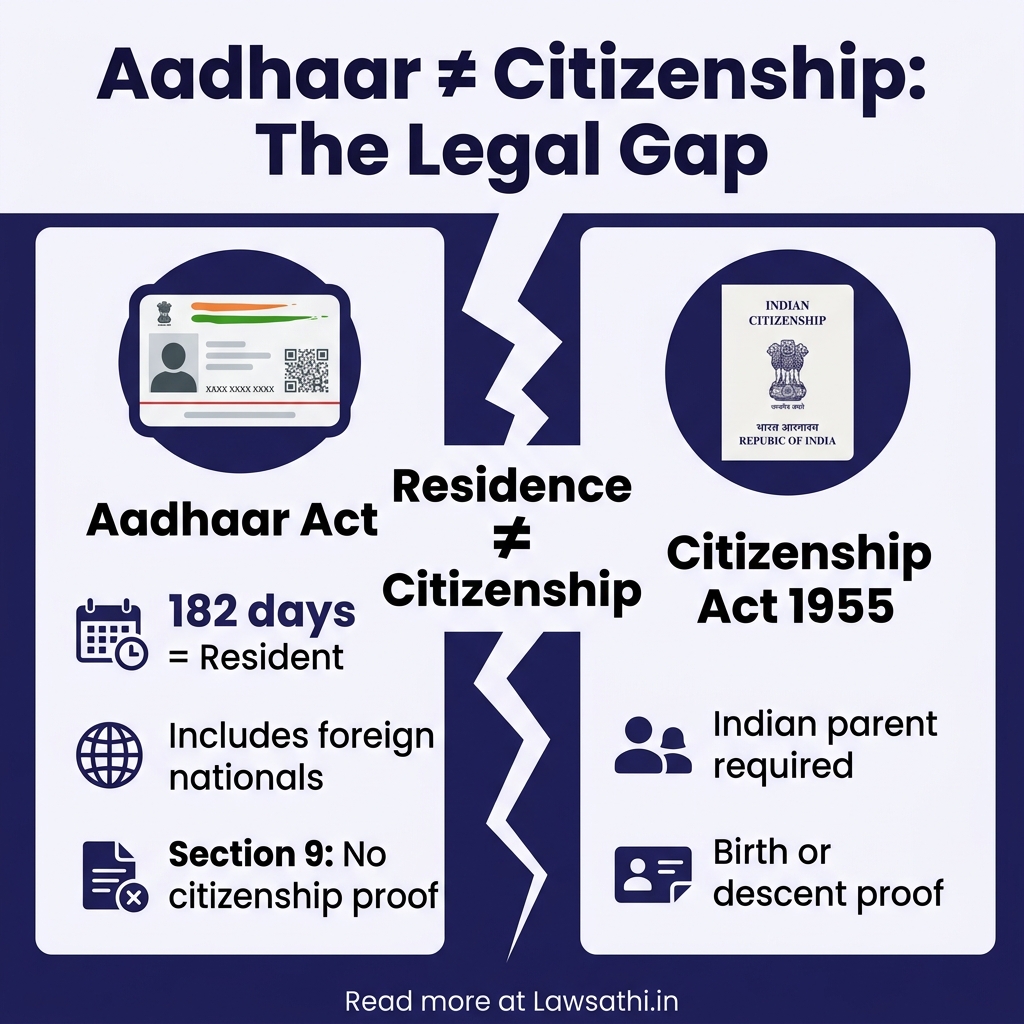
The Aadhaar Act defines a “resident” in specific terms. Someone must have resided in India for at least 182 days in the preceding 12 months. This definition is crucial for understanding the Supreme Court Aadhaar citizenship issue.
Notably, this residence requirement applies broadly. It covers both Indian citizens and foreign nationals equally.
In contrast, the Citizenship Act, 1955 establishes different criteria altogether. For individuals born after December 3, 2004, citizenship requires specific proof. At least one parent must be an Indian citizen. Additionally, the other parent must not be an illegal migrant.
The Documentation Gap
The practical problem is evident in enrolment procedures. Aadhaar can be obtained through relatively simple documentation. Rent agreements, recommendations from local elected representatives, or the introducer system suffice for enrollment.
Moreover, no verification of parents’ citizenship status occurs during this process.
Therefore, a fundamental legal gap exists. Aadhaar establishes mere residence. However, citizenship demands proof of birth in India or descent from Indian citizens. This distinction has profound implications for national security and electoral integrity.
Petitioner’s Arguments: National Security and Electoral Integrity
The PIL presents compelling arguments about the consequences of conflating identity with citizenship. News on Air’s coverage highlights the petitioner’s national security concerns.
The Chain of Documents Vulnerability
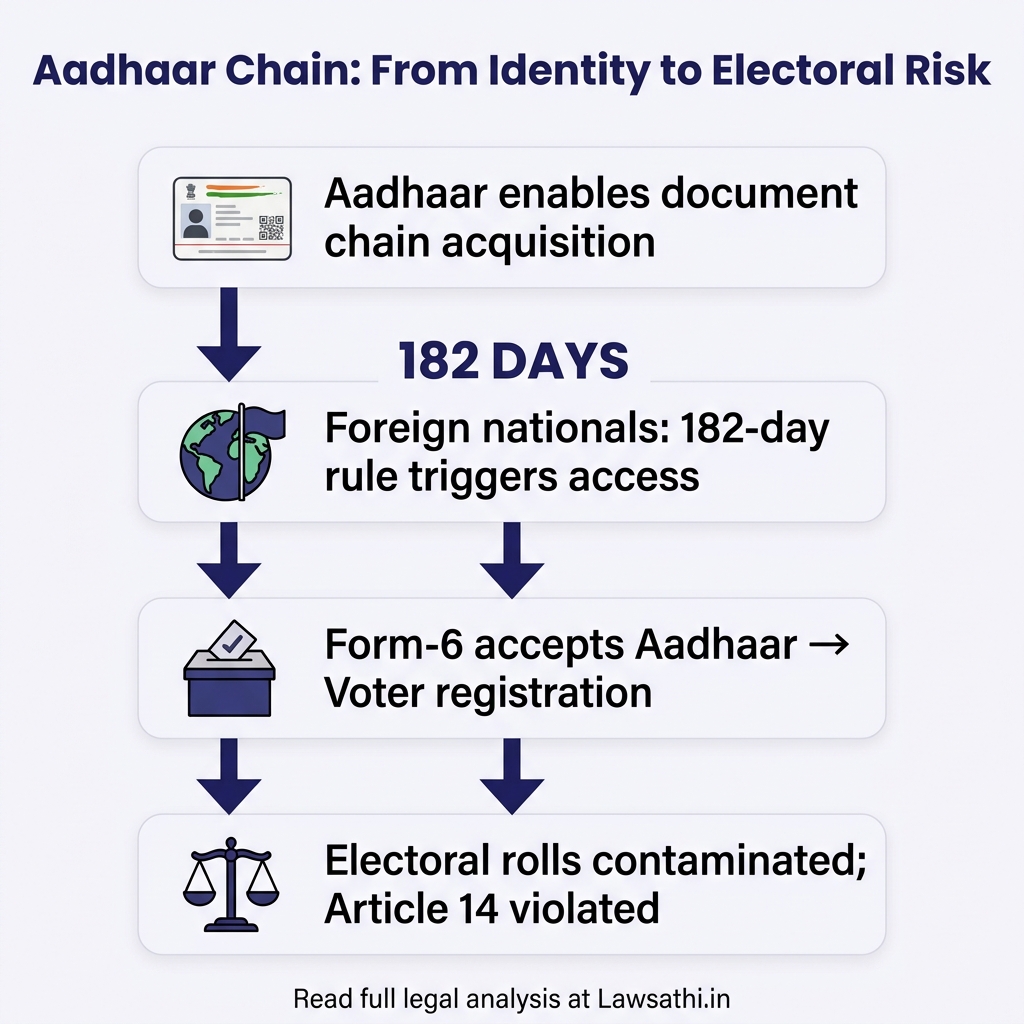
The petition argues that Aadhaar often serves as the foundational document. Once obtained, it facilitates acquisition of other identity documents. This creates what the petitioner terms a “chain of documents” vulnerability.
Foreign nationals who meet the 182-day residence requirement can initiate this document chain. Moreover, the petitioner highlights a critical concern. As quoted in LiveLaw’s Hindi coverage, infiltrators can subsequently access welfare schemes. These benefits are meant for economically weaker sections. They may even avail benefits reserved for SC, ST, OBC, and minority communities.
Electoral Roll Contamination Concerns
Form-6 is used for voter registration. Currently, it accepts Aadhaar as proof of date of birth and residence. The petitioner argues this violates Section 23(4) of the Representation of the People Act, 1950.
The concern extends beyond individual cases. It reaches systemic electoral impact.
When illegal immigrants enter electoral rolls, the consequences multiply. Increased voter numbers affect delimitation of constituencies. This fundamentally alters representative democracy’s arithmetic. The petition therefore seeks a declaration. It argues Aadhaar’s use in Form-6 violates constitutional provisions under Article 14.
Specific Relief Sought
The petitioner has requested precise judicial intervention. First, a declaration that Aadhaar use in voter registration violates Section 9 of the Aadhaar Act. Second, directions to ensure Aadhaar serves exclusively as proof of identity. Third, specific guidelines to the Election Commission and UIDAI to enforce these distinctions.
Precedents and Past Judicial Pronouncements
The K.S. Puttaswamy Foundation
The landmark K.S. Puttaswamy v. Union of India judgment established critical principles. While affirming the right to privacy, the Constitution Bench also addressed Aadhaar’s scope.
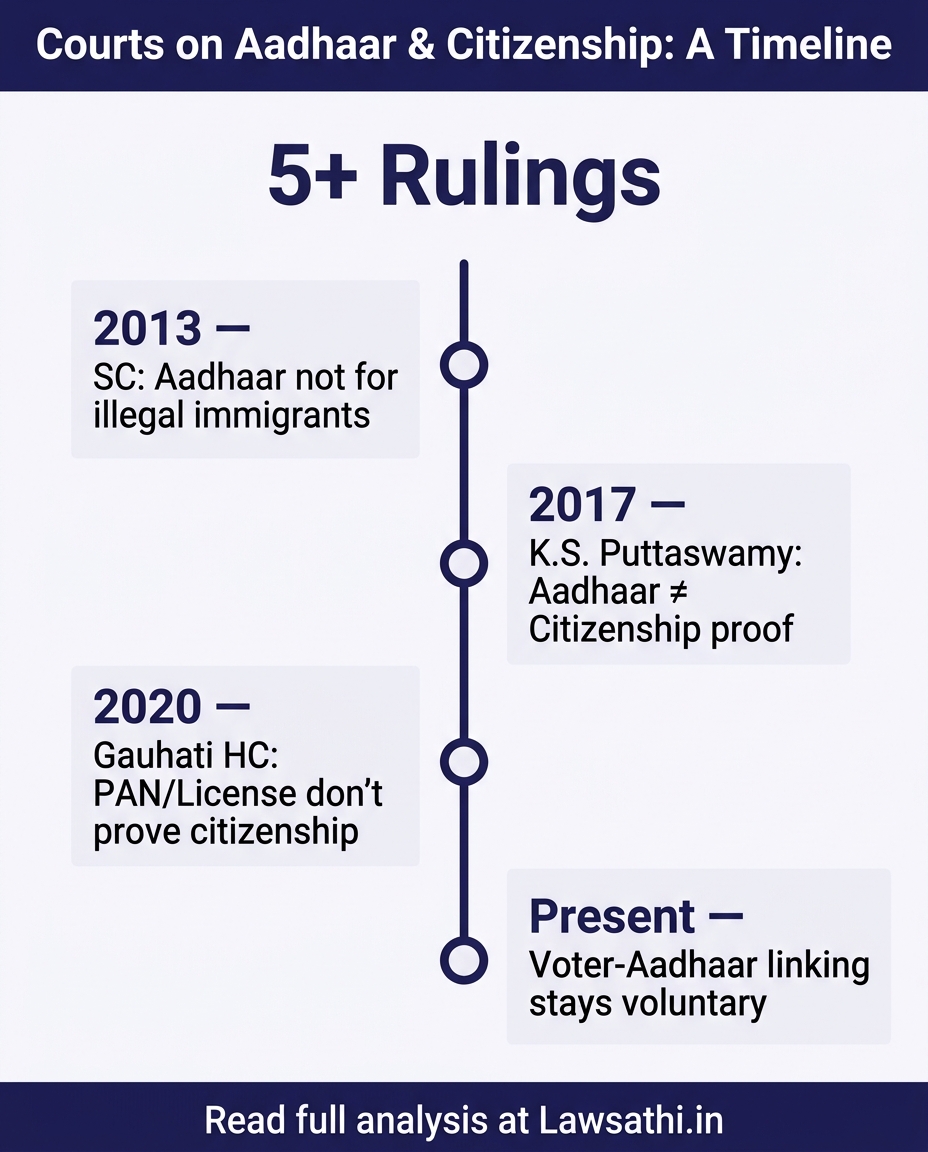
The nine-judge bench explicitly acknowledged Aadhaar’s purpose. It serves identity verification purposes, not citizenship determination.
Furthermore, an interim order from September 2013 remains relevant. The Court had directed that Aadhaar should not be given to any illegal immigrant. However, implementation of this directive has proven administratively challenging.
Gauhati High Court’s Clarifications
In February 2020, the Gauhati High Court delivered significant rulings on this issue. As analyzed in LiveLaw’s citizenship documentation article, the court held that documents like driving licenses, PAN cards, and Aadhaar do not prove citizenship.
The court’s reasoning was straightforward. These documents consider “residency” as the relevant factor, not citizenship. This principle emerged from cases related to the Assam Accord and NRC process. The cut-off date of March 24, 1971, remains crucial in that context.
The Electoral Roll Linkage Litigation
Previous litigation on Aadhaar-Voter ID linkage provides important context. According to LiveLaw’s report on the challenge, the Supreme Court issued notice on the Election Laws Amendment Act, 2021.
Senior Advocate Shyam Divan had argued before the Court. He contended that Aadhaar’s specific statutory limitation conflicts with electoral roll usage.
The Union Law Minister later confirmed that Aadhaar-Voter ID linking remains voluntary. Names cannot be struck off voter rolls for non-linking, as LiveLaw reported.
Implications for Legal Practitioners and Law Firms
Advisory for Documentation
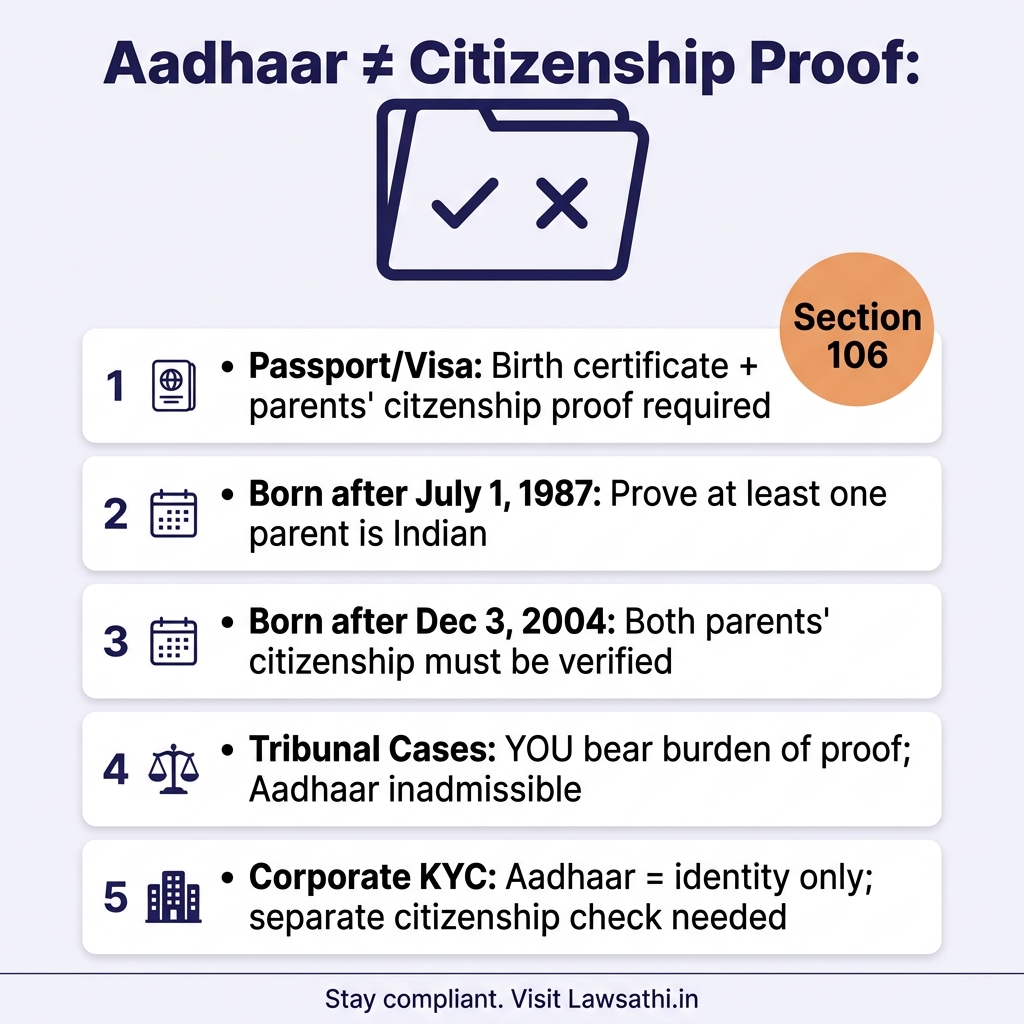
Legal practitioners must advise clients carefully on documentation requirements. For passport and visa applications, Aadhaar alone remains insufficient for citizenship proof. Required documents include birth certificates and evidence of parents’ citizenship status.
For clients born after July 1, 1987, the rules are specific. Evidence of at least one parent’s Indian citizenship becomes mandatory.
Those born after December 3, 2004, face even stricter requirements. Both parents’ status must be verified. Additionally, confirmation that neither is an illegal migrant is necessary.
Impact on Foreigners Tribunal Cases
Litigation involving suspected illegal migrants requires careful strategy. According to the Supreme Court’s ruling in Sarbananda Sonowal, the burden of proof lies with the individual. Section 106 of the Evidence Act applies. It places onus on the person claiming citizenship.
Therefore, lawyers handling Foreigners Tribunal cases must ensure clients understand this burden. Aadhaar cannot serve as citizenship evidence in these proceedings. Comprehensive documentation becomes essential. This includes birth records, parental citizenship proof, and school certificates.
Corporate Compliance Considerations
For corporate clients, employee verification requires nuanced understanding. Aadhaar remains valid for identity verification and KYC purposes under the Aadhaar Act. However, it cannot confirm Indian citizenship status for positions requiring such qualification.
Consequently, separate verification mechanisms become necessary for sensitive positions. Government roles, security clearances, and certain regulated industries demand citizenship confirmation beyond Aadhaar.
What Lies Ahead: The Centre’s Potential Response
Anticipated Government Arguments
The Centre is likely to argue that existing statutory provisions already address the petitioner’s concerns. Section 9’s explicit bar on citizenship claims through Aadhaar provides the legislative framework. Implementation gaps, if any, are administrative rather than legislative defects.
Moreover, the UIDAI’s August 2023 notification already clarifies Aadhaar’s limited scope. The government may argue that this official clarification suffices. Practical difficulties in implementing stricter verification procedures will also feature in their response.
Possible Legislative Measures
Amendments to the Representation of the People Act could emerge as a solution. Explicitly excluding Aadhaar from Form-6’s acceptable documents would address electoral concerns. Revised enrollment procedures with enhanced documentation requirements might follow.
Additionally, standardization across all government forms could resolve inconsistencies. The Court may suggest or mandate such uniformity through its eventual order.
Timeline and Potential Outcomes
The notice was issued on June 16, 2026. The government’s affidavit will follow, with subsequent hearings scheduled accordingly. Three potential scenarios emerge from this litigation.
First, dismissal remains possible if the Court finds Section 9 self-executing. The judiciary may leave implementation to executive discretion. Second, stringent guidelines could mandate strict enforcement of existing provisions. Third, referral to a larger bench might occur given constitutional dimensions and connections to prior Aadhaar litigation.
Conclusion: Clarifying the Legal Landscape
The Supreme Court Aadhaar citizenship hearing represents a pivotal moment in Indian constitutional jurisprudence. The legal distinction between identity proof and citizenship proof has practical consequences. Aadhaar establishes that you are who you claim to be. However, citizenship determines your constitutional status under Articles 5-11.
For legal professionals, this case offers crucial guidance on client advisories. Documentation strategies must reflect the clear legal hierarchy between residence and citizenship. The outcome will shape litigation approaches in Foreigners Tribunals, passport applications, and electoral disputes.
Most importantly, this hearing addresses the tension between national security and administrative convenience. The world’s largest biometric identification system must operate within constitutional boundaries. As the Court considers the Centre’s response, legal practitioners should monitor developments closely. The final order will clarify whether statutory provisions alone suffice, or whether judicial enforcement becomes necessary.
Stay ahead of critical legal developments. Use LawSathi’s AI-powered case law search to find precedents on the Citizenship Act and Aadhaar rulings instantly. Start your free trial today.