
Introduction: The Fresh Constitutional Storm
The Transgender Persons Amendment Act 2026 has ignited a fierce constitutional battle in the Supreme Court of India. On June 15, 2026, the Court issued notice to the Centre. Additionally, it stayed proceedings across various High Courts challenging the amendment’s validity. Therefore, this development marks a critical juncture in India’s transgender rights jurisprudence.
The petitioners include prominent transgender rights activists and organizations. Specifically, Laxmi Narayan Tripathi, Zainab Javid Patel, and Kinner Maa Ek Samajik Sanstha Trust have spearheaded this constitutional challenge. Furthermore, trans men Manveer Yadav and Vishwanath Maithil, along with activist Abhina Aher, have filed separate petitions. This is according to LiveLaw’s report on the Supreme Court challenge.
Bench Composition and Procedural Developments
Chief Justice Surya Kant presided over the hearings alongside Justices Joymalya Bagchi and V. Mohana on different dates. The matter is now slated for placement before a three-judge bench. This progression is significant. The original NALSA judgment was delivered by a two-judge bench as noted by Bar and Bench.
The constitutional challenge questions whether Parliament can remove a fundamental right through ordinary legislation. This strikes at the heart of separation of powers in Indian constitutional law. For practitioners, this case presents an unprecedented examination of the doctrine of non-retrogression of fundamental rights.
Background: From NALSA to the 2026 Amendment
The NALSA Judgment: A Landmark Recognition
The National Legal Services Authority v. Union of India judgment (2014) fundamentally transformed transgender rights in India. The Supreme Court recognized hijras and eunuchs as “third gender” for constitutional protection. Furthermore, the Court upheld the right to self-identification of gender as part of personal autonomy under Article 21.
Justice K.S. Radhakrishnan explicitly stated that no medical examination could determine gender identity. Similarly, no biological test could determine gender either. The judgment directed Centre and State Governments to grant legal recognition without preconditions. According to Bar and Bench’s analysis of NALSA’s impact, the verdict established self-determination as a fundamental right.
The Court also mandated reservation for transgender persons as socially and educationally backward classes. Additionally, it directed separate HIV sero-surveillance centers and public toilet facilities. These directions aimed at substantive equality rather than mere formal recognition.
The 2019 Act: Implementation Challenges
The Transgender Persons (Protection of Rights) Act, 2019 fell short of NALSA’s vision in several aspects. Section 4-6 made rights contingent upon District Magistrate certification. Critics pointed out that requiring surgery proof contradicted self-identification principles. Specifically, it contradicted self-identification for male or female recognition.
As LiveLaw’s analysis of the 2019 Act highlights, only 227 certificates were issued out of 1,915 applications. This bureaucratic bottleneck demonstrated the practical barriers transgender persons faced. Moreover, the Act lacked clear reservation provisions. It also had weak anti-discrimination enforcement mechanisms.
The 2026 Amendment: Key Changes Introduced
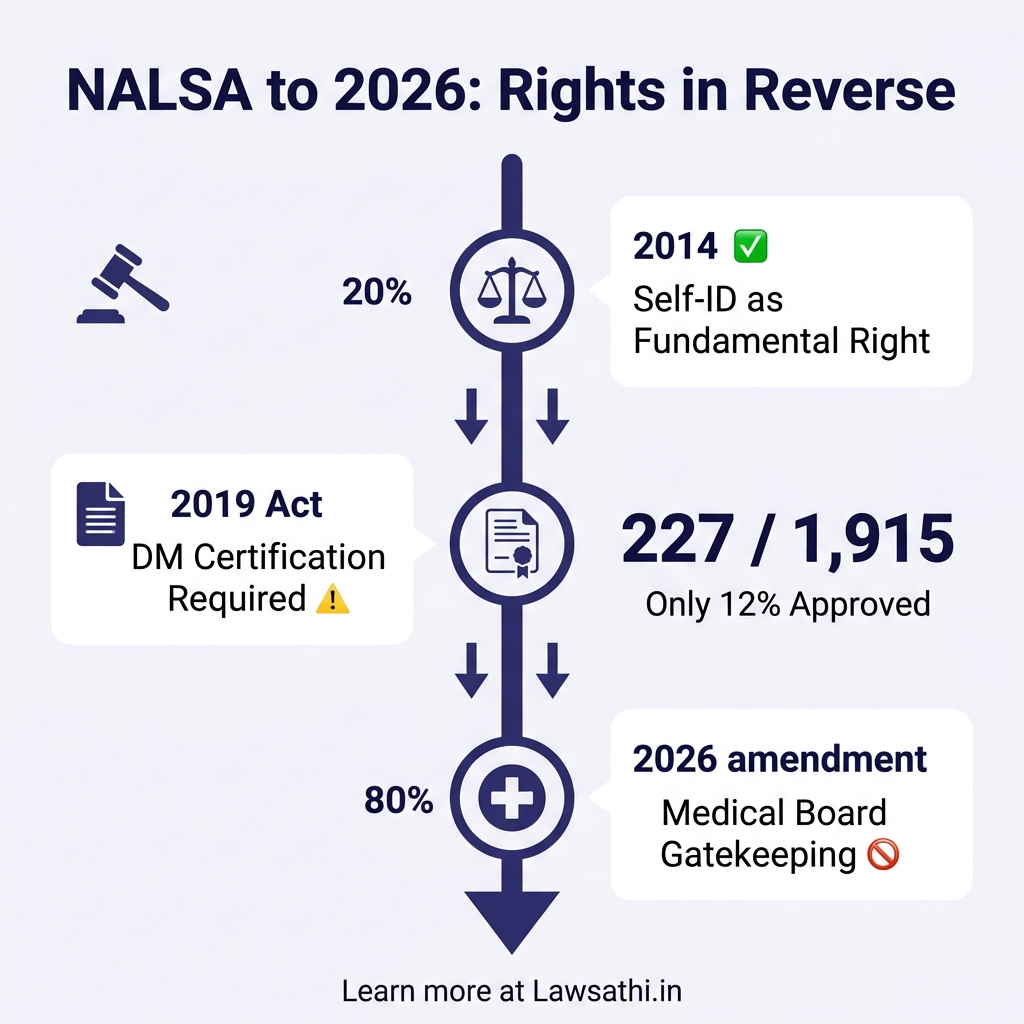
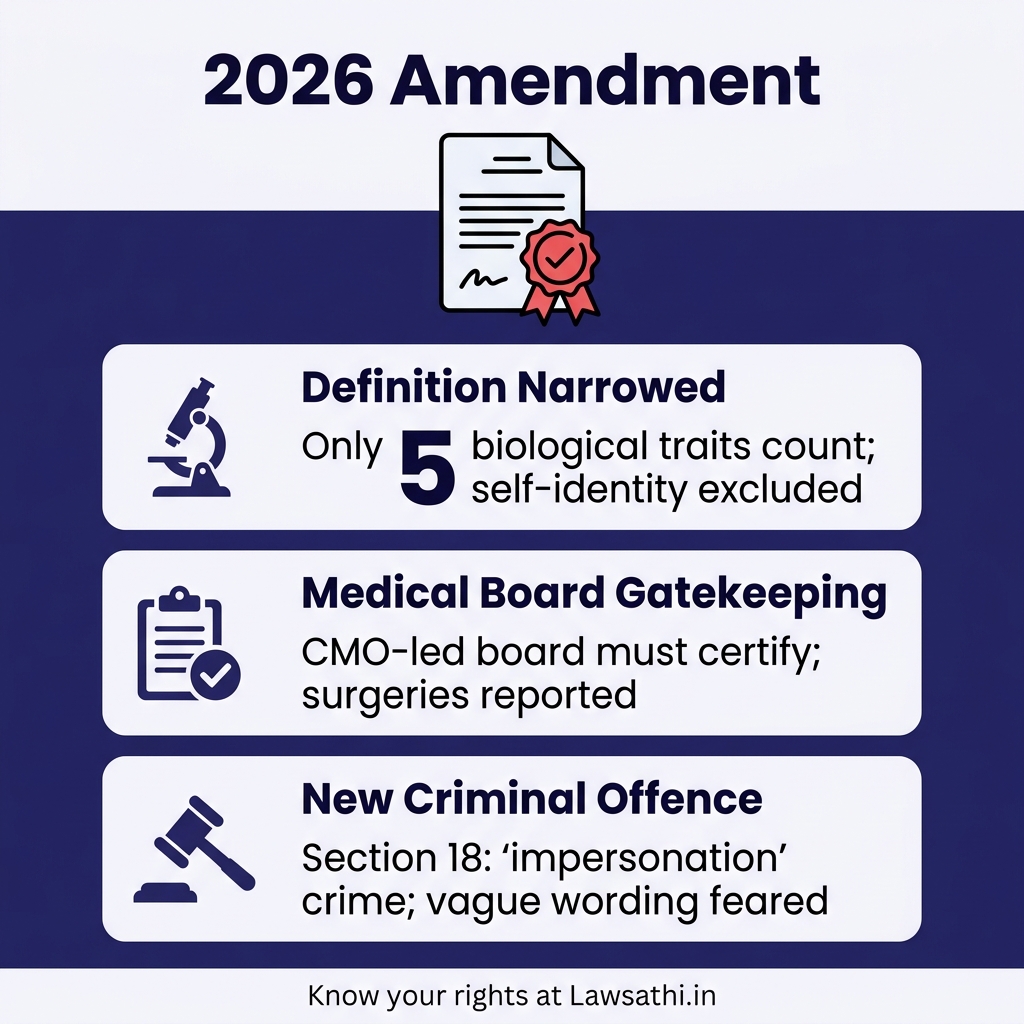
The Transgender Persons Amendment Act 2026 fundamentally alters the definition of “transgender person” in Section 2(k). The amendment limits recognition to five biological characteristics. These include primary sexual characteristics, external genitalia, chromosomal patterns, gonadal development, and endogenous hormone production.
Most critically, the proviso explicitly excludes “persons with different sexual orientations and self-perceived sexual identities.” This exclusion directly contradicts NALSA’s core holding on self-identification. According to LiveLaw’s detailed examination, this represents a radical departure from psychological self-determination.
New Certification Requirements
The certification process now requires a medical board headed by the Chief Medical Officer. Furthermore, hospitals must report gender-affirming surgeries to authorities. The new Section 18 creates criminal offences including “impersonation” with vague definitions. As a result, activists fear these provisions will be misused.
Key Grounds of Constitutional Challenge
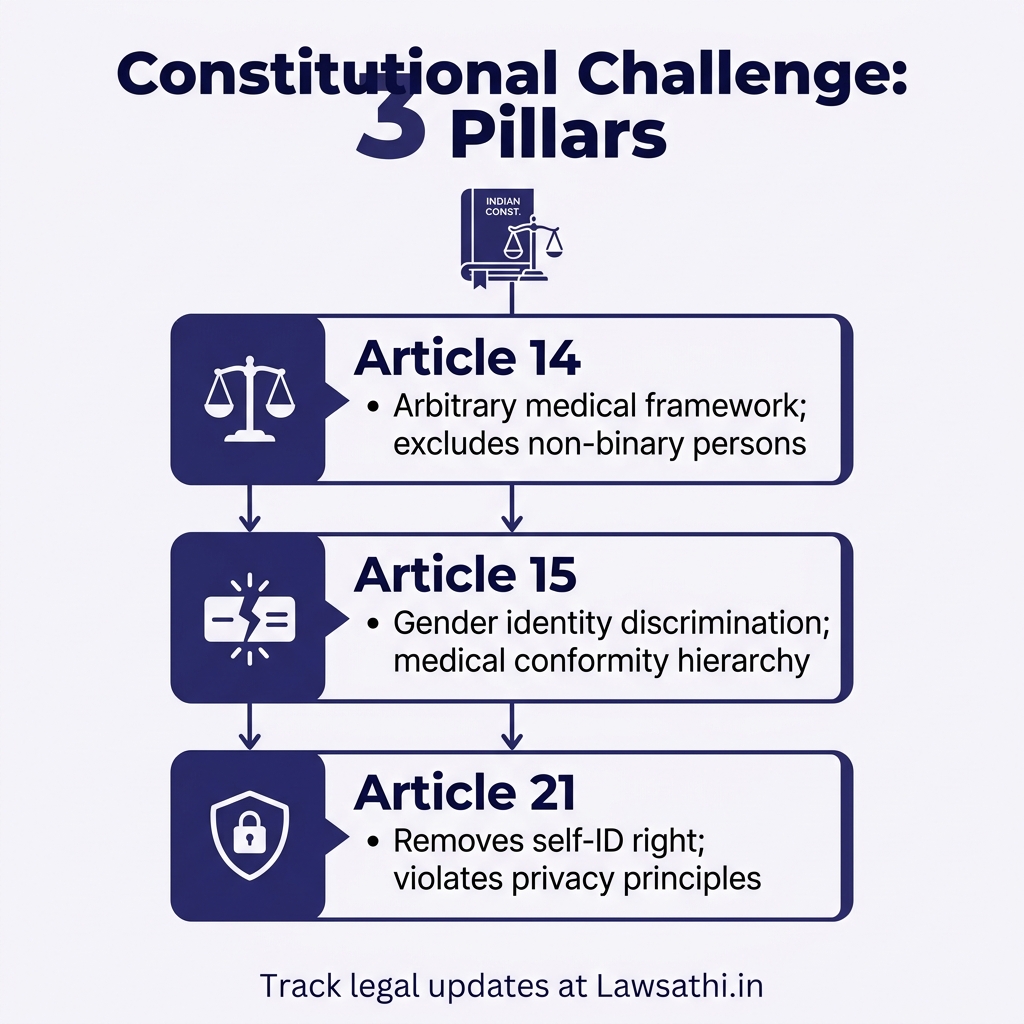
Article 14: Right to Equality Violated
Petitioners argue the amendment creates an arbitrary “watertight medical framework” for gender recognition. The definition excludes trans men, non-binary, genderqueer, and genderfluid individuals entirely. Moreover, it privileges Hindi and Sanskrit-derived categories. At the same time, it erases regional identities like Thirunangai, Thirunambi, and Mangal Mukhi.
The classification lacks a reasonable nexus to any legitimate state objective. As LiveLaw’s constitutional analysis notes, the vague terms like “inducement” and “presentation” invite arbitrary enforcement. This violates the settled principle that penal provisions must be precise and predictable.
Article 15: Discrimination Based on Gender Identity
The amendment allegedly discriminates on grounds of sex and gender identity prohibited under Article 15. Instead of eliminating prejudice, petitioners contend it reinforces existing hierarchies. In fact, the legislation creates a hierarchy of legitimacy among transgender identities based on medical conformity.
This approach contradicts the NALSA judgment’s emphasis on substantive equality. The Supreme Court had held that transgender persons must be treated as full constitutional citizens. However, the 2026 amendment subjects them to intrusive medical scrutiny. This scrutiny is unavailable to cisgender citizens.
Article 21: Personal Autonomy Under Attack
The most fundamental challenge concerns the deletion of self-identification rights recognized in NALSA. Petitioners argue Parliament cannot remove a fundamental right through ordinary legislation. This invokes the doctrine of non-retrogression of fundamental rights.
According to LiveLaw’s report on the petition, the medical board requirement violates privacy rights established in K.S. Puttaswamy. The mandatory medical surveillance system breaches confidentiality of sensitive personal data. Furthermore, conditioning identity on bodily conformity before State recognition violates dignity.
The petition powerfully states that Parliament has “repealed the statutory right that this Court held to be a fundamental right under Article 21.” Therefore, this argument goes to the core of constitutional supremacy over legislative majorities.
The Supreme Court’s Observations and Centre’s Defense
CJI Surya Kant’s Concerns About Misuse
Chief Justice Surya Kant raised concerns about potential misuse of transgender identity for reservations. He questioned whether people might “masquerade as transgender persons for getting some reservations or privileges.” This echoed common criticisms about self-identification policies.
However, Senior Advocate Dr. Abhishek Manu Singhvi countered that no reservation currently exists for transgender persons. He argued that “a remote possibility of misuse in a 0.01% case cannot justify the suspension of Article 21 right of the majority.” Consequently, this exchange highlighted the tension between legitimate state interests and fundamental rights.
Justice Joymalya Bagchi’s Critical Observation
Justice Bagchi made a crucial observation about legislative power to change judicial substratum. He noted that “this amendment changed the substratum of the law on which NALSA examined it.” Therefore, instead of self-determination, the amendment introduces medical evaluation.
This observation could prove pivotal. It acknowledges that Parliament has altered the foundational basis of the NALSA judgment. According to Bar and Bench’s coverage, this framing suggests the Court may need to re-examine the entire constitutional framework.
Solicitor General Tushar Mehta’s Defense
The Solicitor General defended the criminal provisions as targeting forced castration and child manipulation. He stated that “only forcing someone to undergo a sex change, or forcing a child into such a change, is criminalised.” On exclusion from benefits, he argued that “you are either a man or a woman. You are not excluded.”
However, activists point out that the vague “impersonation” offence criminalizes everyday gender expression. Moreover, the defence that existing male/female categories suffice ignores non-binary identities entirely.
Interim Relief and Current Status
The Supreme Court refused to grant an interim stay on the Act. However, the Centre has not yet notified the Act for implementation. Singhvi sought interim relief for ongoing hormone replacement therapy but was denied as per Bar and Bench.
The Karnataka and Kerala High Courts have permitted continuation of hormone replacement therapy in specific cases. Consequently, the Supreme Court has now stayed all High Court proceedings and may consolidate petitions.
Comparative Analysis: International Standards on Transgender Rights
The Yogyakarta Principles and Self-Identification
The Yogyakarta Principles establish that gender identity is self-defined. Principle 3 explicitly states that no person should undergo medical procedures for legal recognition. In fact, the Supreme Court in NALSA relied heavily on these principles.
Updated Yogyakarta Principles from November 2017 address legal recognition comprehensively. They mandate that states must provide procedures for gender recognition based on self-determination alone. According to LiveLaw’s earlier analysis, India’s 2026 amendment contradicts these internationally recognized standards.
Argentina’s Progressive Model
Argentina’s Gender Identity Law (2012) represents the gold standard for self-identification. It allows gender change on official records based solely on self-declaration. Furthermore, no psychological or medical gatekeeping exists under Argentine law.
Gender-affirming care is treated as a basic entitlement rather than a bureaucratic barrier. This approach respects human dignity while preventing intrusive state surveillance. In contrast, India’s 2026 amendment moves in the opposite direction from such progressive models.
India’s Position in Global Context
The 2026 amendment aligns India with anti-trans legislative trends seen in parts of the United States and Eastern Europe. This contradicts progressive patterns of self-ID laws across Europe and Latin America. Moreover, India has ratified the International Covenant on Civil and Political Rights which protects privacy under Article 17.
International jurisprudence increasingly favors self-identification models. The Supreme Court referenced foreign judgments in both NALSA and Navtej Singh Johar. Similarly, K.S. Puttaswamy drew extensively on international privacy standards. Therefore, global developments may influence the Court’s final verdict according to LiveLaw’s psychological perspective.
Implications for Legal Practitioners and Law Firms
Corporate Compliance Considerations
Documentation requirements for transgender employees will fundamentally change if the Act is upheld. Companies must update HR policies regarding gender recognition procedures. Additionally, inclusion and diversity programs may require significant modifications.
Confidentiality obligations under labour laws may conflict with mandatory medical reporting requirements. Legal advisors must carefully navigate these competing obligations. Therefore, employment lawyers should prepare compliance frameworks addressing both scenarios.
Documentation and Procedural Changes
Clients will need medical board certification before approaching District Magistrates. The name change process has been affected by omission of the right to change first name in birth certificates. Furthermore, revised gender certificates are now mandatory after surgery where they were previously permissive.
As LiveLaw’s analysis suggests, lawyers must track these procedural shifts carefully. Medical institutions face new reporting obligations that create potential liability issues. Consequently, practitioners should advise clients to document medical treatment histories thoroughly.
Litigation and PIL Opportunities
Multiple litigation opportunities exist in this evolving landscape. Individual writ petitions for interim relief remain viable in certain jurisdictions. Specifically, petitions for ongoing medical treatments have succeeded in some courts. The Karnataka High Court has shown willingness to protect hormone replacement therapy access.
Privacy challenges to medical surveillance requirements could follow K.S. Puttaswamy principles. Additionally, challenges to the retrospective proviso affecting existing certificate holders present another avenue. As LiveLaw reported, practitioners should monitor High Court developments closely.
Client Advisory Best Practices
Advise transgender clients to apply for certificates under the existing 2019 framework before notification. Document medical treatment histories for potential grandfathering arguments. Furthermore, prepare for certificate validity challenges under the retrospective proviso.
Monitor hormone replacement therapy access in respective states. Some High Courts have provided interim protections that practitioners can leverage. Additionally, track the status of Act notification by the Centre for timing considerations.
Conclusion and Way Forward
Timeline and Procedural Status
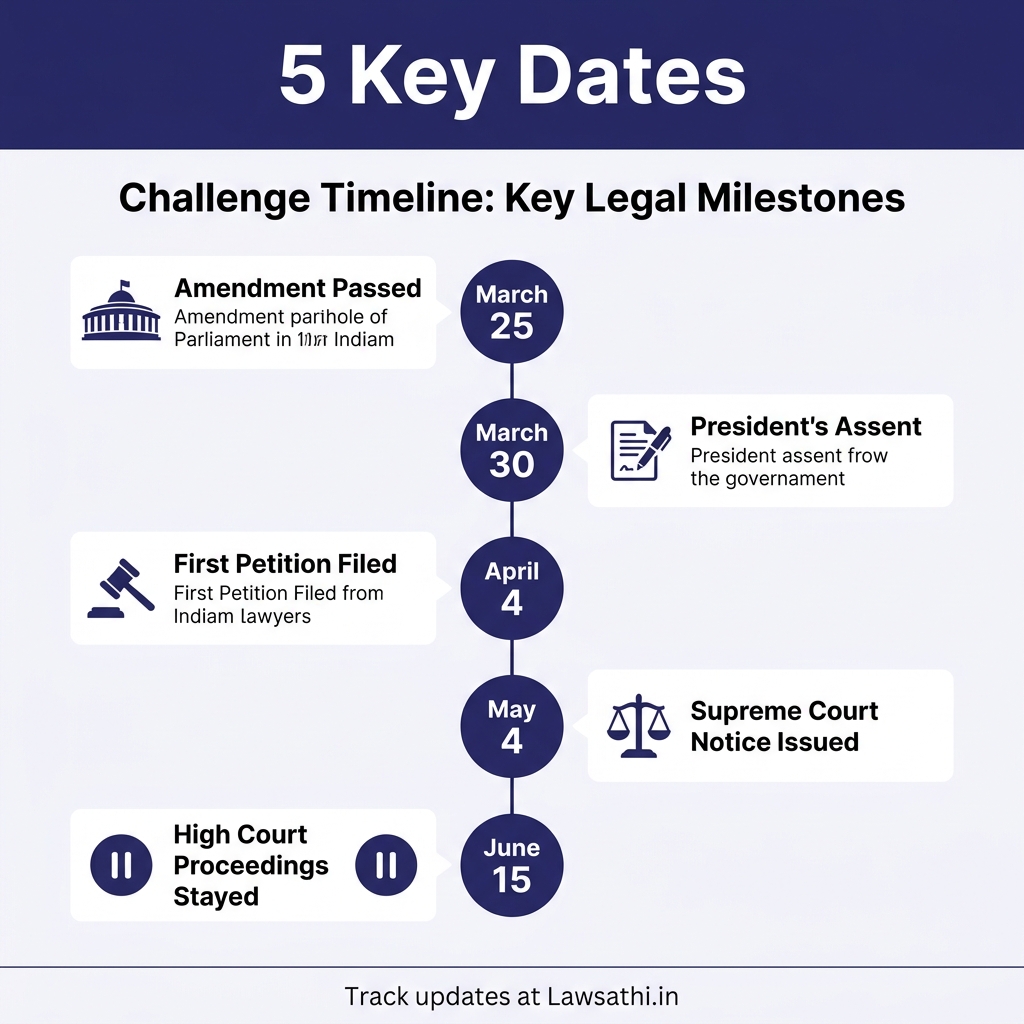
The constitutional challenge moves through multiple stages. Parliament passed the amendment on March 25, 2026. Subsequently, the President granted assent on March 30, 2026. The first Supreme Court petition was filed on April 4, 2026.
Notice was issued on May 4, 2026, with a six-week returnable period. On June 15, 2026, the Supreme Court stayed High Court proceedings according to LiveLaw’s update. Currently, the matter awaits constitution of a three-judge bench by the Chief Justice.
Core Constitutional Questions for Determination
The Court must answer whether ordinary legislation can remove a fundamental right. The doctrine of non-retrogression requires examination in this specific context. Furthermore, whether the legislature can change the “substratum” of a judicial decision presents a novel question.
Medical gatekeeping for gender recognition must be tested against Articles 14 and 21. Mandatory medical reporting triggers privacy concerns under K.S. Puttaswamy. Additionally, the penal provisions require scrutiny for unconstitutional vagueness.
Predicted Trajectory and Significance
The Supreme Court will likely consolidate all petitions before a three-judge bench. The bench may consider referring the matter to a Constitution bench given the fundamental rights implications. Moreover, interim relief for ongoing medical treatments may emerge as the Court examines affidavits.
This case tests India’s constitutional commitment to transgender rights a decade after NALSA. It determines whether legislative majorities can override judicial pronouncements on fundamental rights. Therefore, the verdict will significantly impact India’s standing in the international human rights community.
For constitutional law practitioners, this challenge represents a defining moment in Indian jurisprudence. The intersection of legislative competence, judicial authority, and fundamental rights has rarely been tested so directly.
Stay ahead of critical court updates with LawSathi. Use our AI-powered legal research tools to track case status, analyze precedents, and manage your practice efficiently. Start your free trial today.