
Introduction: The Current Legal Standoff on Stray Dog Management
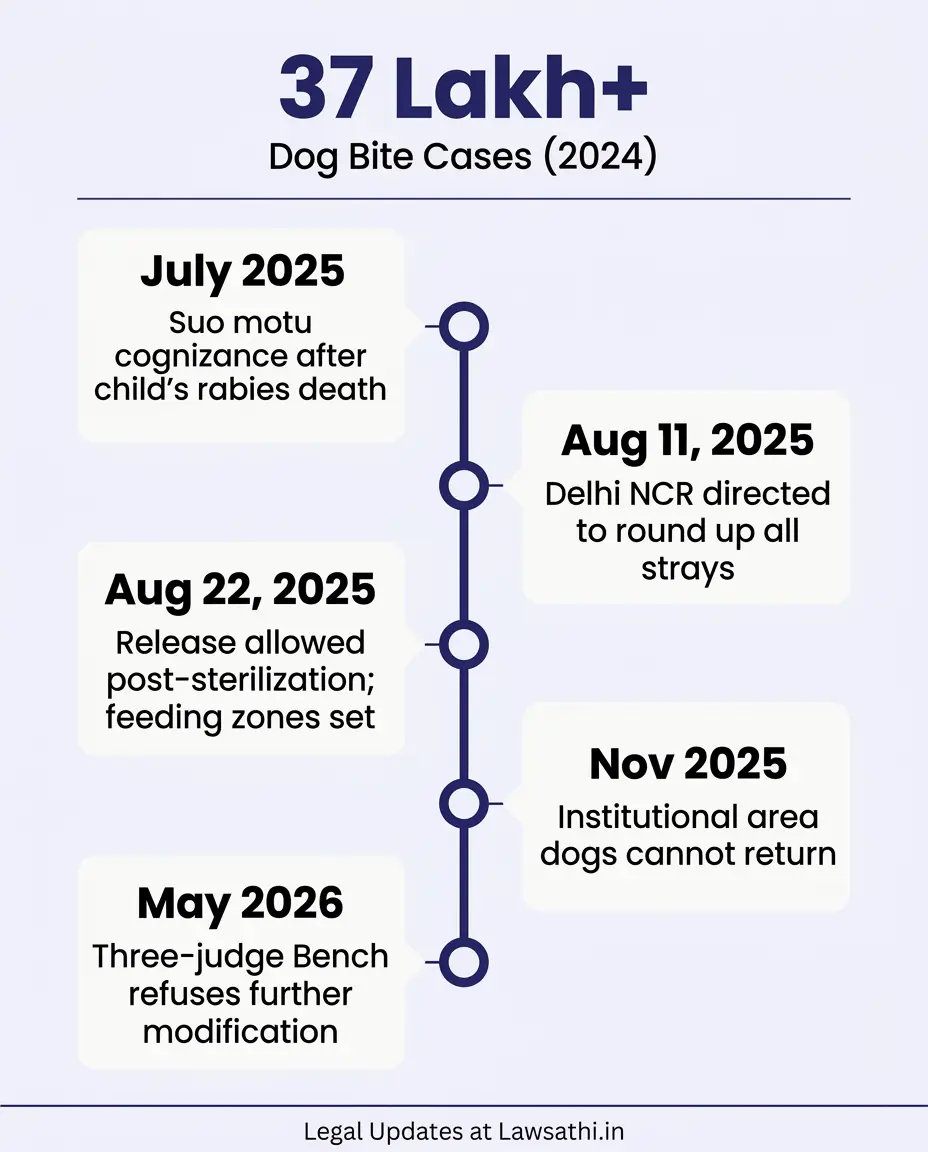
The Supreme Court order stray dogs removal has become a landmark ruling. Every Indian legal practitioner must understand this significant decision. On May 19, 2026, a three-judge Bench comprising Justices Vikram Nath, Sandeep Mehta, and NV Anjaria refused to modify its earlier directions. These directions concerned removing stray dogs from public places.
This decision has significant implications for municipal law practitioners. Additionally, animal rights litigators and lawyers advising local bodies must take note. The ruling emerges from a broader tension between public safety concerns and India’s evolving animal rights jurisprudence.
Why This Matters for Legal Practitioners
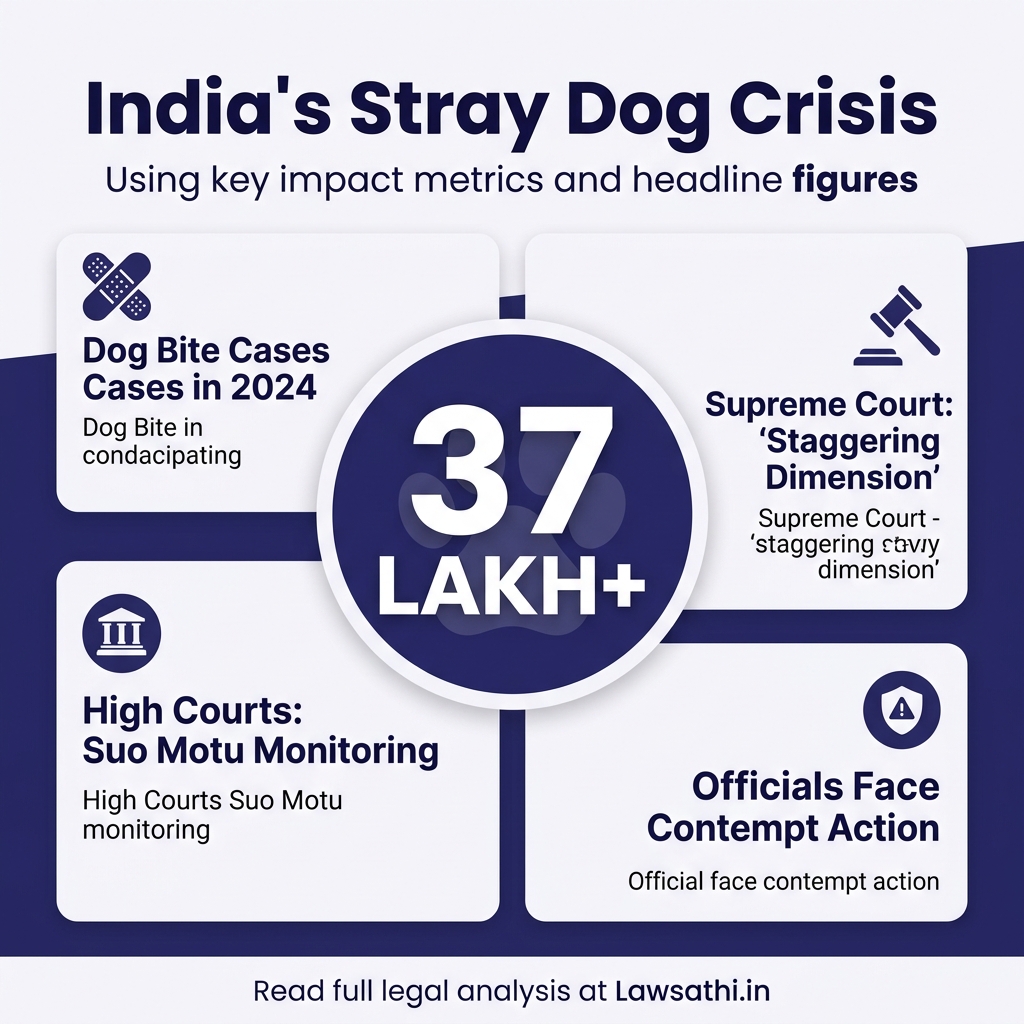
Over 37 lakh dog bite cases were reported in 2024 alone. Therefore, the Court acknowledged what it called a problem of “staggering dimension” according to LiveLaw’s coverage. Consequently, this development demands careful analysis from every litigation lawyer handling civic and public interest matters.
The significance extends beyond animal welfare litigation. High Courts across India have been directed to register suo motu cases to monitor compliance. Furthermore, erring officials now face contempt and disciplinary action. As a result, lawyers advising Urban Local Bodies (ULBs), Resident Welfare Associations (RWAs), and institutional clients must understand the legal boundaries clearly.
Case Background: The Plea for Modification
The Genesis of the Proceedings
The Supreme Court’s involvement began on July 28, 2025. A two-judge Bench of Justices JB Pardiwala and R Mahadevan took suo motu cognizance of a Times of India report. The article was titled “City Hounded by Strays, Kids Pay Price.” It detailed the tragic death of a six-year-old girl from rabies after a dog attack in Delhi.
Subsequently, on August 11, 2025, the Court issued extraordinary directions. These included rounding up all stray dogs from Delhi NCR. Additionally, the dogs were to be relocated to designated shelters. Most significantly, dogs were not to be released back to streets under any circumstances as per the Supreme Court’s order.
Subsequent Modifications and Petitioner Challenges
However, on August 22, 2025, a three-judge Bench modified these directions. Dogs could now be released back to the same locality after sterilization and vaccination. The exception applied only to rabid, aggressive, or suspected rabid dogs.
Additionally, designated feeding zones became mandatory. Individual dog lovers were required to deposit Rs. 25,000. In contrast, NGOs had to deposit Rs. 2,00,000.
The November 7, 2025 order further refined the framework. Dogs picked up from “institutional areas” like schools, hospitals, and airports would not be released back to the same premises according to the final order. Consequently, multiple petitioners, including animal rights organizations, sought modification of these directions.
The Court’s Reasoning for Declining Modification
Justice Sandeep Mehta’s observations proved particularly significant. He stated that the “right to life with dignity encompasses the right to live freely without threat of harm from a dog bite attack.”
The Court emphasized that the Constitution doesn’t envisage a specific type of society. Specifically, it rejected a society where children and elderly people survive on the mercy of physical strength or chance as reported by Bar & Bench. Therefore, the Court declined to modify its earlier directions.
—
The Legal Framework: ABC Rules and Prevention of Cruelty to Animals Act
Understanding the Animal Birth Control Rules, 2023
The Animal Birth Control (ABC) Rules, 2023 provide the statutory foundation for stray dog management in India. Notified on March 10, 2023, these rules superseded the 2001 ABC Rules. Furthermore, they operate under the Prevention of Cruelty to Animals Act, 1960.
Rule 11(19) specifically mandates that dogs shall be released at the same place. This must be the same locality from where they were captured. Geo-tagging of both capture and release locations is mandatory. Additionally, sterilization, deworming, and immunization must be completed before release per AWBI guidelines.
The Prevention of Cruelty to Animals Act, 1960
The PCA Act 1960 establishes the broader legislative framework. Section 9(h) defines cruelty to include abandoning animals without reasonable cause. Section 11 prescribes offenses for cruel treatment. Moreover, Section 38 grants rule-making authority to the Central Government.
However, the Supreme Court’s interpretation in its August 22, 2025 order clarified the legal position. The Court stated that “intensive implementation of the Animal Birth Control program by local bodies is the only rational and scientific solution.” This solution addresses overpopulation and rabies control as noted in the judgment.
The Tension Between Rules and Court Directions
A significant legal tension now exists. The ABC Rules mandate release back to the same locality. However, the Supreme Court’s November 2025 directions create an exception for “institutional areas.”
Therefore, practitioners must navigate this apparent conflict carefully. The Court’s reasoning suggests that statutory provisions cannot override the fundamental right to life under Article 21. As a result, lawyers must advise clients accordingly.
Defining ‘Critical Areas’: Legal Ambiguities and Interpretations
What Constitutes an Institutional or Critical Area?
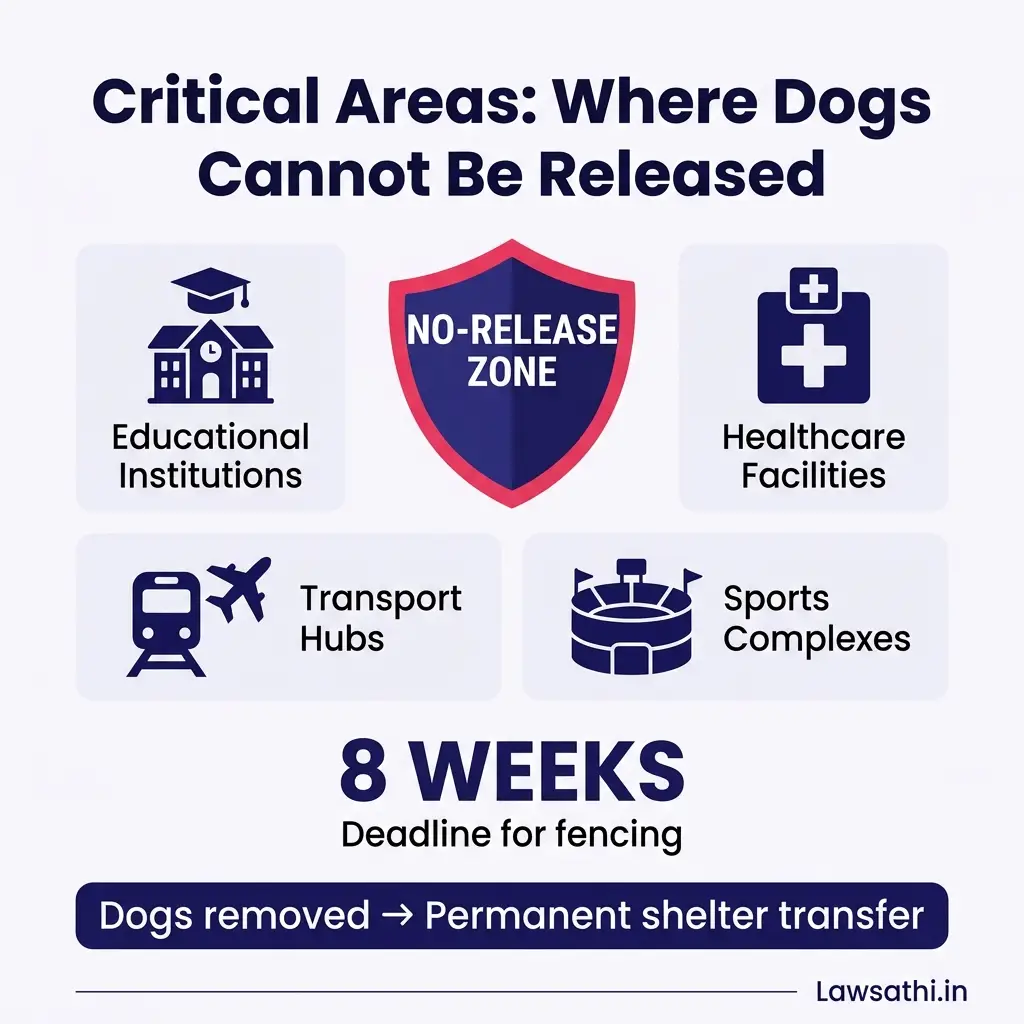
The Supreme Court has provided a specific definition. The Court listed educational institutions as protected zones. These include both government and private schools and colleges. Additionally, hospitals, sports complexes, railway stations, bus stands, and airports fall under this category per SCC Times analysis.
For these areas, distinct legal requirements apply. Fencing or boundary walls must be completed within eight weeks. Nodal officers must be designated immediately. Furthermore, regular municipal inspections are mandated every three months.
Legal Requirements for Critical Areas
The requirements create enforceable obligations. First, removal of stray dogs by municipal bodies must happen “forthwith.” Second, dogs removed from these areas cannot be released back to the same location. Third, they must be shifted to designated shelters permanently.
The Court explicitly reasoned that permitting release back to institutional areas would “frustrate the very effect of the directions issued to liberate such institutional areas.” Therefore, a clear legal distinction now exists between general public places and critical areas.
Practical Challenges for Implementation
Municipal Corporations face substantial hurdles in implementing these directions. For example, infrastructure gaps persist across most Indian cities. Adequate dog pounds and shelters are lacking. Moreover, manpower shortages affect veterinary staff and dog-catching personnel. Additionally, specially modified vehicles remain insufficient in most jurisdictions.
These practical challenges create liability risks. When municipalities fail to implement ABC programs properly, they expose themselves to compensation claims from dog bite victims. Consequently, legal practitioners must advise municipalities about these risks.
Implications for Municipal Bodies and Local Administration
Mandatory Obligations Under Current Law
Urban Local Bodies now face clear statutory duties. First, they must implement ABC programs as mandated by Rule 3 of the ABC Rules 2023. Second, they must set up at least one ABC centre per district. Additionally, they must create designated feeding zones per ward and establish municipal helplines.
The Supreme Court’s May 2026 order added further requirements. States must ensure anti-rabies vaccine availability. They must file compliance affidavits regularly. Most importantly, they must secure institutional areas with proper fencing.
Liability Risks for Municipalities
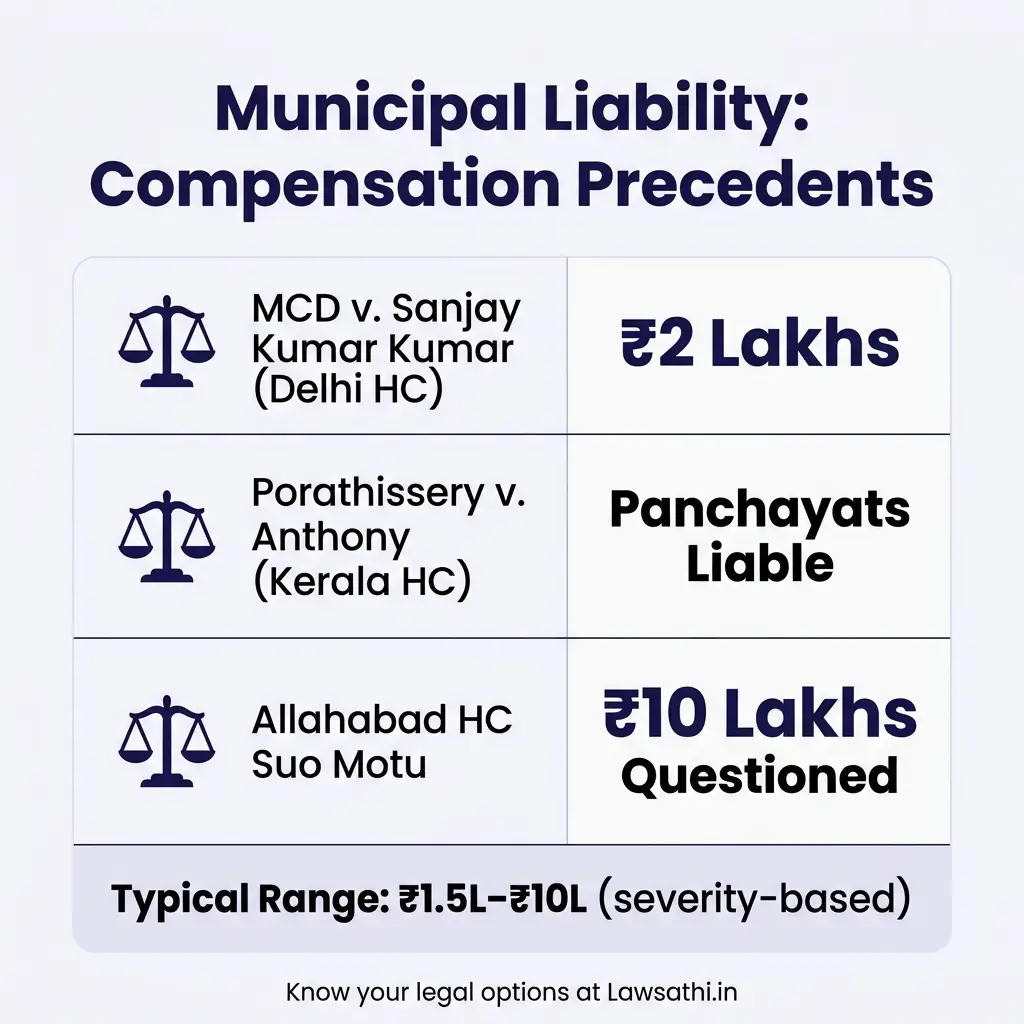
Several precedents establish municipal liability for dog bite incidents. In MCD v. Sanjay Kumar, the Delhi High Court awarded Rs. 2 lakhs compensation for injuries from stray animals as per the judgment. The Court held that municipal corporations have a duty to protect citizens from such threats.
Similarly, in Porathissery Grama Panchayath v. Anthony, the Kerala High Court ruled that panchayats are duty-bound to pay compensation. This compensation goes to dog bite victims. Furthermore, the Allahabad High Court, in a suo motu case, asked the Nagar Nigam a specific question. The Court asked why Rs. 10 lakhs compensation should not be awarded after a child was killed by stray dogs as reported by SCC Online.
Protection for Officials Acting in Good Faith
The Supreme Court has provided some protection for officials. Officials performing their duties to secure places from dogs “shall be entitled to due protection.” No FIRs or criminal complaints should ordinarily be registered against them.
However, this protection applies only to lawful actions performed in good faith. Therefore, lawyers must advise municipal officials to document their actions carefully. This documentation serves as evidence of good faith if disputes arise.
Impact on Ongoing Litigation and Future Remedies
Effect on Pending High Court Cases
The Supreme Court’s directions create a unified framework for handling stray dog cases. The Registry was directed to seek information on similar pending writ petitions from all High Courts. Such petitions are to be transferred to the Supreme Court for analogous consideration. This ensures a “uniform and coherent approach” across the country.
Furthermore, High Courts must register suo motu cases to monitor compliance. This creates parallel monitoring mechanisms at the state level. Therefore, lawyers handling such matters must track both Supreme Court and High Court developments.
Alternative Remedies for Aggrieved Citizens
For dog bite victims, multiple legal avenues exist. Compensation claims can be filed against municipal corporations. Additionally, consumer forums can address negligence claims. Writ jurisdiction remains available for enforcement of duties. Moreover, criminal complaints can target specific individuals for negligence.
For residents facing dog menace, the options differ. First, they must complain to municipal helplines, which are now mandatory. Second, they can petition the District Magistrate. Finally, they can make representations to the Animal Welfare Board of India (AWBI).
The Role of AWBI in Enforcement
The AWBI plays a crucial administrative role in implementation. It grants Project Recognition to Animal Welfare Organizations for ABC programs. Additionally, it issues SOPs and guidelines. Furthermore, it monitors nationwide sterilization and vaccination drives.
However, as of January 2026, only 76 recognized sterilization centers exist nationwide per Bar & Bench reporting. Consequently, the infrastructure gap remains significant. Lawyers advising clients must consider this practical limitation.
Practical Takeaways for Legal Practitioners
Advising Resident Welfare Associations
Lawyers advising RWAs must provide clear guidance on legal boundaries. First, RWAs cannot independently remove dogs. Second, they must coordinate with municipal authorities for designated feeding zones. Third, they can demand compliance with ABC programs in their areas. However, they cannot encourage feeding on streets, which is now prohibited.
Most importantly, RWAs must understand the legal consequences. Any attempt at independent removal or obstruction of municipal officials can attract criminal liability. Furthermore, they cannot support mass culling or cruel methods under any circumstances.
Defending Animal Rights Organizations
Practitioners representing animal welfare groups face new challenges. The May 2026 order emphasizes human right to life concerns more heavily than before. Additionally, the “critical areas” exception limits the general release-back principle established in ABC Rules.
However, strong legal arguments remain available for defense counsel. The ABC Rules 2023 represent a statutory mandate that courts must respect. Moreover, the right to life extends to animals under Article 21 interpretation. The Prevention of Cruelty to Animals Act prohibits cruel treatment. Furthermore, scientific evidence supports sterilization over removal as an effective approach.
Key Case Laws for Reference
Practitioners should familiarize themselves with essential precedents in this area. The leading case is In Re: “City Hounded by Strays, Kids Pay Price” (2025 INSC 977, 1018, 1357). Additionally, Animal Welfare Board of India v. People for Elimination of Stray Troubles (WP 691/2009) provides critical ABC Rules interpretation as documented in case law.
For compensation claims, two cases remain essential reading. MCD v. Sanjay Kumar (Delhi HC, 2011) and MCD v. Sushila Devi (1999, 4 SCC 317) establish municipal liability principles available on Indian Kanoon. These cases are applicable to stray animal incidents nationwide.
Compensation Claim Strategies
For lawyers handling dog bite compensation cases, documentation proves critical. Photographs of injuries must be preserved carefully. Medical records and bills require proper maintenance. Furthermore, FIR or police reports should be filed immediately after incidents.
Compensation typically ranges from Rs. 1.5 lakhs to Rs. 10 lakhs depending on severity. Death cases command higher compensation amounts. Additionally, loss of vision or disability cases have seen awards exceeding Rs. 2 lakhs in various precedents.
Conclusion: Navigating the Evolving Legal Landscape
The Supreme Court order stray dogs removal represents a significant shift in Indian jurisprudence. The Court has balanced animal welfare concerns against public safety imperatives. For legal practitioners, this creates both challenges and opportunities.
Municipal law practitioners must ensure their clients comply with the expanded obligations. Litigation lawyers handling public interest matters must navigate the new framework carefully. Furthermore, compensation claims for dog bite victims now have stronger judicial support than before.
The key takeaway remains clear for all practitioners. Sterilization and vaccination programs must be implemented intensively. Critical areas require special protection under the new framework. Moreover, municipal bodies face genuine liability risks for non-compliance. Therefore, proactive legal counsel for ULBs, institutions, and RWAs has become essential in this evolving regulatory environment.
Stay ahead of evolving legal precedents. Use LawSathi’s AI-powered case law research tools to analyze Supreme Court rulings and manage your litigation workflow efficiently. Start your free trial today.