
Introduction: Reinforcing Administrative Hierarchy in the Judiciary
Defined administrative protocols form the backbone of judicial independence in India’s legal system. Without clear chains of command, the judiciary risks internal chaos and external influence. Therefore, the Supreme Court Registrar General disciplinary action ruling on May 18, 2026, has now reinforced this critical principle.
A bench comprising Chief Justice of India Surya Kant and Justice Joymalya Bagchi delivered a landmark judgment. The Court held that a Registrar General of a High Court lacks independent authority. Specifically, he cannot initiate disciplinary proceedings against judicial officers on his own. This ruling carries significant implications for judicial officers across India and High Court administration nationwide.
The case, Uttarakhand High Court v. Deepali Sharma [SLP(C) No. 16520/2026], addresses fundamental questions about administrative control. Specifically, it clarifies who holds the power to discipline judicial officers under Article 235 of the Constitution.
Constitutional Significance of the Ruling
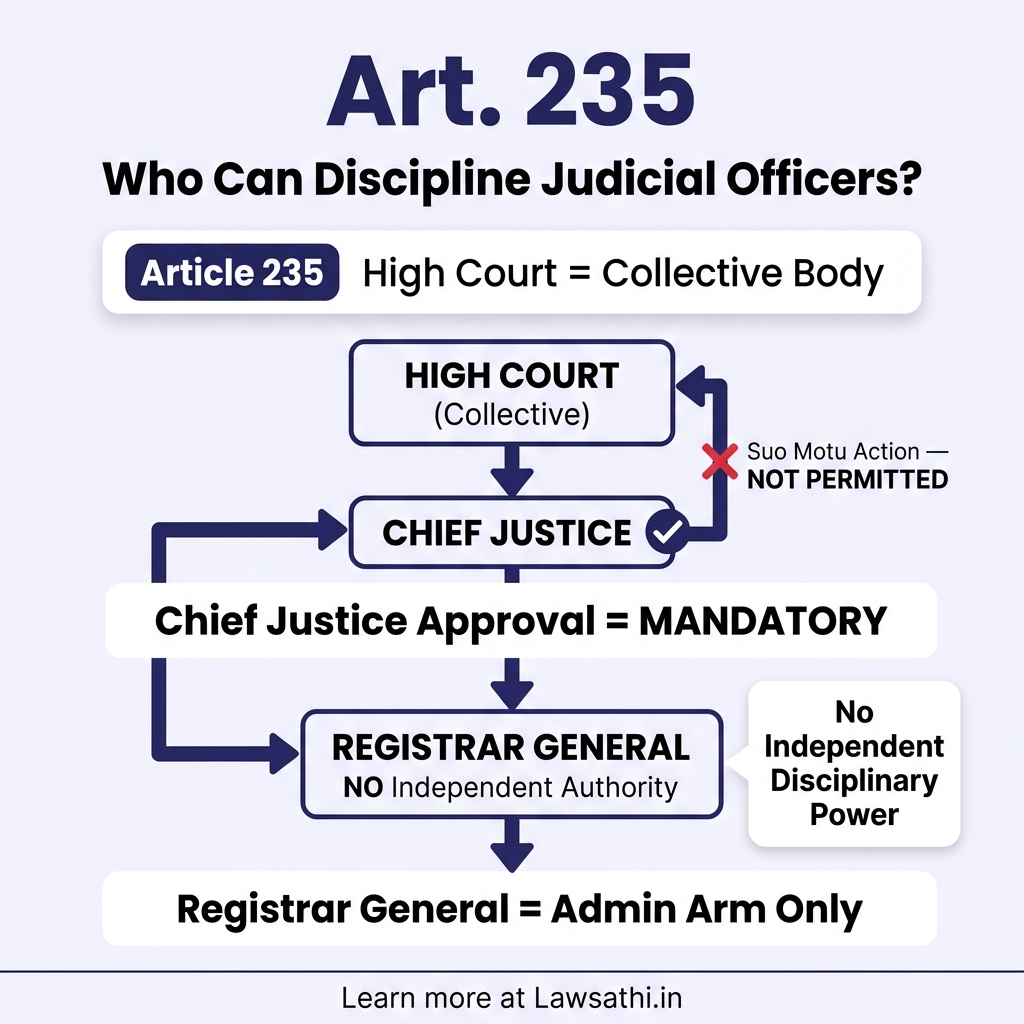
The Supreme Court emphasized the constitutional mandate under Article 235. This article vests disciplinary control over subordinate judiciary in the High Court. However, “High Court” means the collective body of judges, not administrative staff. The Chief Justice serves as the administrative head who must authorize any disciplinary action.
Case Background: What Triggered the Supreme Court’s Intervention?
The Parties Involved
The appellant was the High Court of Uttarakhand at Nainital, acting through its administrative side. The respondent was Deepali Sharma, a Civil Judge (Senior Division). She faced serious allegations that led to her termination from service.
The Anonymous Complaint
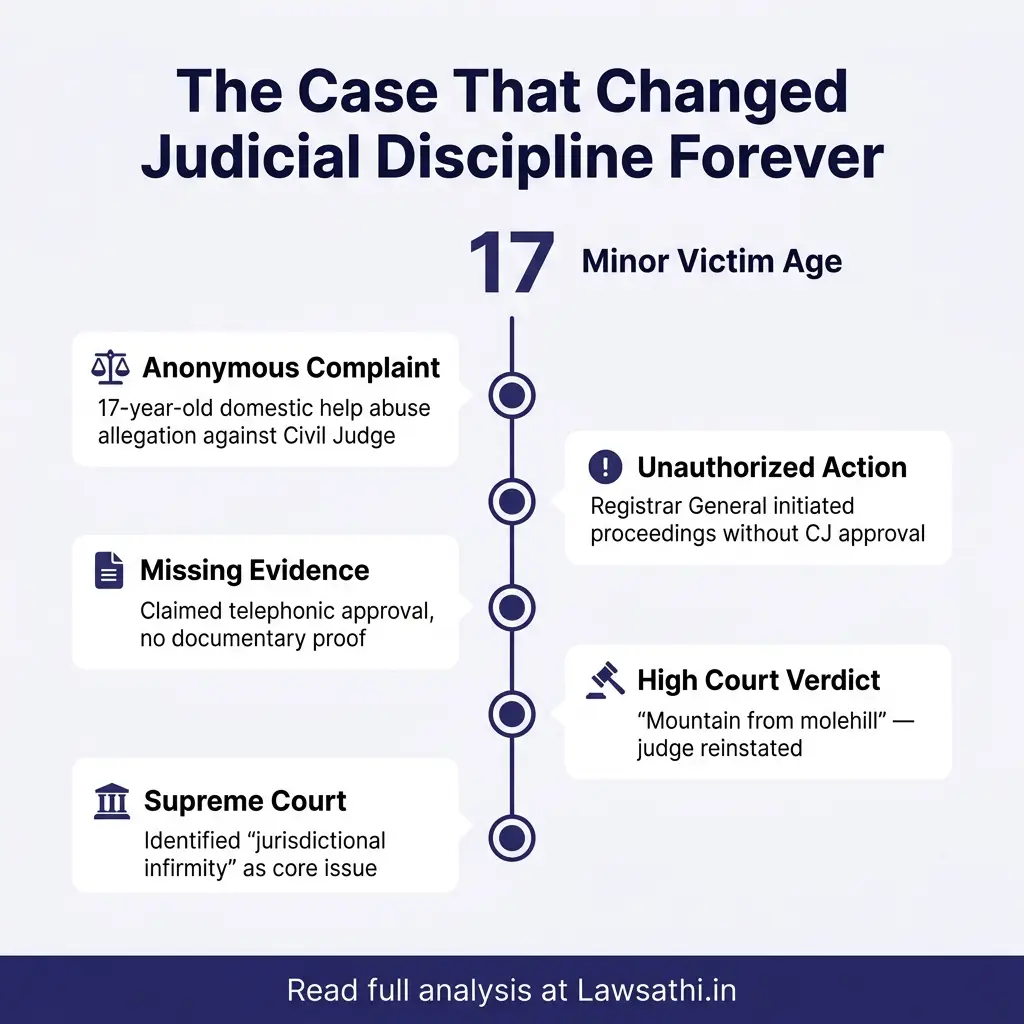
The controversy began in 2020 with an anonymous complaint sent to the Uttarakhand High Court’s email. The complaint alleged that the judicial officer physically and emotionally abused a 17-year-old minor girl. Furthermore, the girl was employed as a domestic help at the judge’s residence.
Following this complaint, the Registrar General initiated disciplinary proceedings. However, he did so without documented approval from the Chief Justice. Consequently, this procedural gap became the central issue before the Supreme Court.
Actions Taken by the Registrar General
The Registrar General acted swiftly after receiving the anonymous complaint. He claimed telephonic approval from the then-Chief Justice for the suspension order. However, no documentary proof of this authorization was placed on record.
Furthermore, the Registrar General raided the judge’s residence with a large police force. He also brought two videographers to document the raid. The Uttarakhand High Court later described this as “over-kill or motivated” action.
The High Court’s January 2026 Order
On January 6, 2026, a Single Bench of the Uttarakhand High Court reinstated the judge. The Court described the case as one of “no evidence.” Additionally, it called the case a “carefully crafted edifice without a foundation.” It also labeled the proceedings a “mountain made out of a molehill.”
The High Court found the manner of inquiry “shocking.” It questioned whether the approach was disproportionate. Alternatively, it asked whether the approach was motivated by factors beyond the allegations.
The Supreme Court’s Rationale: Authority of the Chief Justice
Constitutional Framework Under Article 235
Article 235 of the Constitution vests control over district courts and subordinate courts in the High Court. This control includes posting, promotion, and disciplinary matters. Therefore, the Supreme Court examined whether the Registrar General could exercise this power independently.
The Court held that the power under Article 235 belongs to the High Court collectively. This necessarily includes the Chief Justice and companion judges. Therefore, the Supreme Court Registrar General disciplinary action decision clarifies that administrative officers cannot bypass this constitutional structure.
Chief Justice as “Master of the Roster”
The Court reaffirmed the concept of the Chief Justice as the administrative head of the High Court. As “Master of the Roster,” the Chief Justice controls all administrative matters. This includes disciplinary control over the subordinate judiciary.
According to the Supreme Court, the Registrar General acts only as an administrative arm. He cannot function as an independent decision-making authority in disciplinary matters. This distinction is crucial for maintaining proper judicial hierarchy.
Key Observations from the Judgment
The Supreme Court made several critical observations. Specifically, it stated that the Registrar General has “absolutely no authority” to suo motu initiate disciplinary action. This applies both under the Constitution and statutory rules governing judicial service conditions.
> “Unless the disciplinary action is approved by the Chief Justice of the High Court, or by a committee of judges constituted by him and delegated for all intents and purposes, such proceedings cannot be validly initiated.”
The Meaning of “High Court” in Disciplinary Matters
The Court clarified that “High Court” in Article 235 means the collective judicial body. It does not refer to administrative functionaries. Therefore, the Registrar General can only act on behalf of the Chief Justice and judges. He cannot act independently under any circumstances.
Limits of Suo Motu Power: Why Procedural Safeguards Matter
The Strict Chain of Command
Disciplinary actions against judicial officers must follow a strict chain of command. The Supreme Court established that any deviation renders proceedings void ab initio. In other words, such proceedings are invalid from their very inception.
The Court found a “jurisdictional infirmity” in the present case. This infirmity went to the root of the matter. Therefore, the entire disciplinary action collapsed due to procedural failure.
Risks of Unchecked Administrative Power
Unchecked power in administrative officials poses serious risks to judicial independence. Arbitrary actions can destroy careers without proper oversight. Consequently, the Supreme Court Registrar General disciplinary action ruling addresses these concerns directly.
| Risk | Protection Provided | |——|———————| | Arbitrary action | CJ approval creates documented oversight | | Harassment of officers | Neutral committee review required | | Politically motivated complaints | Proper verification before initiation | | Anonymous complaint misuse | Filter through judicial process |
Protection from Victimisation
This ruling protects judicial officers from potential harassment or victimization. Administrative officials may have biases or external influences. Therefore, the Chief Justice’s approval creates an independent filter before proceedings begin.
Additionally, the judgment protects officers from anonymous complaints triggering immediate action. Even serious allegations require proper authorization before investigation.
Distinction Between Administrative and Adjudicatory Roles
The Registrar General performs important administrative duties. These include managing court operations, records, and communications. However, he has no adjudicatory functions in disciplinary matters.
He cannot be a decision-maker in proceedings against judicial officers. Only the Chief Justice or a duly constituted committee of judges holds this authority. Thus, this distinction preserves the integrity of disciplinary processes.
Impact on High Court Administration and Judicial Officers
Changed Standard Operating Procedures
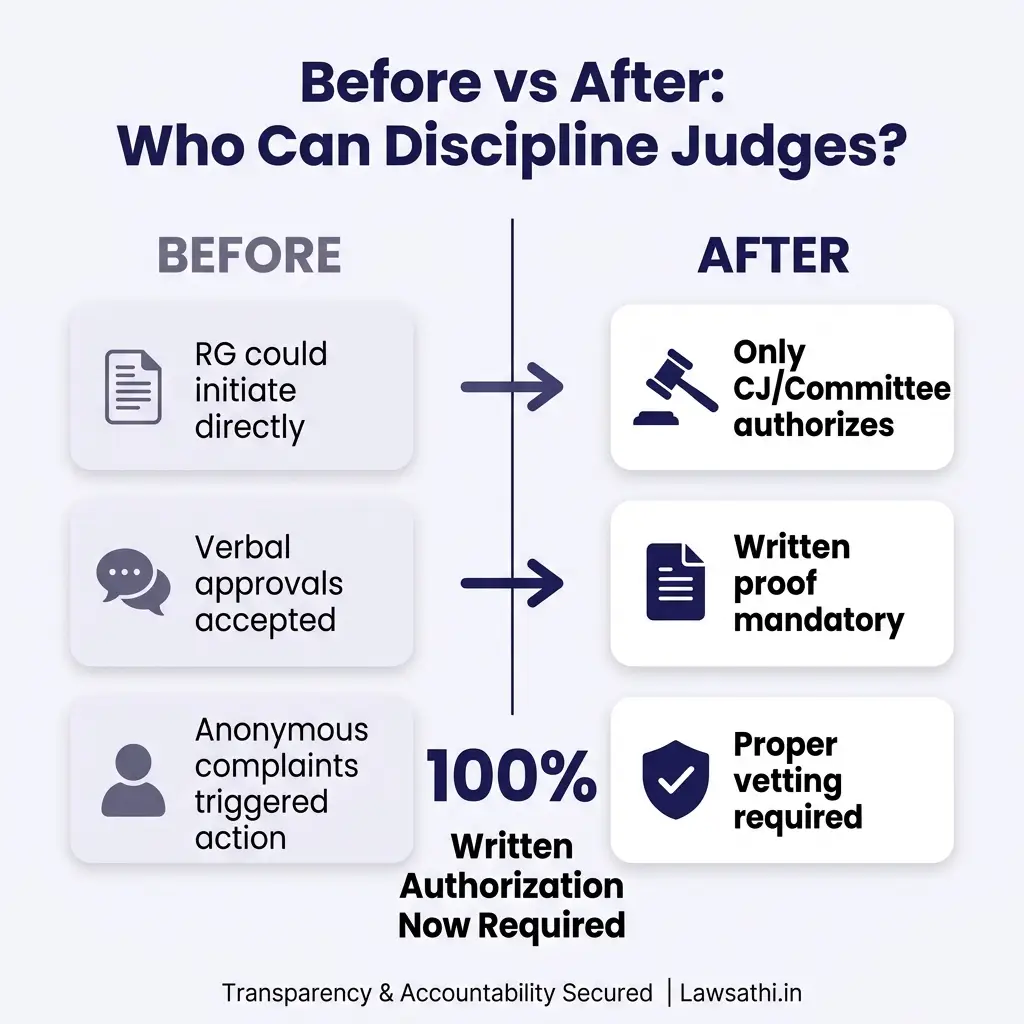
This judgment fundamentally alters how complaints against judicial officers must be handled. Previously, some High Courts may have allowed Registrars General to initiate proceedings. However, such actions now require explicit Chief Justice approval.
| Before This Judgment | After This Judgment | |———————-|———————| | RG could initiate based on complaints | Only CJ or committee can authorize | | Verbal approvals were accepted | Documentary proof mandatory | | Anonymous complaints triggered action | Proper vetting through CJ required |
Mandatory Documentation Requirements
Going forward, High Courts must maintain clear documentation. The Chief Justice must provide written authorization before any inquiry begins. Furthermore, if the Chief Justice delegates authority, it must go to a properly constituted committee.
Moreover, proof of approval must be placed on the official record. Telephonic or verbal approvals will no longer suffice. This ensures transparency and accountability in the process.
Implications for Service Matters and Tribunals
This ruling affects ongoing and future service matters involving judicial officers. Tribunals handling appeals from judicial officers must now verify proper authorization. Additionally, past disciplinary proceedings may face challenges if they lacked documented Chief Justice approval.
Defense lawyers now have a new ground to challenge disciplinary proceedings. Specifically, they can question whether the initiation followed proper constitutional procedure.
Guidance for Lawyers Defending Judicial Officers
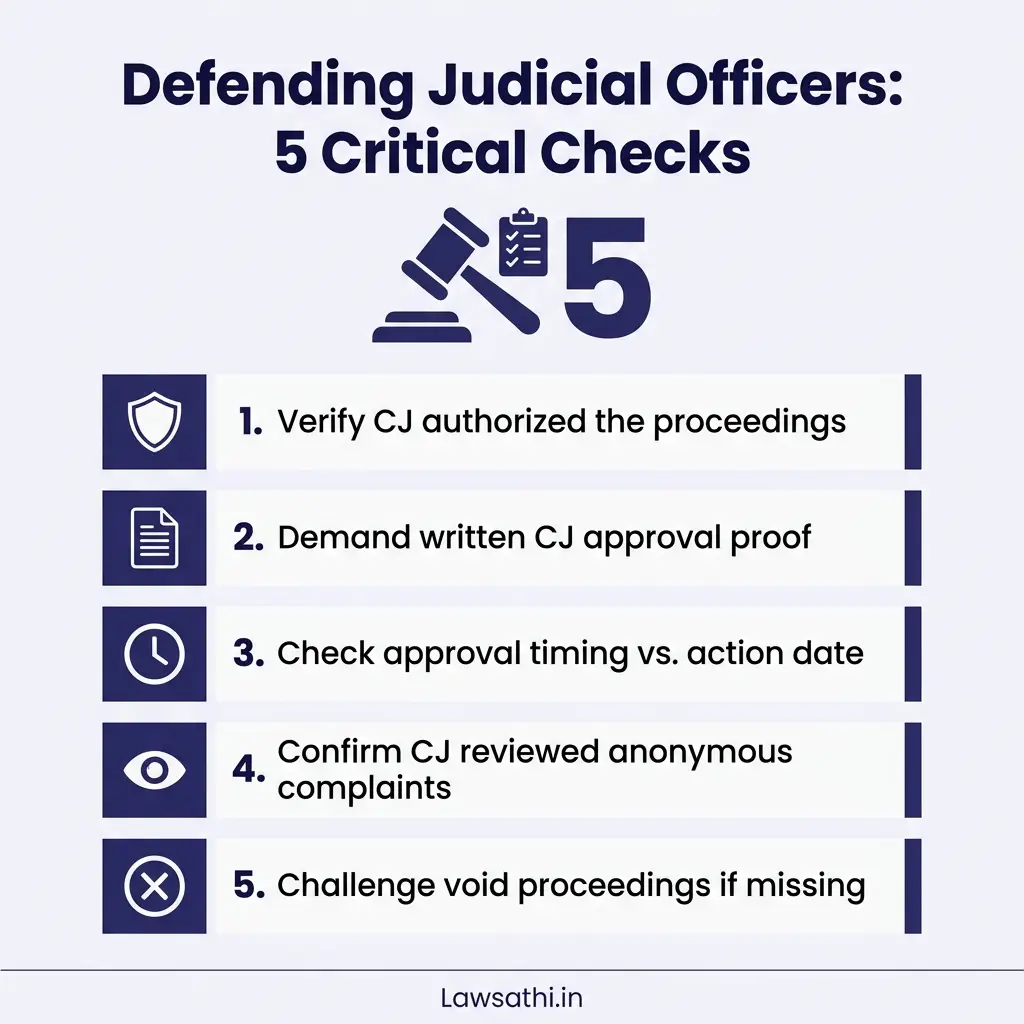
Practicing lawyers defending judicial officers should check several critical points. First, they must verify whether the Chief Justice authorized the initiation. Second, they should demand documentation of this approval.
Additionally, lawyers should challenge any verbal authorizations as insufficient. They must examine when approval was given versus when proceedings began. If a committee handled the matter, lawyers should verify its proper constitution.
For cases involving anonymous complaints, lawyers must demand proof of Chief Justice review. In such cases, the complaint should have been placed before the Chief Justice before any action.
Conclusion: Upholding Judicial Independence and Hierarchy
The Supreme Court’s ruling establishes one clear principle above all else. The Chief Justice, or a properly delegated committee, stands as the sole authority to sanction disciplinary inquiries. No other administrative official holds this power independently.
This judgment reinforces the Supreme Court’s stance on maintaining discipline within administrative hierarchy. It balances two critical values: accountability through proper process and independence from arbitrary action. Moreover, the Court prioritized procedural integrity even when faced with serious allegations.
Broader Implications for the Indian Judiciary
This precedent strengthens judicial independence at the district level across India. It creates uniform standards for all High Courts to follow. Furthermore, the ruling reinforces the separation of powers within the judiciary itself.
Judicial officers can now feel more secure in their positions. They know that proper procedures must precede any disciplinary action against them. Ultimately, this security benefits the administration of justice throughout India.
Final Thoughts
The High Court Chief Justice approval requirement is not mere formality. Rather, it represents a constitutional safeguard against abuse of administrative power. As the Supreme Court noted, proceedings without such approval are void from the beginning.
This ruling serves as a reminder that procedure matters in law. Even serious allegations must follow proper channels before initiating action against judicial officers.
Stay updated with the latest legal judgments and streamline your case management. Try LawSathi free for 14 days to automate your legal practice and track court updates effortlessly.