
A fundamental confusion has long plagued criminal courts across India regarding discharge powers in summons cases. Many magistrates have struggled with whether they can discharge an accused at the Section 251 CrPC stage. The Section 251 CrPC discharge question has now received definitive clarification through judicial precedent.
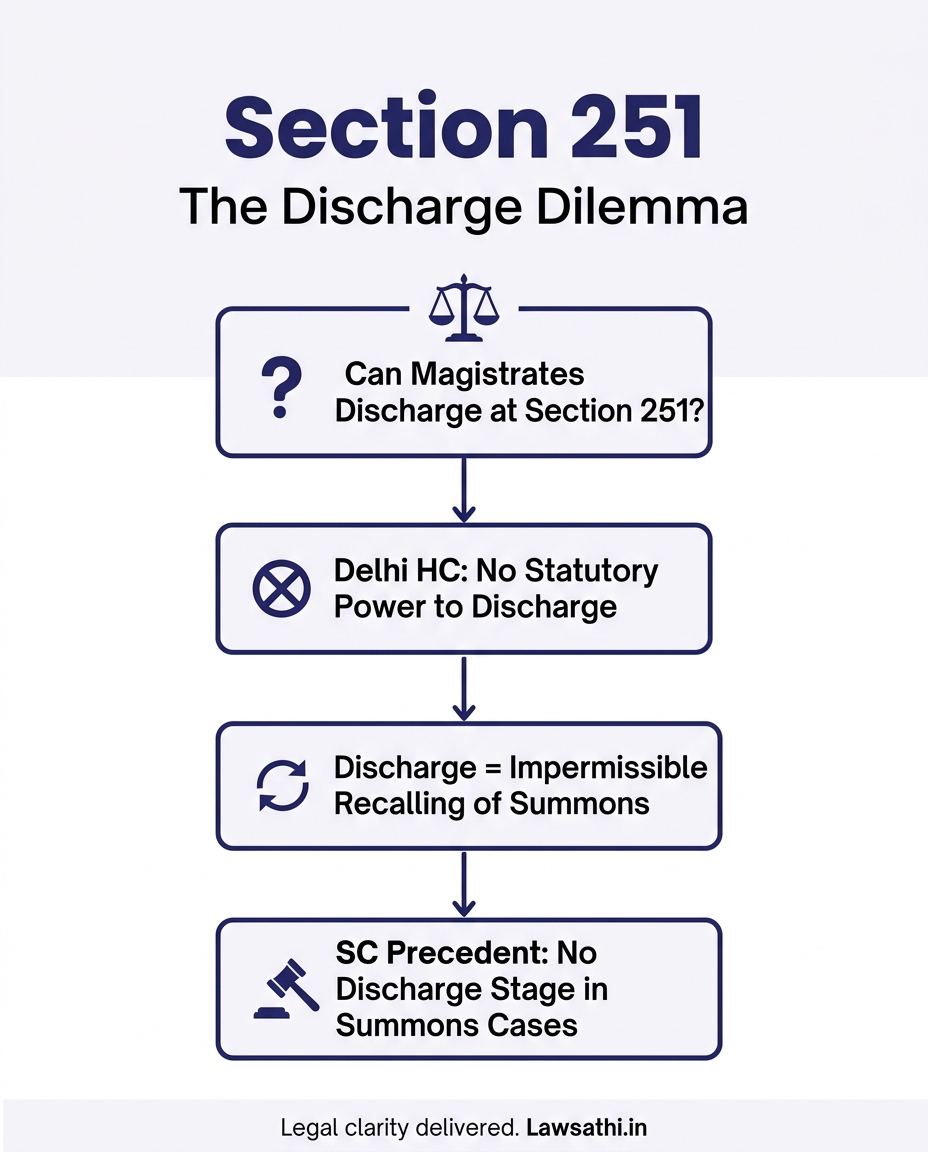
Recently, the Delhi High Court ruled that magistrates lack the statutory power to discharge accused persons at this procedural stage in summons cases. This ruling carries profound implications for procedural compliance in lower courts across India.
Introduction: The Critical Procedural Distinction
The confusion surrounding discharge powers in summons cases stems from inconsistent judicial approaches over the years. Some magistrates have attempted to apply discharge provisions meant for warrant cases to summons proceedings. As a result, this practice has led to conflicting orders and procedural uncertainty in criminal courts nationwide.
Why This Matters for Criminal Practitioners
The Delhi High Court’s ruling in Tulip Multispecialty Hospital (P) Ltd. v. Akhil Saxena addressed this issue head-on. According to the full text of the Delhi High Court judgment, magistrates cannot discharge accused persons after cognizance has been taken and summons issued. The Court held that such discharge would effectively amount to “recalling of summons.” This action is impermissible under law.
This clarification ensures uniform application of criminal procedure across magistrate courts. Furthermore, it prevents unauthorized judicial review at an inappropriate stage of proceedings. It also maintains the integrity of summons trial procedure under Chapter XX of the CrPC.
The Foundation: Supreme Court Precedents
The Delhi High Court relied heavily on established Supreme Court precedents. In Subramanium Sethuraman v. State of Maharashtra, a three-judge bench definitively held that summons cases do not contemplate a discharge stage. The Court emphasized that Chapter XX of the CrPC lacks any provision equivalent to Section 239. As LiveLaw’s analysis notes, this precedent squarely addresses the issue.
Understanding Section 251 CrPC: The ‘Substance of Accusation’
To grasp why discharge is impermissible at this stage, we must examine what Section 251 actually mandates. The provision serves a specific, limited function in the trial of summons cases.
The Statutory Text Explained
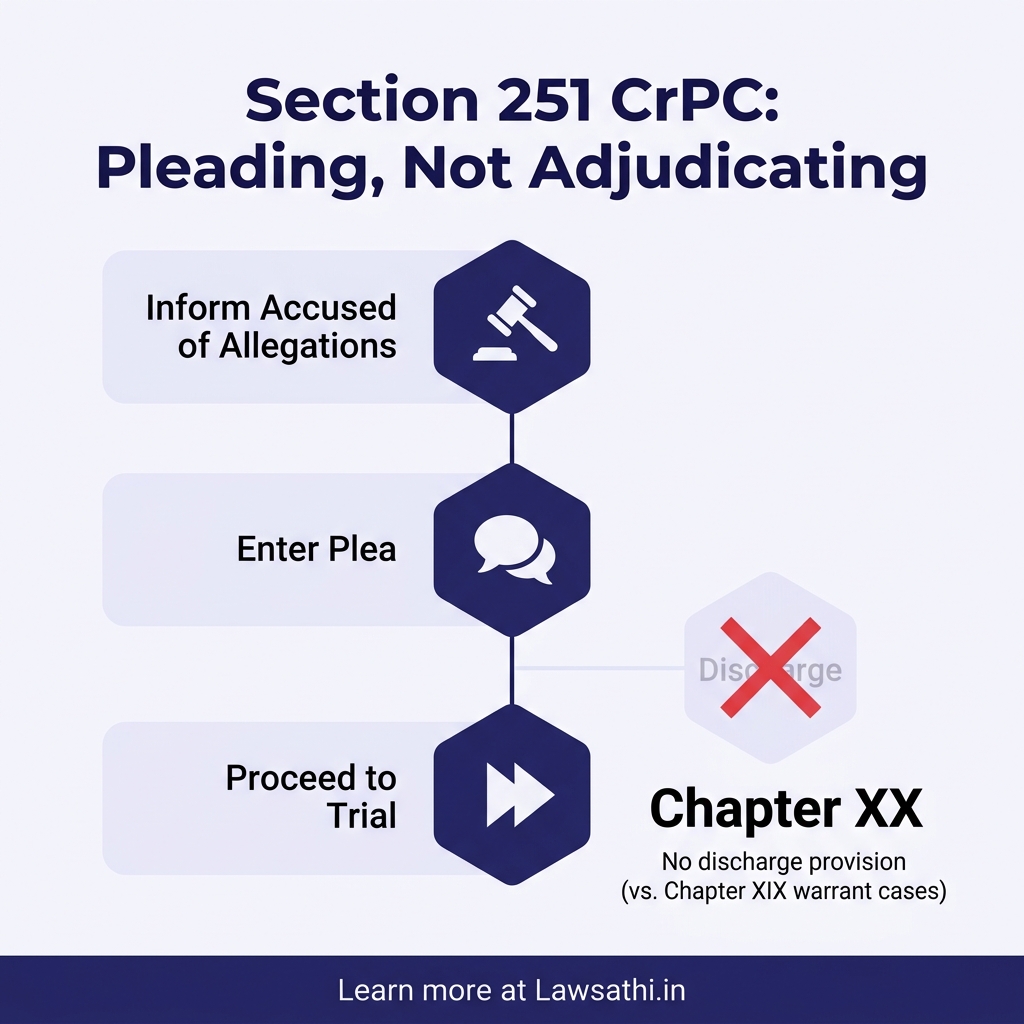
Section 251 CrPC states that when an accused appears before a Magistrate in a summons case, the particulars of the offence shall be stated to him. The accused must then be asked whether he pleads guilty or has any defence to make. Importantly, the statute explicitly states that it shall not be necessary to frame a formal charge.
The provision appears in Chapter XX, which governs the trial of summons cases entirely. As the text of Section 251 on Indian Kanoon makes clear, this is a pleading stage, not an adjudicatory one. Therefore, the legislature designed this as an expedited procedure for lesser offences.
What Section 251 Actually Does
This provision serves merely to inform the accused of the allegations. The accused then enters a plea of guilty or not guilty. No formal charge document needs preparation in summons cases. Consequently, the trial proceeds directly after this brief interaction.
However, some courts have erroneously treated this stage as an opportunity to evaluate evidence sufficiency. This misapprehension has caused significant procedural confusion. As SCC Online’s detailed analysis explains, discharge simply has no place in the summons trial scheme.
Contrast with Warrant Case Procedure
Warrant cases follow an entirely different procedural track. Section 240 CrPC governs charge framing in warrant cases instituted on police reports. Section 246 addresses warrant cases instituted otherwise than on police reports.
Both provisions require formal charge framing after the prosecution presents its case. More importantly, Section 239 provides for discharge in warrant cases before charge framing. This stage allows magistrates to weed out groundless prosecutions in serious matters.
The Supreme Court’s Rationale: Absence of Statutory Power
The judicial reasoning against discharge at Section 251 stage rests on fundamental principles of statutory interpretation. Courts cannot create powers that the legislature has explicitly or implicitly withheld.
The Express Provision Principle
The Supreme Court has consistently held that magistrates possess only those powers expressly conferred by statute. In Adalat Prasad v. Roopal Jindal, the Court reiterated that magistrates cannot recall summons once issued. The SCC Online summary of the recent Delhi High Court decision highlights this foundational principle.
This principle prevents lower courts from exercising inherent powers not granted by legislation. The CrPC carefully delineates powers for each type of case. Therefore, courts must respect these statutory boundaries.
Why Section 239 Cannot Apply to Summons Cases
Section 239 appears in Chapter XIX, which exclusively governs warrant case trials. Summons cases fall under Chapter XX entirely. The legislature intentionally omitted any discharge provision in Chapter XX.
This omission carries legal significance. As established principles of interpretation hold, expressio unius est exclusio alterius. In other words, the expression of one thing excludes another. Therefore, the presence of discharge in Chapter XIX and its absence in Chapter XX reflects deliberate legislative design.
The Inversion Test Applied
The Delhi High Court applied the “inversion test” from State of Gujarat v. Utility Users’ Welfare Assn. This test determines whether a proposition forms part of a judgment’s ratio decidendi. If removing the proposition leaves the conclusion intact, that proposition is merely obiter.
The Court found that earlier observations in Bhushan Kumar v. State (NCT of Delhi) regarding discharge were merely passing references. These observations did not constitute binding precedent. The comprehensive academic paper on discharge details this analysis thoroughly.
Summons vs. Warrant Cases: Identifying the Procedural Gap
Understanding the fundamental differences between these two case types clarifies why discharge exists in one but not the other. The distinction affects every stage of criminal proceedings.
Defining the Two Categories
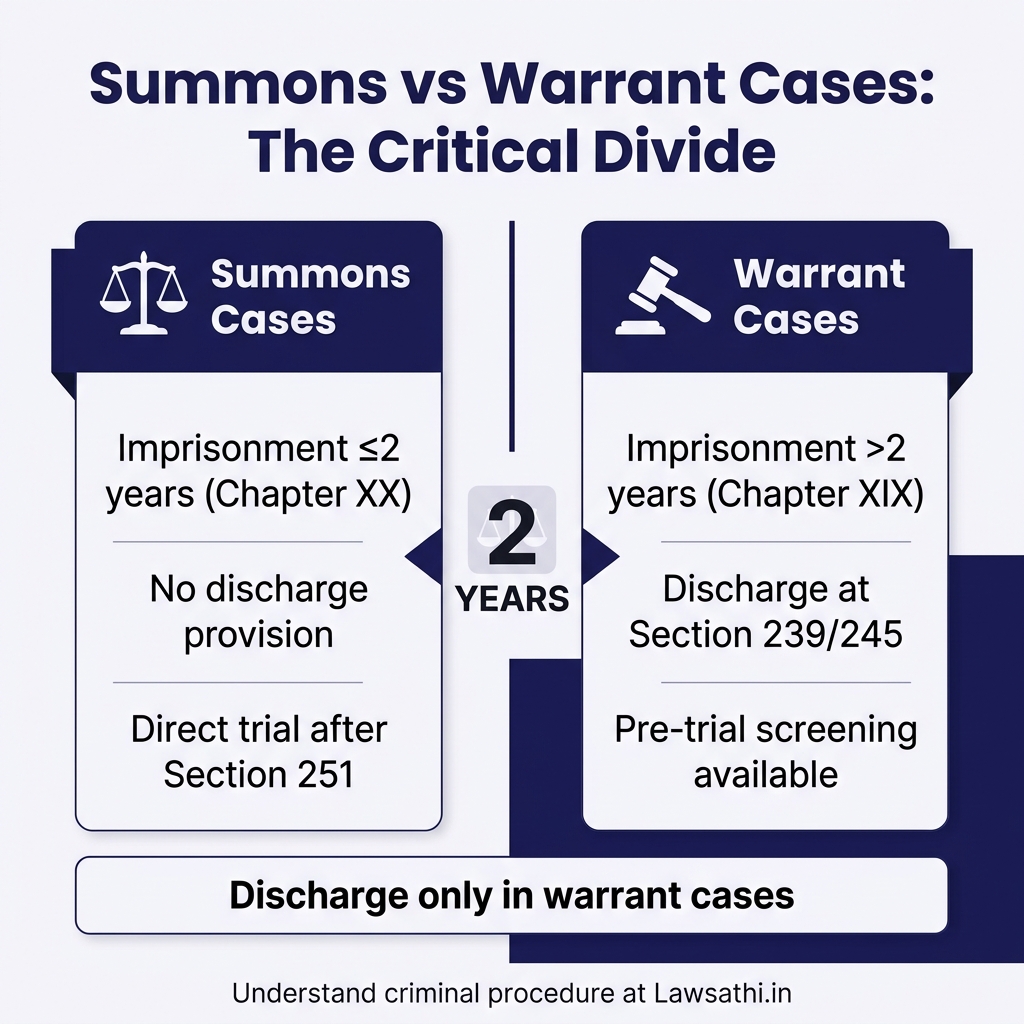
Summons cases involve offences punishable with imprisonment up to two years. Section 2(w) of the CrPC provides this definition. In contrast, warrant cases involve offences punishable with imprisonment exceeding two years, as defined in Section 2(x).
This classification reflects the legislature’s assessment of offence severity. More serious offences warrant more elaborate procedural safeguards. However, lesser offences receive streamlined treatment.
The Procedural Gap Explained
| Feature | Summons Cases | Warrant Cases | |———|—————|—————| | Governing Chapter | Chapter XX CrPC | Chapter XIX CrPC | | Discharge Stage | NOT AVAILABLE | Available (Section 239/245) | | Formal Charge | Not required | Required | | Section 251 Role | Pleading stage only | Not applicable | | Recall of Process | Impermissible | Impermissible after charge | | Remedies for Accused | Section 482 or acquittal | Discharge or acquittal |
The table above illustrates the stark procedural gap. Warrant cases have a discharge filter at the Section 239 stage. However, summons cases must proceed directly to trial after the Section 251 interaction.
Rationale Behind the Legislative Design
The legislature intended faster disposal for lesser offences. Adding a discharge stage would defeat this purpose by introducing additional proceedings. Moreover, the consequences of conviction in summons cases remain less severe.
However, this design also means accused persons in summons cases lack an intermediate remedy. They must either proceed to full trial or approach the High Court under Section 482. The Section 239 text on Indian Kanoon shows how discharge operates in warrant cases.
Implications for Legal Practice: What Lawyers Must Know
This ruling carries immediate practical consequences for criminal practitioners. Lawyers must adjust their strategies and client counselling accordingly.
Advising Clients Accurately
Clients facing summons cases must understand that discharge is simply unavailable. The trial will proceed to its conclusion after the Section 251 stage. Therefore, lawyers should prepare clients for full trial proceedings rather than discharge applications.
This reality affects case timelines significantly. Summons cases may proceed faster but offer no intermediate opportunity for dismissal. Clients should know this from the outset. As Manupatra’s educational resource explains, understanding case classification is essential.
Available Remedies for the Accused
Several remedies remain available despite the absence of discharge in summons cases:
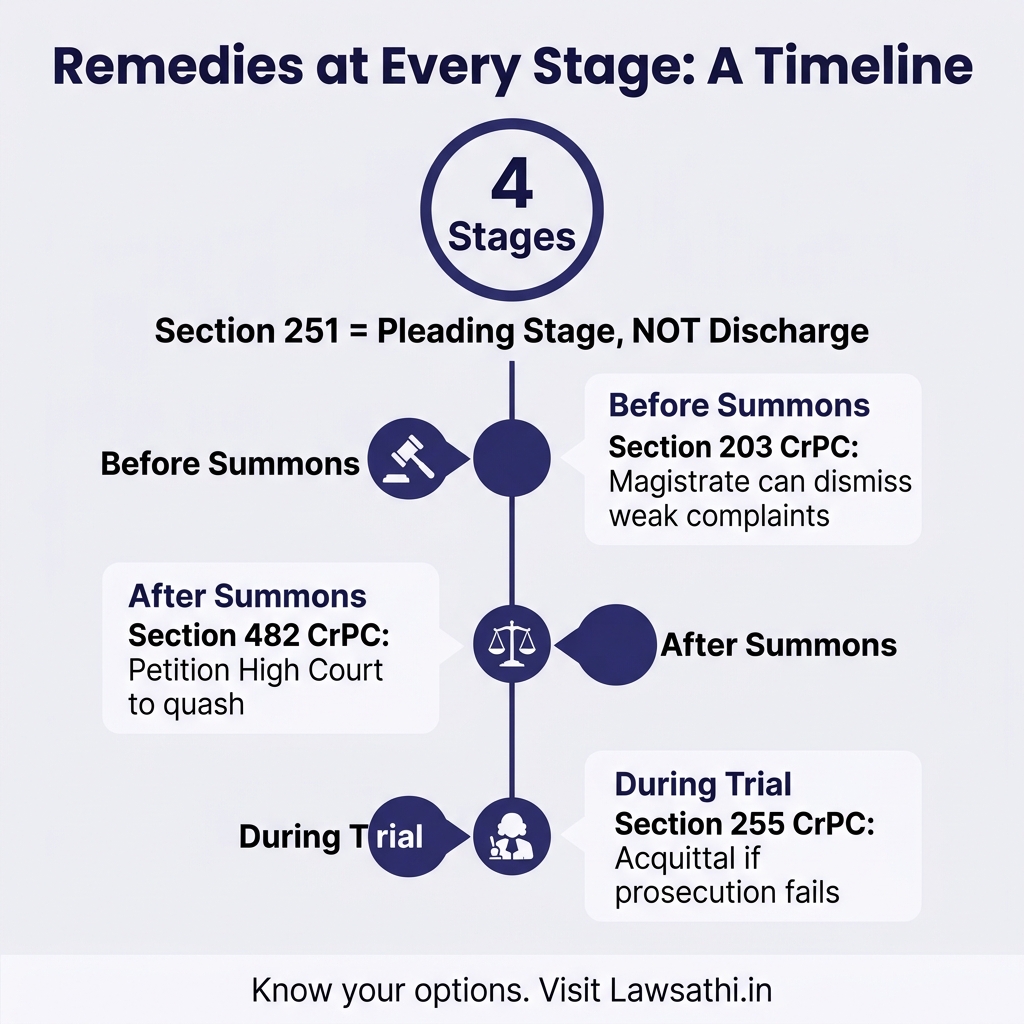
Before Summons Issued: Section 203 CrPC allows magistrates to dismiss complaints lacking sufficient grounds. This represents the only preventive stage before trial begins.
After Summons Issued: Section 482 CrPC permits petitioning the High Court to quash proceedings. Grounds include abuse of process, absence of any offence made out, or frivolous complaints. However, as the Supreme Court analysis on Section 482 notes, High Courts exercise this power sparingly.
During Trial: Section 255 CrPC provides for acquittal if the prosecution fails to prove its case. Specifically, defense lawyers must present their case during trial, not at the Section 251 stage.
Avoiding Common Procedural Errors
Many practitioners continue filing discharge applications in summons cases despite clear legal position. Such applications waste time and resources. They also reflect poorly on counsel’s procedural knowledge.
Furthermore, relying on Bhushan Kumar (2012) without noting its per incuriam status constitutes an error. Subsequent larger bench decisions have effectively overruled its observations on discharge in summons cases.
Key Takeaways from the Judgment
The legal position now stands definitively established. Practitioners must internalize these principles for effective advocacy.
The Established Legal Position
First, Section 251 CrPC is a pleading stage, not a discharge stage. The accused merely enters a plea at this point. No evidence evaluation occurs.
Second, magistrates cannot discharge accused persons in summons cases after cognizance and summons issuance. Doing so would constitute an unauthorized review of the summoning order.
Third, discharge under Section 239 applies exclusively to warrant cases governed by Chapter XIX. Chapter XX contains no parallel provision.
Fourth, recalling summons remains impermissible at any stage after issuance. The comprehensive research document elaborates on this principle.
Impact on Pending Cases
Discharge orders already passed at the Section 251 stage face potential reversal. Revision petitions can challenge such orders. Consequently, courts may remand matters for further proceedings.
However, this ruling does not affect case merits. It addresses only procedural compliance. Accused persons must seek appropriate remedies through proper channels.
Required Procedural Discipline
Magistrates must avoid applying Section 239 to summons cases. They should proceed with trial after the Section 251 stage. Additionally, they cannot recall or review summoning orders.
Defense lawyers must use Section 482 CrPC for appropriate cases. They should prepare for trial rather than pursuing non-maintainable discharge applications. Distinguishing between summons and warrant procedures is essential.
Conclusion: Navigating Procedural Law with LawSathi
Staying updated with judicial pronouncements remains essential for criminal practitioners. This Delhi High Court ruling clarifies decades of confusion surrounding Section 251 CrPC discharge powers. The ruling relies squarely on established Supreme Court precedents.
Procedure forms the backbone of criminal justice administration. Errors in procedural compliance can derail entire prosecutions or defenses. Therefore, understanding the critical distinction between summons and warrant cases prevents such errors.
Correct case classification at the filing stage determines available remedies throughout proceedings. Lawyers can advise clients accurately about realistic options. This knowledge reduces wasted efforts on non-maintainable applications.
Moving Forward with Clarity
Know your case type thoroughly. Summons cases lack discharge provisions entirely. The only remedies are Section 482 quashing or acquittal after trial. Additionally, follow binding Supreme Court precedents rather than passing observations from earlier decisions. Procedural accuracy ensures better outcomes for clients.
The principles established in this ruling reinforce fundamental tenets of criminal procedure. Courts possess only those powers expressly granted by statute. The legislature’s intentional omission of discharge in Chapter XX reflects deliberate policy choices.
Simplify your criminal practice management. Track case stages, manage court dates, and access legal research with LawSathi. Start your free trial today!