
A Check on Arbitrary Police Powers
Bank account freezing has become India’s silent financial punishment. A single instruction from an investigating agency can lock a person out of their own money overnight. This happens without prior notice, without a timeline for defreezing, and without an easy remedy. According to LiveLaw’s analysis, account freezing has quietly morphed from a protective measure into a blunt weapon against citizens.
The Delhi High Court’s landmark ruling in Malabar Gold and Diamond Limited v. Union of India (2026 LiveLaw (Del) 166) changes this landscape dramatically. Justice Purushaindra Kumar Kaurav held that police cannot freeze bank accounts under BNSS Section 107 without prior approval from a competent Magistrate. This BNSS Section 107 bank account freeze ruling establishes crucial procedural safeguards. Every criminal law practitioner must understand these developments.
Why This Matters Under the New Criminal Laws
The Bharatiya Nagarik Suraksha Sanhita (BNSS) replaced the CrPC on July 1, 2024. Section 107 BNSS is a completely new provision dealing with attachment of “proceeds of crime.” However, police departments across India have been misusing existing provisions to freeze accounts arbitrarily. This judgment clarifies that judicial approval for account freeze is mandatory, not optional.
For legal practitioners, this ruling provides powerful ammunition to challenge arbitrary police actions. Additionally, it clarifies the critical distinction between investigative necessity and arbitrary coercion.
Case Background: The Facts Leading to the Verdict
The Petitioner’s Predicament
Malabar Gold and Diamond Limited operates a legitimate business buying and selling gold ornaments, gold bars, coins, and precious stones. The company maintains full compliance with all statutory and regulatory requirements. In 2024-25, a customer named Dallas E-com Infotech Private Limited approached them for gold purchases. These purchases totaled approximately Rs. 14.2 crore.
Subsequently, complaints emerged against Dallas E-com alleging fraud and cyber-crime. However, crucially, no FIR or complaint was filed against Malabar Gold. The company was neither an accused nor even a suspect in any offence.
The Arbitrary Freezing Action
Despite Malabar Gold’s non-involvement, investigating agencies directed two banks to freeze amounts in the company’s accounts. By March 28, 2025, approximately Rs. 80,10,857 stood frozen across Malabar Gold’s bank accounts. The agencies treated these funds as suspected “proceeds of crime” without any judicial determination.
According to SCC Online’s detailed case analysis, the freezing action completely disrupted Malabar Gold’s business operations. The company could not pay salaries or meet daily expenses. Furthermore, they suffered loss of commercial goodwill and faced severe financial consequences. All this occurred without them being accused of any crime.
The Legal Challenge
Malabar Gold challenged the freezing before the Delhi High Court on multiple grounds. First, the action violated Sections 106 and 107 of BNSS. Second, it violated fundamental rights under Articles 19(1)(g) and 21 of the Constitution. Third, the freezing was arbitrary, disproportionate, and violated due process.

The petitioner argued they were entitled to be informed of the reasons for freezing their accounts. Moreover, they contended that the entire approach treated them as guilty without any investigation or trial.
The Ruling: Why Judicial Sanction is Mandatory
Core Holding on Section 106 BNSS
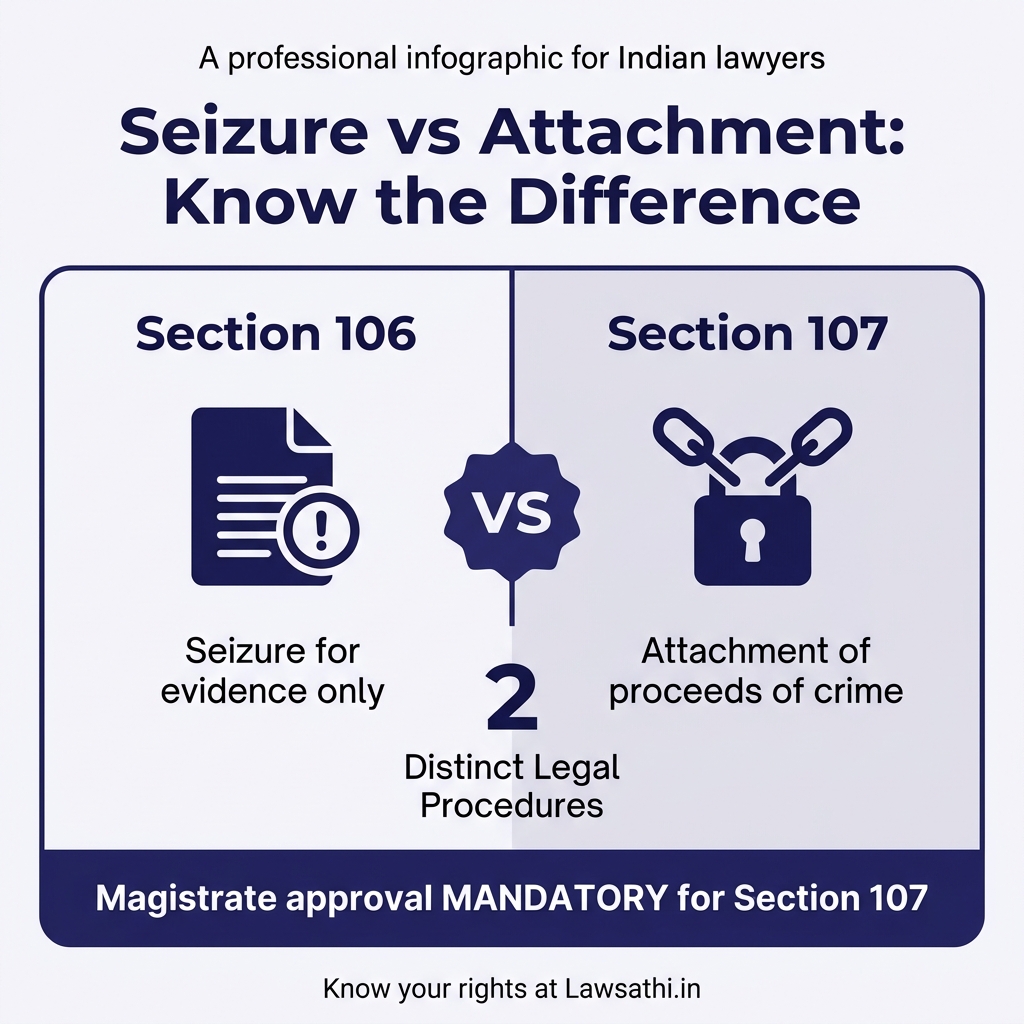
Justice Purushaindra Kumar Kaurav delivered a crystal-clear verdict. The Court held that Section 106 of BNSS empowers police only to seize property for evidentiary purposes. Therefore, it does not confer any authority to attach or debit-freeze bank accounts.
As the official Delhi High Court judgment states: “Section 106 empowers police officers only to seize property for evidentiary purposes and does not confer authority to attach or debit-freeze bank accounts.”
The Mandatory Magistrate Route Under Section 107
The Court then addressed Section 107 BNSS directly. Attachment or freezing of bank accounts constitutes a measure directed at securing alleged proceeds of crime. Therefore, such action can be undertaken only under Section 107 of the BNSS. Moreover, it must be strictly upon orders of a competent Magistrate.
The Court emphasized that prescribed procedural safeguards must be followed before any freezing occurs. Consequently, this requirement for judicial approval for account freeze under BNSS Section 107 bank account freeze actions is now mandatory across India.
Constitutional Violations Identified
The Delhi High Court did not stop at procedural interpretation. Instead, it identified serious constitutional violations in the police’s actions.
According to LiveLaw’s reporting, the Court held: “Any blanket or disproportionate freezing of bank accounts, particularly where the account holder is neither an accused nor even a suspect in the offence under investigation, is manifestly arbitrary.”
Such freezing violates Articles 19(1)(g) and 21 of the Constitution. These provisions protect the right to livelihood and freedom to carry on trade and business. The Court noted that indiscriminate debit freezing “has the inevitable effect of paralysing the day-to-day business operations of an otherwise innocent entity.”
Proportionality and Alternative Measures
Importantly, the Court suggested that investigating agencies should explore marking a lien on disputed amounts. This approach is far more proportionate than freezing entire accounts. When the disputed amount is identifiable, agencies should restrict action to that specific sum. They should not paralyse complete financial operations.
Legal Analysis: BNSS Section 107 vs. Section 106
Understanding Section 106 BNSS (Seizure for Evidence)
Section 106 BNSS corresponds to the erstwhile Section 102 CrPC. It empowers police officers to seize property that is either stolen or found under suspicious circumstances. The key limitation is that this power serves only evidentiary purposes during investigation.
As the Kerala High Court explained in Headstar Global: “The purpose of seizure is more to secure the evidence during an investigation, whereas attachment is intended to secure the proceeds of crime by preventing its disposal.”
The New Section 107 BNSS (Attachment of Proceeds)
Section 107 BNSS is a novel provision with no direct equivalent in the old CrPC. It specifically provides for attachment of “proceeds of crime.” The definition under Section 111(c) BNSS covers any property derived or obtained directly or indirectly through criminal activity.
However, the critical requirement is that a police officer must approach the jurisdictional Magistrate seeking attachment. The Magistrate may order attachment only after hearing all parties concerned. This judicial oversight is what the Delhi High Court emphasized as mandatory.
Why This Distinction Matters
Police departments across India have been using Section 106 as a shortcut to freeze accounts. This approach functionally achieves attachment without following due process. The judgment clarifies that if police want to attach accounts, they must use Section 107 and obtain Magistrate approval.
According to LiveLaw’s analysis of BNSS provisions, this distinction prevents misuse of preventive sections for investigative purposes. Seizure secures evidence; attachment secures proceeds of crime. These are legally distinct actions requiring different procedures.
Procedural Safeguards Under BNSS
The BNSS introduces explicit safeguards through Section 106(3). Police must forthwith report any seizure to the Magistrate. Consequently, the Magistrate has a supervisory role and can examine whether the seizure conforms to law. This prevents police from acting as unaccountable financial gatekeepers.
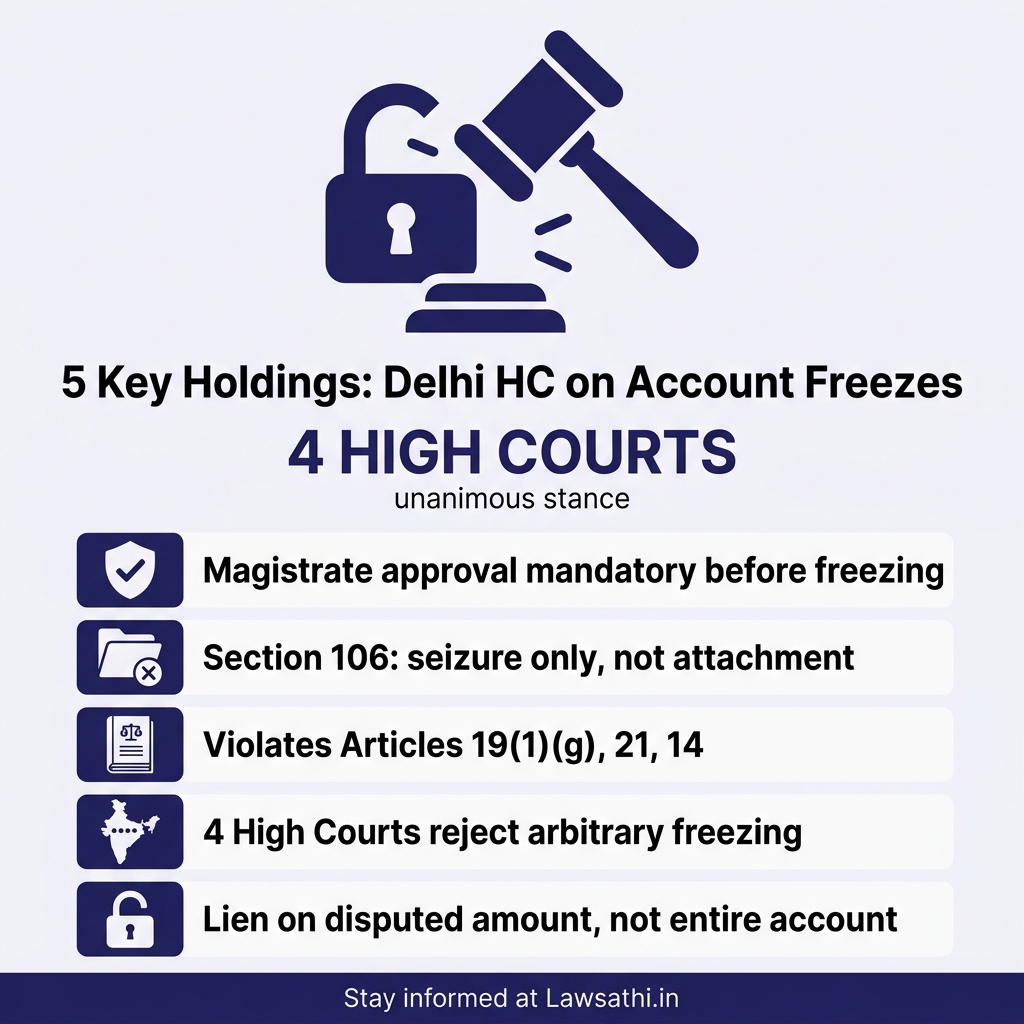
Additionally, the Bombay High Court has similarly held that investigating agencies have no power to debit-freeze bank accounts under Section 106 BNSS. This creates a consistent judicial position across multiple High Courts.
Implications for Legal Practitioners and Law Firms
Grounds for Challenging Existing Freezes
The Delhi High Court judgment 2026 opens multiple avenues for challenging arbitrary freezes. Practitioners can now argue:
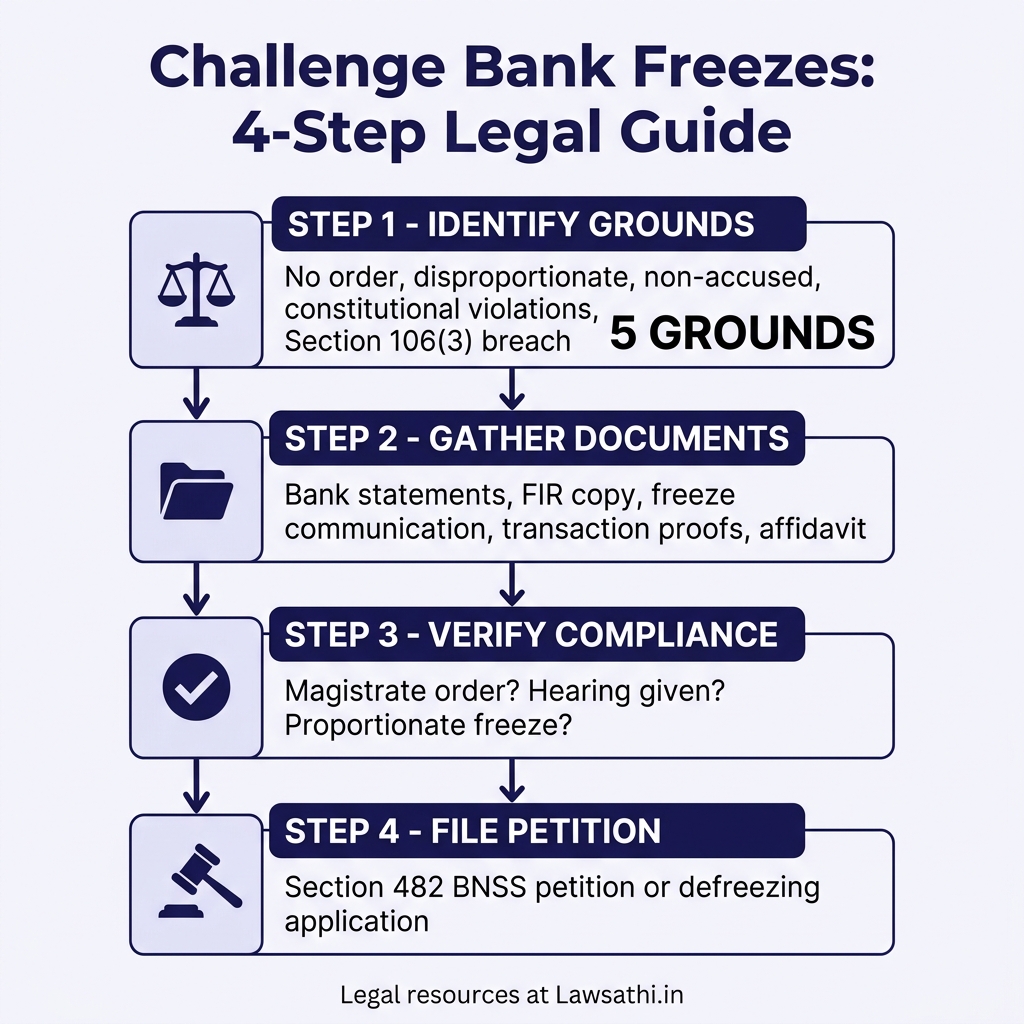
1. No Magistrate Order: If accounts were frozen without Magistrate approval under Section 107 BNSS 2. Disproportionate Freezing: Entire account frozen when only small amount under suspicion 3. Non-Accused Status: Account holder is neither accused nor suspect in any offence 4. Constitutional Violations: Violation of Articles 19(1)(g), 21, and 14 5. Non-compliance with Section 106(3): Failure to report seizure to Magistrate forthwith
Filing Quashing Petitions and Defreezing Applications
Practitioners can file petitions under Section 482 BNSS before High Courts. Alternatively, applications for defreezing can be moved before Magistrates under corresponding provisions for custody of property.
According to Karnataka High Court precedents, freezing of bank accounts adversely affects the right to life under Article 21. Therefore, this argument can be combined with the new Delhi High Court ruling for stronger petitions.
Documentation Checklist for Challenging Freezes
To challenge police actions post this judgment, practitioners should gather:
– Bank statements showing account balance and transactions – Freezing communication from police to bank – FIR copy to check if client is named as accused – Proof of legitimate business transactions – Affidavit stating no involvement in alleged offence – Bank guarantee or bond (may be required by court as security)
Advisory for Corporate Clients
For law firms advising corporate clients, this ruling necessitates proactive risk mitigation strategies. Clients should maintain rigorous due diligence on transaction partners. Furthermore, documentation of all legitimate transactions must be preserved systematically. KYC compliance requires strict adherence.
Most importantly, clients need protocols for immediate action when accounts are frozen. The difference between prompt legal action and delayed response can determine business survival.
Practical Steps: What Lawyers Should Do Now
Verifying Judicial Backing: A Checklist
Before accepting any freeze order as valid, practitioners must verify:
☐ Was the freeze ordered by a Magistrate?
☐ Is there a written order under Section 107 BNSS?
☐ Was the account holder given an opportunity to be heard?
☐ Is there a live and proximate nexus between funds and alleged criminal activity?
☐ Is there an FIR registered naming the account holder?
☐ Was the seizure reported to Magistrate forthwith under Section 106(3) BNSS?
☐ Is the freezing proportionate to the alleged offence?
If most answers are negative, the freeze likely suffers from serious legal infirmities.
Drafting Section 482 Petitions: Strategic Approach
When drafting quashing petitions, structure them strategically. First, begin with clear facts establishing legitimate business and non-involvement in the offence. Then present grounds including lack of power under Section 106, failure to follow Section 107 requirements, and constitutional violations.
Key case law to cite includes Malabar Gold v. Union of India, Headstar Global v. State of Kerala, and Kartik Yogeshwar Chatur v. Union of India. Recent Karnataka High Court rulings also support arguments against indiscriminate freezing.
Leveraging in Anticipatory Bail Applications
This judgment can strengthen anticipatory bail applications. Practitioners can cite it to demonstrate investigating agency malafide actions. Moreover, evidence of harassment through indiscriminate freezing supports arguments for protection of fundamental rights.
Protecting Constitutional Rights
Article 14 guarantees equality before law. Therefore, arbitrary freezing without proper procedure violates this guarantee. Article 21 protects right to life and livelihood. As courts have consistently held, freezing entire accounts “paralyses the financial autonomy of a person” and violates dignity.
Conclusion: Upholding the Rule of Law
The Delhi High Court’s ruling represents a significant check on arbitrary police powers under the new criminal law regime. Courts across India—from Delhi to Kerala, Bombay to Karnataka—have consistently held against indiscriminate freezing. This judicial consensus establishes clear boundaries for police powers under BNSS.
The judgment strikes an appropriate balance between effective investigation and civil liberties. Investigating agencies can still freeze accounts when genuinely necessary. However, they must follow due process, obtain judicial approval, and ensure proportionality.
Future Outlook
Lower courts are likely to interpret BNSS provisions strictly following this precedent. Magistrates are expected to exercise supervisory roles more actively. Consequently, the era of “punishment first, questions later” approaches to account freezing appears to be ending.
For practitioners, this judgment provides powerful tools to protect client rights. However, staying updated on evolving interpretations requires systematic legal research and case management. The BNSS Section 107 bank account freeze requirement for judicial approval is now firmly established in Indian jurisprudence.
Streamline your legal research and case management with LawSathi. Our AI-powered platform helps you track the latest High Court rulings and draft petitions faster. Sign up for a free trial today.