
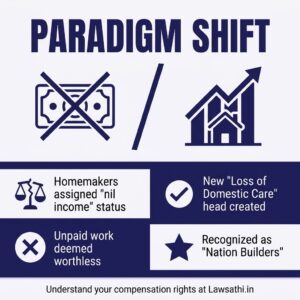
For decades, Indian motor accident claims tribunals assigned homemakers a “nil income” status. This approach systematically undervalued the immense economic contribution of unpaid domestic work. However, the legal landscape has shifted dramatically. The Supreme Court compensation homemaker accident death jurisprudence has evolved to recognize homemakers as economically valuable contributors. This transformation represents a fundamental change in how courts calculate compensation when a homemaker loses her life in a motor accident.
Shifting the Legal Paradigm on Unpaid Domestic Work
The Traditional “Nil Income” Approach
Historically, Motor Accident Claims Tribunals (MACT) across India struggled with quantifying compensation for deceased homemakers. Since homemakers received no salary, tribunals often assigned them zero or nominal notional income. This approach treated unpaid domestic labor as having no economic worth. Consequently, families who lost a homemaker received meager compensation, barely sufficient to cover funeral expenses.
The problematic nature of this approach became increasingly apparent over time. Justice N.V. Ramana, in a landmark ruling, explicitly stated that the conception of housemakers not “working” or adding no economic value must be overcome. This observation in Kirti v. Oriental Insurance Co. Ltd. marked a turning point in Indian compensation law.
Why This Matters for Legal Practitioners Today
The Supreme Court’s interventions have fundamentally altered the compensation framework. Lawyers handling accident death claims must now substantiate higher compensation using structured methodologies. Moreover, the Court’s June 2026 ruling created an entirely new compensation head called “Loss of Domestic Care.” According to SCC Online’s analysis, the Court characterized homemakers as “Nation Builders” deserving of proper recognition.
This shift moves compensation from a charity-based approach to a rights-based framework. Therefore, understanding these changes is essential for lawyers seeking just compensation for their clients in 2026.
The Landmark Judgment: Key Observations by the Supreme Court
Case Background and Facts
The seminal case of Kirti & Anr v. Oriental Insurance Company Ltd., decided on January 5, 2021, involved a tragic motor accident. The accident claimed the lives of Vinod and Poonam, a homemaker. They left behind two minor daughters aged three and four, septuagenarian parents, and an unborn child.
The original Tribunal awarded ₹40.71 lakhs in compensation. However, the Delhi High Court reduced this amount to ₹22 lakhs. The Supreme Court ultimately enhanced the compensation to ₹33.20 lakhs. This added ₹11.20 lakhs to the High Court’s award.
The Court’s Reasoning on Economic Value
Justice N.V. Ramana, writing for the Bench, delivered powerful observations on homemaker compensation. The Court rejected the argument that gratuitous services have no economic value. Instead, it recognized that the work of a homemaker transcends mere caretaking.
The Court noted that domestic work includes preparing meals, procuring groceries, cleaning, financial planning, childcare, and tending to elderly dependents. Furthermore, the Punjab & Haryana High Court observed that such work would command high remuneration if outsourced in the open market.
Distinction Between Loss of Income and Loss of Dependency
A crucial distinction emerged from the judgment. Compensation for homemakers measures the loss of services to dependents, not lost wages. This conceptual shift allows courts to calculate compensation based on what the family has lost.
The Court emphasized the gendered nature of housework in India. Since an overwhelming percentage of women engage in domestic work compared to men, fixing notional income for homemakers attains special significance. Therefore, the Supreme Court compensation homemaker accident death framework addresses both economic and gender justice concerns.
Calculation Methodology: From Notional Income to Just Compensation
Rejection of Arbitrary Lump Sum Awards
Earlier tribunals often awarded arbitrary lump sum amounts without structured calculations. The Supreme Court categorically rejected this approach. Courts must now follow the established multiplier method. This method, outlined in Sarla Verma v. Delhi Transport Corporation, provides a systematic framework for calculating loss of dependency.
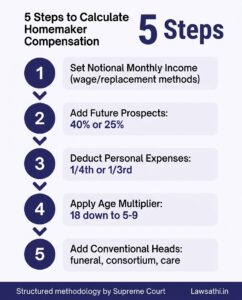
The Five-Step Multiplier Method Framework
Step 1: Determine Notional Monthly Income
Courts use three primary approaches for determining notional income. The minimum wage method applies state minimum wages for skilled or semi-skilled workers. Alternatively, the replacement method calculates the cost of hiring paid workers for equivalent services. The function utility method bases assessment on services rendered, family size, and the homemaker’s age.
Step 2: Add Future Prospects
According to National Insurance Co. Ltd. v. Pranay Sethi, future prospects must be added to the notional income. The Court established that 40% should be added if the deceased was below 40 years of age. For those between 40-50 years, a 25% addition applies.
Step 3: Deduct Personal Expenses
Personal expenses must be deducted from the calculated income. The standard deduction is one-fourth if there are four or more dependents. For fewer dependents, a one-third deduction applies.
Step 4: Apply the Appropriate Multiplier
The multiplier depends on the victim’s age at death. For victims aged 15-20 years, the maximum multiplier of 18 applies. This decreases progressively with age. Victims above 50 years typically receive multipliers between 5-9.
Step 5: Add Conventional Heads
Additional compensation heads include funeral expenses, loss of estate, and loss of consortium. Moreover, the June 2026 Supreme Court ruling added “Loss of Domestic Care” as a mandatory head for homemaker cases.
Practical Calculation Example
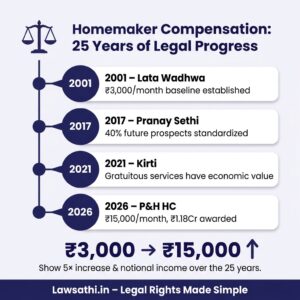
The Punjab & Haryana High Court’s January 2026 ruling provides an excellent illustration. The Court enhanced a homemaker’s notional income to ₹15,000 per month. Consequently, the total compensation increased to ₹1.18 crore from the Tribunal’s original award of ₹58.22 lakhs.
Lawyers can use the MACT Claim Calculator maintained by the Assam Government for preliminary calculations. However, courts retain discretion to enhance amounts based on specific circumstances.
Legal Precedents Supporting the Ruling
Evolution Through Case Law
The Supreme Court compensation homemaker accident death framework evolved through several landmark cases. In 2001, Lata Wadhwa v. State of Bihar established ₹3,000 per month as notional income for housewives. This was based on services rendered and age.
Subsequently, Arun Kumar Agrawal v. National Insurance Co. Ltd. recognized that a wife and mother’s services are unique and irreplaceable. The Court held these services cannot be equated with those of paid servants.
The 2017 judgment in National Insurance Co. Ltd. v. Pranay Sethi standardized future prospects calculations. This ruling established that even non-earning homemakers deserve future prospects addition to their notional income.
The Kirti Judgment’s Clarification
The 2021 Kirti judgment clarified that future prospects must apply to homemakers. Justice N.V. Ramana noted that the painstaking labor of homemakers deserves recognition. This ruling fundamentally modified earlier MACT practices that denied future prospects to non-earning victims.
Recent Developments in 2025-2026
The Nempal case from Punjab & Haryana High Court, decided in February 2026, applied Kirti principles comprehensively. Similarly, commentary on Sunita v. Vinod Singh from 2025 reinforced that a homemaker’s contribution is of “very high order.” It further noted that this contribution is impossible to fully assess monetarily.
International Comparisons
Indian courts have increasingly drawn from international standards. Developed jurisdictions recognize unpaid domestic labor through time-use surveys and economic valuation methods. In fact, Indian women spend approximately 5-6 hours daily on unpaid domestic work according to various studies.
Practical Implications for Legal Practitioners
Drafting Effective Claim Petitions
Lawyers must draft comprehensive claim petitions to maximize compensation. The petition should clearly establish the deceased’s status as a homemaker. Additionally, it must detail the specific services provided to the family.
Essential Documentary Evidence
The Supreme Court’s June 2026 directions mandate specific documentation. Claim petitions must include official proof of age, excluding Aadhaar card. Disability certificates and functional disability opinions are required where applicable.
For income claims, salary slips, income tax returns, or employer certificates serve as evidence. Authenticated medical bills and affidavits regarding attendant charges must accompany the petition. The SCC Online analysis provides detailed guidance on documentary requirements.
Proving Homemaker Services
Lawyers should present diverse evidence to establish the homemaker’s contributions. Family photographs and videos demonstrate quality of life and household management. School records of children show childcare involvement. Furthermore, medical records of elderly dependents establish caregiving roles.
Additionally, affidavits from neighbors and relatives corroborate homemaking activities. Household bills and grocery receipts demonstrate day-to-day management. The number and age of dependents determines both the multiplier and deduction calculations.
Countering Insurance Company Arguments
Insurance companies typically argue that no income proof exists for homemakers. Lawyers must cite Pranay Sethi and Kirti judgments to counter this. Notional income applies regardless of income documentation.
Another common argument suggests only minimum unskilled wages should apply. However, lawyers can demonstrate that homemakers perform skilled, multi-faceted roles. The Punjab & Haryana High Court’s ₹15,000/month assessment provides strong precedent for higher valuations.
Insurance companies also argue against future prospects for non-earners. This argument was explicitly rejected in Kirti. Specifically, Paragraph 26(e) clearly states that granting future prospects is a component of just compensation.
Impact on Settlement Negotiations
The legal landscape has fundamentally changed. Tribunals must now mandatorily apply the “Loss of Domestic Care” compensation head. Higher compensation expectations are fully justified by current precedents.
Lawyers should leverage these developments in settlement negotiations. The summary procedure under Section 169 of the Motor Vehicles Act enables faster resolution. Consequently, insurance companies face increasing pressure to settle claims fairly given the clear judicial trend.
Conclusion: Towards Equitable Justice in Accident Claims
Summary of the Legal Transformation
The Supreme Court compensation homemaker accident death jurisprudence represents a paradigm shift. Courts have moved from nil income assignments to recognition of notional income. Moreover, compensation has shifted from charity-based to rights-based approaches.
Arbitrary lump sum awards have been replaced by structured multiplier methods. Most significantly, homemakers have been recognized as “Nation Builders” whose contributions deserve proper valuation.
Broader Social Impact
This legal evolution advances gender justice within Indian law. It recognizes that women’s unpaid work has genuine economic value. The rulings align with constitutional visions of social equality and dignity under Articles 14, 15, and 21.
Furthermore, these developments fulfill India’s international obligations. The UN Sustainable Development Goals on gender equality inform this progressive judicial interpretation.
Final Checklist for Lawyers
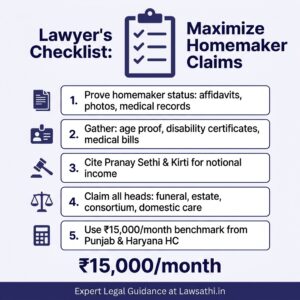
When handling homemaker death cases, lawyers should systematically address each element. First, establish the deceased’s homemaker status through affidavits and family details. Second, determine appropriate notional income benchmarks using minimum wages or skilled worker standards.
Third, apply the correct multiplier based on age. Fourth, add future prospects at the appropriate percentage. Fifth, deduct personal expenses according to the number of dependents.
Sixth, include all conventional heads such as funeral expenses and loss of consortium. Seventh, specifically claim “Loss of Domestic Care” as mandated by the June 2026 ruling. Eighth, file comprehensive documentary evidence. Finally, anticipate and counter insurance company objections with cited precedents.
Streamline your Motor Accident Claim cases with LawSathi. Use our AI-powered document automation to draft compensation petitions faster. Start your free trial today!