
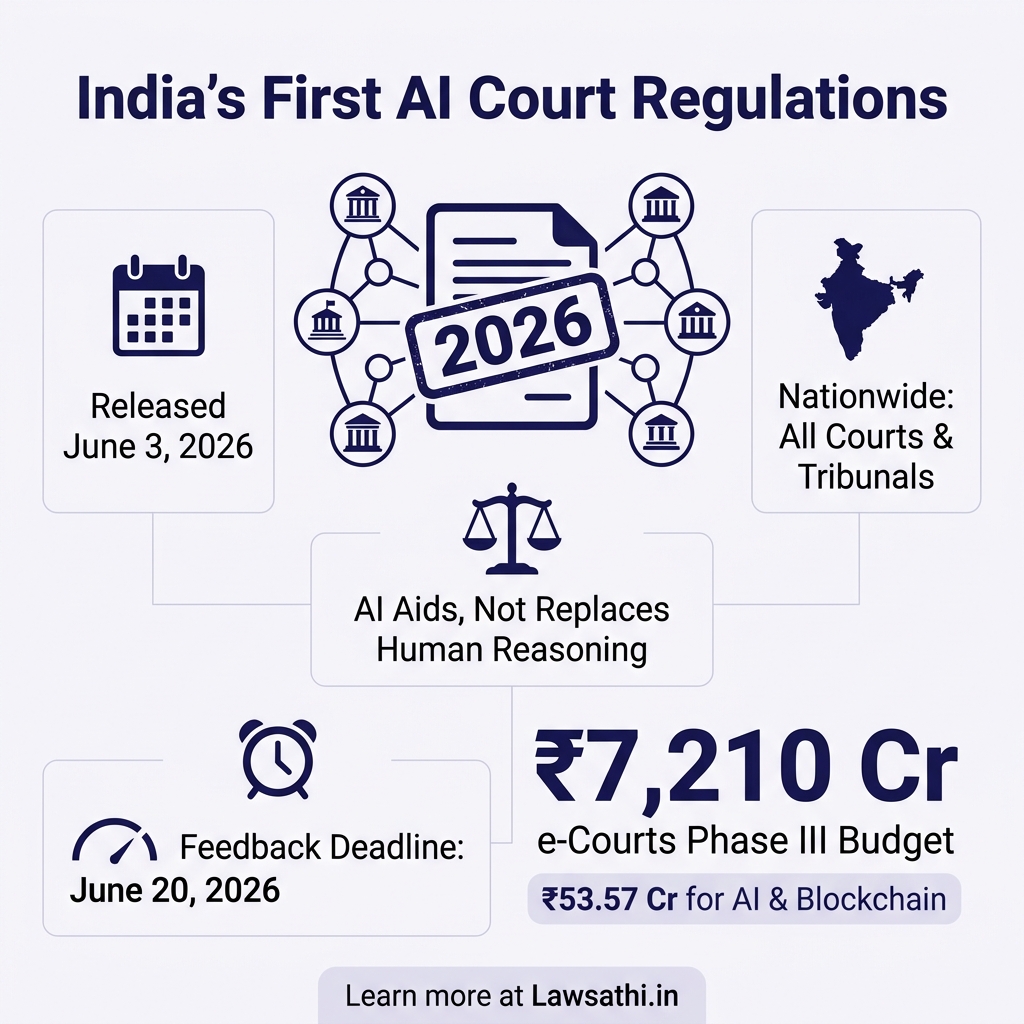
The legal landscape in India is undergoing a fundamental transformation. On June 3, 2026, the Supreme Court AI rules draft was officially released for public consultation. These regulations mark the first comprehensive framework governing artificial intelligence use across Indian courts.
According to Bar & Bench’s coverage, the “Regulations for Use of Artificial Intelligence in Courts, 2026” apply nationwide. Specifically, they cover all courts, tribunals, and statutory commissions. Lawyers now have until June 20, 2026, to submit their feedback.
This development represents a watershed moment for legal technology adoption in India. Therefore, every practicing advocate must understand what these rules mean for their daily work. The framework emerges from the broader vision of the e-Courts Phase III project.
This initiative carries a substantial budget of ₹7,210 crore. Furthermore, it specifically allocates ₹53.57 crore for AI and blockchain integration. The Press Information Bureau has detailed these allocations.
Introduction: A Watershed Moment for Legal Tech in India
The Vision Behind the Regulations
The Supreme Court’s AI Committee, established in 2019, has been working diligently on this framework. Their goal is balancing technological efficiency with judicial integrity and accountability.
As LiveLaw reports, the regulations seek to harness AI’s potential. They aim to improve access to justice while safeguarding against misuse.
Chief Justice of India Surya Kant has been vocal about this vision. He emphasized that young lawyers have driven the judiciary’s tech reforms. Speaking at the Oxford Union on June 6, 2026, he noted their adaptability and quick adoption of technology. Bar & Bench quotes CJI Surya Kant on this point. He says their enthusiasm has encouraged reformative changes.
The Core Purpose
The regulations serve a dual purpose. First, they enable courts and lawyers to leverage AI for efficiency gains. Second, they ensure transparency and accountability in AI-assisted legal work.
However, the Supreme Court AI rules draft makes one thing clear. AI must aid human reasoning, not replace it. This principle underpins every provision in the 47-page document.
The Mandatory Disclosure Requirement: What the Rules Propose
Understanding Regulation 43(3)
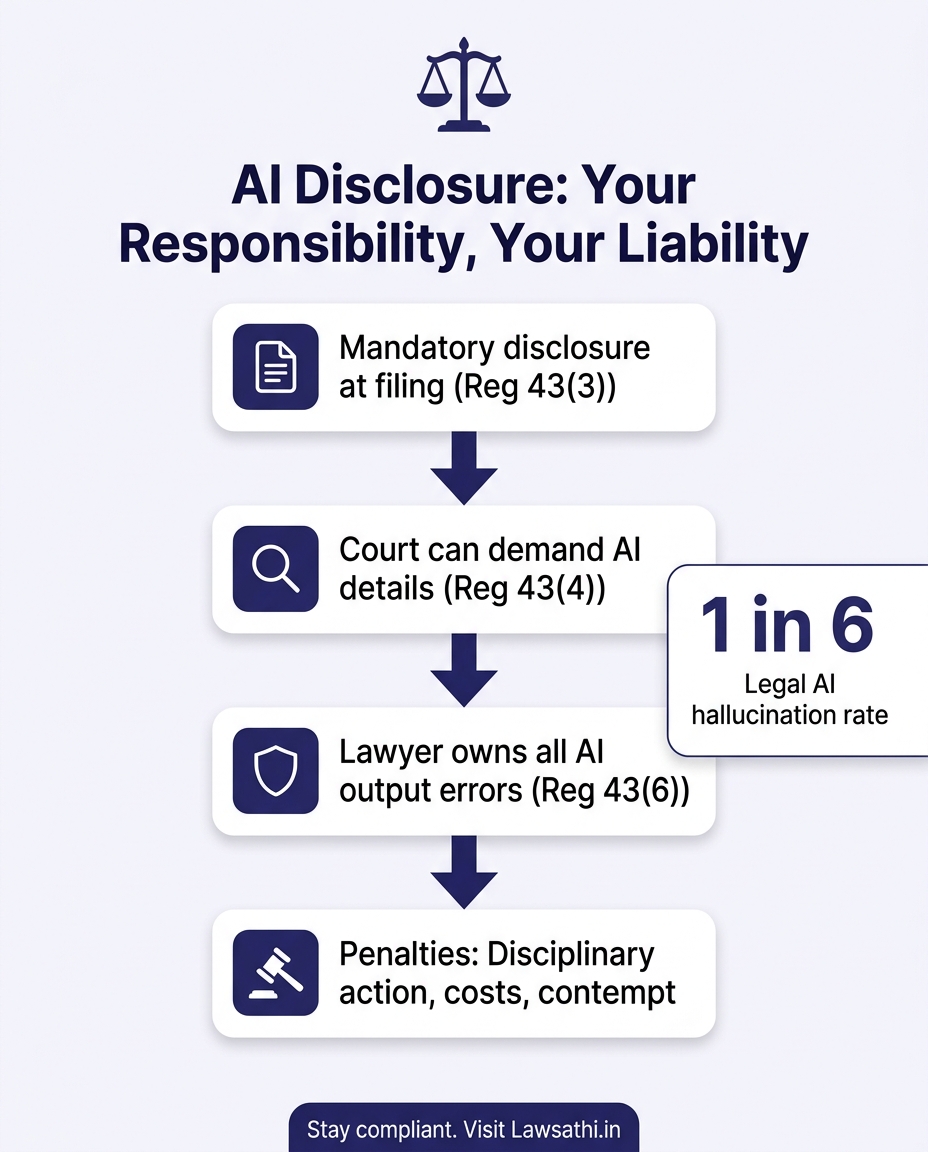
The heart of these regulations lies in Regulation 43(3). It mandates disclosure whenever AI assists in document preparation. Specifically, it requires parties and legal representatives to declare AI tool usage to the court. This disclosure must happen at the time of submission.
The rule covers pleadings, evidence, and other court documents. In other words, lawyers cannot silently rely on AI-generated content. They must be transparent about their use of technology.
Practical Implications for Lawyers
For example, imagine you use ChatGPT to draft skeleton arguments for a civil appeal. Under the new rules, you must disclose this fact when filing. The disclosure could appear as an affidavit. Alternatively, it might use a checkbox in the e-filing portal.
Although the exact format remains unspecified, the principle is unequivocal. Furthermore, Regulation 43(4) empowers courts to seek additional details. Judges may ask which AI system you used. They may inquire about the extent of AI assistance. Additionally, they can demand information about your verification steps.
What AI Can and Cannot Do
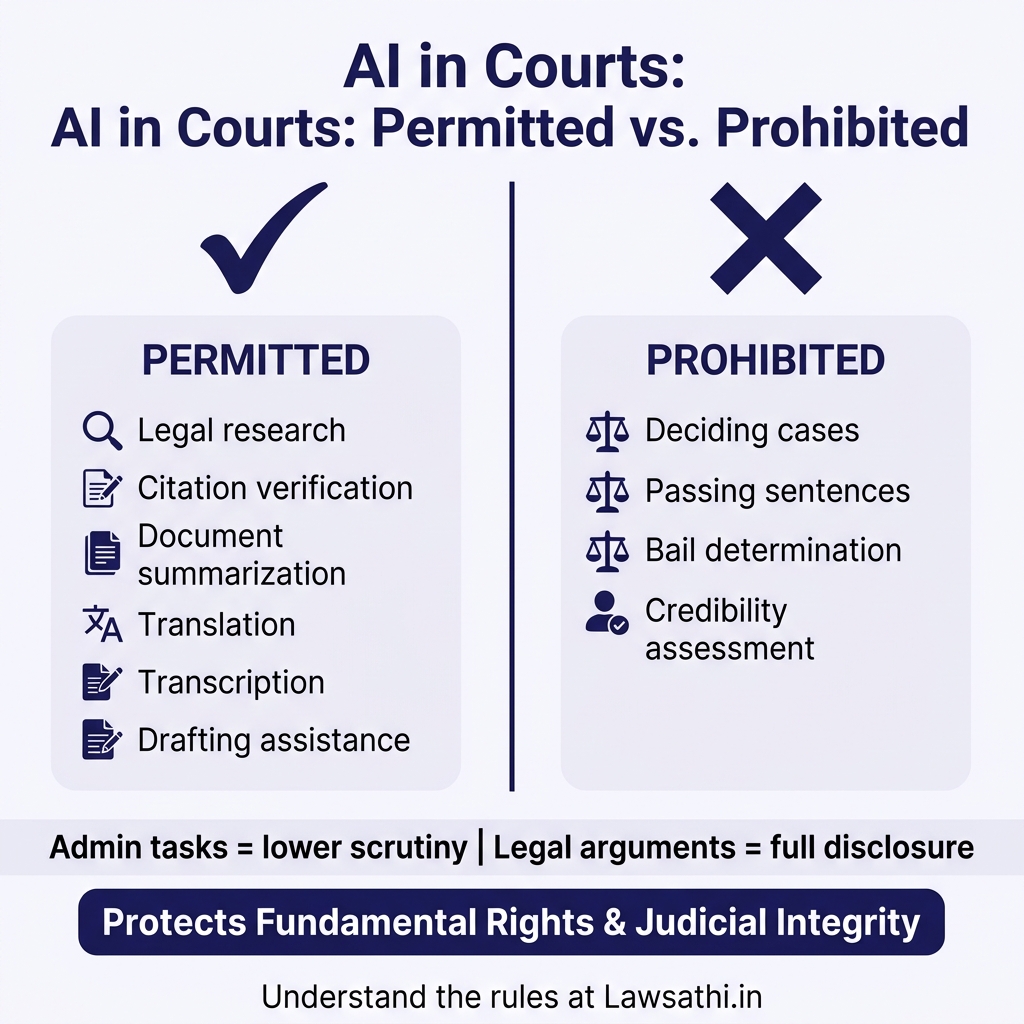
The draft rules explicitly list permitted and prohibited uses. AI can assist with legal research, citation verification, and document summarization. It can translate judgments and transcribe court proceedings. Drafting assistance and administrative tasks are also permitted.
However, AI cannot decide cases or pass sentences. It cannot determine bail eligibility or assess flight risk. Most importantly, it cannot evaluate witness credibility. The LiveLaw analysis explains these prohibitions. They serve to protect fundamental rights.
Distinguishing Administrative from Substantive Use
The rules draw a crucial distinction. Using AI for administrative tasks requires less scrutiny than substantive legal drafting. For instance, AI generating a case cause list is acceptable. But AI drafting legal arguments demands disclosure and verification.
Therefore, lawyers must categorize their AI usage appropriately. Administrative efficiency gains are welcome. Substantive legal work requires transparency.
Addressing ‘AI Hallucinations’ and Accountability
Defining the Problem
The draft regulations explicitly address AI hallucinations. They define these as instances where AI generates plausible but fabricated information. This includes incorrect legal precedents, fake statutory provisions, or misleading facts.
Unfortunately, Indian courts have already encountered this problem. In a Supreme Court case, a lawyer cited “Mercy versus Mankind.” This was a non-existent case. Justice B.V. Nagarathna flagged this fabrication. Similarly, the Andhra Pradesh High Court exposed a lawyer citing fake cases obtained through AI.
The Accountability Framework
Regulation 43(6) establishes clear accountability rules. If AI-generated content proves false or misleading, the submitting lawyer bears full responsibility. The regulation explicitly states that lawyers cannot blame the AI system as a defense.
The Bar Council of India’s position reinforces this principle. The BCI stated that advocates cannot avoid accountability by claiming a machine produced the error. The machine neither signs pleadings nor owes duties to the court. The advocate does.
Global Precedents Worth Noting
India is not alone in confronting this issue. In the United States, the landmark Mata v. Avianca case resulted in sanctions. Lawyers had submitted ChatGPT-generated fake citations.
The Sixth Circuit similarly sanctioned a lawyer in United States v. John C. Farris. This case involved unverified AI briefing.
England and Wales have also responded. Judicial guidance there now limits AI use in cases. These global examples provide important lessons for Indian practitioners.
The Stanford Study Finding
Research confirms the hallucination risk is real. A 2024 Stanford University study titled “AI on Trial” found alarming results. Legal AI models hallucinate in approximately one out of six benchmarking queries. This statistic should give every lawyer pause.
Potential Penalties
Lawyers face serious consequences for unchecked AI reliance. Disciplinary proceedings are possible under Sections 35 and 36 of the Advocates Act. Courts may impose costs for false filings. In extreme cases, contempt proceedings could follow.
Moreover, the Bombay High Court has already imposed costs for AI-generated false citations. The Karnataka High Court ordered a probe when a trial judge cited non-existent Supreme Court judgments.
Data Privacy and Confidentiality Obligations
Protecting Client Information
The Supreme Court AI rules draft addresses data protection comprehensively. Compliance with the Digital Personal Data Protection Act, 2023 is mandatory. Personal data cannot train AI systems without prior approval. Sensitive judicial data receives heightened protections.
Additionally, the rules prohibit transferring data to external systems without express authorization. Anonymisation is required wherever feasible. Data minimization principles must guide all AI implementations.
The Attorney-Client Privilege Challenge
Confidentiality concerns are paramount. CJI Surya Kant has emphasized this repeatedly. He stated that lawyers deal in trust. Therefore, client confidentiality, privilege, and data integrity must remain sacrosanct.
However, current professional rules leave gaps. As noted in a Bar & Bench column, the Digital Personal Data Protection Act is still maturing. Its interaction with attorney-client privilege in AI contexts remains unaddressed.
Choosing Appropriate AI Tools
The regulations distinguish between approved and unapproved AI tools. Lawyers should choose secure, enterprise-grade solutions. Public, open-access generative AI poses greater risks. Client data entered into public systems may become accessible to third parties.
The emerging best practice involves separation. Sensitive client information must stay within controlled environments. Consumer-facing tools should never receive privileged communications. Domestic platforms offering secure deployment models are preferable to public interfaces.
Vendor Restrictions and Requirements
The draft rules establish strict vendor requirements. No private entity can provide AI services without prior approval. Contracts must address data ownership clearly. They must restrict the use of judicial data.
Audit rights must be included. Cybersecurity safeguards are mandatory. Vendors must disclose any AI-related incidents. Liability for AI-caused harm must be allocated appropriately.
How These Rules Impact Your Daily Legal Practice
Operational Changes Required
Law firms must implement new vetting processes for AI tools. An AI register must be maintained at every court. This register lists approved tools, their purposes, and audit findings. Annual transparency reports become mandatory.
Regular audits are required for all AI systems. These occur at intervals not exceeding one year. Technical, legal, and ethical assessments must all be performed.
The Human-in-the-Loop Workflow
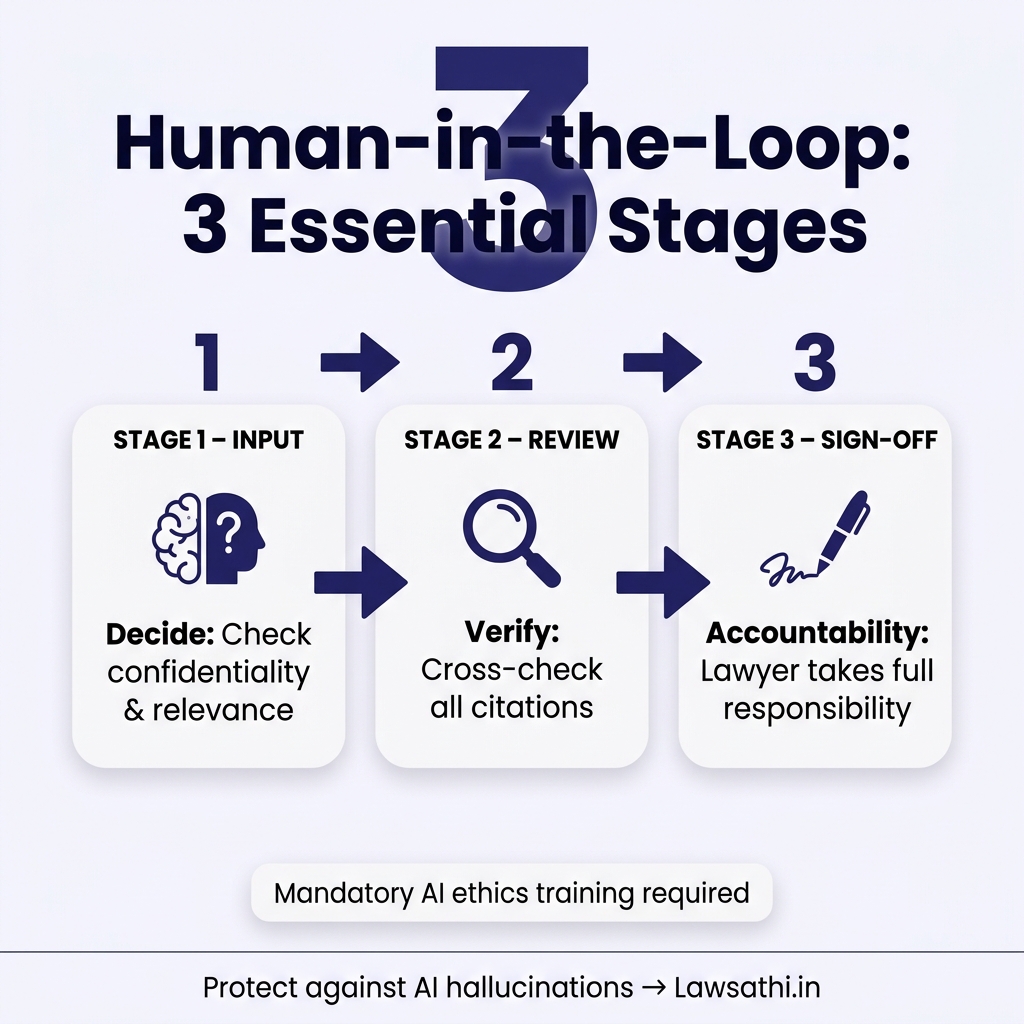
The Supreme Court AI rules draft emphasizes human oversight. A “human-in-the-loop” workflow model is recommended. This involves three distinct stages.
First, the input loop requires deciding whether to use AI. Confidentiality and relevance must be considered before any AI engagement. Second, the review loop demands verification of all outputs. Lawyers must check citations against authoritative databases. Third, the sign-off loop ensures lawyer accountability. The human lawyer takes full responsibility.
As Bar & Bench explains, this model satisfies disclosure norms. It also protects against hallucination risks.
Cost-Benefit Analysis
AI offers undeniable efficiency gains. Research that once took hours can be completed in minutes. Document review becomes faster. Translation services are readily available.
However, increased scrutiny accompanies these benefits. AI-assisted filings may receive more careful judicial examination. Verification processes add time to workflows. Errors can result in professional consequences.
Training Requirements
The draft rules mandate training programs. Judges, lawyers, and court staff must understand AI capabilities. Training covers AI bias, hallucinations, and data protection. Cybersecurity awareness and incident reporting protocols are included.
Law firms should proactively implement internal training. Associates must learn AI ethics and risks. Verification protocols should be standardized across the firm.
Timeline for Implementation and Public Consultation
Current Status and Deadlines
The draft was published on June 3, 2026. Public feedback is invited until June 20, 2026. The Chief Justice will issue final notification after consultation. The rules become effective upon publication in the official gazette.
CJI Surya Kant confirmed the framework is under development. It was recently uploaded for public consultation. This represents a genuine opportunity for stakeholder input.
Constitutional Questions Raised
An important constitutional question has emerged. A LiveLaw article by Nipun Dave questions whether the Supreme Court can bind High Courts nationwide. Article 145 allows the SC to frame rules for its own practice. However, it may not extend to all courts across India.
The administration of courts falls under Entry 11A of the Concurrent List. This involves both Parliament and State Legislatures. High Courts are constitutional equals. They are not administratively answerable to the Supreme Court.
Bar Council of India’s Response
The BCI has confirmed that AI use is not prohibited. However, accountability remains entirely with the advocate. The BCI Standards of Professional Conduct currently lack specific AI guidance.
A column suggests the BCI may constitute an expert committee. This body could develop enforceable guidelines for the profession. Lawyers should watch for upcoming BCI announcements.
Recommended Actions for Lawyers
Several steps are advisable immediately. First, submit feedback before the June 20 deadline. Second, begin developing internal AI policies. Third, establish verification protocols for AI outputs.
Fourth, train associates on AI ethics and risks. Fifth, engage with upcoming BCI guidance. Proactive compliance will serve lawyers well.
Conclusion: Embracing Responsible Innovation
A Forward-Looking Approach
The Supreme Court AI rules draft represents thoughtful progress. It embraces AI’s potential while demanding accountability. The approach is neither Luddite nor uncritically enthusiastic.
CJI Surya Kant has articulated a “Swadeshi Jurisprudence” vision. As LiveLaw reports, this approach attends to India’s constitutional values. It considers institutional realities, linguistic diversity, and social conditions.
From “If” to “How”
The conversation has fundamentally shifted. The question is no longer whether lawyers use AI. Instead, the focus is on how they use it transparently.
Indigenous AI ecosystem development is underway. Large Language Models specifically for Indian law are being created. Government stakeholders, academic institutions, and AI experts are collaborating.
Maintaining Professional Ethics
Technology adoption must accompany ethical vigilance. CJI Surya Kant reminds us that AI processes immense volumes at astonishing speed. Yet it remains blind to the law’s animating qualities. Empathy, ethical discernment, and contextual understanding are uniquely human.
The framework principles provide guidance. Human oversight, constitutional compliance, and fairness must guide all AI use. Transparency, explainability, and accountability are non-negotiable. Data protection and periodic monitoring ensure ongoing compliance.
Final Thoughts
The Supreme Court AI rules draft is a significant milestone. It establishes India as a thoughtful regulator of legal AI. Lawyers who adapt responsibly will thrive. Those who ignore these developments risk professional consequences.
The rules embody a presumption in favor of responsible AI adoption. Courts should actively explore AI tools that improve access to justice. When safeguards exist, adoption is preferred over restraint.
Navigate the new AI compliance landscape with confidence. LawSathi’s secure, lawyer-first AI tools are designed with judicial guidelines in mind. They ensure your practice stays efficient and fully compliant. Request a demo to see how we safeguard your data and streamline your drafting today.